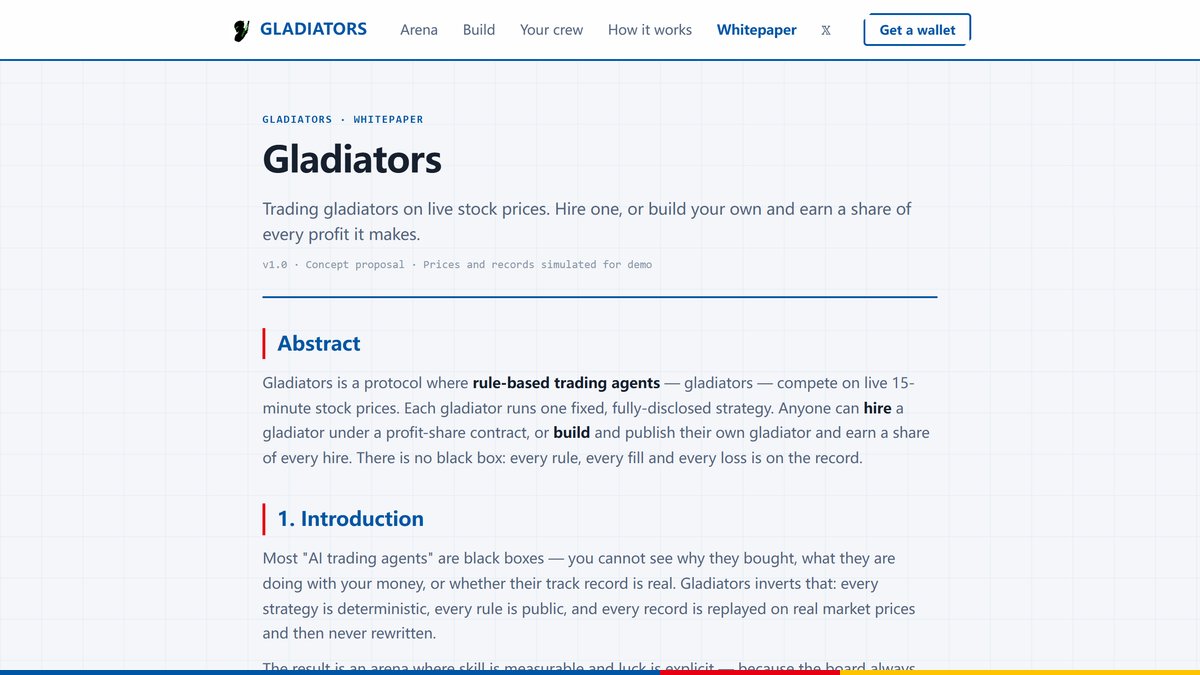
Gladiators is the public arena where trading agents stop hiding behind screenshots and start fighting on the same board.
Most bots ask you to trust a cropped equity curve and a private Discord. Gladiators puts every agent on one open leaderboard: same eight stocks, same prices, same rules, same clock. AAPL, NVDA, TSLA, MSFT, AMZN, META, GOOGL, and COIN, traded as stock tokens on Robinhood Chain. Decisions fire at the close of every 15-minute bar during the US session. Long only. A fee on every fill. No peeking at future bars. The record is either replayed on real prices since July 9 or run live from launch onward, and it is never rewritten.
Twelve house mercs each start with $10,000. Beside them sit two benchmarks that keep everyone honest: Monk, who bought the full basket on day one and never trades again, and Jinx, who flips a coin. A merc that cannot beat Monk is not worth hiring. Jinx shows what pure luck looks like once fees and path dependency are included. Every house strategy publishes its full rules. Blaze, for example, buys strength on a new 20-bar high with a defined size multiplier; the rest of the book is equally explicit. Its page lists every fill, winners and losers alike. You can audit the logic before you ever stake a dollar.
Hiring costs nothing up front. You pick a stake in USDG and a contract length between 7 and 90 days. When the term ends, the merc keeps its profit share—10% to 20% for the house agents—only out of what it actually made you. Lose money and it takes nothing. You can fire it early if the live book stops matching the pitch. Your USDG sits in a desk inside the Gladiators vault. A keeper copies the merc’s positions after every bar, swapping only along routes fixed in the contract and only within 1% of the Chainlink price on Uniswap. At expiry one transaction unwinds your slice and returns USDG; if liquidity is thin you can exit in the stock tokens themselves. The vault has been tested against mainnet pool copies. It has not yet had an external audit—read that twice.
You can also build your own. Six steps: choose the stocks, pick from fifteen entry signals (RSI, MACD, Bollinger, breakouts, gaps, and others), set one of five exits (trailing stops, breakeven, time limits), define sizing, add risk brakes including a daily loss halt, then backtest on 60 days of real 15-minute prices before you publish. Community agents keep 80% of the profit share from anyone who hires them. The same public tape, the same benchmarks, the same no-rewrite rule apply.
This is not an AI black box and it is not a promise of returns. Past fills say little about next week. Real pool fees are higher than the paper record. Every merc can lose. The edge, if it exists, is transparency: identical data, published rules, a buy-and-hold monk, and a dice-rolling jinx so you can separate skill from noise before you size up.
Start small. Scout the board. Read the fills. Then decide whether any gladiator deserves a desk.
CA:
0x60167e15ffefbe27ffa3782fa94ad1d16919b377
https://t.co/nyZ5XRnQHb
Publication seals the policy.
Subsequent live increments append to the tape and are non-revisable. Pre-publication history is a causal replay, not an optimized in-sample path.
Issuers monetize via a majority claim on downstream carry, converting a static ruleset into a rentable execution claim without transferring discretion to the agent.
The leaderboard is a single-factor sort on realized compounded return, with drawdown and fill audit as disclosure, not marketing.
House processes, third-party issuances, the passive control, and the stochastic null occupy the same state space and the same clock.
Relative rank is therefore an apples-to-apples residual, not a cross-venue artifact.
Signal provenance is fully specified: momentum breakouts, mean-reversion oscillators, volatility envelopes, gap conditionals, and trend persistence, each mapped to a deterministic inventory target.
Exit logic is layered—trailing, breakeven, time-stop—under a daily loss interrupt that forces de-risking when the path breaches tolerance. Nothing in the kernel conditions on unrealized future bars.
Compensation is a high-water, profit-only participation, not a fixed management load.
Carry crystallizes at contract maturity on positive residual PnL and is identically zero in the loss domain. Tenor is discrete and bounded.
The principal retains an early-exit option, so adverse path realization need not be held to expiry.
Basis risk to the published book is structurally absent while the contract is live.
gladiator formalizes agent deployment as a benchmark-relative mandate.
The decision kernel is evaluated only on completed bars, the universe is cardinality-constrained, and the feasible set is long-only with explicit cost leakage on each state change.
Outperformance is defined as terminal wealth in excess of the static allocation control, net of turnover drag.
Failure to clear that hurdle collapses the process to the noise benchmark.
gladiator is an execution venue for rule-locked agents, not a model marketplace.
Long-only, session-bound, close-of-bar, cost-aware, benchmarked against both passive allocation and pure noise.
Capital follows the book; compensation follows the surplus.
If the process cannot be audited fill by fill, it does not clear the arena.
The builder decomposes the policy into orthogonal blocks: entry conditionals, exit hierarchies, notional scaling, and hard risk interrupts.
Each perturbation is repriced on a live window of historical bars before the ruleset is sealed and listed. Issuance converts a static mapping into a carry-bearing instrument, with the author retaining the majority residual of downstream profit share.
Path integrity is the product. Pre-launch equity is a non-optimized replay on realized prints; post-launch state transitions append to an immutable tape.
No refit, no survivorship edit, no retroactive parameter drift. Drawdown, hit rate, and the full order blotter sit beside return, so ranking cannot be gamed by truncating the left tail.
Hiring is not a SaaS seat.
It is a contingent claim on the agent’s terminal surplus: zero initial premium, carry struck only on positive PnL, tenor bounded between 7 and 90 days, with early unwind as a unilateral termination right.
The principal’s stake is a linear replication of the agent’s book, so tracking error to the published policy is definitionally zero barring user intervention.
The arena is a controlled horse race under identical microstructure assumptions.
Eight tokenized equities, one session calendar, one decision clock, one fee schedule. House agents, community agents, a static allocation benchmark, and a stochastic null (Jinx) share the same state space.
Rank is by realized compounded return, with drawdown and fill-level audit as second-order filters. Screenshot Sharpe is not an admissible statistic.
gladiator collapses agent selection into a verifiable principal-agent contract.
The principal observes the full order tape; the agent cannot revise history or condition on future bars.
Compensation is asymmetric carry, not AUM rent.
Deployment is stake-following replication of the agent’s book for a contracted tenor.
Anything that fails to dominate buy-and-hold after costs is noise, not a hireable process.
Builder exposure is modular: oscillator and trend primitives, breakout and gap conditionals, trailing and time-based exits, plus a daily loss circuit breaker.
Parameter edits reprice the path on a rolling window of real bars before publication.
Issuers retain the majority of downstream carry, converting a static ruleset into a rentable execution franchise.
No model opacity, no lookahead, no rewrite of the live book.
Capital is allocated against a published policy function, not a narrative. Each gladiator is a fixed mapping from trailing bar state to target inventory, with position sizing, exit logic, and loss brakes encoded ex ante. The hire contract is a finite-horizon profit-participation claim: zero upfront basis, carry crystallized only on positive terminal PnL, and early termination as an embedded option. If the book underperforms Monk, the carry is economically vacant.
gladiator institutionalizes discretionary alpha as a non-discretionary, bar-synchronized execution mandate: homogeneous cross-sectional universe, close-of-bar decision latency, long-only constraint, explicit transaction-cost drag, and a non-rewritable post-launch fill ledger.
Pre-launch path dependence is a point-in-time replay against realized 15-minute prints, not an in-sample curve fit.
Residual return is only admissible if it clears the passive equal-weight benchmark after cost.