We're stil writing the @ManifoldBio story, but @ElliotHershberg just dropped a fantastic piece capturing the journey so far on his blog Century of Biology.
@cremieuxrecueil Reasonable view, but only if you assume the paradigm for how we test things won't radically change (as you mention in the comments).
This assumption is wrong.
Live from @AnthropicAI at #BOSTechWeek
The Lab (live demos of @claudeai for life sciences use cases) meets The Bench (Engineers and AI experts).
An event built for founders and leaders from the life sciences startup ecosystem to network and learn.
@KexinHuang5@glebkuz
If foundational AI models want to "figure out biology" – the fastest way to get there is with a ultra-high-throughput reinforcement learning (RL) loop that works in-vivo (aka as close to human biology as possible).
@ManifoldBio is the way – it's the real-life RL loop for biology.
@jhuber Thanks @jhuber
In addition to advancing the core mission of improving human health, the type of biology we do at @ManifoldBio is uniquely iterative/perturbative in nature and fascinating substrate for connecting AI to the real world.
Live from @AnthropicAI at #BOSTechWeek
The Lab (live demos of @claudeai for life sciences use cases) meets The Bench (Engineers and AI experts).
An event built for founders and leaders from the life sciences startup ecosystem to network and learn.
@KexinHuang5@glebkuz
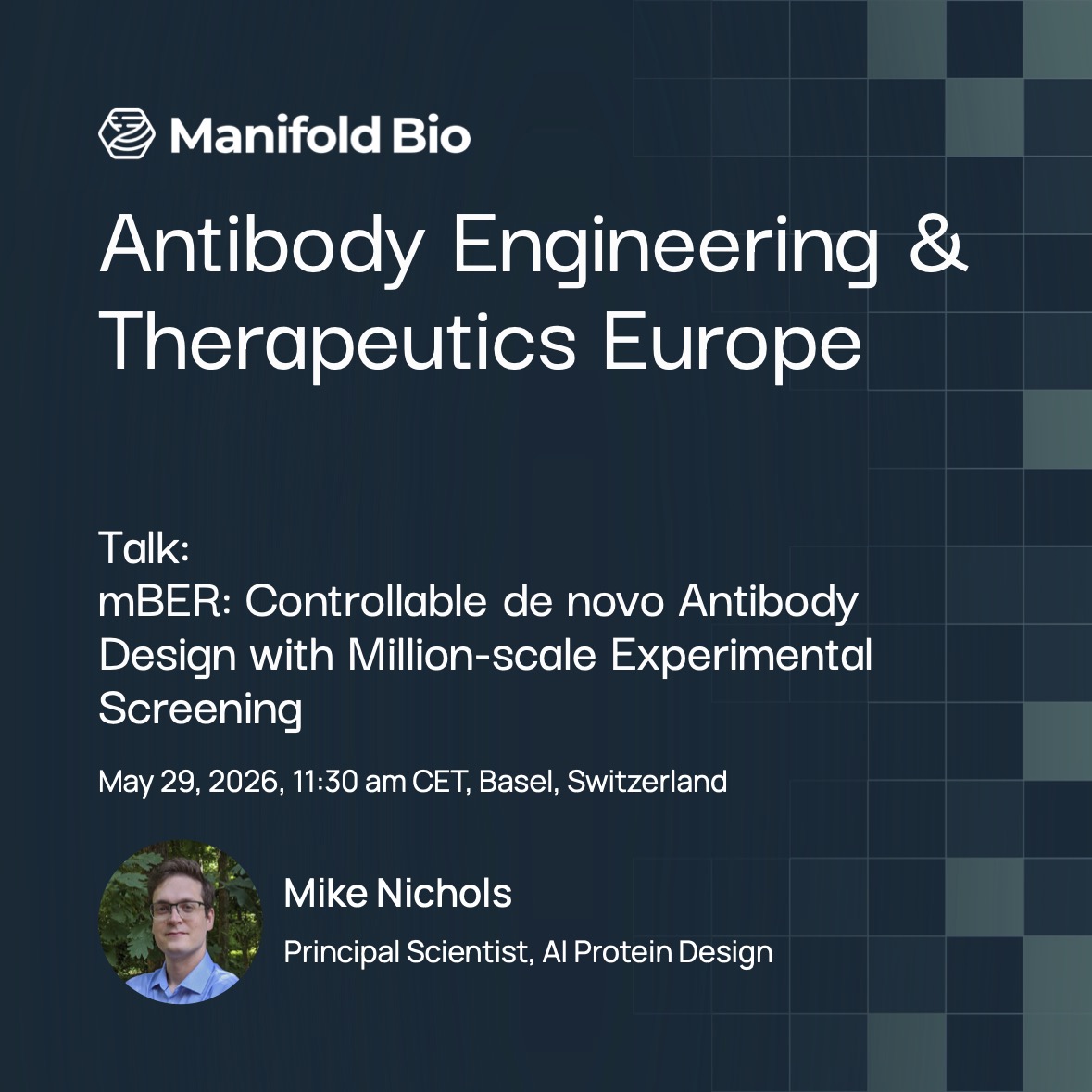
For those at Antibody Engineering & Therapeutics Europe, @ManifoldBio AI Protein Design scientist Mike Nichols is in Basel this week giving a talk on mBER, our open-source AI protein design method.
Mike will share results from the largest de novo antibody design campaign reported to date: 1M+ VHH binders designed against 436 targets, achieving 45% target success.
mBER designs binders in defined formats, outputting both sequences and predicted binding structures. Paired with in vivo multiplexed screening, it forms Manifold’s direct-to-vivo drug discovery platform, taking AI-designed molecules straight to in vivo readouts.
📅 Friday May 29, 2026 | 11:30am CET | Basel, Switzerland
📍@ Antibody Engineering & Therapeutics Europe
We’re excited to join @AnthropicAI for the Founders’ Lab: AI for Life Sciences during #BOSTechWeek tomorrow May 27th in Boston.
@ManifoldBio 's Co-Founder & CEO, @glebkuz , will speak on a panel with other AI x Bio leaders about how Manifold is building the Virtual Organism and the agentic infrastructure enabling it.
📍 Boston
🗓 Wednesday, May 27
⏰ 1:30–5 PM ET
Limited-capacity event; approval required to attend.
Event Link: https://t.co/A6UMJshQd8
Hiring our first People lead at @ManifoldBio.
We have epic momentum building at the intersection of AI and drug discovery. Scientist x engineer team, fast pace, very high bar.
Looking for first-principles thinkers with high slope who are obsessed with how great teams actually get built.
Boston, on site. Please reach out directly.
Great essay that captures the nuances of what's happening on the ground in data rich biological endeavors.
We're seeing this evolve organically at @ManifoldBio. As one of the greatest data generators in the world, we've historically been bottlenecked by analysis as most of our data is some variation on next-gen DNA sequencing data. Now all scientists (not just computational) are armed with agentic systems wired up to our databases and empowered to do (read: prompt) quite advanced analyses on their own data on the scale of hours.
The best place to do it would be somewhere generating diverse data with high throughput, low latency (~week scale), and deep relevance to living biological systems. That place is @ManifoldBio.
We recently opened up 4 new AI roles, and we are adding an RL-focused role soon:
https://t.co/BMlVgCEYFJ
if you’re an ai researcher you should really consider working on bio
pretraining is great: data sets are big enough for interesting stuff but not so big you’re spending all your time on weird cluster optimization
post training is in the age of research:
the lab is the only true validation, but it’s expensive so figuring out the limits of what we can do for evals in silico is still very open question
existing stuff kind of works: we have proof of life for the ability of ai to accelerate bio but there is a long way to go
it feels a lot like computer vision after imagenet or nlp after the first transformers started really working
if your idea works, you might get to help improve the human condition. way cooler to talk about at parties than “we pushed benchmark X for chat model Y up by 3 point”
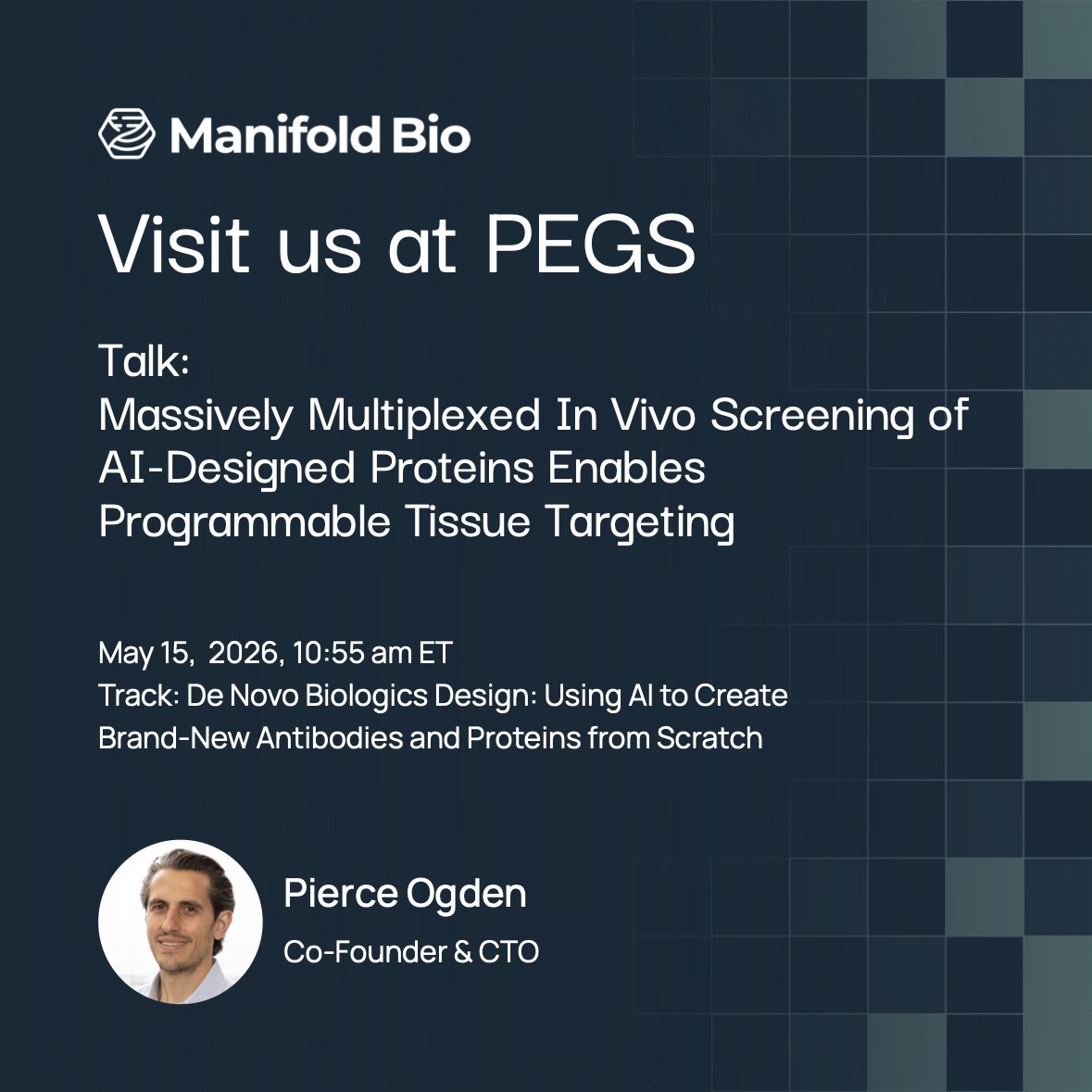
If you're attending @PEGSboston, don't miss the talk by our Co-founder and CTO, @PierceOgdenJ, on Manifold Bio's approach to one of the hardest problems in drug development: getting the right drug to the right tissue.
Pierce will present our platform, which connects AI-driven protein design to functional readouts in living systems. Using massively parallel molecular multiplexing, Manifold can evaluate hundreds of thousands of designs simultaneously in any biological context, including in vivo.
Our multiplexed in vivo screening platform allows simultaneous assessment of tissue distribution across hundreds of receptor candidates in a single study. This enables programmable, selective delivery of diverse therapeutics across the body, driving a pipeline of tissue-targeted medicines.
Directly after his talk, Pierce will join a panel on de novo biologics design chaired by @SurgeBiswas (@nablabio), alongside Prashanth Vishwanath (@TakedaPharma) and Maria Wendt (@sanofi).
📅 Friday May 15, 2026 | 10:55 am ET
📍 PEGS Boston - https://t.co/oVFB4faclD
Heading to #TIDESUSA? Don't miss the talk by our Co-Founder and CTO, @PierceOgdenJ.
Current oligonucleotide delivery technologies are not optimized for diverse tissues and therapeutic product profiles. Pierce will present data from @ManifoldBio's multiplexed in vivo screening platform, which we used to test thousands of AI-designed protein shuttle candidates against hundreds of novel receptors directly in living systems, revealing diverse biodistribution profiles across brain and peripheral tissues and identifying new conjugate partners for improved oligonucleotide delivery.
📅 Wednesday May 13, 2026 | 2:30pm ET
📍 TIDES - https://t.co/Pa2M5NWEIz
Founding story of latch is pretty interesting in that we literally went from nothing to a new product from scratch.
I don’t think most people see the level of failure you have to go through sitting down next to scientists, watching them use what you built, seeing the confusion and breaking clicks over and over again basically hundreds of times until you made something they actually want.
Early days didn’t even feel like work though because we loved helping the scientists. Not even abstractly - literally Chloe, Ben, Kirsten, Jackson - these individual heroes studying disease who we fell in love with helping.
The variability in what they were doing added layers of difficulty - gene editing, transcriptomics, protein models - which meant you couldn’t really build a custom flow for each one, to scale you needed to extract the pattern that would work for everyone and build that.
But after and only after you made it work really really well for one of them.
In this way, I have a lot of respect for great software companies and kinda see software designs that work today as natural selection.
If you truly got adoption at scale it is prob because you built something to match the mindset of people using it.
Tolerance for bad software is at an ATL, and assume it will only get more beautiful, more tailored to individual user needs & workflows every time.
(Claude being an enabler of this, but I don’t believe it will replace software teams who build dedicated products.)
In biology, science, even on earth, probably one of the most exciting times to build software in history is right now!
One of the more interesting enablers/cornerstones for foundation models wanting to do AI bio & drug discovery, imo, is Manifold Bio (@ManifoldBio) – which bridges in-silico/in-vitro approaches (which are becoming more commoditized) with the real-world/in-vivo 'RL data loop at-scale' needed for real progress:
Manifold Bio: Barcoded Biologics
Designing medicines that go where we want them to
https://t.co/iBLZVQnmDy
Introducing mBER: AI antibody design for in vivo-first discovery (open source)
https://t.co/4v9RtwR0PG
Manifold Bio Demonstrates Million-Scale Experimental Validation of AI-Driven Protein Binder Design (w/ Nvidia at GTC)
https://t.co/lB24RSnxG4
In the AI era, the traditional biopharma industry is the underdog. Big tech and AI labs are building wet labs. China has overtaken Europe in molecules produced. But the tools available to the industry discuss science, not do it.
The hard problem in AI for science is at the interface between the physical and digital worlds.
We built an AI Scientist at that seam. It wires together the digital and physical worlds of R&D. Predictive models, data infrastructure, wet lab execution feed into a single loop that reasons, acts, and improves with every experiment. Our ambition: get molecules to the clinic twice as fast.
Last fall I wrote about why biotech needs to be rebuilt for the AI era. Today I'm sharing the next chapter: what the AI Scientist is, a blueprint for how it works, and why even Richard Feynman couldn't hack it in a wet lab.
We can sequence a single cell. We can map every protein in a tumor. We can perturb thousands of genes at once. So why can't we predict what a drug will do in a patient?
#SynBioBeta2026 is May 4-7th in San Jose, California, you can learn more about the conference and get your tickets here: https://t.co/8abYWJ1GbK
The bottleneck isn't data. It's emergence. Molecular measurements don't automatically tell you what happens at the cell level, the tissue level, or the organism level. Predictive power breaks down at every scale transition, and nobody has fully closed that gap yet. Building the virtual cell, and eventually the virtual organism, requires confronting where our models actually fail and why.
At SynBioBeta 2026, a session digs into exactly that: Johnny Yu (CSO & Co-founder, Tahoe Therapeutics), Gleb Kuznetsov (Co-founder & CEO, Manifold Bio), Micha Breakstone (Co-founder & CEO, Cellular Intelligence), and Fabio Boniolo (CSO & Co-founder, Polyphron).
Tahoe built the world's largest single-cell perturbation atlas and runs pooled in vivo drug screening across hundreds of patient-derived models in a single experiment. Manifold tests millions of biologic variants directly in living systems and just closed a $55M upfront deal with Roche. Cellular Intelligence generates dynamic perturbation data at 1,000x conventional efficiency to train a universal cell-signaling model. Polyphron is using AI trained on developmental biology to engineer functional human tissue from scratch.
Four companies, four angles on the same unsolved problem. The session runs May 6 from 3:30–4:15 PM in the AIxBIO track.
If you work in AI-driven drug discovery, virtual cell modeling, or the data infrastructure that makes any of this possible, this is the session to be in.
Great to see Manifold’s #mBER AI protein design model in action!
As part of the Amazon Bio Discovery launch this week, @AmazonScience performed agent-guided de novo design using three independent methods including @ManifoldBio 's #mBER to design nanobody binders against a novel cancer target, identifying several sub-nanomolar hits.
mBER is now available via Amazon Bio Discovery.