📣 Last call: Amazon Research Awards Fall 2026 proposals are due November 11. Successful applicants receive unrestricted funds, AWS promotional credits, and training resources. https://t.co/phBWidoDeE
Amazon senior applied scientist Hamed Karimi received the 2026 @ECMLPKDD Test-of-Time Award for his 2016 paper on the Polyak–Łojasiewicz condition. #ECML2026 https://t.co/rYpf8RTDbR
How do you keep 70-billion-parameter quality while running up to 20 times as fast? AWS researchers combined knowledge distillation with parallel decoding. For @bookingcom's Smart Filters, that meant responses 15 times as fast for 99% of queries. https://t.co/jRQcygQbHX
A text-to-speech system that knows which character is speaking, and voices them accordingly. @audible_com's controllable TTS profiles characters and attributes dialogue with 97% accuracy in English: https://t.co/5ejzH2vJNT
📢 The Amazon Research Awards Fall 2026 deadline has been extended to November 11.
Award recipients receive unrestricted funds, AWS promotional credits, and training resources. Submit your proposal today: https://t.co/TqH3cofT6a
Amazon's custom Trainium chip helps power the diffusion models behind Prime 360's cinematic highlights, reducing diffusion-model inference latency by more than 40%: https://t.co/QZjc3zgx3X
Most AI developers use PyTorch to build their models. And this week @AmazonScience announced a new PyTorch backend for AWS Trainium chips - TorchNeuron. Learn more about the science behind it.
TorchNeuron is now open source. Our new @PyTorch backend translates code into operations executable on AWS Trainium with minimal or no code changes. Learn how the team used AI agents and hundreds of thousands of models to validate it: https://t.co/czPvqSPAcR
Same quality, twice the throughput, half the memory. Hybrid models increase LLM efficiency with mechanisms like sparse attention or state space layers. New AWS research introduces "priming," which reuses pretrained Transformer weights to build these hybrids at less than 1% of the original training cost. 8B and 32B models released. https://t.co/qvG8Yx6jcK
The true root cause may generate no alarm at all. New work augments a network graph with agentic AI to produce a "digital twin" that isolates failures in minutes, not hours. https://t.co/2HdWhD1JOr
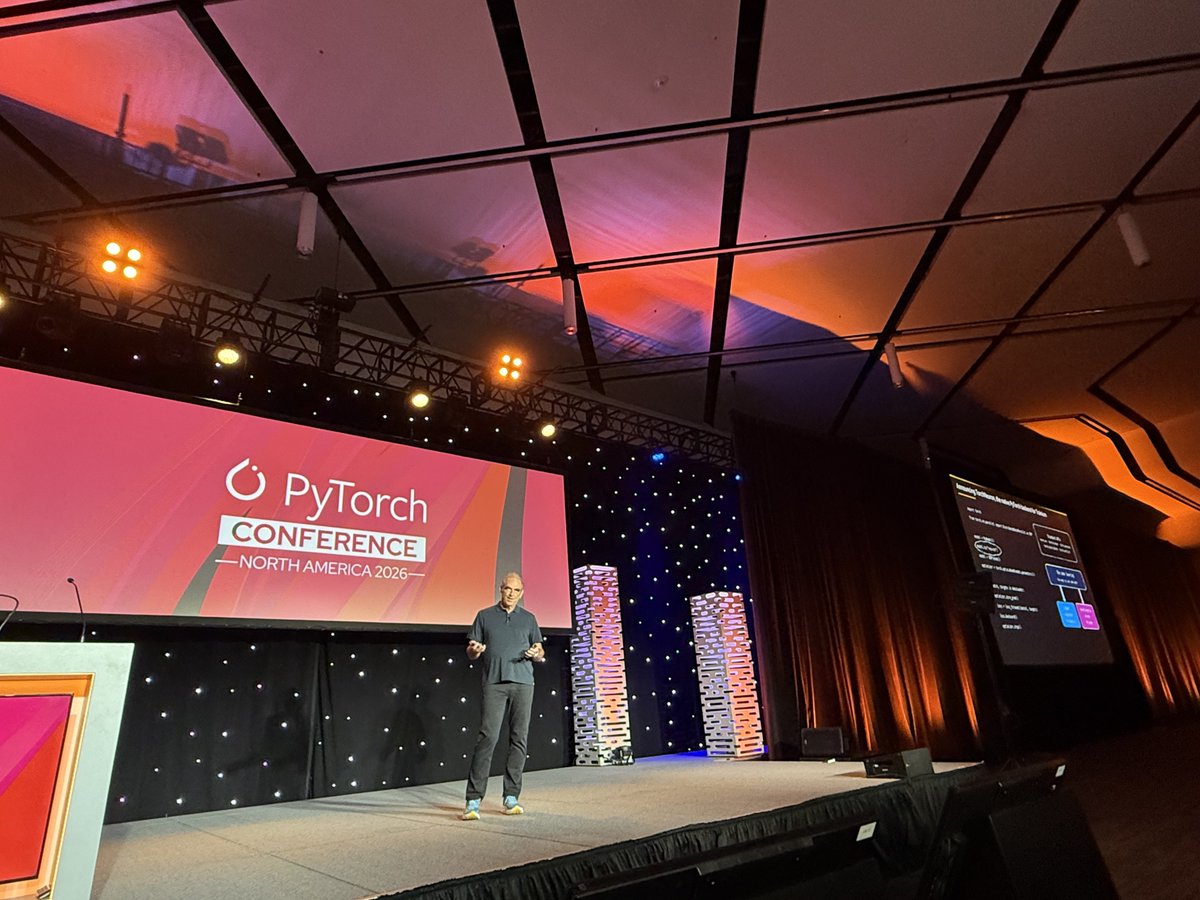
Live from #PyTorchCon 2026, Robert Hundt (@Amazon) introduces TorchNeuron, the native PyTorch backend for @awscloud Trainium.
Robert shows how TorchNeuron supports eager execution and torch.compile, letting developers train on Trainium using familiar PyTorch code and distributed training APIs.
He also covers how vLLM-Neuron uses torch.compile for serving, and how Neuron Explorer lets developers profile execution from PyTorch down to hardware instructions. @AmazonScience
We're open sourcing TorchNeuron. Your existing @PyTorch code runs on Trainium with one config change, and we're contributing upstream to make PyTorch more hardware-agnostic for everyone. https://t.co/Kpq6s2kz81
Trying a new AI chip used to be a lot of work. You often had to rewrite your code, revalidate it, and sink many weeks in, betting this new chip is the right one for your workload.
That cost time and money, and wore on the team. Your best people got buried in plumbing instead of building the thing they came to build.
TorchNeuron is going to largely take that off the table, enabling your existing PyTorch code to run natively on Trainium with one configuration change and no rewrite.
With Trainium’s very appealing price-performance characteristics, TorchNeuron is going to make it even easier for more companies to use AI more cost-effectively. https://t.co/TgNr3p71vw
PyTorch runs natively on @awscloud Tranium with no code changes. AWS Tranium is @amazon's portfolio of AI chips designed for next-generation deep learning training and inference workloads. You can use it with the tools and workflows you are already familiar with. No new frameworks to learn. No code to change. During PyTorch Conference North America keynote, Robert Hundt, VP Distinguished Engineer, Annapurna Labs, Amazon will share the story and the capabilities AWS provided to meet performance and quality goals. @AmazonScience
#PyTorchCon
Introducing TorchNeuron, a new open-source tool that lets developers take their PyTorch code and run it on @awscloud Trainium chips, no rewrite required.
85% of AI researchers and developers write their code in PyTorch, and now, with TorchNeuron, the tools developers already use to test, debug, and scale their models all work on Trainium without modification. Teams building everything from voice AI to drug-discovery models are already using it. ⬇️
More hardware choice for PyTorch developers: TorchNeuron registers @awscloud Trainium as a native device, built on the same extension points the community created to make PyTorch hardware-agnostic.
Open sourcing at PyTorch Conference on Oct. 20. https://t.co/HpO5M0cUAY
Announcing TorchNeuron: @PyTorch code now runs natively on AWS Trainium chips with a single configuration change. No rewrite needed.
Open sourcing at #PyTorchCon on Oct 20: https://t.co/6mz9jVhHTa