

Top Tweets for #PyTorchCon

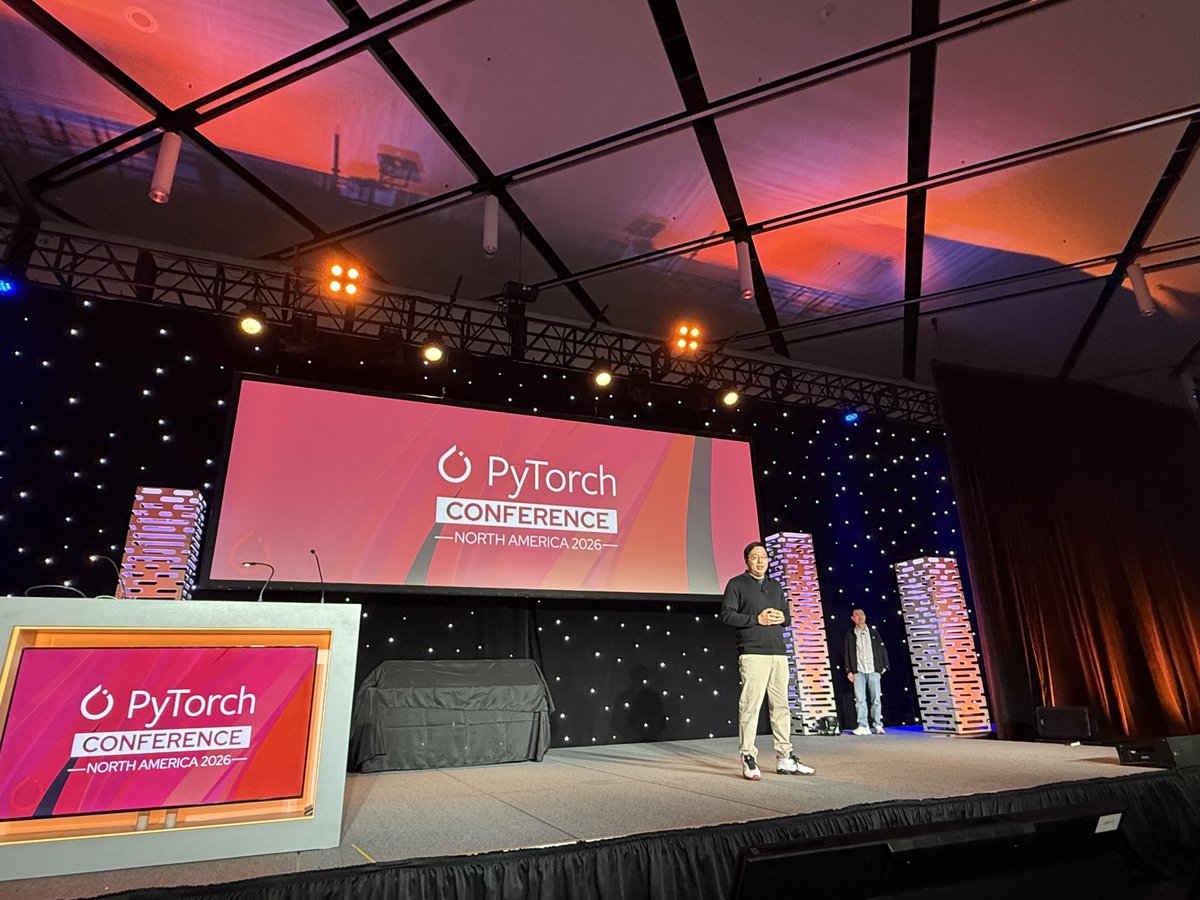
What can you test on one GPU before a big PyTorch training run? PyTorch core maintainer @ezyang (@Meta) explains in this clip from #PyTorchCon North America 2026.
He describes how a fake process group lets developers stub out distributed communication and check for crashes and GPU out-of-memory errors. He also discusses using SPMD types to look for numerical bugs without running a full-scale distributed test.
In the full keynote, PyTorch core maintainer @albanDesmaison (@Meta) discusses hardware backend integration and testing. @ezyang also covers activation checkpointing with torch_remat and discusses FlexShard.
Watch the full keynote: https://t.co/ghNexjcYUY
How does Shopify outperform frontier AI models at a fraction of the cost? During #PyTorchCon North America keynote, @cmazzaanthony of @ShopifyEng explained @Shopify's "Flywheel" a state-of-the-art continual learning loop built on top of @PyTorch and @vllm_project.
As enterprises scale generative AI, the bottleneck quickly shifts from building an initial model to maintaining and improving its performance in production. Shopify solves this by turning real-world failures into a self-improving engine.
Watch the full keynote video on YouTube to learn how this continuous learning loop operates in production: https://t.co/4qxlQ4efNr
We ❤️ our ambassadors. The ambassador meetup at #PyTorchCon North America was a good time to connect and make plans for the year ahead.
PyTorch Foundation Ambassadors help grow our projects (PyTorch, vLLM, DeepSpeed, Ray, Helion, & Safetensors) around the world by organizing events, creating educational content, mentoring new users, and contributing to the open source ecosystem.
Meet all of your PyTorch Foundation ambassadors: https://t.co/1xCcNof6v5

The collaboration between deep learning teams and cloud native engineers doesn't stop when the expo floor closes. We're wrapping up two great days at @PyTorch Conference North America and taking these shared insights straight into KubeCon + CloudNativeCon.
Register for KubeCon + CloudNativeCon North America: https://t.co/AlO0O4n0mP


#PyTorchCon North America 2026 brought 3,500+ attendees to San Jose to accelerate open intelligence.
The PyTorch Foundation welcomed nine new members, including @Nebius, @Nscale, and @Shopify as Platinum members, deepening its role as the intelligence layer for open source AI development.
“Open systems learn faster when more people, projects, and organizations are working together, creating compounding gains,” said @sparkycollier, Executive Director of the PyTorch Foundation. “Open source ecosystems let breakthroughs travel between organizations instead of staying locked inside one company.”
@Google and @Meta introduced TorchTPU for native PyTorch execution on Google TPUs. @awscloud announced TorchNeuron for AWS Trainium. TorchTitan expanded model support, improved training performance, and introduced reinforcement learning through TitanRL.
The program featured more than 100 sessions and 144 poster sessions, alongside Day 0 training and workshops. In the Community Expo, attendees connected with sponsors, exhibitors, and core maintainers through booth conversations, demonstrations, and Meet the Developers.
The 2026 PyTorch Contributor Awards recognized innovation, collaboration, and impact across PyTorch, @vllm_project, @DeepSpeedAI, Ray, Helion, and Safetensors.
Explore the announcements, keynotes, technical updates, contributor recognition, and community highlights in our recap.
Thank you to the contributors, maintainers, speakers, trainers, program chairs and committee, sponsors, and attendees who made #PyTorchCon possible.
Read the recap: https://t.co/GYE2pqxBPT
Stay tuned for session slides and recordings, and save the date: PyTorch Conference returns to San Jose, October 6–7, 2027!

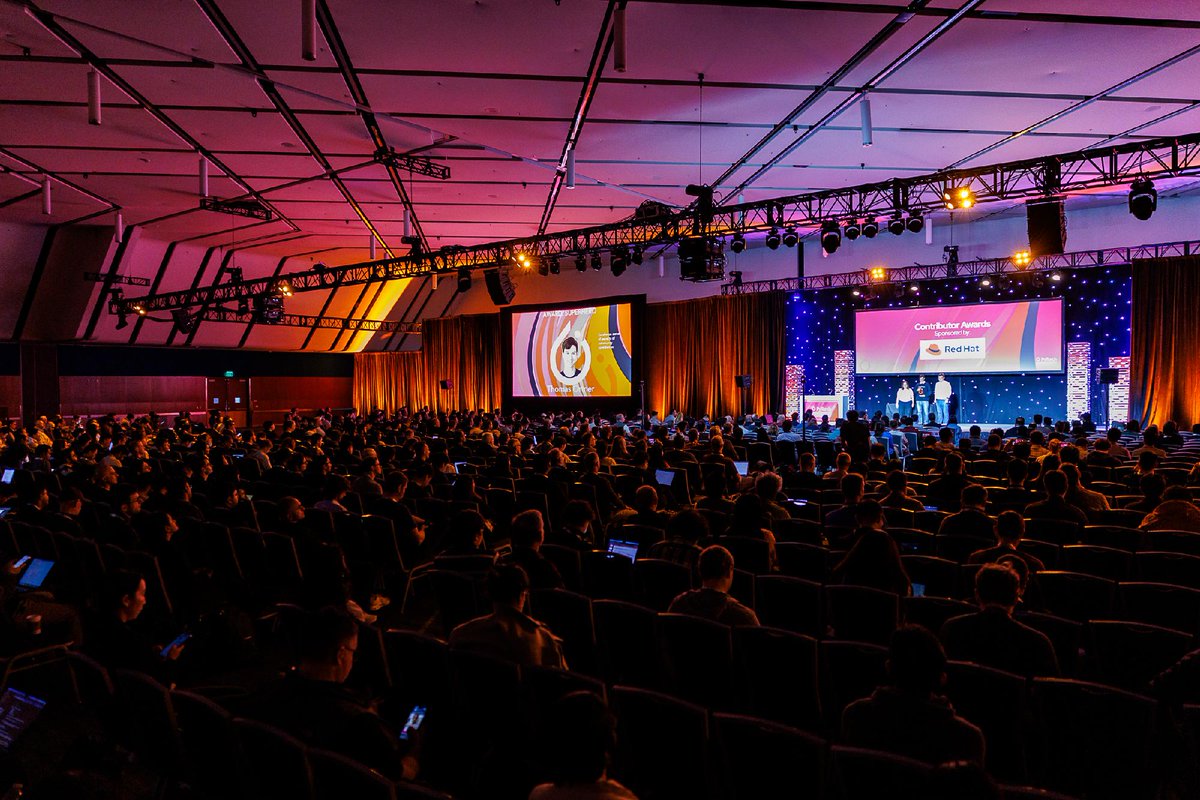
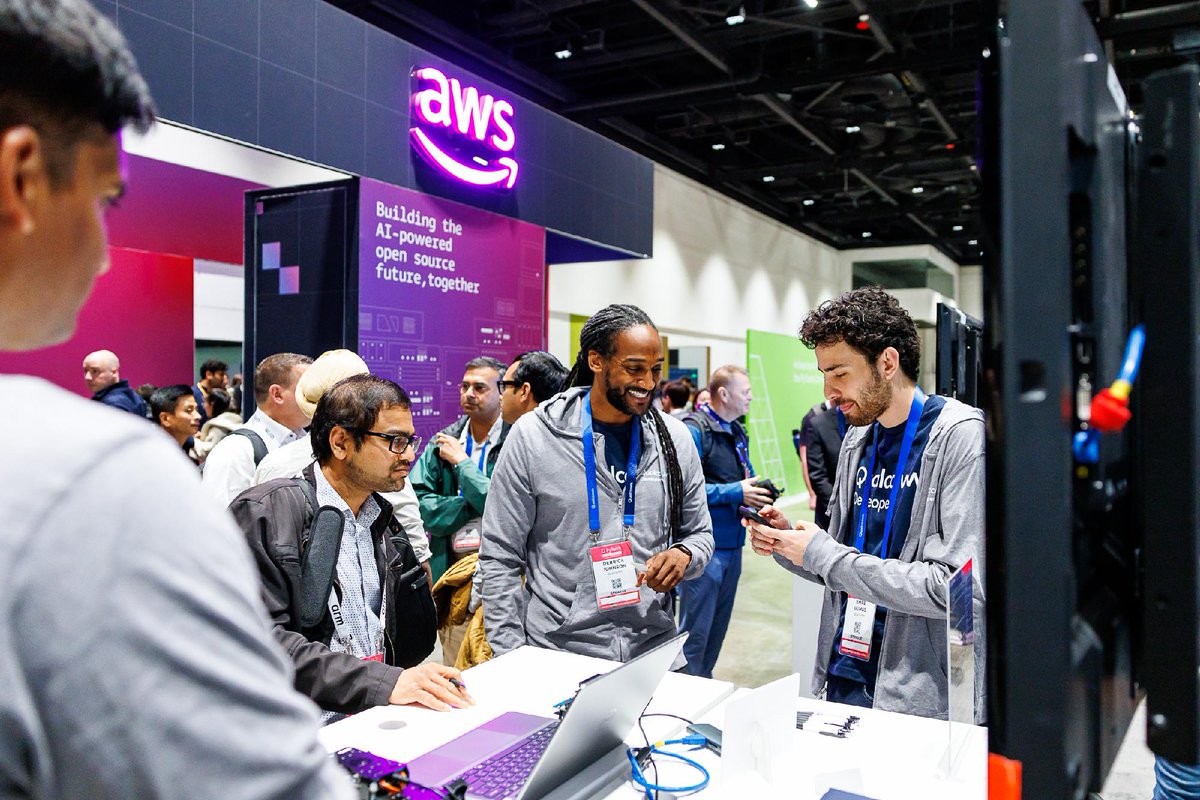


That's a wrap on #PyTorchCon North America 2026!
Thanks to everyone who visited Booth 12!
We've long benefited from the PyTorch ecosystem, and as a PyTorch Foundation Silver Member since September, we plan to support it more actively.
#Lablup #BackendDotAI
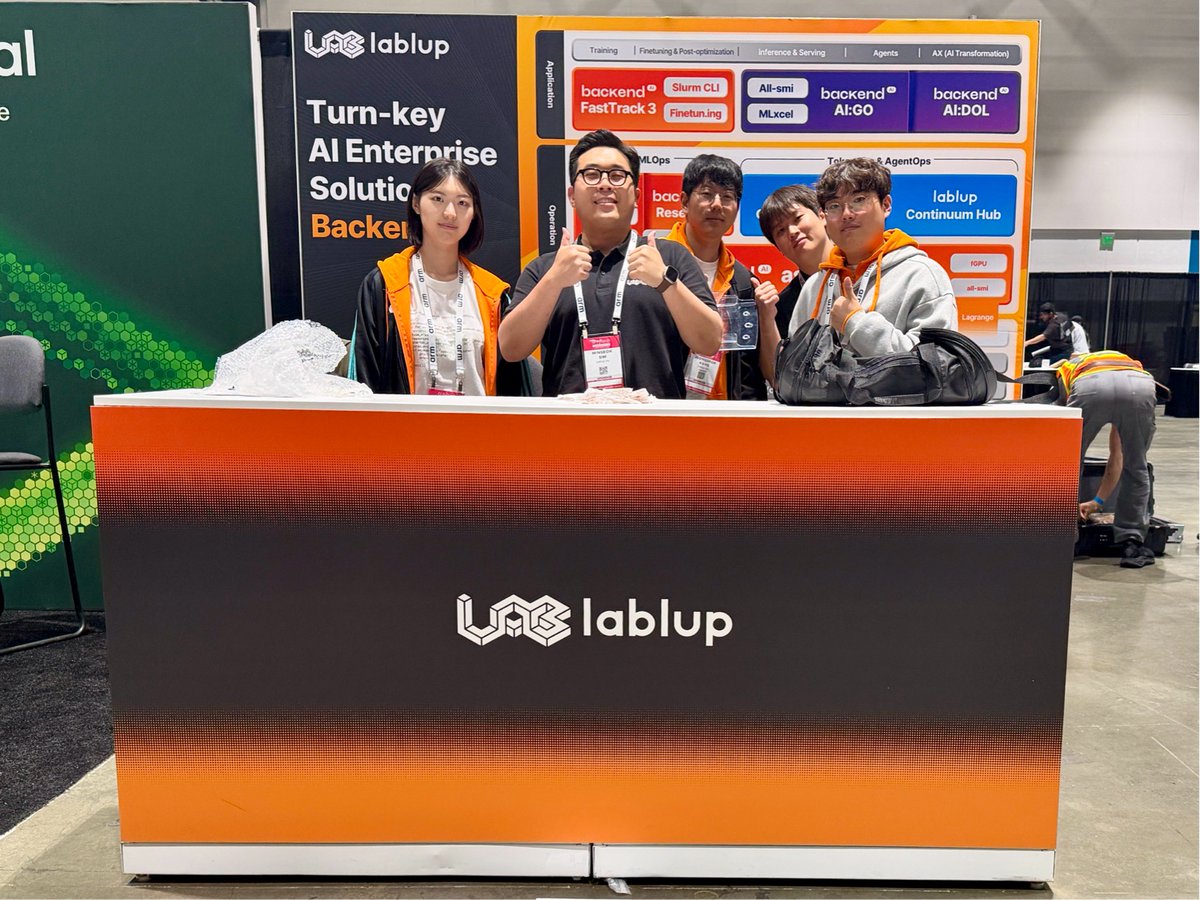

Thank you @philipkiely for Inference Engineering 📕 at @PyTorch 2026 today!
Last year it was @chipro for
AI Engineering and Designing ML systems 📕
Oh and I shared a bit of news from #PyTorchCon as I’m arriving in San Francisco
!
First time stopping by the @GoogleDeepMind Gemma + @GoogleAI Edge booth at @PyTorch 2026 #PyTorchCon, and I ended up staying much longer than planned.
Apparently asking enough questions with enough curiosity can still get you mistaken for a student — I’ll happily take that 😁
Chintan Parikh walked me through what they’re building with Gemma + LiteRT/LiteRT-LM: models running locally, low-latency on-device intelligence, and even Reachy Mini running on a battery-powered wheeled robot with no cloud involved.
That shift — from “call an AI API” to intelligence that can actually live and act on the device — is the part I find especially exciting.
Then, after hearing a little more about what I build, Chintan encouraged me to build something with their stack and mentioned that there will be an opportunity to feature the work on the their Blog.
That was a pretty unexpected ending to a booth visit 😊
Thank you, Chintan, for answering my questions and being so welcoming. I wanted to try the robot demo too, but more people arrived while we were talking, so I stepped aside and let them have their turn.
Next time, Reachy Mini 🤖💚
Congratulations to the 2026 PyTorch Contributor Award winners, recognized today at #PyTorchCon 2026 for their innovation, collaboration, and impact across all PyTorch Foundation projects including PyTorch, vLLM, DeepSpeed, Ray, Helion, and Safetensors.
Outstanding Ambassador: Jiho Kim
Newcomer: Jiangyun Zhu (@jiangyun_zhu), Johannes Lennart Zeiser
Knowledge Enhancer: Abdulsalam Yazid Bande (@abdulsalambande), Suman Debnath (@_sumand)
Bug Buster: Guilherme Vieira Leobas, Vishal Goyal
Review Powerhouse: Wentao Ye
Catalyst: Jiahao Tan, Harry Mellor (@hmellor_)
Innovator: Masahiro Tanaka, Elfie Guo, Xinan Lin
Ecosystem Champion: Guangye Yu
Superhero: Thomas Ortner
Nominees: Chandra Mohan Singh Negi, Arun Bhandari, Masahiro Hiramori, Luka Govedič, Irakli Salia, Jiahao Chen, Kunshang Ji, Rohit Kumar Tiwari, Subin George, Xunzhuo Liu, and Aaron Gokaslan.
Thank you to Cara Delia (@RedHat) and Chris Gottbrath (Gottbrath Technologies) for presenting the awards, and to Red Hat (@RedHat) for sponsoring them.
And thank you to our 2026 Awards Committee: Chris Gottbrath (Gottbrath Technologies), Chris Hoge (@nvidia), Ashok Emani (@intel), Piotr Bialecki (@nvidia), Yashasvi Misra (@CloudNativeFdn), Sudhir Dharanendraiah (@RedHat), Zesheng Zong (@Huawei), Jiawei Li, and Kaichao You (@inferact).
Wednesday's Demo Theater at #PyTorchCon features 13 presentations on training, inference, hardware enablement, and agentic workflows. All sessions are in the Community Expo on the Concourse Level.
10:40–10:50 AM: Maen Suleiman (@awscloud) demos reinforcement learning on Trainium through TorchNeuron, the native PyTorch backend for AWS Trainium, with TorchTitan training, vLLM-Neuron generating rollouts, Monarch orchestrating, and TorchStore syncing weights.
10:55–11:05 AM: Ali Taha (@baseten) breaks down how Wan 2.2 generates a five-second video in under three seconds, a 53.6x improvement over baseline, using timestep distillation, custom kernel engineering, and four-bit quantization.
12:20–12:30 PM: Rain Jiang and Kevin Li (@verdacloud) demo WideEP for expert-parallel MoE inference on an NVIDIA NVL72 system, using a Rust-based frontend to run and monitor the workload.
12:35–12:45 PM: Tristan Webb (@dMatrix_AI) presents dmx-compressor, a PyTorch 2.0 based quantization framework that gives ML engineers numerical reference output to validate models running on ASIC hardware.
12:45–12:55 PM: Lin She (@clockworkio) demos surviving link and node failures in PyTorch training live, with LinkPass and TorchPass keeping the job running on the same training step.
1:00–1:10 PM: Ashok Emani and Qiacheng Li (@intel) show AI Playground Home Agent, which runs PyTorch AI workflows on an Intel AI PC and lets you use them from your phone.
1:15–1:25 PM: Zesheng Zong (@Huawei) presents CRCR (Cross-Repository CI Relay) for joint testing between PyTorch pull requests and accelerator backends, catching regressions at the PR phase.
1:30–1:40 PM: FNU Harsh and Sarah Ahmed (@LightningAI) demo an agent reproducing ML research on Lightning, showing where it succeeds autonomously and where it needs intervention.
1:45–1:55 PM: George Novack (@inferact) introduces TPU megakernels, with Kimi K3 megakernels running inside vLLM-TorchTPU.
2:00–2:10 PM: Jay Dawani (Lemurian Labs) examines why heterogeneous computing is so hard and what a hardware-agnostic stack has to get right.
2:15–2:25 PM: Minwook Ahn (@RebellionsAI) shares how extending PyTorch's device abstraction to support device-persistent tensors minimizes data movement between host and device.
2:30–2:40 PM: Jesse Treger (HPE) introduces OpenCLIC, an open inference communication framework for connectionless networks that is being integrated with vLLM.
3:55–4:05 PM: Mengjin Yan and Joshua Lee (@anyscalecompute) cover evolving Ray Core for post-training at scale, from scaling Ray's scheduling to 10,000-node clusters to moving PyTorch tensors directly between GPUs with Ray Direct Transport.
View the Demo Theater schedule: https://t.co/Sn5gpWxGHO
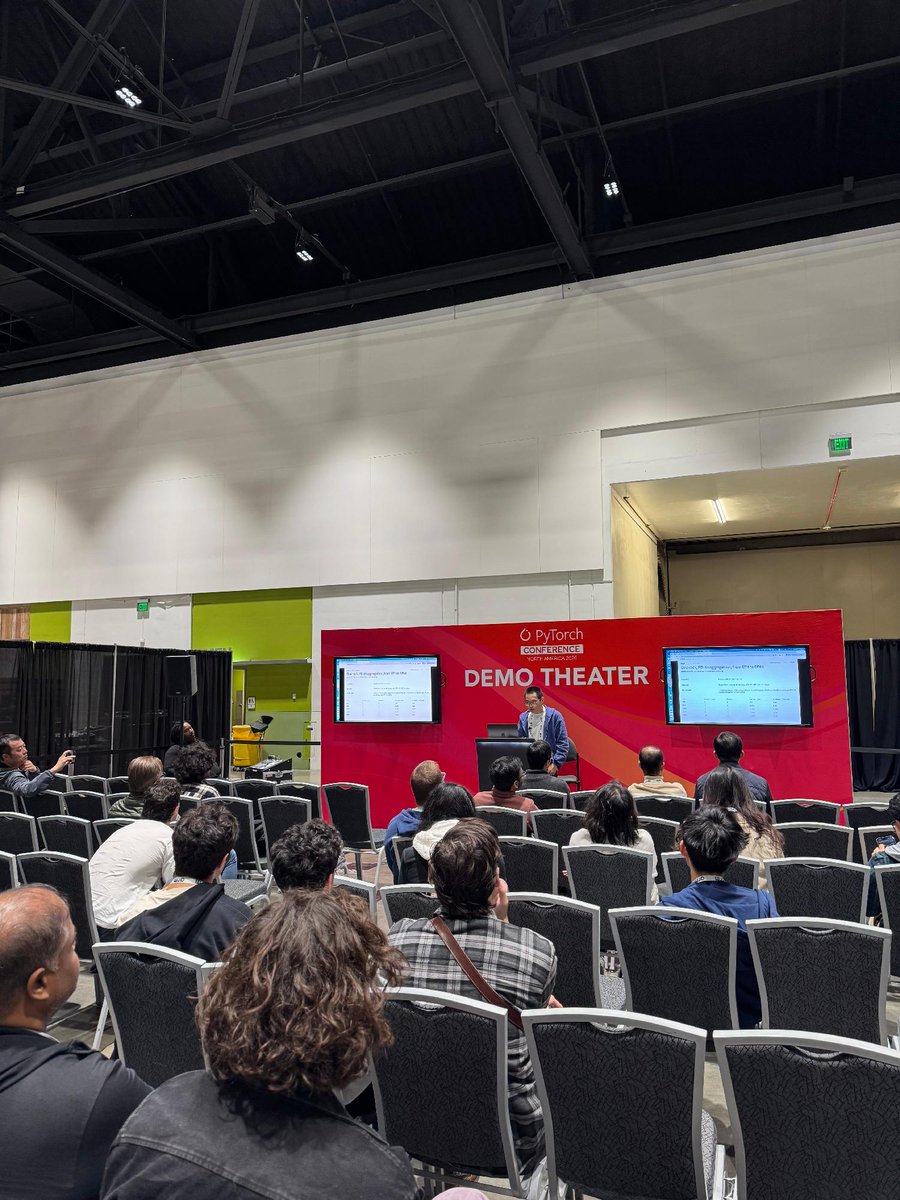
@marksaroufim Fewer training steps don’t necessarily mean faster training. At #PyTorchCon 2026 (@coreauto) examines the linear algebra kernels behind better optimizers.
Mark focuses on QR, symmetric eigendecomposition, and Cholesky, drawing lessons from GPU MODE’s linear algebra competition.
He explains how sequential dependencies constrain GPU execution, and how implementations expose parallel work, overlap independent stages, and combine updates to reduce data movement.

@googlecloud @vllm_project @sgl_project @_llm_d_ @huggingface @raydistributed Exciting news for a native and principled PyTorch backend for Google TPUs announced at #PyTorchCon this week!
Also learn more on the PyTorch blog: https://t.co/WnaK5hLFBd
Yiwei Song (@CrusoeAI) shares the vision and progress behind Crusoe’s LLM post-training platform at #PyTorchCon 2026.
The goal is to help customers customize open weights models for their business use cases to improve accuracy and reduce inference cost.
Yiwei outlines the customization lifecycle: start with a strong base model, inject domain knowledge, align to tasks and preferences, make the model smaller and faster to serve, and deploy it in production.
He presents Crusoe Managed RL as a Tinker API-compatible post-training platform, with customers deciding what to learn while Crusoe runs the GPUs.
Watch the keynote livestream: https://t.co/6TtaEkvsHz

Rachad Alao (@cohere) examines how open science can support transparent and secure AI foundation model development at #PyTorchCon 2026.
Rachad argues for publishing model architectures, training strategies, parameter choices, and evaluation methodologies, alongside an evidence-based risk framework, independent auditing, continuous monitoring, and dynamic safeguards.
He discusses how PyTorch, TorchTitan, and @vllm_project support model development and inference optimization when models are open and accessible, and how access to internal representations enables research in retrieval, reasoning, and multilingual AI.


Zhipeng Wang (@Google) shares technical advances from the @DeepSpeedAI team for large-scale model training at #PyTorchCon 2026.
Zhipeng highlights model-systems co-design and optimizations that enable DeepSpeed to deliver high performance across diverse model architectures, workloads, and accelerator platforms. Highlights include AutoSP for automatic sequence parallelism, Muon optimizer support, and AutoTP and AutoEP for Hugging Face models.
He discusses the continued development of the DeepSpeed open source community and collaboration with model developers, hardware vendors, and AI infrastructure partners to expand adoption and enable emerging large-scale AI workloads.

Priya Nagpurkar (@IBM) shares how IBM and @RedHat contribute across the PyTorch ecosystem in “From Silicon to Models at Scale” at #PyTorchCon 2026.
Priya highlights work bringing IBM Spyre to the PyTorch compiler and vLLM, how AI tools help scale model enablement to thousands of models, and a look ahead at next-generation Spyre hardware.
She discusses Red Hat’s contributions to PyTorch and CI/CD infrastructure for out-of-tree accelerators, helping hardware backends keep pace with the community, alongside work with the llm-d community toward efficient distributed inference at scale.

Bill Jia (@GoogleCloud) and Zongwei Zhou (@Meta) introduce TorchTPU, a native PyTorch backend for Google TPUs, and agentic developer workflows at #PyTorchCon 2026.
TorchTPU is an open source collaboration between Google and Meta, developed in close partnership with PyTorch core maintainers. It integrates with Hugging Face Transformers for modeling, TorchTitan for training, and vLLM and SGLang for serving.
They demonstrate how long-horizon agentic workflows can migrate complex model workloads from GPUs to TPUs. They explore using agents for performance optimization, including quantization, custom kernel generation, and advanced sharding strategies.
Watch the keynote livestream: https://t.co/6TtaEkvsHz

How can LLMs learn from what agents do? At #PyTorchCon 2026, Mazin Gilbert, Executive Director of @AgenticAIFdn, examines the relationship between models and agents.
Mazin maps five layers of the agentic stack: hardware infrastructure, software infrastructure, intelligence, the agentic platform, and user applications. He places PyTorch at the intelligence layer and Agentic AI Foundation at the agentic platform layer.
He proposes designing the stack in both directions: models support agents, while agent traces, evaluations, environments, and rewards feed back into how models are built.
As an open research direction, Mazin describes turning agent evaluations into rewards for training in PyTorch, accounting for safety, task completion, precision, efficiency, and energy use.
Watch the keynote livestream: https://t.co/6TtaEkvsHz

PyTorch Foundation Executive Director Mark Collier @sparkycollier opens Day 2 of #PyTorchCon 2026 with “Building What’s Next in Open Source AI.”
Mark looks ahead to broader hardware participation, workloads moving across more environments, and training and customizing frontier models at greater scale. Returning to the vision of open source software to train and serve models on any chip, in any cloud, for any agent, he discusses how AI itself is beginning to change how these systems are built and improved, creating opportunities and challenges for the community.
The morning explores agentic AI, workload fungibility, the evolution of inference hardware, scaling large-scale frontier models, contributor recognition, and open science. The focus is on the role open collaboration can play in expanding who can build, contribute, experiment, and shape the future of intelligence, so progress continues to come from many people, projects, and organizations.
Watch the keynote livestream: https://t.co/6TtaEkvsHz


Great to be at #PyTorchCon 2026!
Day 1 was packed with insightful talks covering efficient training, hardware acceleration, distributed systems, inference optimization, edge AI, and agentic workflows.
Ready for Day 2!

Last Seen Hashtags on Sotwe
elif karaarslan
Seen from Turkey
pakistani mms
Seen from Bahrain
Naruto
(bioo)(*)*********************************+filter:native_video
ヴェリナ
Seen from United States
รับงานลาดพร้าว
Seen from Thailand
گی_تهران
Seen from Germany
bizdirectory
Seen from United States
minichat(***************************************************************************************************************) filter:videos
Seen from United States
EkinKoç
Seen from United States
Trends for you
Most Popular Users

Elon Musk 
@elonmusk
241.3M followers

Barack Obama
@barackobama
118.8M followers

Cristiano Ronaldo
@cristiano
114.5M followers

Donald J. Trump
@realdonaldtrump
111.9M followers

Narendra Modi
@narendramodi
107M followers

Rihanna
@rihanna
98.7M followers

NASA
@nasa
92.3M followers

Justin Bieber
@justinbieber
91.8M followers

KATY PERRY
@katyperry
90M followers

Taylor Swift
@taylorswift13
84M followers

Lady Gaga
@ladygaga
75.5M followers

Virat Kohli
@imvkohli
73.4M followers

Kim Kardashian
@kimkardashian
70.8M followers

YouTube
@youtube
68.7M followers

Neymar Jr
@neymarjr
66.4M followers

Bill Gates
@billgates
65.2M followers

Selena Gomez
@selenagomez
63.1M followers

The Ellen Show
@theellenshow
62.2M followers

CNN
@cnn
61.7M followers

X
@x
60.7M followers