JSALT is going to Japan 🇯🇵.
It was loads of fun working on omni modal models this year with academics and industry folks from CMU, TTIC, UT Austin, Columbia, Google, NVIDIA to name a few (and beloved JHU of course).
Folks should look into this if you are interested in
>Multimodal Representations, Alignment, Transfer & Evaluation
>Long-Horizon Reasoning, Memory and Human-AI Workflows:
>Agentic and Embodied AI
>Equitable Data Governance and Privacy for AI
Check out @shinjiw_at_cmu CFP below
JSALT is going to Japan 🇯🇵.
It was loads of fun working on omni modal models this year with academics and industry folks from CMU, TTIC, UT Austin, Columbia, Google, NVIDIA to name a few (and beloved JHU of course).
Folks should look into this if you are interested in
>Multimodal Representations, Alignment, Transfer & Evaluation
>Long-Horizon Reasoning, Memory and Human-AI Workflows:
>Agentic and Embodied AI
>Equitable Data Governance and Privacy for AI
Check out @shinjiw_at_cmu CFP below
Excited by how diffusion models align with local intrinsic dimensionality!
By treating data as mixtures of low-rank Gaussians, their training effectively solves subspace clustering, i.e. sample complexity scales with intrinsic dim, not ambient. Geometry + information bottlenecks explain why they break the curse of dimensionality. Really cool to see this work as it closely aligns with my PhD research at @cis_unimelb and @jhuclsp
Why diffusion denoising-based generative methods do not suffer the curse of dimensionality even though the data may lie in extremely high-dim spaces? Our new work, accepted by the JMLR: https://t.co/njMEqzH3TF reveals the not-so-surprising secret: as long as the intrinsic dimension of the distribution is very low, the generative process can be extremely efficient and effective! It seems that a mixture of low-rank Gaussians is a universal model for all informative real-world data. as we stipulated in a former textbook of mine: Generalized Principal Component Analysis: https://t.co/nEy8qcFN7e, published exactly ten years ago!
70% of AI research isn’t reproducible. With ICML 2026 happening last week, over 6000+ research papers have dropped, but how many are actually real and reproducible?
We’re excited to partner with @huggingface on a community challenge to find out.
All you have to do is pick a paper, select one of the claims, and start experimenting.
And now, you can use our autoresearch agent to do the hard work for you while contributing to a massive library of open research artifacts.
Prizes: $4500 in GPU credits 👀
Full details found below 👇
The video of my Stanford CS25 guest lecture, From Language Models to Native Multimodal Intelligence, is now online.
I discussed how the core ideas behind LLMs has shaped multimodal AI, from architectures to training paradigms and scaling, and where the next challenges may lie. 🧠🌐
🎥: https://t.co/sUVxSEjrVf
Recruiting PhD students for Fall 2027 at @JohnsHopkins@jhuclsp! My lab works on speech and language, from generation to security and healthcare applications. If you're interested, please apply to the JHU ECE PhD program (select me as a potential advisor). https://t.co/3XQvTaUINn
Excited to participate in the 12th JSALT workshop at @HopkinsEngineer@jhuclsp! It’s been a great week with A/Prof. Sanjeev Khudanpur kicking off the summer school! Looking forward to collaborating with experts to improve our understanding of robust multimodal/omnimodal encoders.
BTW, in case you're wondering just how sports-mad us Aussies are:
Based on average attendance, men's soccer is only the 5th most popular sport in Australia.
Despite being insanely cool results by itself, I think this study highlights something much more important for the future direction of IR
The goal has never been to create representations that contains all the information about the original input.
We know for a very long time (e.g, 2023 from @jxmnop https://t.co/kWZnoYr1er), that dense - single vector - embeddings contains enough information to reconstruct the input given enough decoding capability.
The BP frames it very nicely: "the role of the embedding model is to convert the information in the documents into a format that can be readily consumed by the efficient scoring mechanism we discussed above"
What we are trying to do, is encoding this information that is _queryable_ in **sublinear time**. You can pre-compute a very large part of the document representations and only do small cross-encoding operations to recover most of the cross-encoder (reranker performance) (@_VictorMorand_ https://t.co/V6WFcWYx7i). You would still be unable to search among millions of documents unless you have a first stage retriever that look for this information in sublinear time.
To enable this, information retrieval needs to create a structure that allows to traverse our documents pool quickly while finding everything that is relevant for a query. The dense space does that by leveraging spatial proximity and finding elements that are in the same neighborhood. The sparse space does so by leveraging the overlaps of components activated between two elements. Both shares a lot (and I would love to come up with an unified theory about them), but they are intrinsically representing the information in two different ways that enable fast search.
More than ever it is important to question everything we have been doing and what we know and start asking fundamental questions
We should stop asking ourselves "how do I encode all of my information", but "how do I present the information such that I am able to query it quickly and accurately"
ColBERT models lifted some limitations of dense - single vector - models. But so does sparse retrieval, in a different way. Maybe the question is not which one is going to win, but whether we'll find something even better in the way
Awesome CuTE DSL article by @derangineer and now part of the @modal GPU Glossary! Lots to learn from the great open source collaboration and tutorials by @charles_irl and others. Thanks guys! 🌟
extremely honored to have played a small part in the @modal GPU glossary writing up CuTeDSL intro. the glossary is such an exceptional resource, from the clear concise material to the unique modal design.
h/t to the legend @charles_irl for the edit and turning the the glossary to a one-stop shop for the entire CUTLASS stack.
📈 New blog post: Training and Finetuning Multimodal Embedding & Reranker Models with Sentence Transformers.
As a practical example, I finetuned Qwen3-VL-Embedding-2B for Visual Document Retrieval (matching text queries to document screenshots).
Thread with highlights 🧵
#ICLR2026 convenes shortly. This year, @modal provided compute grants to researchers tackling problems from AI detection & reasoning RL to protein folding & material discovery.
Here's a quick breakdown of each paper we supported and why I think it's cool.
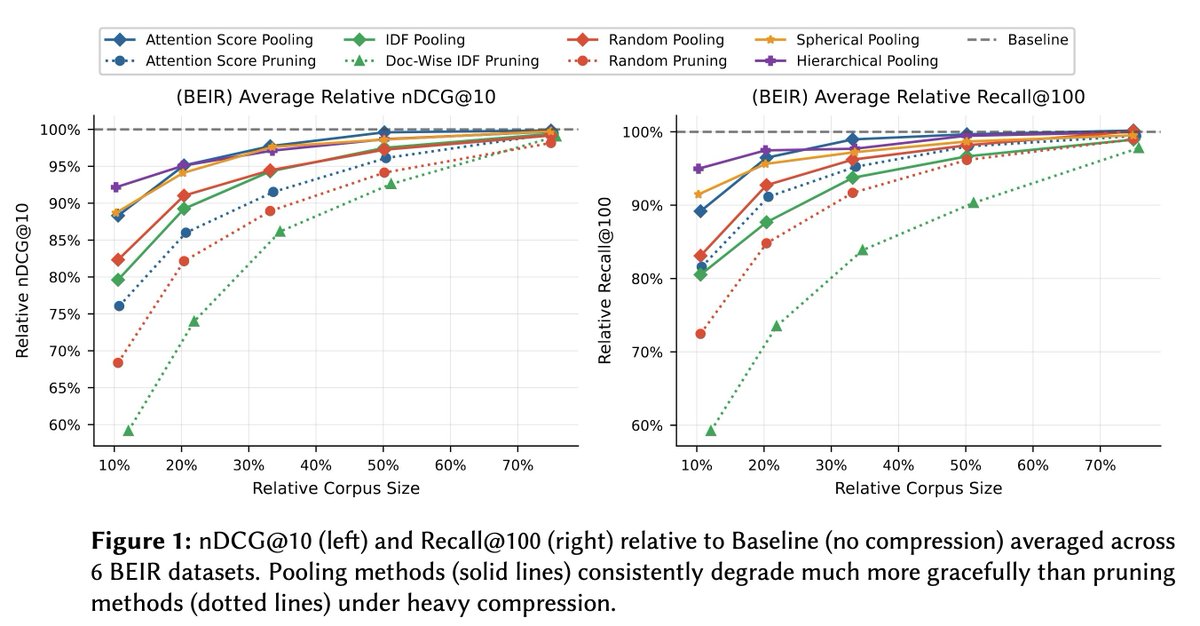
Poster at LIR workshop next week: we compared training-free multi-vector compression methods head-to-head across some BEIR and CoIR sets. The takeaway is clear — pooling > pruning at all compression ratios for text. Not a huge surprise, but nice to have the controlled comparison.