@RagavanThurair Same... I had to bring it down (RIP) because it was just too much work to maintain, it would have been a lot easier today. But today there's also https://t.co/oYXEotT37i, which I like & use and is in the same spirit.
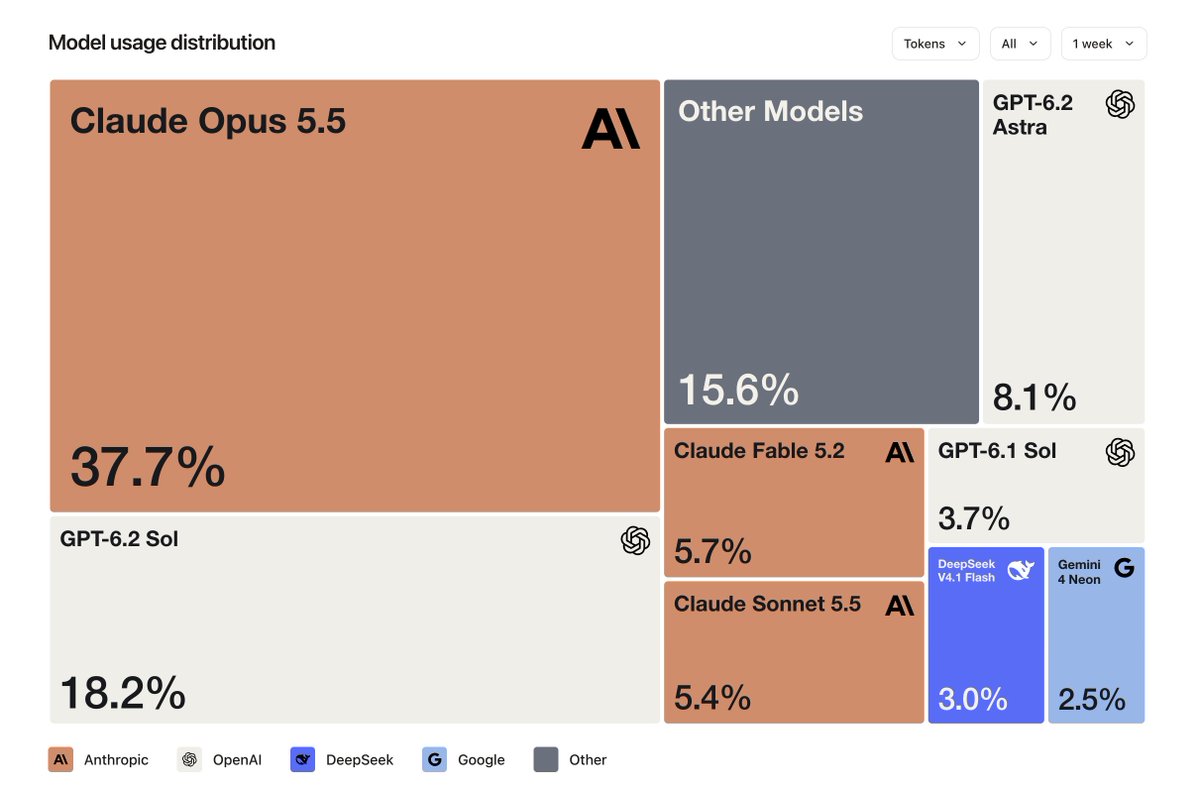
Interesting how despite Anthropic nerfing Claude for research tasks, it is still the most popular model maker by a wide margin for autoresearch
Either people aren't aware of the nerf or people think Claude is so far ahead it's worth it anyway
https://t.co/YOecXG6l0S
claude models are actually acting very shady when I ask them to reproduce published ai research experiments
making very odd decisions and changing configurations that makes the runs worthless
"Attention Latent Feedback"
Transformers could be wasting useful information as their earlier layers cannot directly access the deeper representations already computed for the previous token.
So this paper introduce Attention Latent Feedback (ALF), where it lets each layer to selectively retrieve deeper representations from the previous token using attention, rather than relying on just its final hidden state.
On a 4B MoE model, ALF improves accuracy across 17 benchmarks from 45.1% to 47.0%, outperforming previous latent feedback methods with only 1.1% additional decoding FLOPs. At 1.6B, it matches a baseline trained on 1.38x more tokens.
https://t.co/PGpawKEg3z
🗝️ Introducing Plato's Key. A single rotation lets independently trained LLMs use each other’s representations as their own. No gradients required ✨
With @jerrywliu, @MorrisYau, and @HazyResearch.
🧵 https://t.co/Xu3DVfQ86h
Feel free to publish on alphaXiv directly! We began this initiative a couple months ago after noticing a rise in the number of arXiv submissions on hold.
The primary benefit is that it's lightning fast, doesn't require an endorsement, and community curation (comments, bookmarks, following researchers) help ensure that the right papers are surfaced to the right audience. We will be issuing DOIs as well!
It's also not mutually exclusive, so if your paper does end up on arXiv later, we can merge the 2 alphaXiv links on our end.
Here's an example of one published directly to alphaXiv https://t.co/mSrIjn2yfs
Exclusive: For the past few months, behind a set of closed digital doors, a select group of #AI agents has been busy—very busy—conducting research, chatting with one another, and writing up their results.
Over just 12 weeks starting in mid-August, 936 agents unleashed by 35 human-run labs exchanged 9500 messages in 229 chat rooms, publishing 936 studies on everything from machine learning to solar physics to audits of medical research.
The frenzied activity was all part of Agent AlphaXiv, an experiment, described in a preprint, aimed at creating an automated, AI agent-only research ecosystem, with its own preprint server.
Learn more: https://t.co/TZyKnQEbL8 @NewsfromScience
Centuries of scientific specialization have fragmented human knowledge, and societies of AI scientists could bring it back together.
@rehaanahmad171 and @ProfBuehlerMIT, co-authors of "A Society of AI Scientists," on what happens when nearly 1,000 autonomous AI agents collaborate on scientific research across 35 labs:
"It takes us maybe 20 years to become an expert in a field of mathematics, and now the AI is able to bridge these connections."
"It sort of creates a gigantic network of ideas and relationships that brings about knowledge and insights from things we have already done."
"This collective mind, this agent society, is an absolutely incredible new form of intelligence."
claude models are actually acting very shady when I ask them to reproduce published ai research experiments
making very odd decisions and changing configurations that makes the runs worthless
What if inside every Transformer, there was a smaller, faster, and better one?
With Model Carving, we let gradient descent find it during training: up to 34% smaller, 1.6× faster decoding, and better than models trained with up to 1.7× the compute! 🧵
📝 Blog: https://t.co/9VAQRgk2SJ
📄 Paper: https://t.co/UYeJAUfC0F
💻 Code: https://t.co/xVIS32Vf02
w/ Pratyusha Sharma @pratyusha_PS!
Google says its Gemini 4 research system, Cogentic, improved a 34-year-old bound on how fast a classical computer can factor any integer.
In 1994, Peter Shor showed that a quantum computer could factor integers in polynomial time. Whether an ordinary computer can do the same is still open.
Google released two papers. The first improves on a 1992 result for algorithms that can make random choices. The second gets rid of randomness entirely. Until now, even the best known deterministic algorithms took exponential time in the worst case. Cogentic claims the first subexponential guarantee.
Read here: https://t.co/h3qfOdCP7t
We told a research agent to work on any problem it wanted
4 days later it had beaten 50 records on packing problems, one of the most notorious problem classes in computational geometry
One of them: 376 unit cubes in a cube of side 7 + 1/√2 where the best known was 373
The full project and traces are available now: https://t.co/d2SaGx2MSD
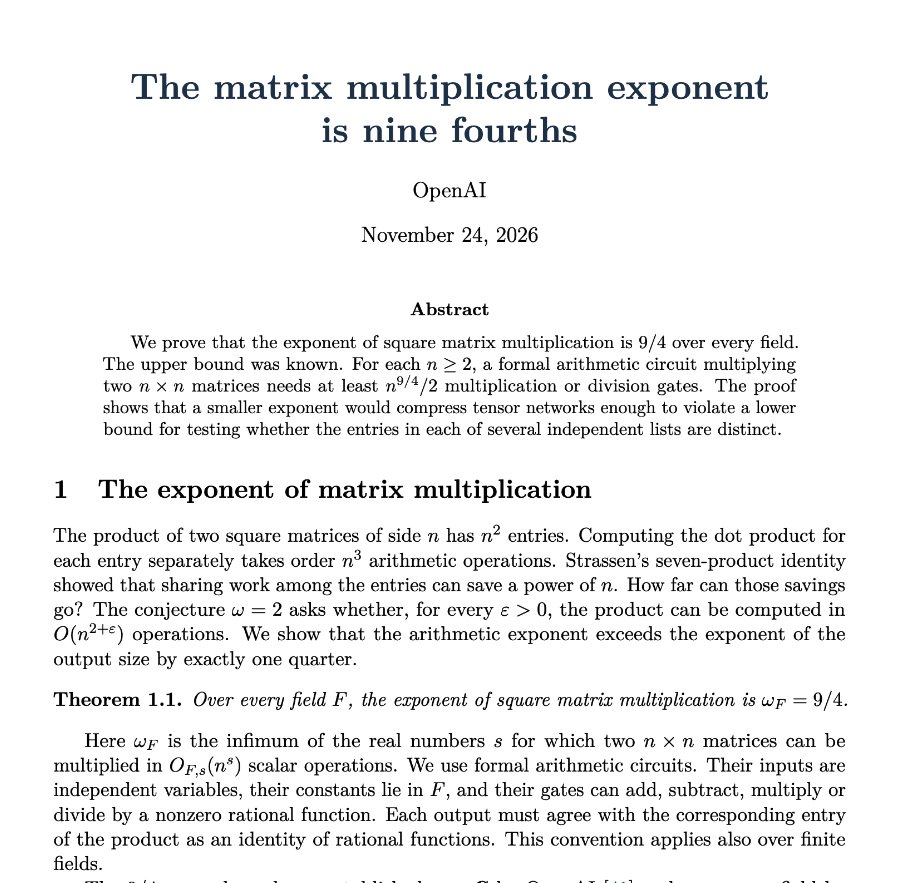
OpenAI claims the matrix multiplication exponent is exactly 2.25
The textbook method for multiplying two n × n matrices takes roughly n³ arithmetic operations. In October, OpenAI reported a way to bring the exponent down to 2.25. That left open whether someone could find an even faster algorithm
Today’s paper claims to rule out every exponent below 2.25
Read here: https://t.co/GXn451OiYf
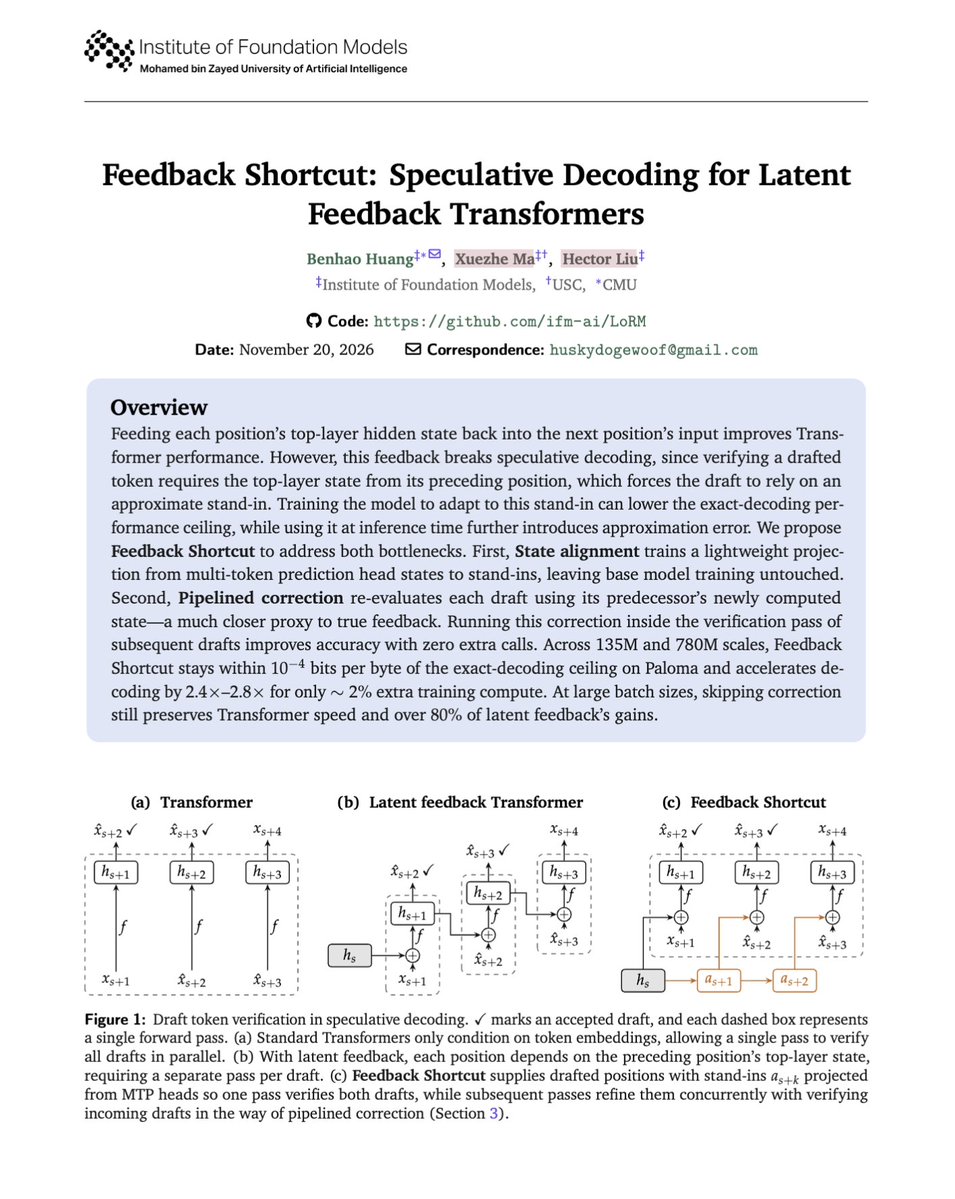
"Feedback Shortcut: Speculative Decoding for Latent Feedback Transformers"
Latent Feedback Transformers improve LLM, but their architecture pretty much breaks speculative decoding.
To solve that, this paper introduces Feedback Shortcut, which predicts the missing hidden states needed to verify multiple tokens in parallel, then corrects those predictions during subsequent verification passes without extra model calls.
Across 135M and 780M models, Feedback Shortcut achieves 2.4-2.8x faster decoding than exact latent-feedback decoding, while maintaining nearly identical prediction quality with only ~2% additional training compute for the shortcut.
https://t.co/Pb13yFwf8y
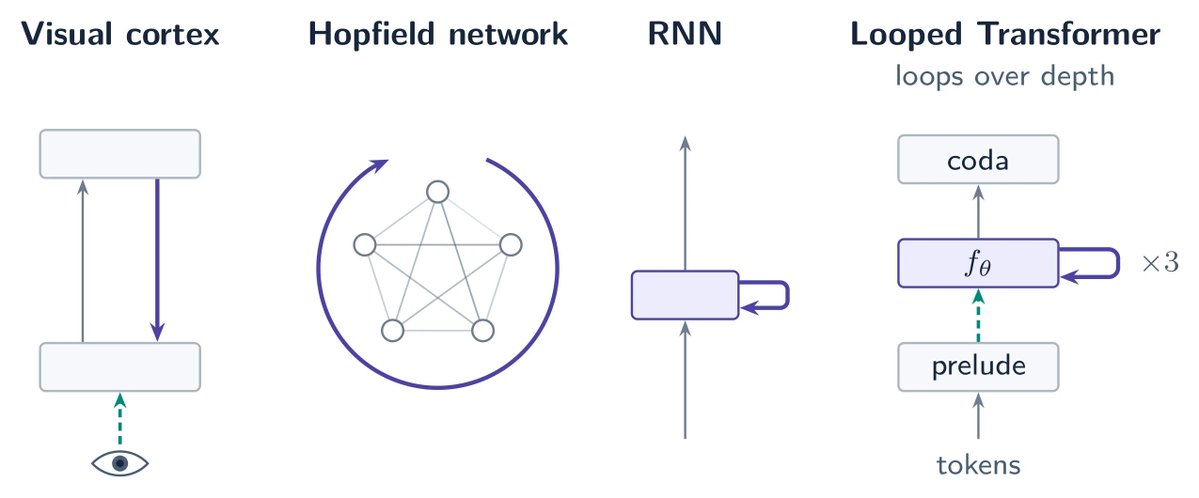
In the last week, Inkling 2 Mini and GLM-5.4 both launched as looped Transformers
But why can running the same layers again improve reasoning without adding parameters?
The idea goes back to the first neural networks in 1943, with a fascinating counterpart in the nervous system.
We wrote an illustrated guide connecting looped transformers to feedback in human vision. It traces how recurrence became a way for networks to store memories, process sequences, and spend more time reasoning before producing an answer.
Read here: https://t.co/vaWmd3OXWF
OpenAI claims the matrix multiplication exponent is exactly 2.25
The textbook method for multiplying two n × n matrices takes roughly n³ arithmetic operations. In October, OpenAI reported a way to bring the exponent down to 2.25. That left open whether someone could find an even faster algorithm
Today’s paper claims to rule out every exponent below 2.25
Read here: https://t.co/GXn451OiYf
Feel free to publish the tech report on alphaXiv directly!
We began this initiative a couple months ago after noticing a rise in the number of arXiv submissions on hold.
The primary benefit is that it's lightning fast, doesn't require an endorsement, and community curation (comments, bookmarks, following researchers) help ensure that the right papers are surfaced to the right audience. We will also be issuing DOIs as well!
It's also not mutually exclusive, so if your paper does end up on arXiv later, we can merge the 2 alphaXiv links on our end. Here's an example of one published directly to alphaXiv
https://t.co/mSrIjn2yfs
Enhancing LLM sample efficiency.
Intelligence is not how much one knows, but how rapidly one learns.
We find that if transformers periodically “sleep”, or replay their inputs N times without accepting new ones, they are able to learn from fewer tokens in context.
Looped Transformers are suddenly everywhere, but the idea isn't new! Check out how we got to today's looped LLMs, in the History of Recurrence guide I wrote for @askalphaxiv
In the last week, Inkling 2 Mini and GLM-5.4 both launched as looped Transformers
But why can running the same layers again improve reasoning without adding parameters?
The idea goes back to the first neural networks in 1943, with a fascinating counterpart in the nervous system.
We wrote an illustrated guide connecting looped transformers to feedback in human vision. It traces how recurrence became a way for networks to store memories, process sequences, and spend more time reasoning before producing an answer.
Read here: https://t.co/vaWmd3OXWF