Thanks for the shout-out @ariG23498!
For everyone new here, I'm the builder of the Transformers modelling backend for vLLM (go figure 🤔). It lets you take 🤗 Transformers model code and run it in vLLM at full speed!
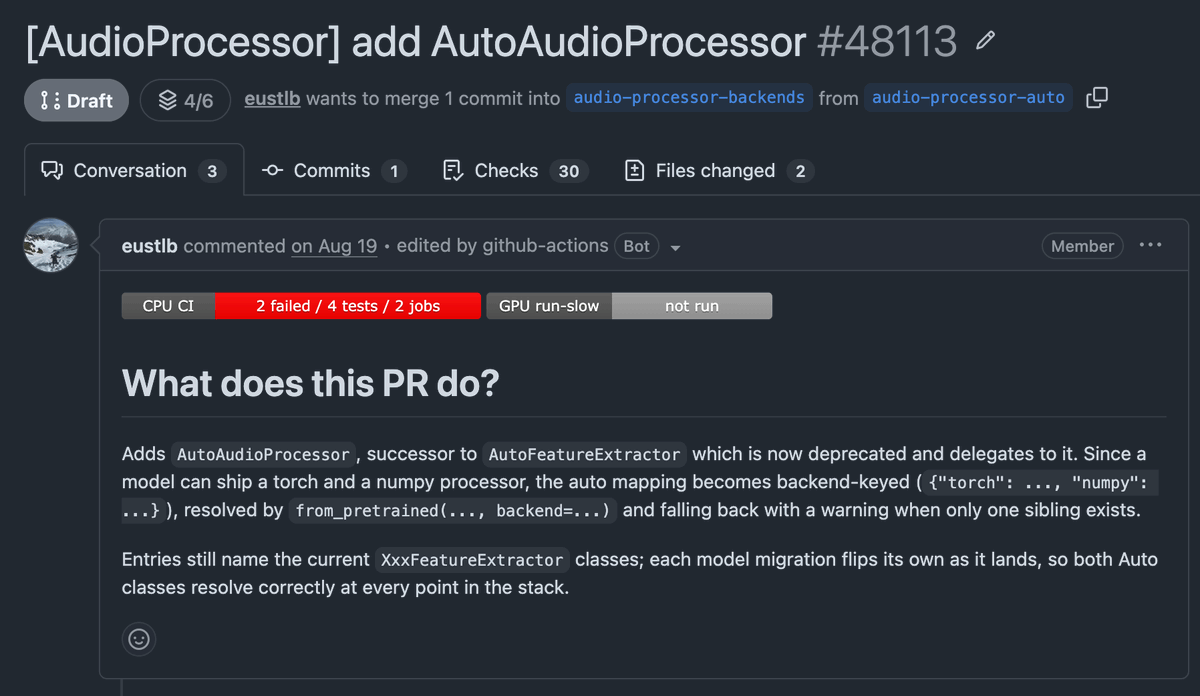
One of the biggest changes in the history of 🤗 Transformers audio is in the works, spearheaded by @eustachelb
We’re rebuilding essentially the entire audio preprocessing stack.
The goal is to move away from every model carrying its own `FeatureExtractor` implementation, and towards a common `AudioProcessor` architecture where models describe their frontend, while shared backends handle the actual computation.
The stack currently covers ~30 audio frontends and 62 model mappings across Whisper, Wav2Vec2, Parakeet, SeamlessM4T, Qwen, Gemma, codecs, TTS models,and many others.
A big part of the work is making backends explicit:
`backend="torch"` → native PyTorch preprocessing (often super fast!)
`backend="numpy"` → portable NumPy preprocessing
That means audio preprocessing can increasingly live in the same framework as the model itself, while still keeping compatibility with the numerical behavior existing checkpoints expect.
It also gives us a much better foundation for what comes next: new hardware backends, faster kernels, compilation, and optimizations that can benefit many audio models at once instead of being implemented model by model.
~30 frontends migrated.
62 model mappings.
One common preprocessing architecture.
The entrypoint, common across all architectures:
`AutoAudioProcessor.from_pretrained(...)`
Audio in Transformers is about to get a much stronger foundation!
🎧🎧🎧
Congratulations to the 2026 PyTorch Contributor Award winners, recognized today at #PyTorchCon 2026 for their innovation, collaboration, and impact across all PyTorch Foundation projects including PyTorch, vLLM, DeepSpeed, Ray, Helion, and Safetensors.
Outstanding Ambassador: Jiho Kim
Newcomer: Jiangyun Zhu (@jiangyun_zhu), Johannes Lennart Zeiser
Knowledge Enhancer: Abdulsalam Yazid Bande (@abdulsalambande), Suman Debnath (@_sumand)
Bug Buster: Guilherme Vieira Leobas, Vishal Goyal
Review Powerhouse: Wentao Ye
Catalyst: Jiahao Tan, Harry Mellor (@hmellor_)
Innovator: Masahiro Tanaka, Elfie Guo, Xinan Lin
Ecosystem Champion: Guangye Yu
Superhero: Thomas Ortner
Nominees: Chandra Mohan Singh Negi, Arun Bhandari, Masahiro Hiramori, Luka Govedič, Irakli Salia, Jiahao Chen, Kunshang Ji, Rohit Kumar Tiwari, Subin George, Xunzhuo Liu, and Aaron Gokaslan.
Thank you to Cara Delia (@RedHat) and Chris Gottbrath (Gottbrath Technologies) for presenting the awards, and to Red Hat (@RedHat) for sponsoring them.
And thank you to our 2026 Awards Committee: Chris Gottbrath (Gottbrath Technologies), Chris Hoge (@nvidia), Ashok Emani (@intel), Piotr Bialecki (@nvidia), Yashasvi Misra (@CloudNativeFdn), Sudhir Dharanendraiah (@RedHat), Zesheng Zong (@Huawei), Jiawei Li, and Kaichao You (@inferact).
Kolibri 1 now runs natively in Transformers 5.20!
We are still overwhelmed by all the community feedback.
You can now spin up our Kolibri models in just a few lines of code using 🤗transformers.
Special thanks go to Luca Motz (@lucamotz3141) and Harry Mellor (@hmellor_) for pushing this.
@sakurayukiai@cohere Exactly, the new video path should not harm the image path and it gives a helpful warning so the user knows where to go to request support!
Text. Images. Audio. Video.
@vllm_project 's @huggingface Transformers modelling backend now serves every modality with zero hand-written vLLM modelling code.
Video support from Harshal Janjani, landing in v0.32.0 🎬
`--model-impl transformers`
Sorry to hear that! As you mentioned, we've been pretty clear on the commitment from NVIDIA to keep us open, neutral and silicon agnostic (cf that screenshot from the 8k filling). But we'll work hard with our actions in the coming years (like we did in the past 10) to show you that and hopefully regain your trust (in case this is not just a ragebait)!
How do you keep @vllm_project moving at the speed of light without excluding users who run diverse models on diverse hardware?
In a new PyTorch Foundation blog, contributors from @IBM, @Meta, and @huggingface introduce hardware-agnostic layers designed to balance frontier performance with portability, helping ensure vLLM continues to meet the needs of the broader open source ecosystem.
Read the blog to learn more: https://t.co/3GIUCZLh2Z
@hmellor_@th_ortner
Millions of GGUF downloads later, those same llama.cpp checkpoints can now run in 🤗 transformers.
Same models, more ways to use them, and fast local inference on Mac powered by ggml kernels!
Blog: https://t.co/AiD8iBRYmx
ggml kernels: https://t.co/tkR5RraSbf
The AI revolution will not be centralized. 🤗
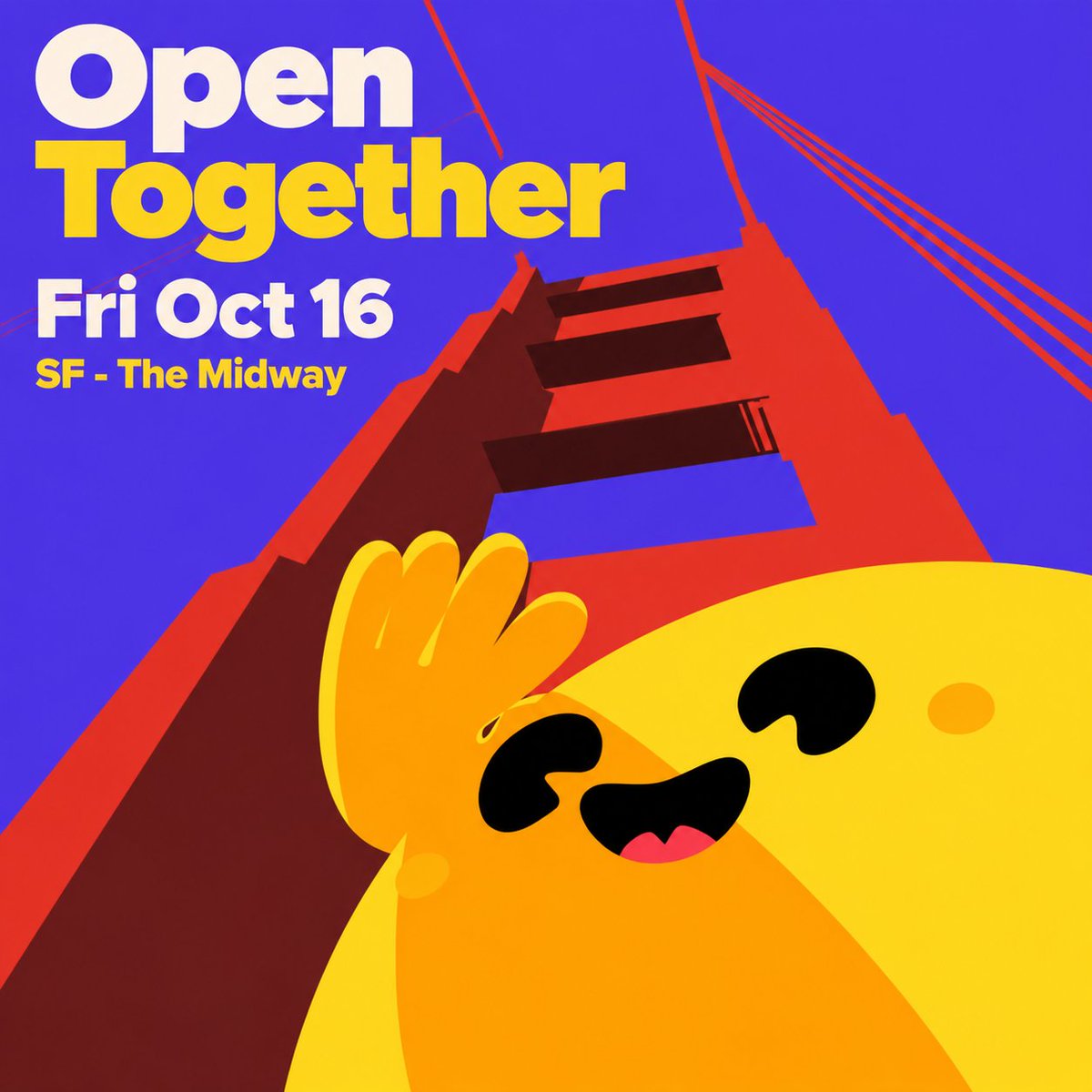
📢 Calling all AI builders to San Francisco on Friday, October 16, one month from today!
We’ll kick off Open Source AI Week with Open Together: a huge meetup, community demos, and a dance party. Come meet the people building with open models.
Everyone should be able to build AI they can control. That’s the gift of open models, and a future worth celebrating together. I’d love to see you there!
Who’s coming? Tell me what you’re building in the replies 👇
Register here: https://t.co/4qbUP45Czu
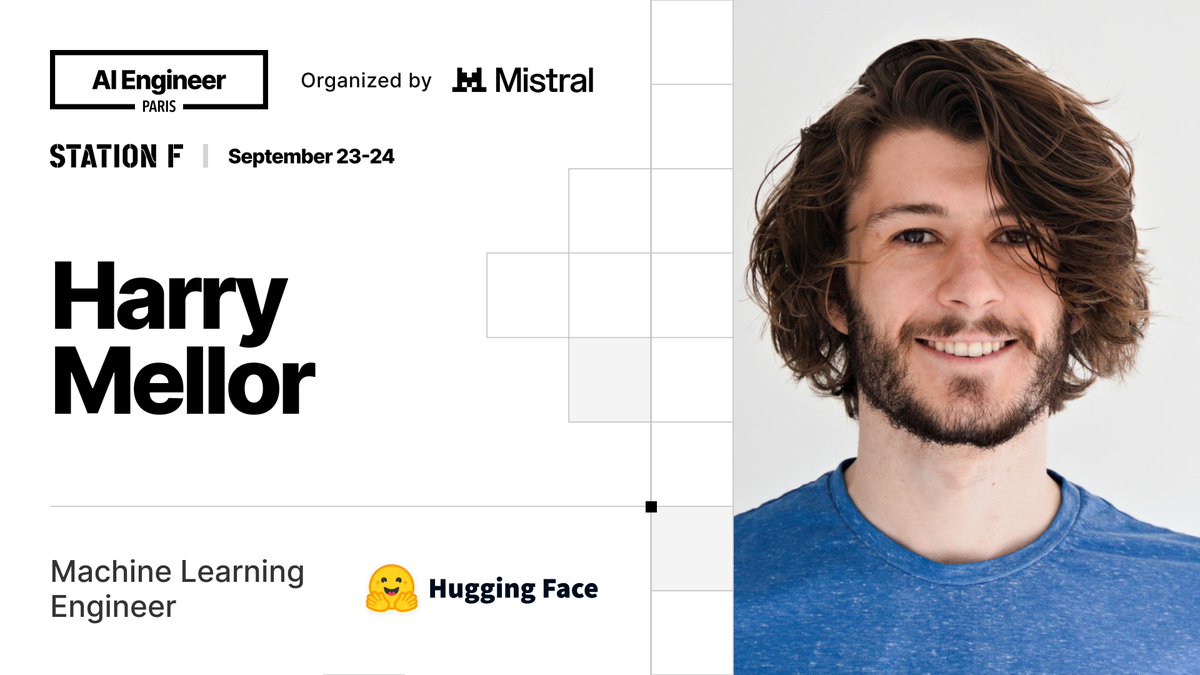
👋 AI Engineers! Join us at the second @aiDotEngineer conference in Paris on September 23-24, organised by @MistralAI!
Swing by the main stage! I’ll be speaking about how a @huggingface Transformers model loads in vLLM at 10:30 on Thursday 24th September.