Preventing "teen" pregnancies was a total fuck up of public policy not being able to articulate an actual problem and creating worse ones.
What government wanted to do was stop black teenagers in big cities getting each other pregant/being impregnated and going on welfare.
What it ended up doing was eliminating pathways leading to marriage and parenthood from 18-22 which were actually completely normal, with a brief period of time where traditional overhang made it possible for 22 to 26 to be the new range, which then shifted further upward to 28 to 32, and now 30 to 34, with each generational cohort marrying later, less often, and having fewer, more sickly children.
https://t.co/Q7xyFphGPl
Cultural factors drive fertility, one reason income has a limited effect is because humans relativise income, in a nation where average income is $25k, people will say they need $50k to have more children, when its $50k, people will say $100k, when its $100k, they will say $200k
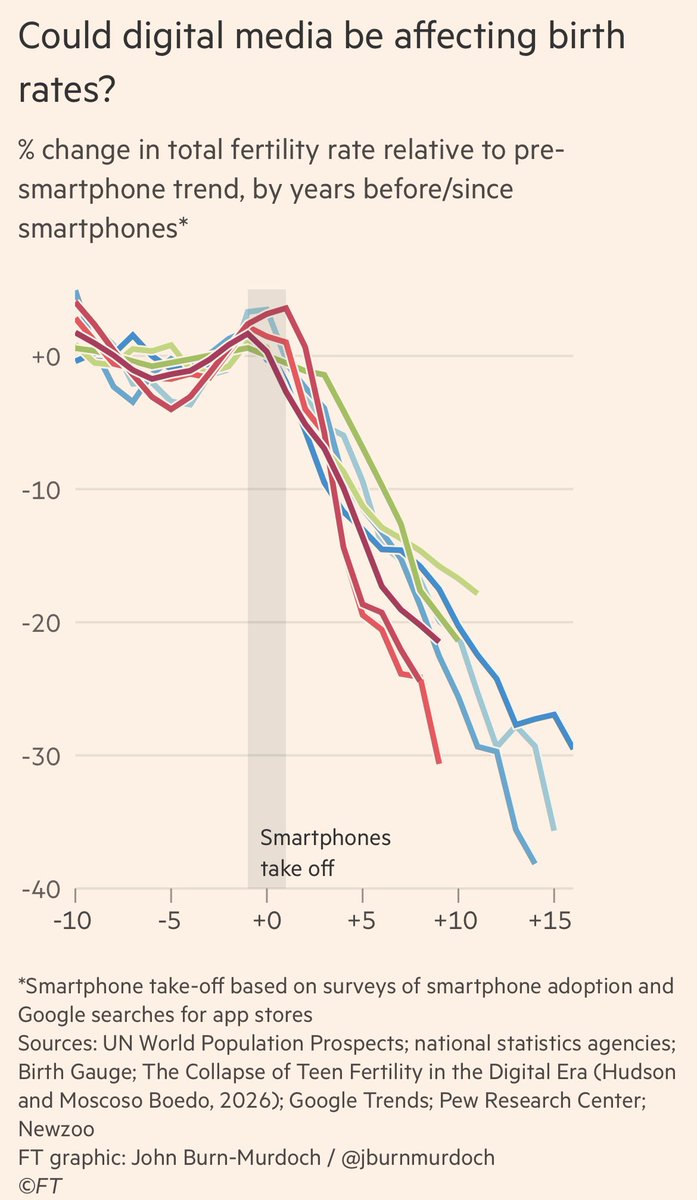
Superb by @jburnmurdoch:
“In country after country the birth rate plunged after the introduction of smartphones, no matter what the previous trend was…the modern digital media environment has had profound effects on society that have led to a decline in romantic coupling”.
https://t.co/EouWmES1zk
Um.... No.
The reason Nelson stands out in memory is that he had already won a string a spectacular naval battles before reaching Trafalgar, each marked by "the Nelson touch." He was a fascinating combination of military genius at sea, beloved by officers and the lower deck alike, and virtually adolescent onshore--think Jack Aubrey. Trafalgar was not just a fleet action, but a historic, strategically decisive victory over Napoleon that secured Britain's naval supremacy for a century. And at very peak of the battle, Nelson, decked out in all his dress finery, making himself a conspicuous target on the quarterdeck, was fatally wounded and died romantically just after the victory was won.
More concisely: Nelson is the most fascinating naval hero in the history of the world.
Romantic lip kissing has been documented in only about 46% of existing cultures**.
If it were an entirely irresistible instinct, I think we'd expect to see it in the exact same form across all human cultures; still, I don't think this means kissing can't have a biological basis.
As far as I know, there are three prominent theories about this: the Premastication (Pre-chewing) Theory, the Mate Selection and Genetic Compatibility (Scent Theory), and the Nerve Endings and Biological Reward theory.
++In recent years, an explanation rooted in grooming/cleaning behavior has also been added to these.
For much of human history, mothers in many societies would chew solid foods into a puree and transfer them directly mouth-to-mouth to their babies. According to this theory, even after food transfer disappeared during the evolutionary process, that very act -- lip-to-lip contact -- may have endured as a biological ritual for showing love, trust, and affection.
According to the Mate Selection and Genetic Compatibility theory, coming face-to-face at such close range allows us to pick up on general body scent and some chemical cues. In other words, the habit of sniffing may have evolved over time into kissing, a much closer form of contact.
Finally, there's the nerve endings theory. The lips are one of the areas with the densest nerve networks in the human body. The space dedicated to the lips in the part of our brain that processes the sense of touch is also disproportionately large. Stimulating the lips can trigger systems associated with reward and attachment; social contact and romantic bonding are linked to processes involving oxytocin and dopamine. This biological reward system may have ensured that the act became permanent.
I think kissing was shaped not by a single reason, but by a combination of these factors. While premastication (the mother-infant bond) laid the emotional and affectionate groundwork, scent/mate selection and the sensitivity of the lips may have transformed it into a romantic ritual.
** For the research: https://t.co/QQWBOPXelr
Last year I put on a bit too much weight from partying, so for our engagement my fiancée and I are both spending this year dieting back down into shape.
Once a week I’ll let myself go out for a cheat meal, because it’s once a week I always find myself paralyzed by the seemingly infinite menu of restaurants at my fingertips.
Then, whenever I get something, I find myself utterly disappointed at how mid it all is. It’s impossible to not feel disgusted that millions of people choose those fleeting moments of satisfaction over their health.
It’s impossible to not be enraged that I am robbed of 1/2 my income to pay their medical bills so they can engorge themselves on “birria taco ramen” or whatever. That my home has been colonized so some salt and sugar addicted degenerate can have papusas or some other variation of bread and meat.
It’s all frivolous, unnecessary, and retarded. It’s all heart disease inducing, it’s all a pathetic addiction. It’s an endless sea of slave to impulse, no different from pigs suffocating themselves in troughs of slop.
Until the 18th century, almost all uses of the word "British" referred to the Welsh, Cornish and Breton.
Cymraeg (the Welsh language) is classified as Brythonic, a word coined by the Welsh scholar John Rhys, and shares a common origin with Cornish and Breton and the many other regional varieties that developed out of Common Brythonic that was once spoken across almost all of Britain.
The Cymru have their own specific regional identity unique to themselves, but they are also Britons in the very real and original sense. Their ancestors were the ones battling Caesar and later the Picts, Scots and Saxons.
When Britons crossed the channel and settled in Brittany in the late Roman period and early Migration Period, they called themselves Britons, and still do in their language, "Bretoned"
Briton is an ancient pan-tribal ethnic identifier which extended from north to south. Thus, the Picts are in Welsh known as the Prydyn, from the same root as Prydain (Original Welsh form of the word Britain).
The Gaels knew them as the Cruithen, which is the Q Celtic form of the same ethnic name, which may mean "the builders, the shapers", related to Welsh "pryd" and Gaelic "cruth".
Since 1707 with the Acts of Union, the term "British" has been increasingly used in a more expanded way, but its true meaning should not be lost, and certainly not rejected, by the very descendants of the Britons.
The reason modern life is so dumb and ugly is because countless thousands of future poets, painters and mythmakers were slaughtered at the Somme & Verdun. WWI was a tragedy from which we may never recover. Lewis & Tolkien survived but we lost a hundred Lewises & Tolkiens.
Absolutely. The anticipation of the cold water is always worse than the swim itself. The only cure for the anxiety of the 'hard thing' is the action of doing it. We often wait for courage to arrive before we act. But in reality, courage is the prize you get after you do the thing you were afraid to do
Harold Wilson was the Labour Prime Minister who:
-Instituted 90+% death taxes that destroyed most of what remained of traditional British society
-Betrayed and led the charge to help Mugabe destroy Rhodesia
-Ended the rum ration out of spite
He was also a cowardly bureaucrat who rode a desk during WWII, was noted for constantly being a lying weasel, was intimidated and aggravated by the presence of "men's men" like Ian Smith, PK van der Byl, and the Duke of Montrose, and did eerything his could to aid communist regimes in the decolonized world
He is probably the worst and most evil Prime Minister Britain has ever had, which is saying a lot. His entire time in office revolved around eclaring war on tradition
There’s no need to be afraid of any scenario in life, because it isn’t personal and it isn't the first time some has found themselves in such a scenario. It’s structural. The ego wants dramatic suffering. It wants its pain to be mythic. But most suffering is procedural. It’s part of the design of being alive.
You are not uniquely cursed. You are not cosmically targeted. You are simply next in line. Because if your problem is not divinely customized, then it is ordinary. And if it is ordinary, it is survivable. Millions before you have stood in this same queue. They felt the same dread. They thought it was the end. It wasn’t.
No, you’re still not getting it. Normal people see a baby as a gift, a miracle. It has infinite value just in existing. A birth is the continuation of the family and a harbinger of endless joy and love.
It has nothing to do with how difficult it is. It is inherently good, something floating above and beyond and always more important than mere accomplishment.
It is quite literally life itself.
Getting a fair bit of "It's too expensive," so here goes:
The default narrative is that you spend four of your most fruitful years growing debt while seeking a degree at a chichi sleepover camp, then try to nurse that degree into a high-paying/high status job.
To do this, you kinda need to go to a city. A secondary pursuit is finding a mate, but you shouldn't get serious until you've explored "all the city has to offer," maybe travel a bit, really expand your options while you're young.
After years of dating, with a career under your feet, you get married, then get a house, then think about kids.
By this point, you've built up a sizable lifestyle: career of course, but also your buddies, your exercise, your vacations, your whatever. All of these things will compete with the time/money you've got available for kids.
Here's an alternative: A chief focus in adulthood is a big family. Instead of college, you get an unskilled/entry-level job locally. You leverage your social capital having grown up in the area to excel and build off connections. You keep expenses down by living small, you accumulate savings, you keep an eye open for an inexpensive home to purchase.
You actively seek a romantic partner, you take the process seriously, the moment you know it's not gonna last you move on. You seek someone who matches your character, not the beautiful soul-mate portrayed in music and film.
You get married in your 20s and start having kids immediately. Since your spouse is local, both of your extended families are close and can supply the bulk of your child care.
You take being a good son-in-law seriously because you are invested in your wife's family (or vice-versa). You take being a good son seriously for the same reasons, you get over the hang-ups you had with your folks, bury the hatchet, and overtly respect your parents. Your siblings too. You become a person who can bridge conflict and petty squabbles because you see the bigger picture. And even moreso for your spouse.
And even moreso for your kids. As they grow up, you make sure they trust you, that they want to be around you and each other, that they recognize the special thing you're building, how they fit in with your extended families.
They apprentice with the local economy, maybe they join you at your work, maybe you start your own company and mentor your kids who want to take over the family business. Or work for one of your many local friends. You've been paving the way for them for many years, and there are many options on hand.
By their teenage years, they are buying their own clothes and gadgets and memberships and driving themselves around.
You own your own home, you don't send them to private school, you don't have fancy vacations, you buy regular food. The kids entertain themselves, they don't need travel soccer or who knows what. You can have a two parent income because you've got plenty of help from extended family, and when the kids get older they can watch the younger ones.
Yes, some of them will get restless and want to see the world, but some will want to stay home and contribute.
When you're old and frail, you've got lots of kids and grandkids to keep you out of a nursing home.
All I'm suggesting is the crazy idea of prioritizing a large family from the beginning, not shifting a default lifestyle to a large family in your late 30s because you read about it on X.
It's interesting that this is not the picture that is painted in school. School is for college, where you leave home and go away to incur debt in the big city where winners live. Some day you might have kids, but only a few. Even small town public schools (where I grew up) convince their own children to leave town and create a life elsewhere. Why? Parents pay taxes to eviscerate your own community, setting themselves up to live alone and pine for visits from their adult children. By the time they're grandparents, they're in their 60s, with little energy and strength for toddlers.
Even private schools do so (otherwise, what you are paying for?) School is a scourge.
(Disclaimers: Obviously the wife shoulders the pregnancy burdens and health risks, she needs to want the project also. Equally obviously, this should be hashed out early in the dating process. Also obviously, some people don't want this, prefer other passions, and that's great too. College is a great idea for many people, and there are millions of paths to the good life, go get 'em!)
Here's what I think happened.
Prior to the Baby Boomers, people had lots of kids because there was no birth control. As such, the dominant culture (primarily religion) explained why children were worth the inevitable toil, but also encouraged parents to make it easy on themselves with such patent irrationalities as "children should be seen and not heard" and "because I said so."
Then, the Boomers were hit with a bunch of new narratives. First, they had birth control, so free love became part of the rebellion against static old-world vibes.
Second, their reaction against their parents included getting free of the burdens of a big family living in cramped conditions, no privacy, no ability to rock out or smoke weed or just be your own person.
Third, they got hit with the population and environmental doomerism, and they got hit hard. Rachel Carson, Paul Ehrlich, Jane Goodall, Club of Rome, etc etc.
All of these created a dominant cultural narrative that lots of kids is bad. Have two at max, to replace yourselves, and otherwise think about preserving the Earth.
In the process, a key piece of cultural knowledge was lost, or perhaps overlooked, and that is the joy of having lots of kids.
I have five, and I can't tell you how amazing it is. That's part of the problem, it's hard to put it in words. Yesterday morning I had a peak experience, probably the happiest I've ever been. My parents and my brother's family were visiting, and the 7 grandkids were playing, and I was chatting with my brother and my wife in the other room, and I just couldn't get over how happy I was.
I think part of it is that, without a lot of kids, one tends to focus on hobbies, or career, or other pursuits to fill out life. There's nothing wrong with this, except that it often falls flat. Or, there's lots of down time. If fishing is your passion, you still spend lots of time not fishing. If you fancy yourself a writer, every moment is an opportunity to feel guilty for not writing.
But with lots of kids, even if you're getting nothing done, you are bearing witness to constant growth that is all your doing. And you constantly have amazing things to do - play a game of chess with the 6 year old and he gets familiar with how the knight moves, and then he can play with his grandfather who's been dying to be able to beat someone. And then the 2 year old comes and hugs your leg while you're making waffles for the 4 year old. I mean, these little moments are nearly ceaseless.
Now, in the before times, I'm sure there were ceaseless little joys like this. But the context was quite different, and I bet the joys were muted. Kids got sick, often desperately so, and even if they weren't dying, you could never be completely at ease. Today, childhood diseases are vastly safer. There wasn't always abundant food, heat, clothes. There were constant discomforts. You couldn't order same-day delivery of diapers. And of course, women were expected to shoulder the burden without having an outlet for other interests.
But today, we have Amazon, the nation of China willing to make cheap toys and baby wipes, vaccines, minivans, drive through French fries, iPads, etc. Having lots of kids has never been easier.
"But it's too expensive!" No, it's not. It's too expensive if you want to maintain your post-college lifestyle of eating out, going to craft breweries, vacationing, and living in Brooklyn. But if you prioritize the joy of having lots of kids, you can support them by living in the suburbs, getting a reliable job, not eating out, not spending money on your lifestyle. It's absolutely possible, it just takes a serious rearranging of your priorities.
Which takes me back to my point about cultural narratives - if the benefits of having lots of kids was more prominent, people would more commonly aspire to it, would get a real major in college (or maybe skip it altogether), get a reliable, high-paying job in their early 20s, look for a life-partner early instead of a dating partner, save, and strive for making a big family instead of climbing various career or status ladders.
And, AND - the basic stuff begins to really matter. You gotta figure out how to get along with your wife, cause you're both in deep. You gotta sand off your rough edges and figure out how to make it work. And you can't be diddling around with insignificant stuff because your life is on serious mode, not demo mode. And you gotta be liked and trusted by your kids so they can help you out as they get older, or at least not try to actively make your life miserable.
I don't know how to change the cultural narrative. And I'm sure many people might hate having lots of kids. Maybe I'm wrong. But my personal experience is one of surprise at never being told by anyone when I was growing up that having a lot of kids is a recipe for a great life. It seems so obvious to me now, and yet whenever ppl find out I have five kids, they make some kind of face or say some kind of thing that essentially amounts to "Ugh." Many are genuinely surprised that I think the future is worth living. (Unbelievable, but true. Imagine if our distant ancestors thought the plagues and famines just made life not worth living.)
I get the idea that we need to revive religion as it is quite an effective pro-human, pro-child narrative that considers people to be the very standard of what is valuable. Despite my deep atheism, I feel more aligned with religious families. But I can't stomach ignoring the God stuff. But also, I can't stomach the Godless religion, that's just phony nonsense. At least the God-fearing are serious.
@ubiquitousnewt Indeed.
As an aside, your posts and replies on this app are possibly some of the highest quality media I consume - not only here, but anywhere. I greatly enjoy everything you write. You’re possibly the highest quality account on this app. Please keep sharing your wisdom with us!
Babies suck because they have yet to grow into their fat heads aka large brains.
They are born unfinished and completely dependent because pregnancy can only safely and sustainably continue for a limited time. They arrive needing adults for everything.
So they are very demanding.
It feels worse in modern life because we build adult routines around sleep, efficiency, independence, and productivity. A baby brings the opposite of all these things. In the WEIRD western world, we typically raise infants in smaller support networks than humans likely evolved with, so its a big disruption.
But usually, hopefully, a welcome one.
Mothers evolved to respond strongly to infant cues, because mothers who did that tended to have more surviving children.
Essentially, babies suck, but the Mother, on average, evolved to suck it up.
All will be well.
The good news is that babies turn into children, teens and adults and grow less dependent and therefore they can suck less over time.
The bad news is that some people still suck even when fully matured and well adulthood.
The difference in marriage rates by class reflects underlying differences in traits that were previously suppressed by strong social norms and institutional pressure.
In the past, stigma, religion, and limited exit options forced many people into marriage regardless of their psychological suitability.
This included people who were impulsive, promiscuous, unstable, low in self control, or poorly equipped for long term cooperation.
Many of these marriages were unhappy, and stressful and destructive to childrens wellbeing. But they persisted because social constraints were strong.
Once those constraints were removed, people began to behave in line with their true dispositions.
Marriage became optional rather than mandatory. Under these conditions, individuals with the traits conducive to stable partnership, such as conscientiousness, emotional regulation, future orientation, and pro social behaviour, continued to marry. These traits are disproportionately concentrated in the higher and upper middle classes.
Those lacking these traits increasingly opted out of marriage or failed to sustain it.
As a result, marriage has become a self sorting institution that selects for psychological stability and long term orientation.
The collapse of marriage in the lower classes therefore reflects not merely or primarily economic change but the expression of underlying trait differences that were always present but previously hidden by social enforcement.
Modern family patterns are not an anomaly but the natural behavioural reality once major social safeguards are removed.
Parents wildly overestimate their causal importance.
Behavioural genetics shows that intelligence, personality, impulse control and psychiatric risk are highly heritable, with shared environment having a negligible impact once basic needs are met.
The micromanaged enriched, status signalling and curated lifestyles parents obsess over do not produce better outcomes when the underlying genetic proclivities are absent.
Children regress toward their genetic mean regardless of how carefully they are raised. Some children outperform others not because of parental effort, but because of the gametes involved at conception.
My experience is that modern parenting culture is neither practically nor emotionally helpful. It is a bloviated, morally conceited cesspit propped up by a combination of smug, status obsessed, clinically anxious adults emphatically farting about their own importance.
Online circles in particular reward aggression, sanctimony and, at times, outright cruelty.
Said parents convert genetic luck into moral superiority, an illusion only the feckless and the arrogant will defend most viciously.
Once one understands behavioural genetics, it becomes difficult to regard oneself in a self congratulatory light.