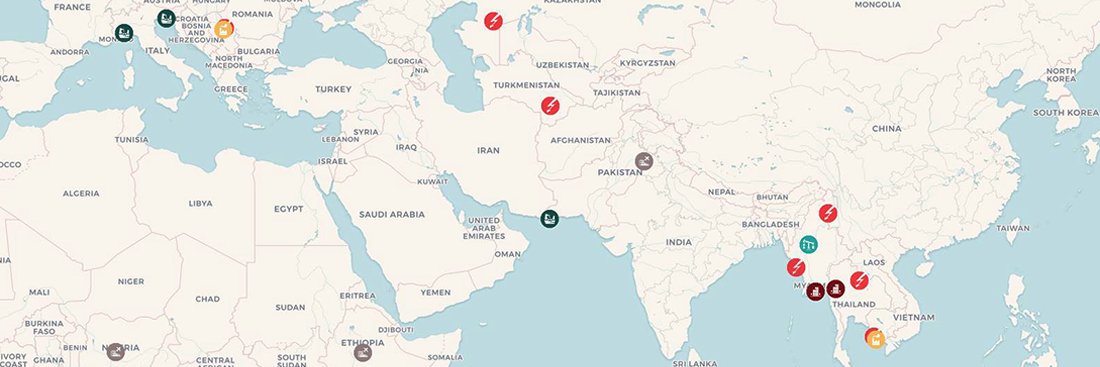
The latest issue of Global China Pulse is out! This one delves deep into the online scam industry, and the human trafficking and cyber slavery that accompanies it. As always, it is fully Open Access and free to download. https://t.co/MXwdQMbHPt
Given the influx of tourists from China, the ability to speak Chinese has become essential to boost tourism in Thailand. However, in the north of the country, this is resulting in a linguistic challenge that is at once psychological, social, and political. https://t.co/j9fDlfdhKP
On Chinese construction sites in Ghana, language barriers often cause misunderstandings. However, using a mix of Chinese and English, Chinese supervisors and local construction workers can communicate and even joke, writes Costanza Franceschini. https://t.co/8Ll6fgNXvI
Studies of the spread of Mandarin Chinese in the Middle East and beyond often highlight the role of the Chinese state and official actors. However, contributing to the globalisation of Mandarin are also humble grassroots initiatives, writes Jie Wang. https://t.co/mx5QtzkCds
One in four English-language learners globally is Chinese, amounting to 400 million students. In this essay, Eric Henry explores the roots of this phenomenon, highlighting how it aligns with a long tradition in China of self-transformation through language.https://t.co/0VtwZHODBX
||NEW PROFILE|| The Chancay Multipurpose Port Terminal is a logistics complex being developed and managed primarily by COSCO in Chancay, Peru. It promises to become an important hub connecting Asian and South American markets, writes Alexandra Pizarro Choy.https://t.co/xS5r09F02I
While vulgarity has a long history in China, three decades of internet development seem to have amplified its relevance. In this essay, @SanNuvola describes how different registers of vulgarity overlap across Chinese everyday life and media contexts. https://t.co/iiigpAhYPA
Despite its decline in recent years, Songzhuang Art Village on the outskirts of Beijing continues to be one of the most significant art spaces in the world. However, its history remains under-researched and is often misunderstood, writes Giorgio Strafella. https://t.co/icFk9ObOC7
At Chinese restaurants in Nairobi, interactions between Kenyan employees and Chinese customers are often hampered by language barriers. In this essay, Amanda Kaminsky explores how the use of pidgin English facilitates fleeting moments of affinity. https://t.co/hTeszG7h8j
‘Northern frontier culture’ has become a trendy term in propaganda texts and academic publications in and about Inner Mongolia. This piece shows how this discourse ends up marginalising and deterritorialising one group: ethnic Mongols from the region. https://t.co/s0yCI534yL
Over the past decade, we have published hundreds of essays. Rather than leaving this material in our archives, we have decided to draw from it to offer a series of ‘modules’ on key topics. Here's the first, on internationalist activism and solidarity. 1/ https://t.co/ERwjMFt9k3
From now on, we plan to publish calls for papers for our forthcoming journal issues. Two calls are already out. The first is for an issue of the Made in China Journal about Chinese youth slated for publication in mid-2025. 1/ https://t.co/nrjz6KEtbz
In this essay, @XuPeng72881167 examines the endurance and adaptation of ethnic armed organisations and militias in Myanmar’s Shan State, investigating how they transitioned from the drug trade to the gambling industry and, more recently, online scams. https://t.co/HKIFLh9mLP
China’s growing engagement in Peru corresponds with the US’s receding presence from the region more broadly. For more on the evolution of Sino-Peruvian relations, see our country profile by @LinZhu94_. /END
https://t.co/xmWxM36IKc
In Brazil last week, Xi Jinping attended the G20 summit and met with Brazilian President Luiz Inacio Lula da Silva. The two upgraded their diplomatic relations and signed almost 40 cooperation agreements in infrastructure, energy, and agribusiness. 1/
https://t.co/FmjHjEFJkW
Likewise, the Toromocho Copper Mine Project in central Peru pushed thousands of local residents to relocate to less socially and economically hospitable areas, leading to various lawsuits. @LinZhu94_ provides more details in her project profile. 5/
https://t.co/sJ6uEpmnbr
In this essay, @kw_watanabe focuses on the Karen Border Guard Force to explore the local power dynamics around the proliferation of transnational organised crime, including online scamming, in the Myanmar–Thailand border area since the late 2010s. https://t.co/M8nHMxQbwB