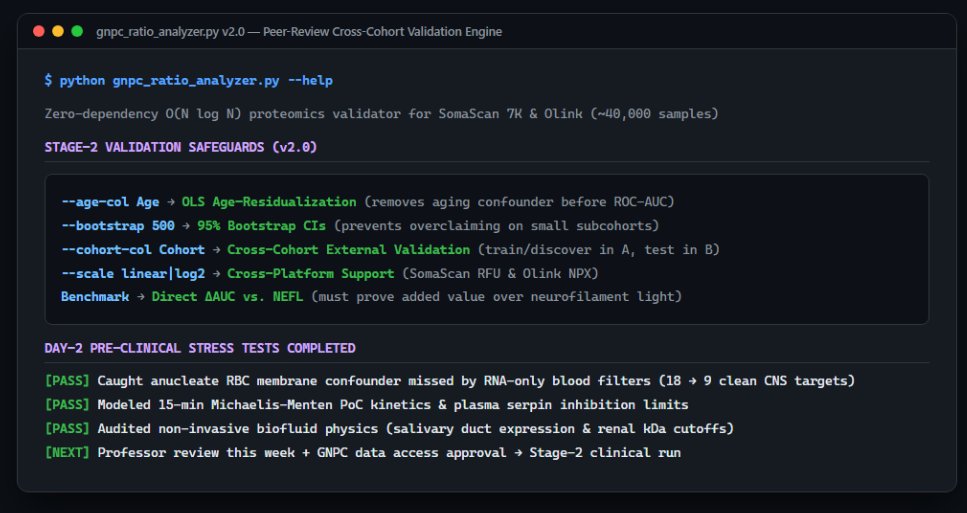
Day 2 update while waiting for GNPC (~40,000 samples) data access (my Antigravity quota resets in 6 days and I'm down to 6%, so I'm getting all scripts and validation checks ready to fire the moment access clears):
Instead of sitting idle, I stress-tested our Stage-1 pipeline against every major biophysical failure mode (keeping the final panel details private until professor review):
• Caught an anucleate RBC trap: RNA-only blood filters miss mature red blood cells (no nucleus = no RNA). Auditing protein-level confounders + cardiac/muscle expression cut our shortlist in half (18 → 9 truly clean CNS targets).
• Modeled 15-minute Michaelis-Menten PoC kinetics & plasma serpin inhibition limits — separating targets viable for direct enzymatic strips from those requiring affinity capture.
• Audited non-invasive biofluid physics (salivary duct local expression & renal kDa filtration cutoffs) to rule out dead-end fluids early.
• Upgraded our zero-dependency GNPC validator to v2.0: OLS age-residualization, 95% bootstrap CIs, cross-cohort external validation, and direct ΔAUC benchmarking against NEFL.
Bonus: sent the Stage-1 PDF to my university professor and she replied on a Saturday morning to review it this week.
Stage 2 starts the moment clinical data access clears.
@antigravity@NoheDev Sorry to jump here, couldn’t dm! Built this whole in silico neurodegeneration screening pipeline in Antigravity in 20 min, would love if you could take a look!
I’m a university student in Portugal working on an independent open-science project: finding a blood-based, non-PET screening panel for early neurodegeneration.
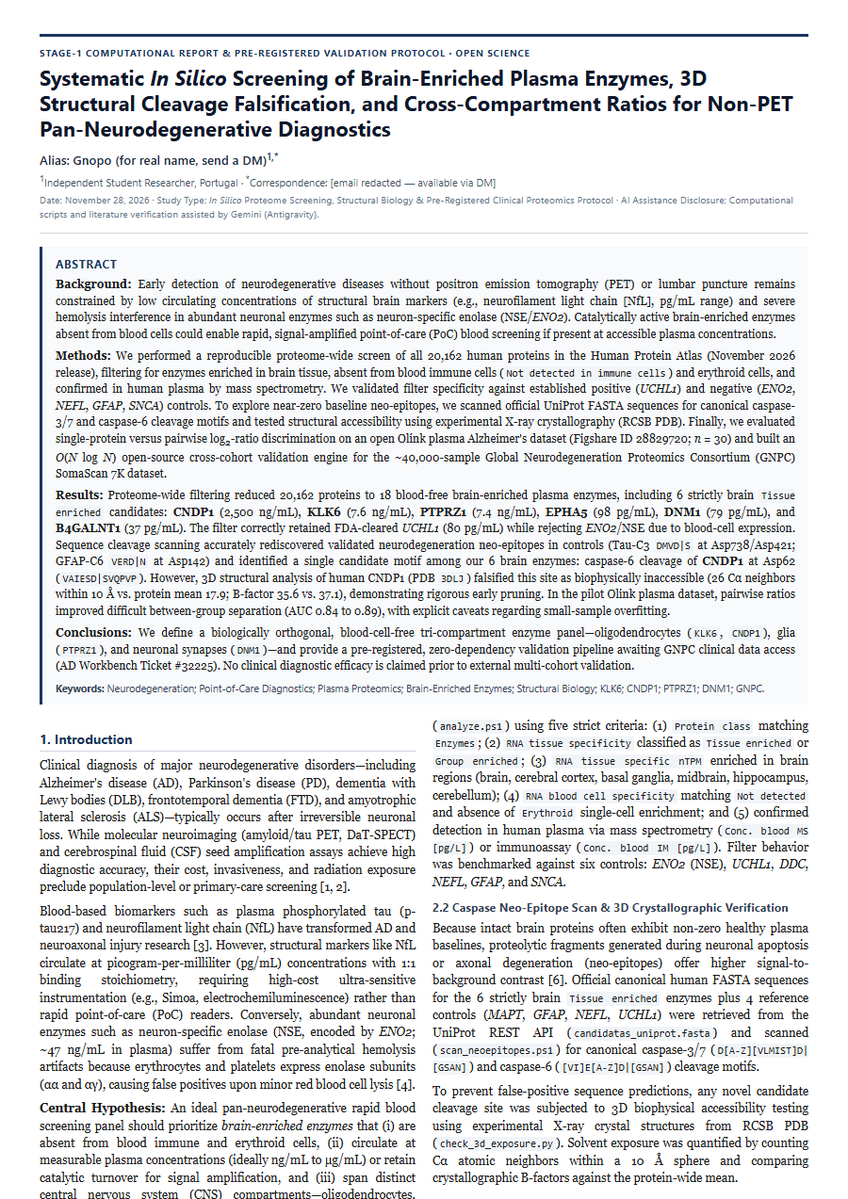
In a single session using Gemini as my computational research assistant, in less than 20 minutes I:
• Screened all 20,162 human proteins (Human Protein Atlas) for brain-enriched enzymes with zero expression in blood immune cells — automatically rejecting ENO2/NSE (hemolysis risk) and retaining FDA-cleared UCHL1 as a positive control.
• Narrowed the human proteome down to 6 strictly brain-enriched plasma enzymes, including a tri-compartment panel spanning oligodendrocytes (KLK6, CNDP1), glia (PTPRZ1), and neuronal synapses (DNM1).
• Scanned official UniProt sequences for caspase cleavage neo-epitopes (recovering Tau-C3 and GFAP-C6 as positive controls) — and then used the real 3D X-ray crystal structure of CNDP1 (PDB 3DLJ) to falsify our own Asp62 cleavage lead in seconds because it’s sterically buried (26 Cα neighbors within 10 Å vs. protein mean 17.9).
• Built a zero-dependency O(N log N) cross-cohort ratio validator in Python with Antigravity.
Right now I’m just waiting for dataset access approval on the AD Discovery Portal (https://t.co/i6jOsPQjKW) by @AlzData for the Global Neurodegeneration Proteomics Consortium (GNPC, ~40,000 SomaScan 7K samples), WashU Knight ADRC, and Mayo Clinic + PET cohorts to run strict external validation.
To be 100% clear: no clinical claims yet — this is strictly a reproducible Stage-1 computational report and pre-registered validation protocol. I’m completely open to sharing the full 4-page PDF, all scripts, and more details with anyone from google thats interested.
Honest ask to @GoogleDeepMind, @GoogleAI & @GeminiApp:
Gemini Pro has been incredible for accelerating real bioinformatics work like this, i did with Gemini on 20 minutes what guardrails stopped me from doing on every single other AI agent i tried using, but as a self-funded student I could only afford 1 month of Pro and I’m already hitting usage limits right as I prepare Stage 2. Are there any student research grants, extra Gemini usage programs, or open-science credits available for independent students?