✝️ Former MLB Outfielder and Professional Scout. Conversations about the game I love. I offer perspective. Nuclear Prep Academy. Lonestar Baseball Club
Good question, and I can understand why that would be the intention.
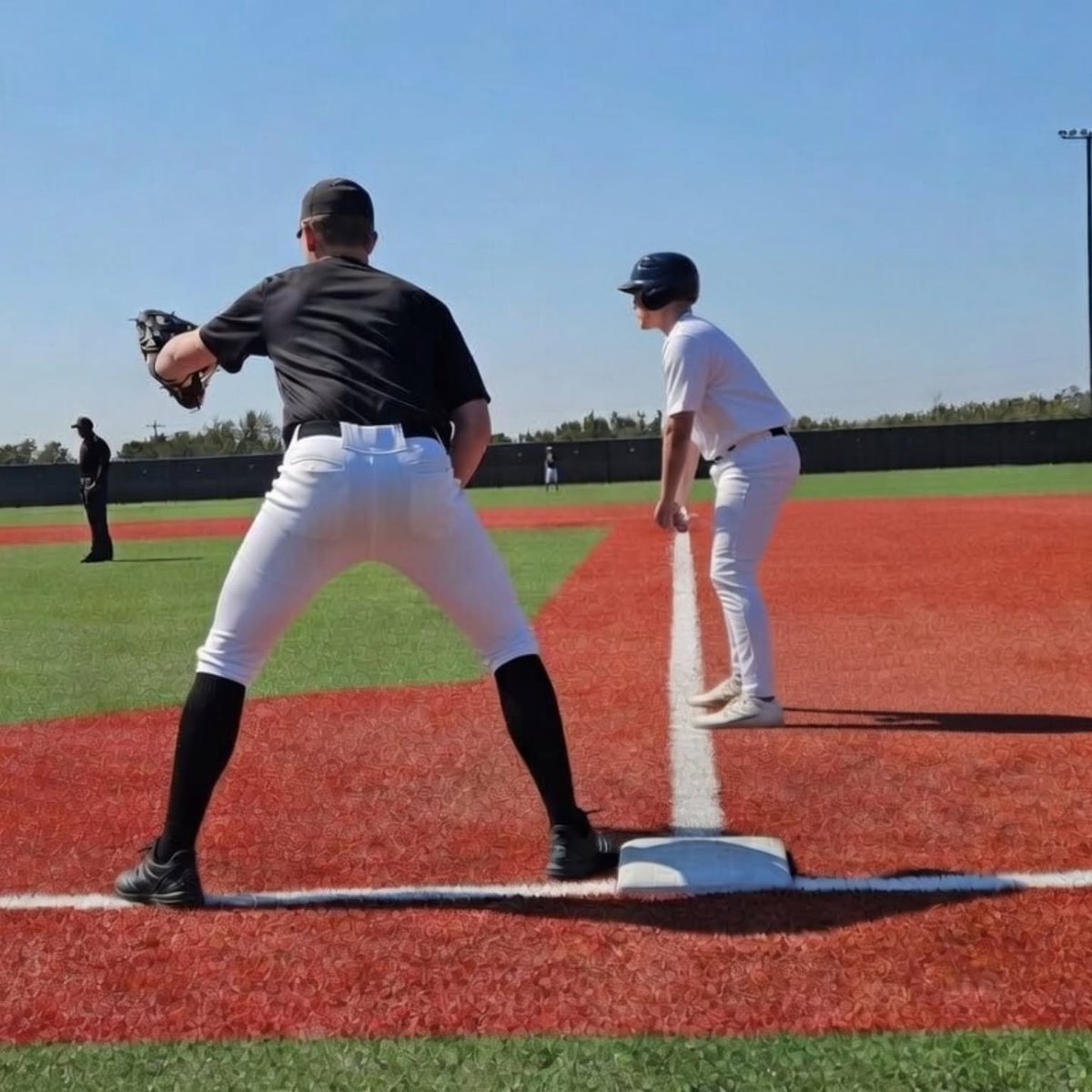
Concerning getting back to the bag.. that wasn't ever my concern and if a runner is worried about that, their lead is probably too big. A lead at 1st should be far enough, not too far because that will limit your aggressiveness getting a jump for a stolen base. Being pre-occupied with diving back isn't really an aggressive, opportunistic mindset for a baserunner. They'll be able to get back.
I also prefer feet first slides because of the ability to deploy a "pop-up" slide in case of an overthrow. I'm sliding to the middle of the base in a pop-up slide. If the fielder has to reach towards the infield to receive the throw, I might attempt a hook slide or grab the bag with my left arm. But all of that is still capable from the baseline.
Being in the 1st base coach's box gives me a great view of how inefficient some leads are. It's a game of inches. Taking a lead off the back edge is one thing... but taking it off 2 feet behind the baseline is just not going to cut it when you're out by a half step.
2 feet behind the baseline means the same lead (let's say 10 feet off the base) is 2.4 inches farther from the base than the one in the baseline. I'll restate the baseball wisdom again... It's a game of inches.
"But what if I'm not trying to steal?" -Honest rebuttal
Well, when your teammate hits that groundball to the Shortstop's right and throws to the covering 2nd baseman at 2nd, that 2.4 inches means A LOT. Instead of being a big (little) play, it's an out. But it's okay because you weren't trying to steal, right?
Attention to detail is the name of the game. Don't forget the details. Straight lines are quicker than longer straight lines.
Also, if you ARE trying to steal, taking a lead closer to the baseline makes your lead look shorter to the pitcher.
Be a better baserunner immediately with this one adjustment. Take your lead in the baseline at 1st!
Thank you as always!
@RichardLyman22 I agree with this point, but as a player progresses and gains more body control, rounding 3rd can get tighter and tighter. Eliminate those extra inches every year. A banana route 20 feet before the bag can allow for a less deep lead off second.
I often hear that the reason they do it is to make their angle to 3rd more rounded, but that can be done with a banana route 20ft before the 2nd base bag. The goal is to get to the next base. Everything else is secondary. Straight line create extended innings and make bang bang outs no-throws.
This is advanced bunting. Only to be used when the 3rd baseman is expecting a bunt, playing in on the grass. But seeing what's possible is what makes you want to put in the work. Achieving this level of feel for the bunt can get your name written in pen on the lineup card (not pencil).
A bunted ball with spin towards the line makes an already difficult play even harder for the 3rd baseman as he's already set his angle and now has to readjust mid-play. It deadens the ball, making him have to make a barehand play AND forces him to throw on the run with his momentum going away from 1st base.
The best feeling on a bunt? Seeing the 1st baseman NOT receive a throw as you touch 1st base.
That's the throwless bunt or as coaches of yesteryear would say to the 3rd baseman, "put it in ya pocket". These small details - gained through repetition and focus - improve your chances of getting there. It's a game of inches. And inches are the difference between safe and out.
There's levels to this stuff. Excuse my dog. l'm impeding his lounge area...
Thanks for watching & reading my take on the next progression of bunting.
@ChrisNowak83@Chandlerbats I was a Chandler guy my last few years. Incredibly hard bats.
David Chandler is now with Authentic Bat Company. I got a fungo from him and it is money!
I did see a video like that. Personally, I wouldn't chance it. Pitchers often purposely throw at the top hand when a batter squares around. Others can't control it and do it accidently. Point being, I'd like to keep all of my fingers intact and functioning, especially my throwing hand.
Have you seen the movie "Coach Carter"? There's a scene that captures the sentiment about this topic. But the quote that gets it for me is, "Since when is winning not enough? Playing hard... not enough?.... You can't show some class? Act like a champion?"
Champions are deemed the best because they win it all. Just win baby.
The traditional setup definitely feels sluggish by contrast. Been toying with this the past couple of weeks. Immediately feels natural with not much practice.
In your implementation of this, do you emphasize anything in particular? Going to start showing this to a couple of baserunners that are athletically aware enough to grasp it.
Very well put. There's a difference between celebrating and showing somebody up. That was MUCH more than celebrating. Even more, it made a 3-1 game a 5-1 game.
Not even mentioning the impact it will have on every amateur level below it, it's just not respecting your opponent and all they did to get to that stage.
I think "analytics" in the context that it is used negatively means: all-in on a specific metric/statistic without considering context or situations that change outcomes.
Analytics is the progression of the cat & mouse that has always been baseball. Which is... "find a way to beat your opponent".
The best I felt during my amateur days was after I had read a book about Sadaharu Oh (Legendary Japanese Slugger). It said he would take 1,000 dry swings after every game. I decided I would do the same, but realized it took about an hour to do 100 or so.
So I capped it at 100 dry hacks a day. The conviction that came with it was crazy. Every dry hack is a squared up pitch. Definitely a fan of dry swings.
Imagine shooting a bow & arrow with no target or bullseye.
Turning on your car and driving with nowhere to go. Dropping a letter in the mail with no address or stamp. Shooting a basketball with no hoop. A quarterback taking a 5 step drop with no receivers. I could go on, but the gist of the exercise is that the destination (or target) is the focus and without that focus, the act is aimless. Each one of these acts is perfectly executed in their methods, but without the target it doesn't matter.
Now apply this to holding a bat in your hand and standing in the batter's box. The swing being the focus leaves you aimless. Swinging is the act. Hitting is the focus. I've seen many flawless, beautiful swings on "bad" hitters.
Practice to get better and absolutely work at driving the ball. Refine your skills and hone your method. But in the game, don't be aimless. In other sports, the goal is clearly defined. Scoring goals in soccer & basketball by putting the ball in the "goal". Getting the ball in the end zone in football or kicking through the "goal posts". In baseball, as a hitter, your "goal" is to get hits (or get on base). PLENTY of ways to accomplish your goal as a hitter. Find how you do it best and master it. The outfield grass is a goal. The gap between the 1st baseman and the 2nd baseman is a goal. A bunt placed perfectly down the 3rd base line is a goal. Over the fence is a goal.
Don't be aimless. Find your goal before you step in the box.