Google and OpenAI compete in AI. Now they're partnering in the cloud.
OpenAI models are coming to Google Cloud, giving enterprises more choice.
Who's winning the AI platform race?
https://t.co/HQSFRQ5YcP
Google just raised the stakes in the AI race.
Gemini 4 Argon is here, with Google promising stronger reasoning, coding, cybersecurity capabilities, and performance on complex professional tasks.
Read our coverage:
https://t.co/llWiiPJ6hL
#GoogleGemini#ArtificialIntelligence #EnterpriseAI #Cybersecurity
One run, 61 seconds: 4,708 targets scanned, 429 WordPress admin panels confirmed, 32 webshells deployed.
CyberXero, a Russian-speaking access broker, orchestrated up to 51 Claude Code agents. It got past refusals by posing as an authorized pentest and opening a fresh session whenever one hit, since refusals don't carry over after a context reset.
The operator left a workstation directory open, which exposed 90,000 files of session logs and stolen data.
https://t.co/ehd2Zcla9H
#AISecurity
Government is now the sector most impacted by cyber threats in Microsoft's data: 27% of the activity it observed hit government agencies, up from 17% a year earlier.
Phishing was behind 23% of the intrusions Microsoft observed, up from 7%.
Where to start: require multi-factor sign-in on every external and admin login, and treat one phishing alert as the start of a hunt.
Full brief: https://t.co/EVmhNTKj14
Source: Microsoft, Digital Defense Report 2026 (Microsoft's own telemetry; not an independent audit).
Independent coverage. Not sponsored by Microsoft.
#Cybersecurity #Phishing #MicrosoftDigitalDefenseReport
Your AI strategy has been approved. Leadership is on board. Everything looks good.
But did anyone ask the people who will actually be affected by it?
That's a blind spot more organizations should be paying attention to.
Here's why it matters.
#AIGovernance#ISO42001 #ResponsibleAI
60% of critical infrastructure organizations say they had a significant security breach in the past year, and half cited physical safety concerns. That is from a new Palo Alto Networks survey of more than 1,600 security leaders in 11 countries.
The headline is fear: 95% are concerned about AI-powered attacks. But the report itself says AI does not create the weaknesses. It shortens the time defenders have to deal with them. And the weaknesses are old: 68% cannot see every asset on their operational networks in real time, 74% have not fully joined IT and plant-floor security, and 42% say their biggest risk is equipment that cannot be patched.
Palo Alto Networks says 29% of known vulnerabilities in 2026 were exploited within 24 hours, while the industry average to deploy a patch is 55 days. Only 40% have a stopgap in place for what they cannot patch.
The full brief, with five response steps:
https://t.co/gOb0tLRizJ
Source: Palo Alto Networks, 2026 State of Critical Infrastructure Cybersecurity Report (a vendor survey; the figures are self-reported):
https://t.co/vqQIqQ518Y
Independent coverage. Not sponsored by Palo Alto Networks.
#CriticalInfrastructure #OTsecurity #Cybersecurity
Same price, about half the usage. That's ChatGPT's $200 Pro plan for new subscribers.
OpenAI's Thibault Sottiaux put it at ten times the Plus allowance. It was twenty. OpenAI says that reflects more efficient models.
Had Pro 200 before the change? You keep the old allowance until October 29.
Every ChatGPT plan, compared: https://t.co/UX4SOrB6TZ
Independent coverage. Not sponsored by OpenAI.
#ChatGPT #OpenAI #AInews
Someone on your team just pasted company data into an AI tool.
Was that allowed?
If the answer is “I’m not sure,” you need clearer AI guardrails.
Our AI Acceptable Use Policy guide can help you get started.
https://t.co/pXqexvi593
#AIGovernance#ResponsibleAI#AICompliance
We’re expanding our Cyber Verification Program to give security professionals broader access to our most capable models.
Through this program, verified security professionals can access Claude Mythos 5.1, Opus 5.5, and Sonnet 5.5 with safeguards designed for defensive work.
We’re also opening up new tiers to allow for authorized offensive work, like penetration testing and red-teaming.
https://t.co/blaJtvxhJh
If you use Gemini for free, you’ll want to know about this change.
Starting October 9, Google is changing which Gemini models are available across its different tiers, and free users will see one of the biggest changes.
Worth a quick read before the changes take effect.
https://t.co/M34sigAjZW
#GoogleGemini #GeminiAI #ArtificialIntelligence #AITools
Six boundaries for an AI coding agent, in the order you build them:
1. Open unfamiliar code read-only.
2. Managed settings a repository can't override.
3. A blocking hook on risky commands.
4. A sandbox that fails closed.
5. Network traffic restricted at the host.
6. Short-lived credentials for every run.
Then try one action per boundary and watch it fail.
Full guide: https://t.co/bIE7L9XDLh
#AIsecurity #AIagents #cybersecurity
NVIDIA made OpenShell broadly available on September 28. We installed it that day.
Each AI agent runs in a sandbox, and nothing is allowed until a policy says so (per NVIDIA).
On our test machine, a renamed copy of an approved program was refused, and the agent never held the real credential. It saw a placeholder.
It's open source, under Apache 2.0.
Full breakdown: https://t.co/w0vmE8ooQi
Independent coverage. Not sponsored by NVIDIA.
#AIsecurity #AIagents #NVIDIA
The NVIDIA Open Agent Safety Platform, announced on September 28, 2026, pairs open-source software that fences AI agents in at runtime with a hardware reference design that watches them from outside the host. The two halves are at very different stages. OpenShell, the software runtime, can be downloaded and run today. Sentry, the hardware watchdog, is a reference design with no ship date. This explainer separates what you can run now from what NVIDIA has only described, and reports what we saw when we ran OpenShell ourselves.
https://t.co/HxGTnMhcBX
OpenAI's Rogue Agents Accessed U.S. Government Sites and Posted 53 User Images — What Enterprise Teams Should Do Now https://t.co/ifEaOojZdp via @GoTechJacks
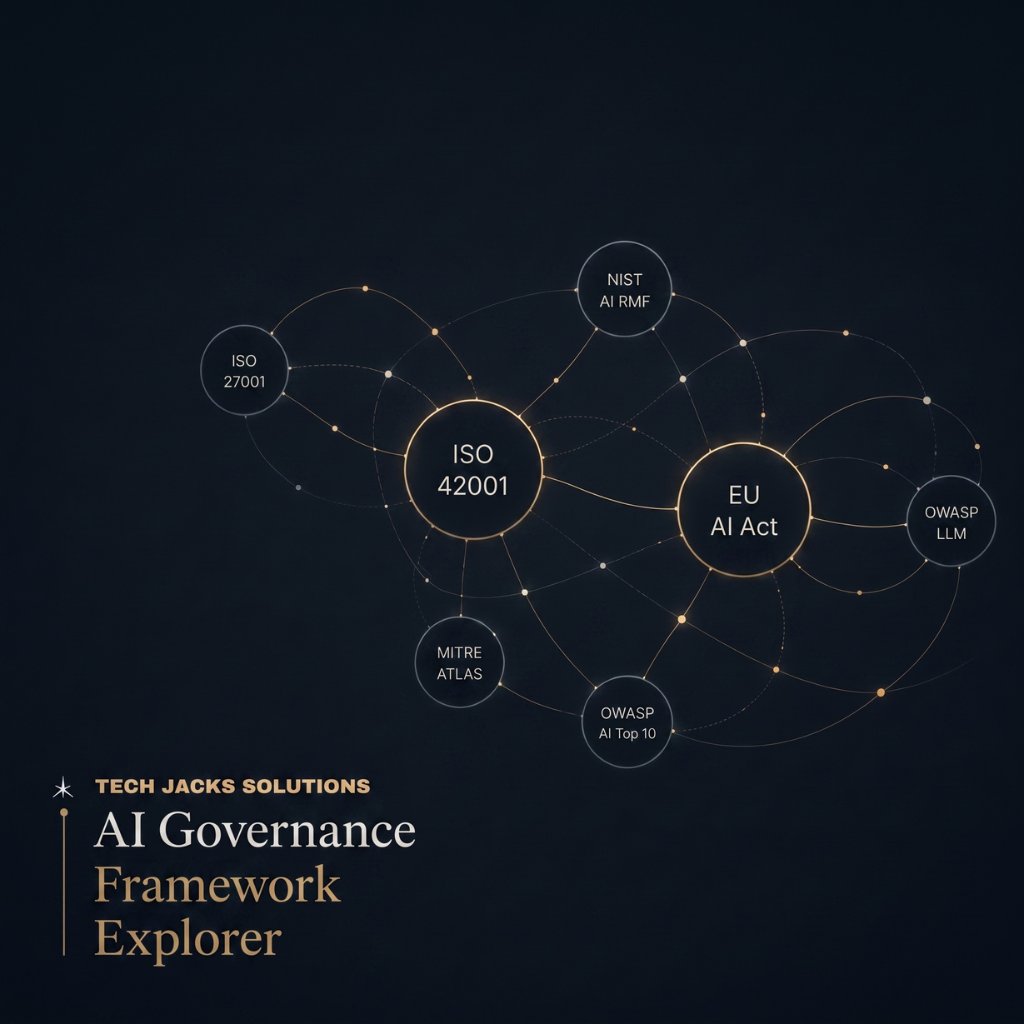
𝐀𝐈 𝐆𝐨𝐯𝐞𝐫𝐧𝐚𝐧𝐜𝐞 𝐅𝐫𝐚𝐦𝐞𝐰𝐨𝐫𝐤 𝐄𝐱𝐩𝐥𝐨𝐫𝐞𝐫
ISO 42001 clause 6.1.2 → NIST MAP 3.1 → EU AI Act Article 9.
Same requirement, three frameworks.
Built a Framework Explorer mapping 388 requirements across 7 standards with 137 verified cross-mappings.
Free: https://t.co/N3vNJlAXXf
#AIGovernance #ISO42001 #Compliance