Researchers using microprisms: I am planning to place an order from FST for 1.5 mm wide diamond knives with a 30 deg point (similiar to https://t.co/ykbxnWGuKg but with a 1.5mm wide blade), but there is a minimum lot number. Anyone else interested in purchasing one? Let me know!
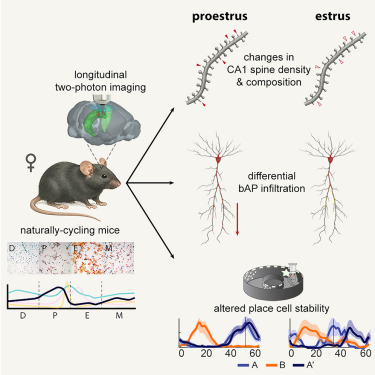
Very happy to see a Transmitter (@_TheTransmitter) piece on our recent work on estrous cycle modulation of hippocampal structure and function. Thanks to Sydney Wyatt (@sydney_elise44) for covering the work and its context: https://t.co/dLikIGWFFV
Very surprised (but very excited) to announce that I’ll be officially starting as an Assistant Professor at Johns Hopkins in the Electrical and Computer Engineering Department @JHUECE and as part of the new Data Science and AI Institute @HopkinsDSAI in July 2026!
And a huge congrats to lead author and soon-to-be PhD Nora Wolcott (@NoraWolcott). Nora was the driving force behind this project, and it couldn’t have happened without her. She’s moving to Harvard soon to start her postdoc with Bob Datta, can’t wait to see what she does next!
🚨Very excited to share a new paper from our lab in Neuron (@NeuroCellPress), on the influence of the estrous cycle on structural and functional plasticity in the hippocampus: https://t.co/QVpjDCaEWU
Thread below:
I wanted to close with a big thanks to my spouse and (first-time) co-author Emily Jacobs (@emilyjacobs) for sowing the seed of this idea many years ago.
Excited to have our paper “Robust variability of grid cell properties within individual grid modules enhances encoding of local space” officially out in @eLife ! Really fun collaboration with co-first author @s_acosta_4, @weixx2, and @GoardMichael https://t.co/E0TJYjBKcq 1/
This was a very challenging review to write, but was also a lot of fun due to working with thoughtful co-authors Dylan Martins (@dmmartins), Joy Manda, and Phil Parker (@CosmouseVision).
When we enter a new environment, we use visual input to rapidly build an internal model of the local spatial environment. How does our brain do this? We review past literature and suggest some new ways forward in our new review in @CurrentBiology: https://t.co/tS5ZB8TXGa