📢 We’re Hiring! Doctoral Researcher (f/m/d) – Labor Economics & Data Science
💡 Are you interested in how global megatrends are reshaping labor markets?
📈 Do you have a background in Economics or related STEM field?
🖥️ Do you enjoy working with large-scale data, combining econometrics + data science methods? hashtag#ML hashtag#NLP
If you answered 3x "YES!" and want to develop your dissertation around above research agenda – then this could be the perfect opportunity for you:
We at the @IHS_Vienna are looking for two Doctoral Researchers to join my team in the newly established Junior Research Group "Skill Demand during Structural Change".
At IHS, we offer:
✔ Comprehensive mentoring and support for your PhD in Economics
✔ Dedicated research time and international collaboration opportunities
✔ A vibrant research environment with excellent opportunities for further career development – and all of that in the heart of Vienna: one of the world’s most liveable cities (https://t.co/BM1x6CIUMn)
✔ Flexible work arrangements in a family-friendly institute
📅 Application deadline: March 7, 2025 ([email protected])
📍 Location: Vienna, Austria
💰 Salary: €2,684 gross/month paid out 14x a year (30h/week)
🔍 More details & application: https://t.co/ox1aN1WqfG
📩 Questions? Feel Free to DM or Reach out to me: [email protected]
If you or someone in your network is interested, feel free to share or tag them! RTs also appreciated🙂
🚨I am recruiting a *Full-time Predoc* to work with me at @MITEcon
Looking for people who are curious & driven to work on exciting (at least to me!) questions in labor: imperfect competition, institutions, inequality
Deadline: Feb 20
Apply here: https://t.co/rex0ab8WOi
Was macht den Exzellenzcluster @ECON_tribute aus? Die Verbindung von herausragender Grundlagenforschung und der Anwendung in Unternehmen, bei der Gestaltung von Märkten und im öffentlichen Diskurs über Fragen der Wirtschaftspolitik, schreiben @christianbaye13, @fixbierbrauer, Axel Ockenfels und @MattSutter_MPI. Demnächst in @PerspektivenWP. Mehr Info👉https://t.co/mcR5MyKVgC (1/4).
TGIF! Und nur noch 6+ Wochen bis zur #BTW2025. Niemand kann es sich leisten, jetzt auch nur annähernd apolitisch zu werden. Ich möchte das Gegenteil sein. Und es gibt ein Thema, das die gesamte Debatte überschattet: Migration. Dieses Thema richtig anzugehen, birgt die größten...
This is a thread about remaking the tech sector.
Silicon Valley still claims the mantle of “disruption”, as if it is made up of competitive small companies rushing to innovate in order to edge into established industries. The truth is that Silicon Valley is now home to the largest corporations humanity has ever seen. At the beginning of the 20thcentury, when US society and lawmakers were alarmed about the growing power of “trusts” (large corporations), the two leading companies, Standard Oil and US Steel, had market capitalizations of around $1 billion, which in today’s currency would be worth about $32 billion. In comparison, Alphabet/Google’s and Amazon’s market valuations are hovering around $2.3 trillion, Apple’s is above $3.6 trillion, and Microsoft’s is close to $3 trillion. Today’s tech giants also have revenues that are more than 100 times those of early 20th century trusts, including Standard Oil and US Steel.
Tech boosters might argue that this is because of the innovativeness of these companies or an inevitable consequence of network economies, generating winner-take-all dynamics for companies that acquire the biggest clientele or the largest amount of data about users. The truth is more nuanced.
Tech companies have been innovative. Nevertheless, there is recent evidence suggesting that they have done so by employing a large fraction of the supply of innovators and scientists, and once an innovator starts working for these large corporations, they are less innovative than they used to be in smaller companies: https://t.co/oCQB8fiSIO
Worse, tech giants have also grown their size partly by aggressively acquiring rivals: https://t.co/tLqm9SMnYg
Numerous acquisitions, like Facebook’s purchase of Instagram, did not just help tech giants grow rapidly. They may have also extinguished competition:
(see https://t.co/rhaXwQZ5un
or https://t.co/9ThJKxA2Zi also https://t.co/FP97beQ5cP
for the contrary view).
My overall assessment from this evidence is that these companies have grown so much at least partly because of a failure of antitrust in the United States and Europe.
A tradition dating back to US Supreme Court Justice Louis Brandeis recognizes that a failure of antitrust will not just mean higher prices for consumers and bigger distortions. It would also pose a challenge to democracy, as these companies wield oversized political and social power. This is what we have to come to accept as normal today, with the tech sector becoming the second-largest vendor on lobbying in the United States (after pharma) and the values and viewpoints of Silicon Valley dominating every part of our social lives, including unfortunately journalism. (The data on lobbying expenditures come from Open Secrets, https://t.co/hKROnmVGEm).
Two key antitrust cases against Google’s monopoly in advertising on the two sides of the Atlantic could reshape the web and in the process kickstart a turnaround in antitrust philosophy and practice. (See https://t.co/6HVP4stCBY https://t.co/UfvQWlxjax).
It is about time.
The background to the story is very well known. Digital ads dominate the web, and Google/Alphabet dominates digital ads (with Meta/Facebook being a distant second). The question is whether this state of affairs reflects Google’s amazing innovativeness in AdTech (the marketplace for digital advertising) or whether it also reflects the company’s monopolistic abuses. Lawmakers on both sides of the Atlantic are converging to the latter interpretation and are accusing Google of abusing its market power to generate monopoly profits and harming consumers, publishers and competition as a result.
US judge Amit P. Mehta ruledin August that Google had illegally monopolized the search engine market, among other things, by paying billions to be the default search engine on various platforms. After years of tech giants consolidating their hold over key markets, this could be a first step towards limiting this growth or even a prelude to a series of breakups.
True, the incoming Trump administration has promised to be much more friendly to various parts of the tech eco-system, and especially to artificial intelligence (AI) and crypto currency. Nevertheless, there is no love lost for Big Tech among some Trumpers. VP-in-waiting JD Vance, for example, recently praisedthe current head of the FTC, Lina Kahn, who is partly responsible for reenergizing anti-trust in the United States: https://t.co/wXGiWnjZ4X
Next will be Europe’s turn. EU moved early against Big Tech, fining them for competition breaches and passing the Digital Markets Act and Digital Services Act. Yet the tech sector is as consolidated as ever and European consumers are still dependent on these mega platforms. EU could take a more decisive step towards ending the dominance of these tech companies with the Google AdTech case.
The root problem is Google’s overwhelming dominance of the entire AdTech ecosystem, which enables the company to act simultaneously as buyer, seller, and market-maker in an industry worth over $800 billion today and projected to grow to $2.5 trillion in the next several years: https://t.co/C2bVE0j4Gk
Google’s control over the entire market leaves advertisers and publishers with little choice but to accept its terms.
This dynamic has been ruinous for many industries, including journalism. Independent publishers are a cornerstone of any democratic marketplace but can no longer survive squeezed by Google. In 2023, Google accrued 237 billion dollars from its AdTech monopoly, while the revenues of independent publishers and newspapers have declined. As a result, we have a new phenomenon: news deserts, which are areas where communities lack access to credible local news sources, once again damaging democracy and civic citizenship: https://t.co/N9l5kxQjVq
Big Tech defenders have historically claimed that breaking up these companies will harm consumers, slow innovation, and lead to economic stagnation. But monopolies are typically bad for innovation. If the AT&T monopoly wasn’t broken up in 1982, the digital and then the subsequent Internet revolutions may not have taken place. Why should the dominance of today’s Big Tech be any different?
Breaking up tech giants wouldn’t by itself be sufficient for a competitive marketplace in new technologies. In the US, bipartisan draft legislation proposes structural firewalls to prevent companies from operating on both sides of the AdTech market. Portions of the Digital Markets Act mandates ad transparency. If adopted on both sides of the Atlantic, these measures could help but are not sufficient.
I have argued repeatedly that the key challenge for today is to innovate in new technologies that provide better information and services to consumers and create new tasks and productivity-enhancing for workers: https://t.co/BDTTrAAOWI
Yet, such technologies are unlikely to be forthcoming rapidly when digital ads are the only game in town and most of the revenues online are from digital advertisements. This isn’t just because of the social negatives of massive data collection and the attention economy undergirding huge digital ad revenues, which are now well understood. It is also because the current structure is anti-competitive.
New companies experimenting with new technologies and business models are at a disadvantage relative to big platforms when they can only raise revenues by monetizing data via digital ads, because they have less data than established incumbents. Worse, as unknown quantities, they cannot develop new business models based on subscription fees or sales of new services when leading platforms are making money using digital ads.
One way of breaking this cycle is to impose a sizable digital ad tax in order to increase competition in the online economy, as Simon Johnson and I have argued. We proposed a tax of 50% for all ad revenues above $500 million a year, which EU can unilaterally impose, changing the whole digital game at one fell swoop: https://t.co/bdbh6oqWZT
Other reforms are also necessary. The future of the Internet and AI is entangled with creating a fair data economy, as a new report under the auspices of the Project Liberty Institute argues (to which I also contributed): https://t.co/37DVHtvXUu
To make such an aspiration a reality, we need new laws that simultaneously protect the privacy of individuals and lay the foundations for more inclusive markets, in which individuals and data collectives (or data unions) can control data, so that large platforms and AI companies cannot expropriate people’s information and the fruits of their labor.
I believe that this shouldn’t be bad for tech companies. The right architecture of data markets would ultimately help the tech sector by encouraging people to invest in and produce higher-quality data, which are a key input for more useful AI tools and more valuable online services. But there would be a lot of opposition from many tech companies today against any attempt to protect people’s data and introduce property rights over data.
Here, too, Europe can play the leading role, not only disrupting the current oligopoly in the tech sector but also taking steps towards a new, more productive, more competitive and fairer data economy.
How do unions and collective bargaining work around the world? And how do they affect the wage structure?
A new paper with Suresh Naidu @snaidunl and Benjamin Schoefer @Schoefer_B out as @nberpubs WP and prepared for the Handbook of Labor Economics.
Thread below. 👇
🚨 PUBLICATION ALERT 🚨
How are firms are affected by (longer) parental leave absences? Paper with @MathiasHuebener , @daniel_kuehnle & @jonasjessen is forthcoming at @EJ_RES
Anticipated, longer parental leave does not have a lasting impact on firms
https://t.co/lhVGOGZxhL
Nach Habeck-Berater @simon_jaeger stellt sich nun auch die Forschungseinrichting der Bundesagentur für Arbeit gegen das längere Kurzarbeitergeld. Aber wen kümmert im Wahlkampf schon die Einschätzung von Experten.... @iab_news
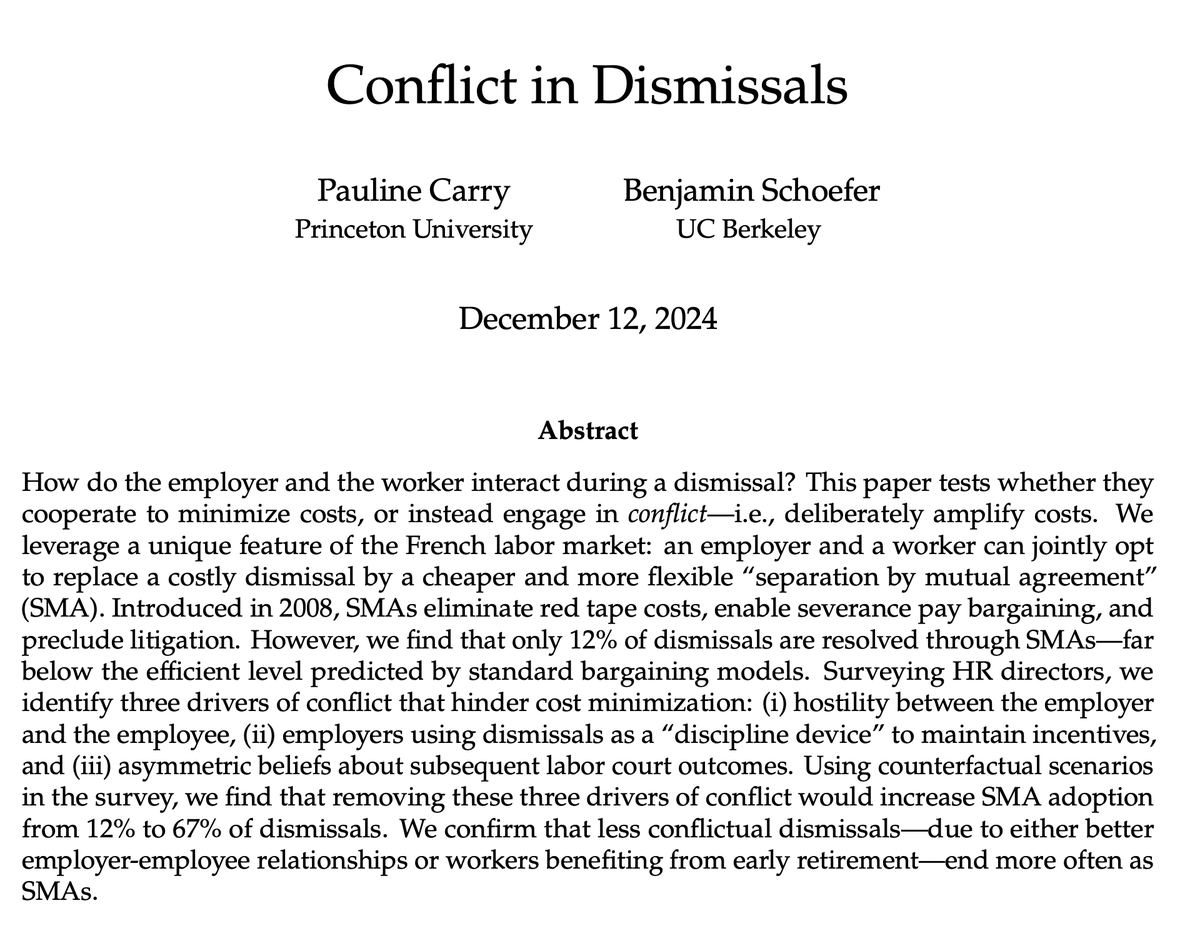
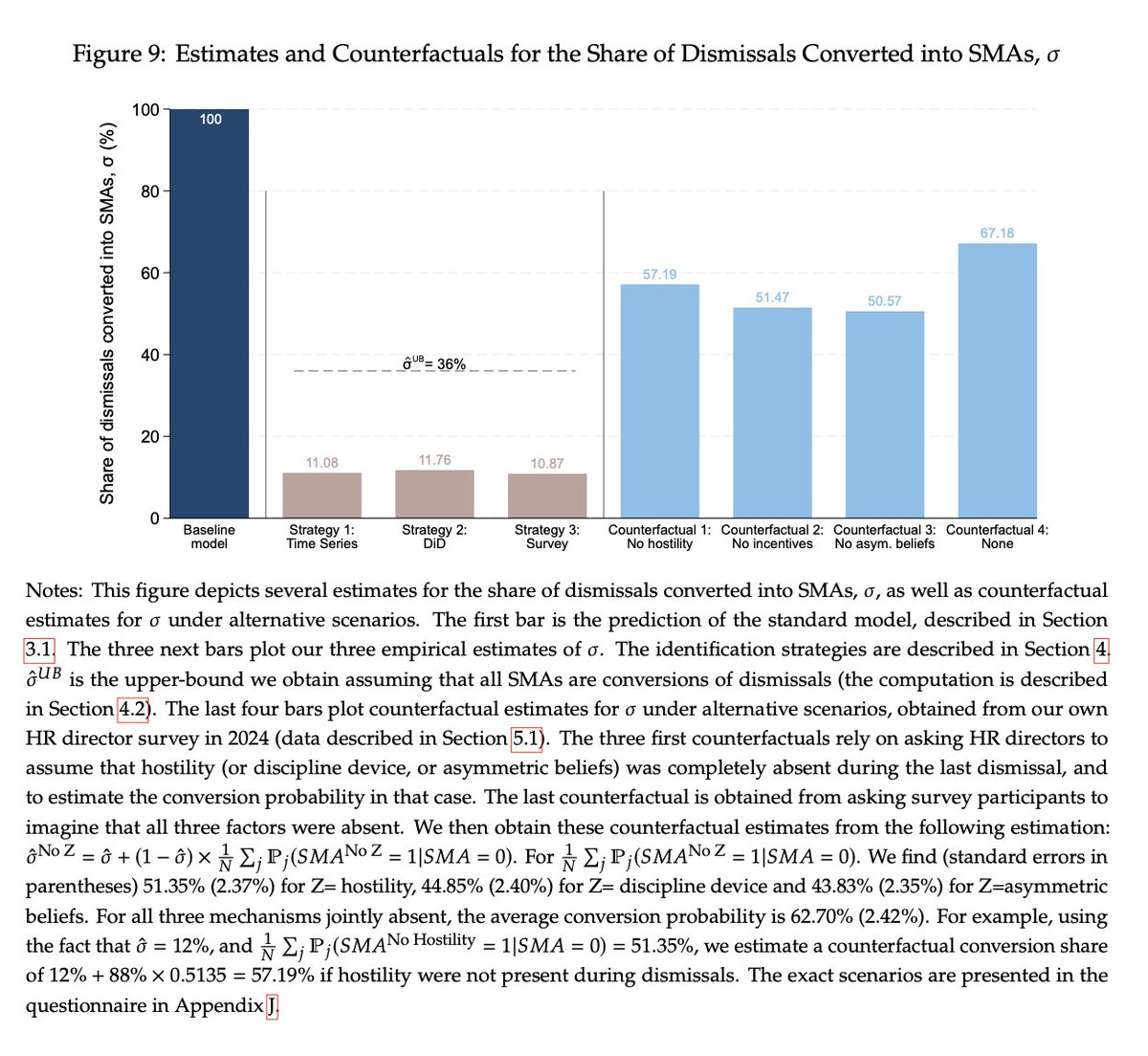
New paper w/ @PaulineCarry:
"Conflict in Dismissals"
We uncover & dissect the role & drivers of conflict in dismissals,
by studying failures to take up "cheaper" "separations by mutual agreement" in France.
NBER WP: https://t.co/DZwPIrtstG
Ungated PDF: https://t.co/qvgwEPI0kp
Sie hat es wieder getan: Die @BundesregDE verlängert das Kurzarbeitergeld. Leider schreibt die @tagesschau ohne Beleg, dass Kurzarbeit Arbeitsplätze sichern würde. Die wissenschaftliche Evidenz (@simon_jaeger@farzado) stützt diese Behauptung jedoch nicht.
https://t.co/0HHZzSQgyd
The amount of influence exercised by the highly educated liberal intelligentsia in shaping the conversations within the Democratic Party is probably the biggest barrier to making Democrats electorally competitive.
And I say this as one of those people.
Ein hervorragendes Interview in der @faznet von @JoPennekamp mit @DAcemogluMIT, der heute den @NobelPrize erhält. Auch jenseits der Tagespolitik spannende Einschätzungen zur Zukunft liberaler Demokratien und zum 🇩🇪 Modell, z.B. zur Mitbestimmung. https://t.co/Pdnlja5MTV
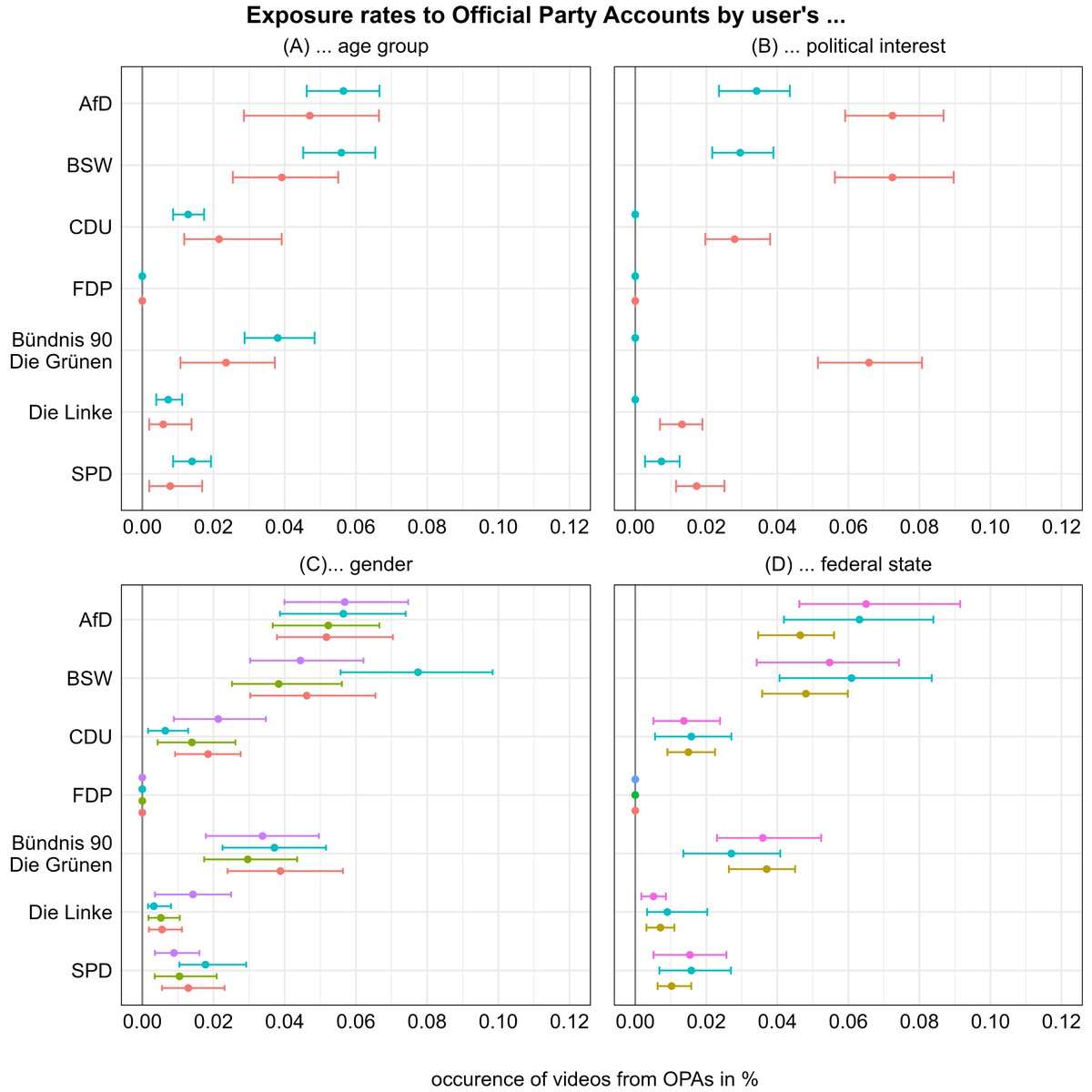
Our new working paper on #TikTok and #AfD is out. We present a data collection approach (algorithm audit) and apply it to German regional elections
1/3 on the main findings....
https://t.co/gKB4IqBaaU
Couples rearrange their time after having a child—but what happens to their relationship? My JMP w/@belenininina introduces a novel measure of relationship quality (RQ). We find a sharp, lasting RQ decline after birth, driven by shifts in household specialization. 1/11
Gender norms are extremely persistent and constrain women's life opportunities, especially so in poor countries. In my Job Market Paper, I show that grassroots media are an effective policy instrument to address gender norms at scale. #EconJMP#econtwitter
A thread about whether the global – and American – center-left needs a different kind of liberalism. These are thoughts triggered by Trump’s victory in the United States and the swing against mainstream incumbents in many other elections around the world.
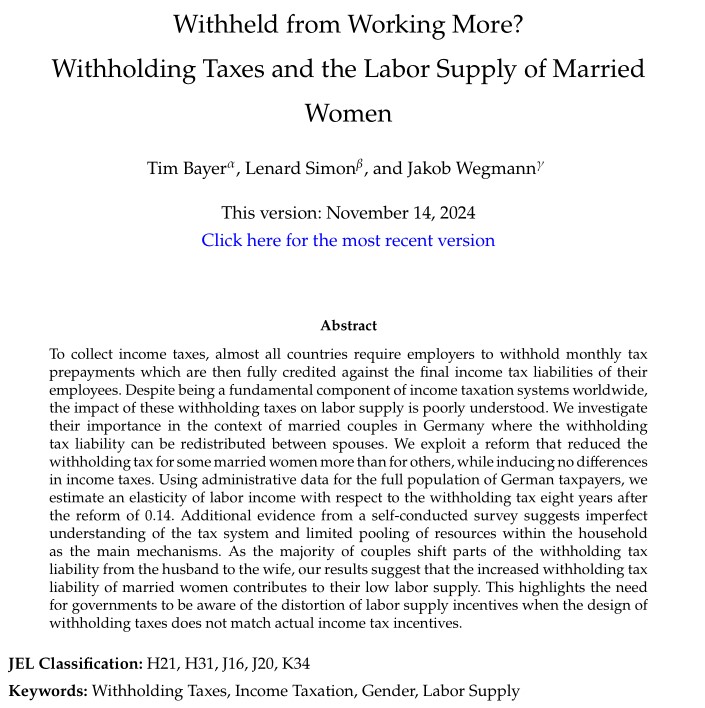
🎉Thrilled to share my #JMP🎉
It provides a missing piece to understand how people react to income taxation.
Tldr: By changing tax pre-payments governments can - with almost no costs - increase perceived work incentives of secondary earners.
Thread👇🧵 #EconTwitter
Excited to share a new paper w/ Matthias Mertens:
From Labor to Intermediates: Firm Growth, Input Substitution, and Monopsony
We document, dissect, understand, draw consequences of a new stylized fact about firm growth:
the shift from labor to intermediate inputs.
Summary:
A propos tariffs… It’s job risks, not cheaper goods, that shape how people feel about trade. Most doubt that trade has lowered prices on what they buy, but many see it as boosting the variety of goods available. See my paper on trade & summary here: https://t.co/fQh1yo7h2S