Asmongold couldn't BELIEVE what Rockstar was making him do in GTA 6, he GENUINELY felt like a COMPLETE CUCK getting DOMESTICATED for Lucia 😭💀
"I'm an actual CUCK simulator, I'm a little errand boy, bro. I went from working at Blackwater to delivering water, I'm getting domesticated now." 🤣
Jensen Huang was building an open AI ecosystem that threatened Anthropic's business model. His ouster changes the stakes of its IPO. https://t.co/MBgw0FhRFy
Jack Clarke of Anthropic was reportedly the one who leaked the Jensen Huang spy story to The New York Times.
The New York Times is controlled by the Jewish Ochs-Sulzberger family through the Ochs-Sulzberger Trust. As of March 2026, the trust holds approximately 94.6% of the Class B stock.
During Jensen Huang's recent October tour he publicly voiced support for open weight, locally run AI models, which was a direct threat to Anthropic and OpenAI.
This was also a threat to Israel's control over the entire AI industry, since they have their people in place at the head of Antropic, OpenAI and Palantir.
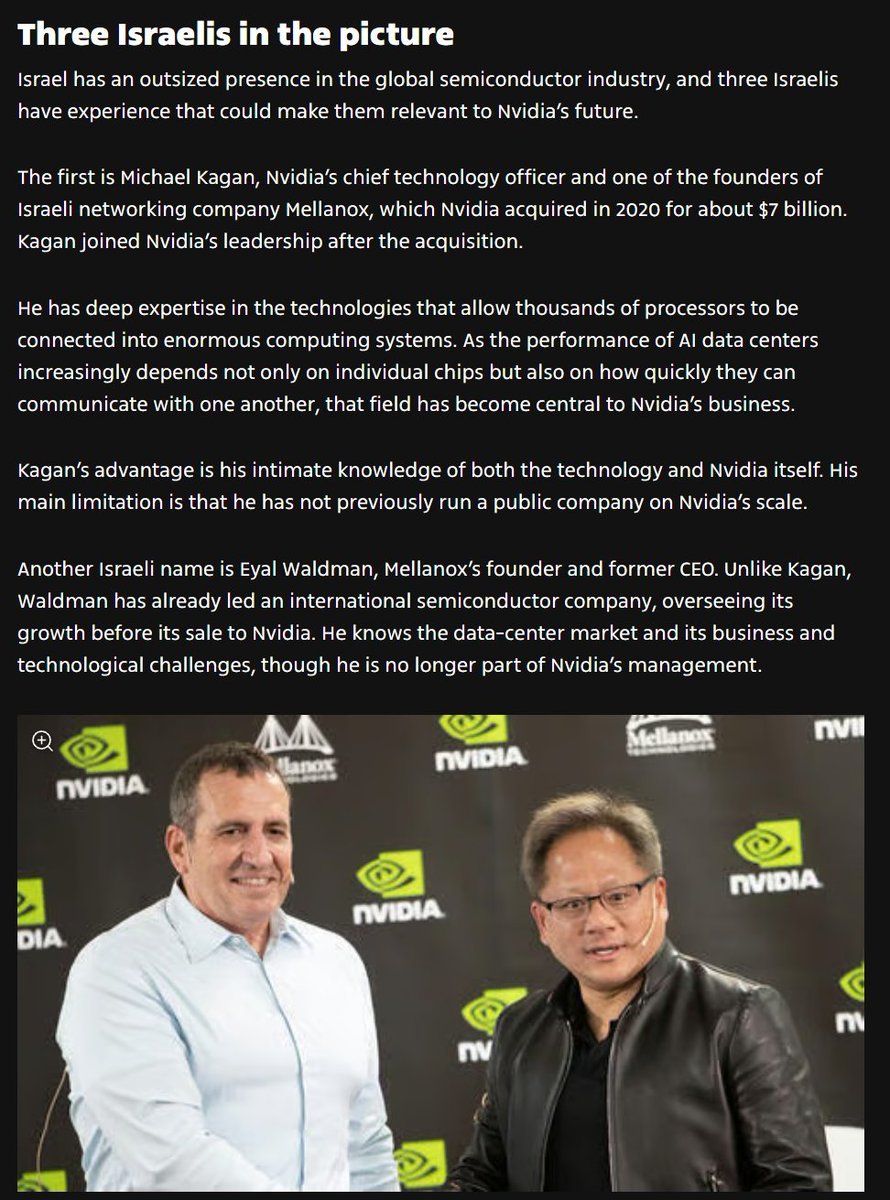
The media is already preparing the public by announcing "Meet the 3 Israelis who could inherit Nvidia's AI empire"
This was an Israeli psyop to oust Jensen from $NVDA and take control of the one company that threatened their control over the entire AI industry.
@adonispara You are 100% correct. They pushed me out when I turned 64 without severance with only a 30 minute notice. A few month later, when things started going to shit, they reached out to me to see if I might help. I told them GFY.
to be or not to be like Jensen Huang?
1963
- he was born in Tainan
1973
- his parents sent him to the US at 9 with his older brother to live with their uncle.
- his uncle thought he had found them a good boarding school, but it was a reform school in Kentucky.
- his daily job there was cleaning the toilets.
- his roommate was 17 and had knife scars from fights.
- Jensen taught him to read, and in return he taught Jensen to bench press.
- he also picked up table tennis there and got good enough to be nationally ranked as a teenager.
late 1970s
- his family reunited in Oregon.
- he worked at Denny's as a dishwasher and busboy while he was in high school.
- he skipped two grades and finished high school at 16.
1984
- he graduated in electrical engineering from Oregon State.
- his lab partner there was Lori, and he later married her.
- he went on to design chips at AMD and then at LSI Logic.
1992
- he finished a master's at Stanford while working full time.
- he started meeting two engineers, Chris Malachowsky and Curtis Priem, at a Denny's in San Jose to plan a company.
1993
- he turned 30 and they started NVIDIA.
1995
- their first chip, the NV1, flopped.
1996
- the chip they were building for Sega's next console didn't work either.
- he told Sega they couldn't deliver, and asked them to invest anyway.
- Sega put in $5M, which he later said was all the money they had.
- he laid off more than half the company, going from about 100 people to 40.
- for years after that, he opened meetings with "our company is 30 days from going out of business".
1997
- their next chip, the RIVA 128, sold 1 million units in its first 4 months.
1999
- NVIDIA went public at $12 a share.
- they launched the GeForce 256 and called it the world's first GPU.
2000
- Microsoft picked NVIDIA to make the graphics chip for the first Xbox.
2006
- they launched CUDA so their chips could do more than games.
2008
- the market didn't understand CUDA, and NVIDIA fell below $5 billion during the financial crisis.
2012
- AlexNet, the model that kicked off modern AI, was trained on 2 NVIDIA gaming cards.
2016
- he hand-delivered his first AI supercomputer to a small nonprofit called OpenAI.
2019
- he bought the networking company Mellanox for $6.9B.
2020
- he agreed to buy Arm for $40B, and regulators killed the deal in 2022.
2022
- the stock dropped about 50% that year.
- ChatGPT launched in November, trained on NVIDIA chips.
2023
- NVIDIA hit $1 trillion.
- when someone asked if he'd start NVIDIA again, he said "I wouldn't do it".
2024
- NVIDIA passed $3 trillion and briefly became the most valuable company in the world.
2025
- in July it became the first company ever to hit $4 trillion.
- in October it became the first to hit $5 trillion.
October 2026
- the NYT reported that he was close to a woman US officials suspect is a Chinese spy.
- NVIDIA said his dealings with her were "not unusual or unexpected".
November 2026
- 3 House committee chairs asked him to explain his ties to her in a closed-door briefing.
- 3 days later he admitted he had been unfaithful to his wife.
- the board opened an investigation.
- the NYT then reported a second alleged affair, with an NVIDIA executive who reports to him.
- the WSJ reported that the board was getting ready to push him out.
- the stock kept falling.
- on November 12 he resigned as CEO, 33 years after he started NVIDIA.
- within hours, NVIDIA lost as much as $600 billion in value, before closing the day down 4.3%.
- the same day, Reuters reported a third alleged affair, with another NVIDIA employee.
so, to be or not to be like Jensen Huang?
They’re going to bring him back soon anyway when the share price keeps dropping and the CFO they put in place isn’t cutting it.
Return of the Mack like Steve Jobs
This Jensen Huang thing is so ugly. Guy takes a company from zero to absolute pinnacle, through blood, sweat, and tears, a pure founder’s founder, great products, makes so many people rich beyond their imaginations, champions open free local AI, and then the incumbent modern managerial safetyist human instrumentality establishment collectively decides they want to rip it all away from him because they think they can “do better”.
😳💥 FULL FOOTAGE shows Usman Nurmagomedov landing loud slap and knees on Merab Dvalishvili, while his friend tried to hold him back.
Merab was shocked and couldn't believe what happened at first. https://t.co/FHplLHrSJs
In 2015, I built an AI that detects early cancer.
It’s still running across hundreds of hospitals in the US today.
It was the most fulfilling work of my life, and I was building in AI years before everyone called it “AI”.
Building in AI then was a dream.
Now It feels like we’ve taken a turn for the worse.
It started when i was in undergrad.
I built my first company: AI models that made the political data transparent to voters.
At 21, I was offered six figures for it, but the buyers wanted to use it for reasons I couldn't ethically support.
So we turned down the offer and shut down the company instead.
In 2014, I moved into deep learning research on language models, for the Intelligence Community and Goldman Sachs.
Then HCA Healthcare came to us.
They put me in a competition against 10 people from IBM Watson. It was just me and the tools I’d built.
Our job was to build an AI model that can catch the cancer that slips through the cracks in hospitals.
It was the most intense 30 days of my life. Multiple all nighters.
My models won. That turned into a $5M deal, and later its own company, Azra AI.
Then the world caught on.
ChatGPT and Claude arrived, and AI costs exploded.
Building in AI in 2015 felt novel.
We were using it to find cancer tumours and save lives.
Now the biggest tech companies have turned AI into a money extraction machine.
That’s when I decided to make a change.
We raised $8.5M to build a better future for AI.
On Wednesday, we’re launching Rayline.
AI shouldn’t be locked inside a few labs’ models, prices and clouds. It should be open, transparent and decentralized.
More on Wednesday.