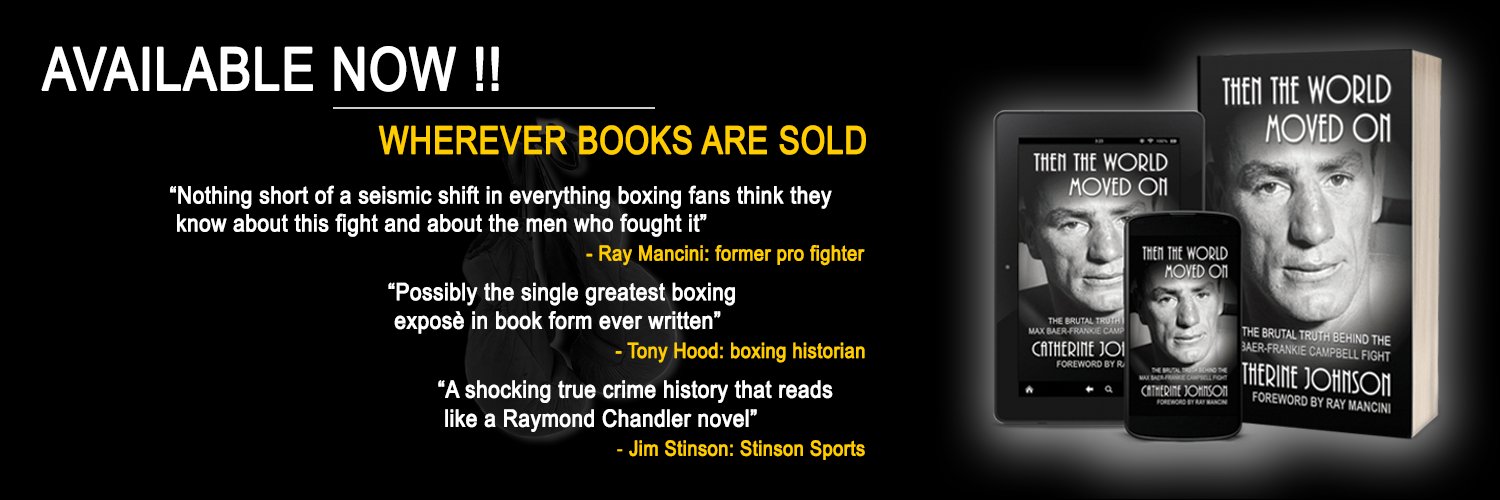
Almost a century in the making, my book on the truth behind the Baer-Campbell fight, exposure of the many myths about Max Baer, and the tragic life of Frankie Campbell, is now available globally. Amazon, Barnes & Noble, Google Books, Apple Books, Kobo, etc., and you can order from your favorite local/online bookstore too.
"Then The World Moved On: The Brutal Truth Behind the Baer–Campbell Fight" by Catherine Johnson, knocks boxing history on its cauliflowered ear, with the most painstakingly researched and scrupulously detailed book ever written about the tragic end of Frankie Campbell, and Max Baer's shocking hand in his death.
Preceded with a Foreword by Ray Mancini, the book chronicles not only Campbell's life and career, it exhaustively examines his fight with Baer, the resultant fallout and appalling coverup of the truth, and the horrific details of Baer's lies and manipulation of the event and its aftermath.
A variety of original source materials, never accessed by previous historians, and going back a century, were thoroughly investigated and meticulously pieced together, among them newspapers, court transcripts, medical records, genealogical, archival, federal, state, and local records, along with psychological analysis and brain trauma study, as well as interviews with Campbell's family members, former pro fighters, and boxing historians.
Along with over 1400 cited sources, over 150 rare photos, illustrations, and fight advertisements, the book also discusses the legendary men who made California a boxing mecca in the early Twentieth Century, and the popular venues where fights were held. Woven artfully into the narrative, is how the context of the times, the Golden Age of American Sports, the Roaring Twenties, Prohibition, and the Great Depression, affected the sport, and the lives of the men who molded the game.
@JoaoII168315@CorpasWriter He was notorious for weaving a good story that was light on facts. He liked to tell the dime store novel version not the truth.
@CorpasWriter It really is. @WilliamDettloff once pointed out that most fans favor the fighters of the era in which they grew up and care little for the past. Most of these Top 10 lists adhere to that then throw in a couple old-timers to seem legit.
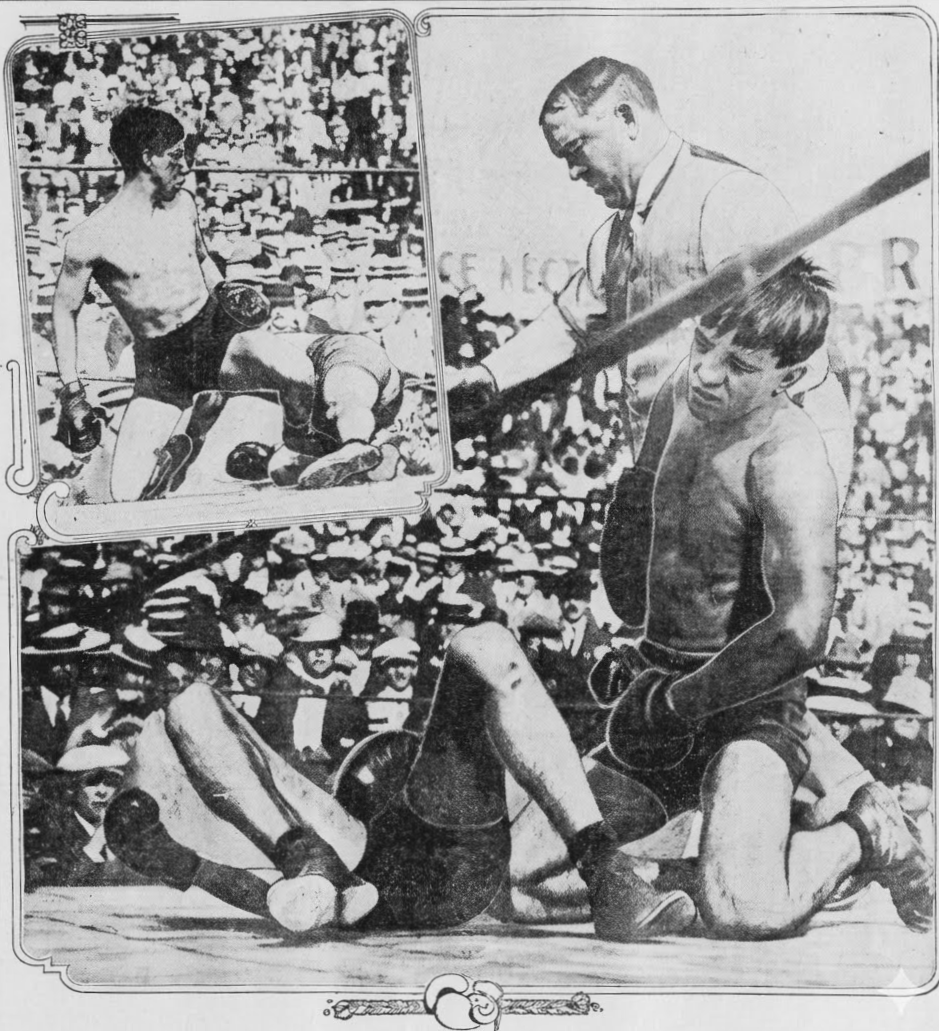
In one of the most bizarre and controversial title bouts in boxing history, on July 4, 1912, over 11,000 fans packed the stands of Jack Doyle's Vernon Arena just outside of Los Angeles under a blazing midday sun. "Mexican" Joe Rivers and World Lightweight Champion Ad Wolgast had battled for twelve grueling rounds. By the 13th, both men were thoroughly exhausted and bloodied. The fight had turned into an absolute war. While many onlookers felt Rivers had won most of the early rounds, Wolgast later fiercely disputed this, confidently claiming that he had Rivers completely licked and was dominating the pace.
As they clashed near the ropes, at the exact same fraction of a second, both fighters unleashed finishing blows. Wolgast slammed a punch directly into Rivers' midsection—which Rivers’ camp swore was a vicious low blow—while Rivers simultaneously landed a devastating right-left combination flush to Wolgast's jaw. Both men collapsed into each other. Because boxing rings back then used only two rows of ropes, they nearly tumbled out through the lower gap and into the crowd. As the fighters teetered on the edge of the ring apron, cornermen, nearby officials, and Wolgast's manager Tom Jones (who later managed Jess Willard) lunged forward to hold up the fighters and keep them from falling all the way out of the ring.
Instead of counting both men out, referee Jack Welch hoisted a semi-conscious Wolgast up off the floor with one arm. While physically supporting the champion, Welch used his other hand to count out a paralyzed Joe Rivers. Welch reached the count of ten and declared Wolgast the winner by knockout. He turned to shout at the rabid crowd that his actions were completely fair and stood as the final verdict. Furious, Joe Rivers' manager, Joe Levy, jumped through the ropes and physically confronted Welch. As an angry mob of fans rushed the ring in protest, Welch slipped through the ropes and fled the arena. Joe Rivers stood up and walked around seemingly recovered, while Wolgast had to be carried from the ring by his handlers.
Reporters the next day called the decision a disgrace to America's Independence Day. They openly insinuated that Welch had long been on Ad Wolgast’s team payroll. The press argued Welch had deliberately ignored the rules throughout the entire match by letting Wolgast use illegal tactics. Furthermore, the timekeeper, Al Holder, insisted the round's closing bell actually rang when Welch was only at the count of four. The fight should have officially gone to the next round, but Welch completely ignored the bell.
Jack Welch vehemently denied Wolgast had thrown a low blow, claiming it was a perfectly legal shot to the stomach that caused Rivers to collapse. However, three doctors who later examined Rivers declared that the severe bruising around his groin clearly indicated a low blow. Welch then argued that because Wolgast had started to rise from the canvas before the fatal ten-count, he had merely assisted a fighter who was already actively recovering on his own.
Wolgast didn't get to enjoy his stolen championship belt for very long. Just a few months later, on November 28, 1912, he defended his title against Willie Ritchie. Wolgast resorted to his dirty tactics again and hit Ritchie with two blatant, vicious low blows in the 16th round. But this time, referee James Griffin didn't play along. Griffin immediately disqualified Wolgast on the spot, stripped him of his title, and awarded the championship to Ritchie.
Once upon a time #OTD in 1930, a future heavyweight champ purposefully beat to death his opponent. Then he bragged about it. He lied and changed his story about what happened. He lied about his support of the dead man's family. He used that death as a public relations tactic for pity and support and to intimidate his opponents. So three years of solid research and 1400 solid primary sources later, I wrote a book about it. If you want to know the uncomfortable truths after a century of lies, check it out: https://t.co/aH0DWyVwlV
@dragonflyranch5@AncientHistorry This is similar to people I have 30-50 years on who tell me what occurred or how popular figures were thought of from the mid- to late-1900s when I actually lived through it. 🙃
@efreitabeth Excellent, thanks very much Elizabeth!! I lost the link to a wastewater by general region site I had last year. Something local and drilled down like this is even better.
@USFWS@CornellBirds Pffft! Your pals over at the FCC approving Reflect Orbital's mirrored demo satellite, with a later launch goal of 50,000 of them, are going to affect migrating birds and nocturnal wildlife ahelluva lot more than our porch lights. https://t.co/jfJqEWWhxV
On a whim, in early 2025 a fella in Iowa brought a painting he'd paid $20 for at a garage sale, to the Antiques Roadshow for appraisal. His 20-spot turned out to be this original painting by Robert Riggs called "The Fall Guy," done for a 1951 Saturday Evening Post article by sports journalist W.C. Heinz titled "The Fixed Fight."
In the story, an underdog fighter accepts a bribe from mobsters to deliberately throw a high-profile fight. Instead of taking a dive, the boxer knocks out his opponent to win the bout. Gamblers and fans, who had bet big on a sure thing, caused a riot after the match.
The fella in Iowa's Robert Riggs painting was appraised for $70,000-90,000.
@LWOSGarryWhite I'm deep into day to day research circa 1904-1910 so have been watching the rise of Nelson and Wolgast and the fall of Gans. Good gawd these fellas barely took breaks between fights and often racked up 20-40 rounds a month. Agreed, their ends were always heartbreaking.
Rare image of a young and unmarked Battling Nelson. He began his pro career at around 14 or 15 years old so this first image is possibly a promotional card from about 1896-1897. Based out of Hegewisch, a working-class, heavily industrial neighborhood on the far southeast side of Chicago, Nelson fought his earliest bouts in Chicago railyards, local athletic clubs, and small smokey local clubs. He wore no mouthguard, no rigid groin protection, and fought with 5 ounce horsehair-padded gloves. By the second image, taken in 1911 when Nelson was 29 years old, he had fought over 1000 hard rounds.
@efreitabeth Could I get a link to this please? Never can find a decent source for spikes in the county. FWIW I ask my doctors office when I’m there, usually every 1-2 weeks, about spikes in Rosa, and it’s been pretty quiet with cases presenting.
@marceelias What’s next? Not on Friday’s either so as not to jinx the hoodoo? Yes that was once a thing when potentially signing legal documents fell on a Friday.
The title says it all .... champion Jack Johnson was a notorious speed freak behind the wheel of his racing cars. This photo was taken during Jack's last week in Chicago before he boarded a train for California to continue training for defense of his title against James J. Jeffries in "The Fight of the Century," when the bout was still scheduled to be fought in the Golden State.