There are no baseball fields left in Greece. The youth leagues are gone. The only Greek-born player on the national team, Loukas Soukeras, is moving to Norway so he can even play baseball this year.
He's trying to bring the sport back to the country.
https://t.co/TzeItMI1PM
@DamonStrong Christine needs to be slapped with serious charges and convicted. Her interference, not following orders, etc. was a distraction to the officers and was a significant contributor to this incident.
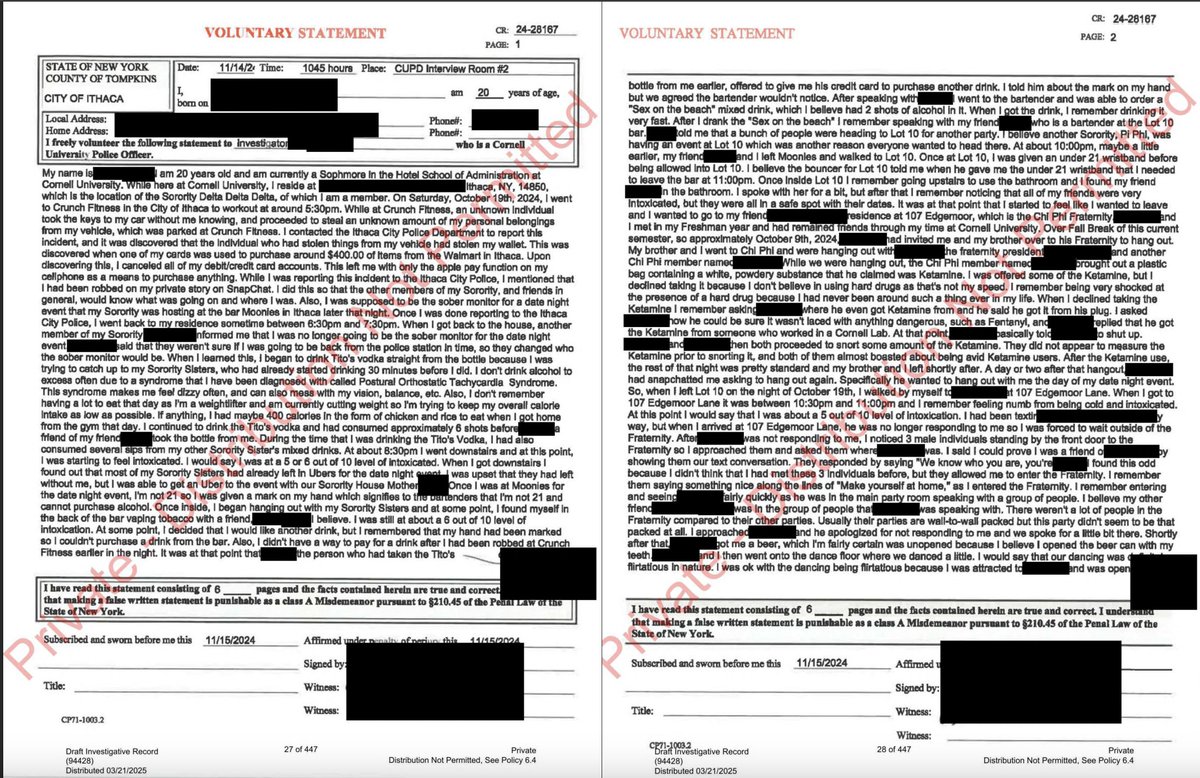
Cornell Case - Jane Doe's Full Six-Page Statement
Jane Doe's complete six-page sworn police statement provides substantially more detail about the night at Chi Phi than the excerpts previously made public.
Several details stand out.
Doe says she arrived at Chi Phi between 10:30 and 11:00 p.m. She had been to the fraternity before, knew several of the men, and describes a previous sexual encounter with Newell (I noted this in a previous post). She also recognized at least one of the men who entered the room later that night from her previous visit.
She recounts movement through the fraternity, conversations, sexual activity, drug consumption, people entering and leaving, and numerous interactions throughout the night.
There are also some details in Doe's statement that I find difficult to reconcile, particularly when comparing her descriptions of feeling trapped with her physical actions.
She recounts opening the bedroom door for Lopes while undressed after Newell explained that he also lived in the room. Why didn't she put her dress on before letting someone new into the room?
Later, when additional men entered, she describes hiding beneath the covers because she was naked, feeling unable to leave because the men were between her and the door, and being unable to access her phone across the room. She also explains that her bank cards had been stolen earlier, leaving her without money for an Uber.
Yet she also describes sitting up, exposing her breasts to yell at one of the guys, that her legs were exposed showing scars she had, then getting completely out of bed, standing naked in front of the men, and flexing her muscles. She says her intention was to intimidate one of them. At least two of the men's accounts also describe her flexing, laughing, and talking to the guys.
That raises questions for me.
If she was physically able to get out of bed and stand in front of the group, what prevented her from retrieving her dress and phone? And why did she feel emboldened enough to stand up and confront someone, but then felt too intimidated to approach the door?
Why didn't she communicate to Ingalls or Newell that she wanted to leave? And how does the text exchange with her roommate fit into that timeline?
I'm not suggesting that someone must attempt to escape or physically resist to establish that sexual contact was unwanted. They don't.
But when an account includes specific explanations for why someone felt unable to act, I think it's reasonable to examine those explanations alongside what the person describes physically doing.
I've now reviewed the DA's summary of her statement, the full six-page document, portions of her police interview, excerpts from Cornell's Title IX investigation, the 99-page hearing panel decision, and publicly released text messages.
I approached Doe's statement by separating her communication, physical behavior, and observable condition throughout the night, weighing her recollections alongside the accounts of the accused men.
What was communicated?
Doe describes multiple instances of verbal communication throughout the night.
She recounts men asking before initiating certain sexual acts, her responses, and occasions when she refused and the men stopped.
She also describes unwanted touching, a kiss she pulled away from, and feeling pressured into sexual activity.
The men's accounts in Title IX reporting provide another perspective. They describe conversations, checking whether she was okay, her communicating dizziness, and interactions in which they understood her to be participating voluntarily.
What was she physically capable of doing?
Doe describes a remarkable amount of activity over the course of the evening.
She recounts walking between locations, interacting with friends, drinking, consuming ketamine, participating in sexual activity, helping care for intoxicated men, moving around the bedroom, getting up naked and flexing, getting dressed, moving to another room, sleeping, and eventually leaving.
She recalls details about furniture, people, conversations, sexual acts, and the layout of the rooms.
The men's statements describe additional interactions and physical activity. These observations become important when assessing intoxication and capacity.
Doe estimates her intoxication at different points as 5/10, 6/10, and 8/10. She also describes being severely intoxicated and more impaired than she had ever been at the end of the night.
Those are subjective assessments, just as the men's descriptions of their own intoxication are subjective. They deserve consideration, but they must also be weighed against observable behavior and other evidence.
Without toxicology testing, reconstructing everyone's level of impairment will depend heavily on testimony, observations, and corroborating evidence.
What could the men reasonably have known?
This is where I think some of the public discussion has blurred important distinctions.
Doe describes feeling used in the moment, uncomfortable, isolated, angry, disgusted, and unable to make decisions. She recounts hoping she might pass out and thinking about the possibility of the men being charged with rape.
She also describes getting up naked in front of the group and flexing towards one of the men while telling him she would mess him up, explaining that her intention was to intimidate him. Her explanation provides insight into how she says she experienced the moment.
But what did the men actually observe?
Did they interpret her behavior as discomfort, intoxication, participation, or something else?
The men couldn't read her thoughts. Criminal responsibility cannot be established merely by assuming they knew what she was privately thinking.
That doesn't mean internal experiences are irrelevant, or that silence establishes consent. It means we must distinguish what someone felt from what another person knew, observed, or reasonably should have recognized.
INTOXICATION AND CONSENT
Everyone involved reportedly consumed alcohol or drugs to varying degrees.
Under New York law, voluntary intoxication alone doesn't automatically establish legal incapacity to consent. The degree and nature of impairment, and the applicable legal definitions, matter.
I also think the men's intoxication deserves consistent consideration. If ketamine could affect Doe's memory, perception, and judgment, it could also affect theirs.
That doesn't excuse criminal behavior, but it matters when evaluating inconsistent recollections.
CONTRADICTIONS AND EVOLVING ACCOUNTS
The full statement adds context, but it also raises additional questions when compared with Doe's later text messages, subsequent allegations, and the men's accounts.
Some believe those differences reflect a person gradually recognizing and processing sexual assault. Others question whether regret, shame, social pressure, or discovering that intimate details had been shared publicly contributed to her changing interpretation.
The same scrutiny should apply to the men's statements. Contradictions deserve examination, but they do not automatically prove deception.
WHERE I STAND RIGHT NOW
Based on the publicly available evidence I've reviewed, I have substantial questions about whether criminal charges could be proven beyond a reasonable doubt against each of the seven men.
That is not a declaration that nothing criminal happened; there is evidence we haven't seen.
But criminal responsibility must be evaluated individually. Being present in a room, behaving reprehensibly, participating in consensual sexual activity, and committing sexual assault are not interchangeable acts.
Nor should we assume that because Doe consented to some encounters, she necessarily consented to everything that followed.
What I see is an evening involving substantial intoxication, questionable judgment, degrading communications, blurred boundaries, and decisions that have had enormous consequences for everyone involved.
There are lessons here about personal responsibility, protecting ourselves and others when intoxicated, respecting sexual boundaries, and recognizing that consent to one person or one encounter is not consent to an entire room.
None of that requires blaming all men, dismissing women who report sexual assault, or treating fraternities and sororities as inherently dangerous.
The objective should be truth, accountability, and preventing similar situations.
American an European friends,
I’m so ashamed, but you need to see what France has become.
Don’t make the same mistakes we did.
The only peaceful solution is to send them back to their countries of origin they love so much.
We cannot coexist. It will be them, or us.
I condemn racism in all its forms, including James Talarico saying white men are America's top terror threat and that he prays to overcome his own 'whiteness,' whatever that means. Only one person in this race has a history of dividing Texans by race, and it’s James Talarico. I will continue to focus on uniting our State and bringing together the broadest possible coalition to fight for Texas, our values, and our families.