🚨 Manchester United exploring deal to sign Andrey Santos from Chelsea. No club talks yet - enquiries by multiple suitors to 22yo’s agents. #MUFC keen but will depend on price. #CFC would not block move if suits all parties @TheAthleticFC after @Will_Unwin https://t.co/Tu9nemUkcG
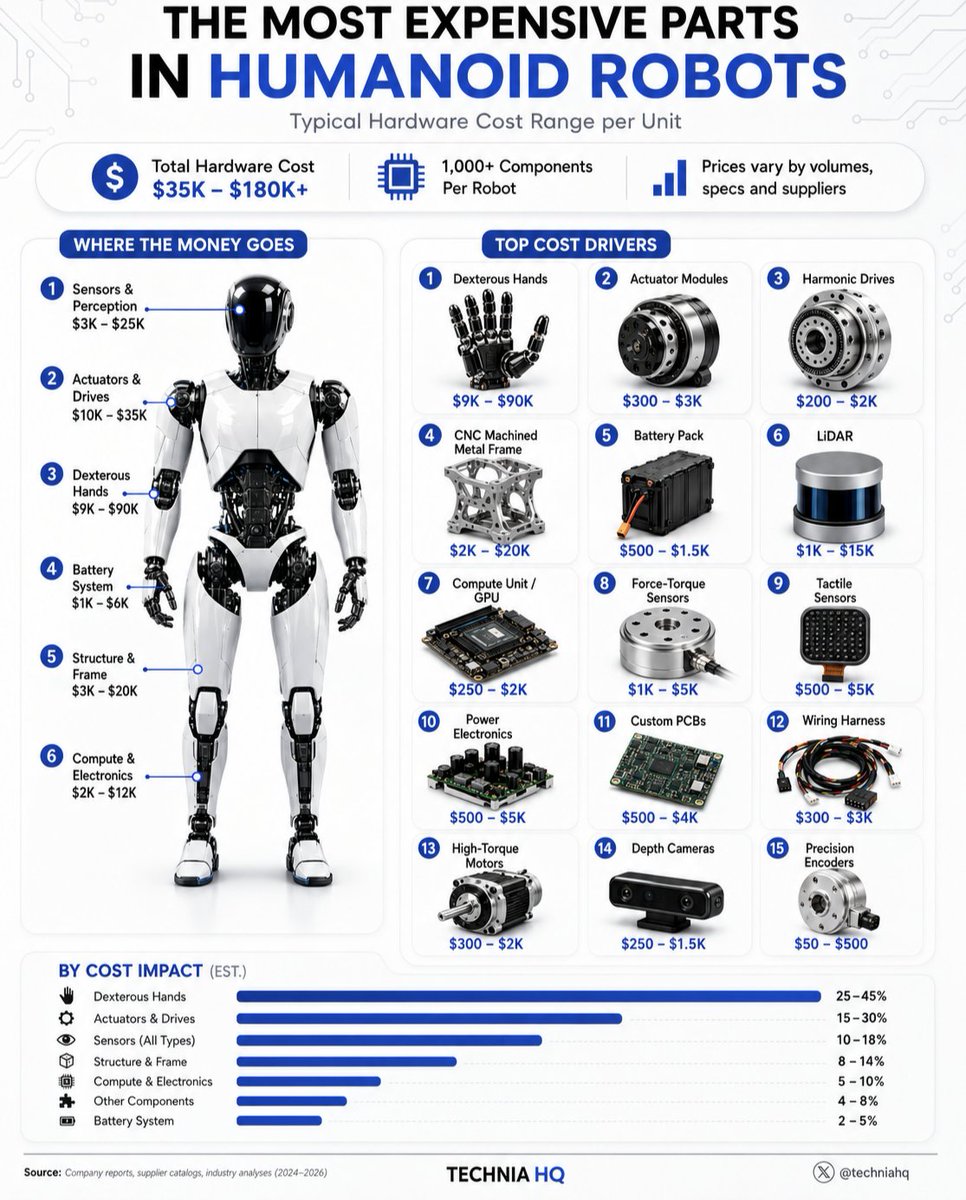
The most expensive parts in humanoid robots are not the cameras.
The real hardware cost is hidden in the parts that move, carry load, survive impact and repeat the same motion thousands of times without failing.
Typical hardware cost range per humanoid robot:
• Dexterous hands
➝ $9K–$90K
The hardest part to make cheap. Each hand needs small actuators, tendons or linkages, tactile sensing, finger joints, wiring and control boards packed into a very small space.
• CNC metal frame
➝ $2K–$20K
The skeleton must hold motors, batteries, electronics and impact loads. Low volume machining makes this expensive, especially for torso, hip, shoulder and leg structures.
• LiDAR
➝ $1K–$15K
Used for mapping, navigation and obstacle detection. Cost depends on range, resolution, scan type and whether the robot needs outdoor reliability.
• Force-torque sensors
➝ $1K–$5K
Critical for balance, manipulation and safe contact. These sensors help the robot measure pressure through wrists, ankles or joints.
• Tactile sensors
➝ $500–$5K
Needed when a robot must grip soft, fragile or uneven objects. The cost rises fast when sensors cover fingers, palms or large skin-like surfaces.
• Actuator modules
➝ $300–$3K each
One of the biggest cost drivers. A humanoid can use dozens of actuators across legs, arms, waist, neck and hands. Torque, cooling, gearbox quality and control electronics change the price fast.
• Battery pack
➝ $500–$1.5K
The battery must deliver high current while staying compact. Weight is a major constraint because every extra kilogram makes the legs work harder.
• Compute / GPU
➝ $250–$2K
The robot needs onboard compute for vision, control, planning and sensor fusion. Higher autonomy requires more compute, better thermal design and more power.
• Harmonic drives
➝ $200–$2K each
Used where compact high torque is needed. They are expensive because precision, backlash and durability matter in knees, hips, shoulders and wrists.
• Power electronics
➝ $500–$5K
Motor drivers, converters, protection circuits and power distribution decide how stable the robot is under heavy motion.
• Wiring harness
➝ $300–$3K
Humanoids have cables moving through arms, legs, torso and neck. Bad routing means broken wires, noisy signals and hard maintenance.
• Precision encoders
➝ $50–$500 each
Every joint needs position feedback. Better encoders give smoother motion, better balance and more accurate manipulation.
A serious humanoid robot can still carry $35K–$180K+ in hardware before software, assembly, testing, repair stock, certification and support.
That is why the cheapest demo robot is not always the cheapest robot to deploy.
Figure is private.
1X is private.
Tesla's Optimus is only one part of a much larger business.
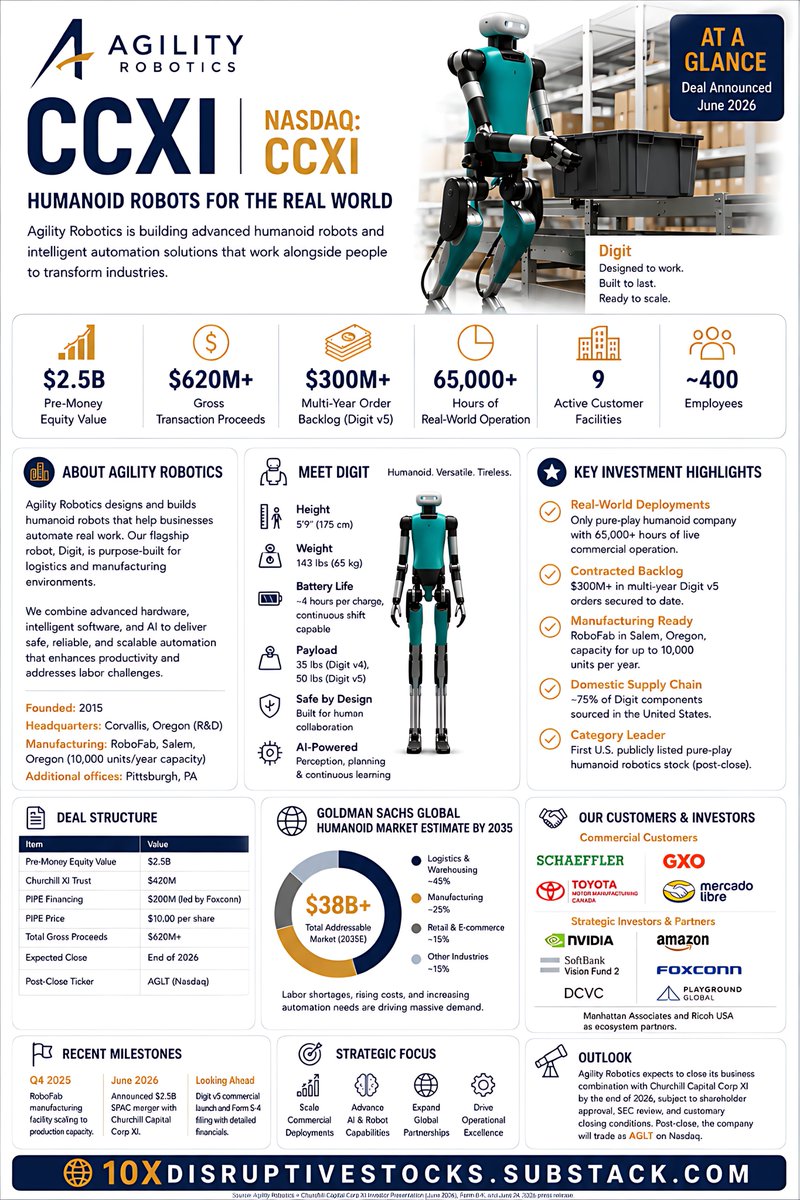
Agility Robotics ($CCXI) is the first publicly traded pure-play humanoid robotics company.
Its robot, Digit, is already being deployed in warehouses, and the company is backed by Amazon, Nvidia, SoftBank Vision Fund 2, and Foxconn.
Most investors haven't connected the dots yet.
Read the full investment thesis:
https://t.co/5Z923ERsmg
🚨 BREAKING: Spurs have made a new bid for Sandro Tonali worth around £90m.
Newcastle hoping for £100m. Talks between clubs continue.
Spurs remain optimistic.
🤝 @alex_crook
Why is $OUST soaring today?
Three catalysts may be converging:
• NDAA Section 164 takes effect tomorrow (June 30), limiting Chinese LiDAR in U.S. federal procurement. That could strengthen Ouster's position with defense and government customers.
• Agility Robotics is going public via $CCXI. Its Digit humanoid robots use Ouster LiDAR.
• Investors may be starting to price in Physical AI, with Ouster emerging as a key sensing play.
As Physical AI scales, sensing could become just as important as compute.
I recently published a deep dive on $OUST:
https://t.co/3ODo1QoM49
Everyone and their mother is talking about humanoids on my timeline, so I thought I'd give it a go.
Here's the stack, layer by layer. Household names first, hidden picks last.
1. AI Brains // the intelligence
$NVDA Nvidia -- Jetson + GR00T foundation model.
$QCOM Qualcomm -- RB6 robotics platform, lower power, industrial design wins.
2. Sensors & Perception // how it sees and feels
$CGNX Cognex -- the established machine-vision incumbent.
$ALGM Allegro Micro -- magnetic position sensors.
$OUST Ouster -- solid-state lidar pure-play, the small-cap everyone debates.
$VPG Vishay Precision -- strain gauges and force sensing.
3. Edge AI Inference // decisions on-device
$LSCC Lattice -- low-power FPGAs for sensor fusion.
$AMBA Ambarella -- edge vision processors crossing over from auto.
$CEVA Ceva -- DSP and inference IP. Pure licensing, pure obscurity.
4. Motors & Motion // the muscles
$AME Ametek -- precision instruments and motion, blue-chip industrial.
$NJDCY Nidec -- world's largest motor maker.
$RRX Regal Rexnord -- motors and drives at scale.
$RBC RBC Bearings -- precision components.
5. Joints & Precision Motion // human-like movement
$ALNT Allient -- US-listed, integrated motion.
6324.T Harmonic Drive -- strain wave gears. Every Optimus joint uses one. Potentially a bottleneck name.
6481.T THK -- linear bearings and ball screws. Tokyo-listed, off the radar.
6. Power Electronics // energy into controlled motion
$TXN Texas Instruments -- motor control MCUs at scale.
$STM STMicro -- broad motor control portfolio.
$IFNNY Infineon -- dominant in automotive-grade power.
$ON onsemi -- power management and sensing.
$RNECY Renesas -- automotive and industrial motor control.
$MPWR Monolithic Power -- high-efficiency DC-DC for compact systems.
$WOLF Wolfspeed -- silicon carbide pure-play, the distressed wildcard.
$NVTS Navitas -- GaN, asymmetric small-cap.
7. Energy & Rare Earth // the raw fuel
$MP MP Materials -- the REE pure-play everyone knows.
$LYSCF Lynas -- largest non-China producer.
$ENS EnerSys -- industrial batteries.
$UUUU Energy Fuels -- diversified REE and uranium.
$USAR USA Rare Earth -- magnet manufacturing, the new entrant.
The winners may not be the robot makers. They may be the companies inside the robot.
Now, I'm not investing in this theme just yet.
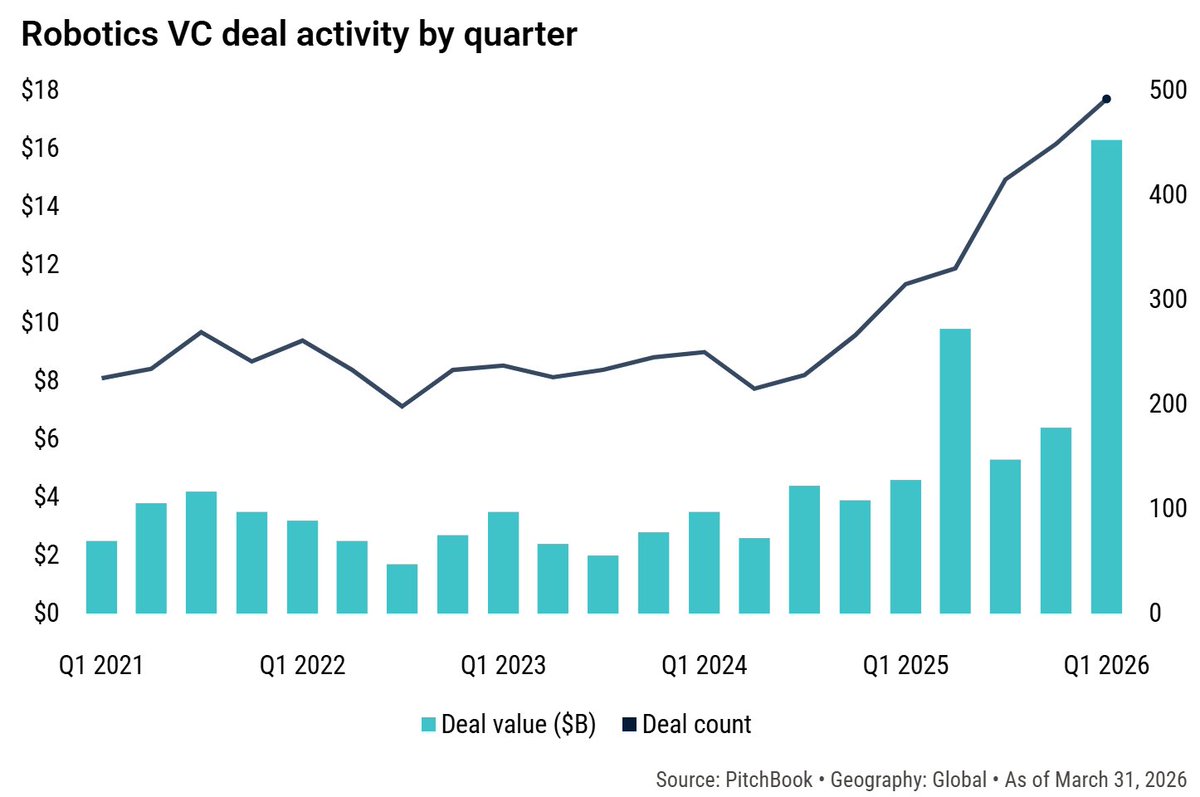
Robotics VC hit a RECORD HIGH of ~$16B in Q1 2026.
But AI venture funding reached $255.5B in the same quarter, eclipsing the full-year 2025 total of $254.4B in a single three-month stretch. That's 16x what robotics pulled in the same window.
I'm bullish on everything here, but I also know where to allocate my money.
Maybe 5 of every 100 lesser-known names in this sector will actually do well. I'm going to keep waiting to see which ones have a clearer path.
For now I have exactly 3 in mind, and I'm not yet invested. I'll do proper research before I talk about it.
Credit to @realfuturistlens on Substack for the ilustration.
🚨 | Fred Vasseur: “The strategy is not the issue, I think the issue is that we didn’t have the pace of the Mercedes and Verstappen.”
“We tried to compensate taking risks on the strategy but it was not a good fight. It’s more a matter of pace.”
🔵 $OUST → the eyes of Physical AI.
Compute lets a machine think. Perception lets it see. Without sight, the robot, the truck, the city cannot act.
$OUST builds that layer in silicon. Here is the full breakdown 👇
Robotics is moving so fast.
I expect deal value to 10x in the upcoming years.
With private capital flowing into companies that can manufacture at scale + win paying customers.
Some of the biggest deals so far this year include:
-> Saronic (US) w/ $1.75B Series D in March for autonomous naval vessels.
-> Skild AI (US) w/ $1.4B round for humanoid software.
-> Apptronik (US) w/ $0.94B Series A for industrial humanoids.
-> Mind Robotics spun out from $RIVN and raised $0.9B YTD.
There'll be plenty of public investment opportunities though.
Either by investing upstream in the suppliers that make up humanoid's BOM e.g. in actuators or perception systems.
In a similar style to the AI supply chain, going upstream to find where the winners are.
Or via pure-play robotics companies selling B2B and B2C once production ramp hits in a year or two.
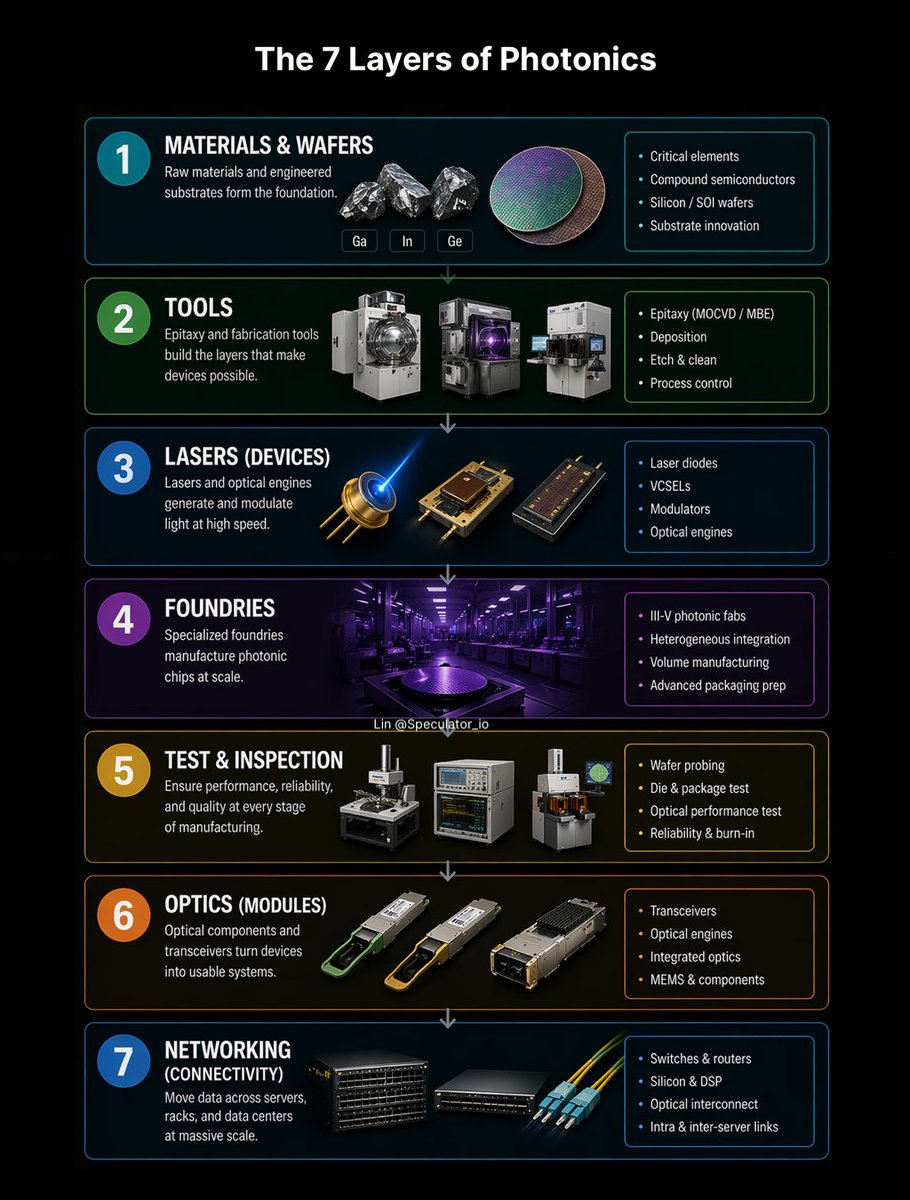
In a few years all high-bandwidth interconnects in data centers will be optical.
That's why photonics has become one of the most important AI infrastructure themes:
$SIVE Sivers Semiconductors +2290.36%
$IQE IQE +1088.21%
$SOl Soitec +455.58%
$AXTI AXT Inc +437.44%
$AAOI Applied Optoelectronics +371.06%
$AEHR Aehr Test Systems +328.79%
$OPTX Syntec Optics +303.10%
$ALRIB Riber +268.57%
$MRVL Marvell Technology +254.92%
$UMC United Microelectronics +249.87%
$AIXA Aixtron +248.64%
$LWLG Lightwave Logic +208.62%
$WOLF Wolfspeed +196.25%
$VIAV Viavi Solutions +193.30%