This is the official account of the Programme Operator of the Programme Good Governance, Accountable Institutions, Transparency co-funded EEA Grants 2014-2021
📢Call for Expressions of Interest
The OECD, with support from #DGREGIO 🇪🇺 , is helping EU Member States unlock the full potential of #StrategicPublicProcurement (SPP) to drive sustainability, efficiency & innovation.
Deadline extended 🗓️ 21 March ⤵️ https://t.co/6UGhjFJvTU
AI made in 🇪🇺
OpenEuroLLM, the first family of open source Large Language Models covering all EU languages, has earned the first STEP Seal for its excellence.
It brings together EU startups, research labs and supercomputing hosts to train AI on European supercomputers ↓
#OECDTrustSurvey: 2024 Results
Survey confirms that, to meet growing expectations, governments need to strengthen the processes underpinning democratic governance, including:
✅Accountability
🗣️Voice
📊Evidence-based policymaking
Data and insights 👉 https://t.co/DWQeOjvAkd
📢 OECD unveils new #Youth Toolkit with practical guidance on how to improve opportunities for young people.
With over 7⃣0⃣ good policy examples from around the world, learn+ about how to help unlock the full potential of young people 👉 https://t.co/3GA0b1Vj5N
#OECD4Youth
#OutNow 📢 Practical Guide for Policymakers on Protecting and Promoting #CivicSpace
New report provides guidance in implementing the OECD’s 10 high-level recommendations to protect and promote civic space
See ➡️ https://t.co/fHVyvG0CuX #OpenGovernment
Celebrating the 30 years of EEA Grants @eeagrants_gr@EEANorwayGrants in Greece .. Γιορτάζοντας τα 30 χρόνια τou Χρηματοδοτικού Μηχανισμου του ΕΟΧ στην Ελλάδα με καλές συναδέλφους @Synigoros που γνωριστήκαμε και δουλέψαμε μαζί για μια συμπεριληπτικη κοινωνία @EEANorwayGrants
📢 Join the OECD Global Forum🌐 Building Trust and #ReinforcingDemocracy
Breaking New Ground for the Future of Democracy
🔵Dignity 🔵Security 🔵Trust
🗓️21-22 October 2024 📌 Milan, Italy 🇮🇹
Register now 👉https://t.co/baasvcxSrI
OECD Global Forum 🌐 Building Trust and #ReinforcingDemocracy#OpenGov blog series ✨ New Frontiers of Citizen Participation
📖 Read insights on shaping the future of trust & democracy, and join us in Milan 🇮🇹 21-22 Oct🗓️to discuss further!
👉 https://t.co/dR86ylByd2
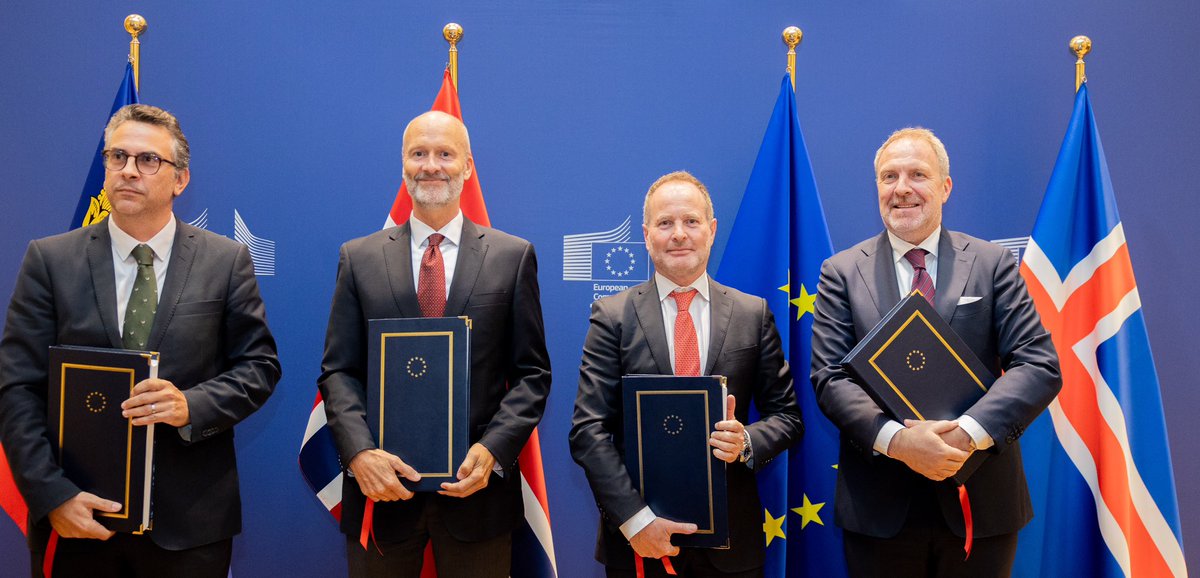
Signed and sealed 🤝 paving the way to €3.2 bn in funding via the EEA and Norwegian financial mechanisms up to 2028.
Another positive milestone, as we mark the 30th anniversary of the EEA Agreement this year.
👉 https://t.co/2PbNZOAAB0
One of the most tedious (but critical tasks) for software development teams is updating foundational software. It’s not new feature work, and it doesn’t feel like you’re moving the experience forward. As a result, this work is either dreaded or put off for more exciting work—or both.
Amazon Q, our GenAI assistant for software development, is trying to bring some light to this heaviness. We have a new code transformation capability, and here’s what we found when we integrated it into our internal systems and applied it to our needed Java upgrades:
- The average time to upgrade an application to Java 17 plummeted from what’s typically 50 developer-days to just a few hours. We estimate this has saved us the equivalent of 4,500 developer-years of work (yes, that number is crazy but, real).
- In under six months, we've been able to upgrade more than 50% of our production Java systems to modernized Java versions at a fraction of the usual time and effort. And, our developers shipped 79% of the auto-generated code reviews without any additional changes.
- The benefits go beyond how much effort we’ve saved developers. The upgrades have enhanced security and reduced infrastructure costs, providing an estimated $260M in annualized efficiency gains.
This is a great example of how large-scale enterprises can gain significant efficiencies in foundational software hygiene work by leveraging Amazon Q. It’s been a game changer for us, and not only do our Amazon teams plan to use this transformation capability more, but our Q team plans to add more transformations for developers to leverage.
🇳🇴’s Minister of Int Dev @AnneBeathe_ at today's launch of the @OECD Development Co-operation Report 2024:
✅Inequality a systematic issue
✅#DomesticResourceMobilization at the heart of #SDG funding
✅We need to stop tax evasion, corruption and illicit financial flows
📢#OECDTrustSurvey: 2024 Results
"How much do you trust your government?"
🗳️~ 60 000 people in 30 countries replied:
❌ 44% had no or low trust
✅ 39% had high or moderately high trust
🟰16% were neutral
❓1% Don't know
Data and analysis 👉 https://t.co/DWQeOjw89L
This year for a more #inclusive#Europe:
💶 €1,061 million spent across 59 programmes
🎯 3,987 projects backed
📜 900 national policies and laws influenced
❤️ 374,460 vulnerable individuals reached by empowerment measures
... and much more ⬇️
https://t.co/wtaPZ8WVxf
📢 OECD #OURdata Index 2023
📊 Paper presents the main findings of the OECD Open, Useful, and Re-usable data (OURdata) Index, benchmarking efforts made by governments to design and implement national open government data policies.
👉 https://t.co/HsNUssJD5s #OpenData
#IntegrityOutlook 2024 🌐 finds that less than 5⃣0⃣% of OECD countries have defined #lobbying activities and which actors are considered lobbyists.
Clear definitions can reduce loopholes and exploitation of safeguards against undue influence.
See🔗 https://t.co/W0mKplKaE8
🚨 [AI & PRIVACY] @OECD publishes the paper "AI, Data Governance and Privacy - Synergies and Areas of International Cooperation," a must-read for everyone in privacy & AI. Highlights and a few comments:
➡️ The section "Generative AI: a catalyst for collaboration on AI and privacy" has an interesting overview of the latest developments in the intersection between Privacy Enhancing Technologies (PETs) and AI. Quotes:
"For example, researchers are developing different encrypted data processing tools which allow data to remain encrypted while in use and thus can help enhance privacy at various stages throughout the AI system lifecycle (OECD, 2023[18]). Such techniques include homomorphic encryption and trusted execution environments (TEEs), where actors along the AI lifecycle are not able to view the underlying data without permission (O’Brien, 2020[19]; Mulligan et al., 2021[20])." (page 19)
-
"Machine unlearning is another emergent subfield of machine learning that would grant individuals control over their personal data, even after it has been shared. Indeed, recent research has shown that in some cases it may be possible to infer with high accuracy whether an individual's data was used to train a model even if that individual's data has been deleted from a database. Machine unlearning aims to tackle this challenge and would give individuals the possibility to withdraw their consent to the collection and processing of their data and to ask for the data to be deleted, even after they have been shared (Tarun, 2023[27])" (page 20)
➡️ The paper also covers:
➵ Mapping existing OECD principles on privacy and on AI: key policy considerations
➵ National and regional developments on AI and privacy
➡️ In the last 18 months, I've been writing about the intersection of AI & privacy and some of the unsolved legal challenges.
➡️ One of these issues is the practical interpretation of legitimate interest requirements in the context of AI. Current AI practices do not fit the traditional interpretation of this lawful basis (meaning that currently, the whole AI industry has uncertain legal status in the EU). On the issue of legitimate interest, this paper writes:
"(...) most privacy and personal data protection frameworks require that there be a “lawful basis” for both collecting and processing data. While most laws generally provide for a series of such legal bases, in practice, the legal basis known as “legitimate interests” is the one which is considered the most suitable in the context of Generative AI. This requires that the interest pursued by the AI developer, provider or user (e.g. in developing or implementing a model) be legitimate, that the data processing at stake is effectively needed to meet this legitimate interest, and that it does not create disproportionate interference with the interests and rights of data subjects. As mentioned earlier, striking the right balance between these different interests can be complex in the current state of the art and calls for reinforced co-operation between the AI and the privacy community"
➡️ My personal comment is that this issue still needs a firm stand from data protection authorities, and the matter remains open.
➡️ As with other recent OECD papers, this one is an interesting summary of the current global understanding and the state of the art in the intersection of AI, privacy & data governance.
-
➡️ Read the paper below.
➡️ To stay up to date with recent developments in AI policy & regulation, join 27,000+ people who subscribe to my weekly newsletter (link below).
The #EEANorwayGrants are tackling challenges in #Europe 🇪🇺 through bilateral cooperation 🤝🌍.
📺 Watch this edition of #OurStories to learn more about how our partners are working together to build a greener 🌱, more democratic 🗳️, and inclusive #Europe 🫂.
@EEAGrantsPT@CMCascais
📢Consultation on the Draft Recommendation on Human-Centred Public Administrative Services.
The Recommendation will help govts design and deliver public admin. services with people’s needs as the main consideration.
🗓️Deadline for comments: 5 July
➡️https://t.co/KFXywpTRx8








![LuizaJarovsky's tweet photo. 🚨 [AI & PRIVACY] @OECD publishes the paper "AI, Data Governance and Privacy - Synergies and Areas of International Cooperation," a must-read for everyone in privacy & AI. Highlights and a few comments:
➡️ The section "Generative AI: a catalyst for collaboration on AI and privacy" has an interesting overview of the latest developments in the intersection between Privacy Enhancing Technologies (PETs) and AI. Quotes:
"For example, researchers are developing different encrypted data processing tools which allow data to remain encrypted while in use and thus can help enhance privacy at various stages throughout the AI system lifecycle (OECD, 2023[18]). Such techniques include homomorphic encryption and trusted execution environments (TEEs), where actors along the AI lifecycle are not able to view the underlying data without permission (O’Brien, 2020[19]; Mulligan et al., 2021[20])." (page 19)
-
"Machine unlearning is another emergent subfield of machine learning that would grant individuals control over their personal data, even after it has been shared. Indeed, recent research has shown that in some cases it may be possible to infer with high accuracy whether an individual's data was used to train a model even if that individual's data has been deleted from a database. Machine unlearning aims to tackle this challenge and would give individuals the possibility to withdraw their consent to the collection and processing of their data and to ask for the data to be deleted, even after they have been shared (Tarun, 2023[27])" (page 20)
➡️ The paper also covers:
➵ Mapping existing OECD principles on privacy and on AI: key policy considerations
➵ National and regional developments on AI and privacy
➡️ In the last 18 months, I've been writing about the intersection of AI & privacy and some of the unsolved legal challenges.
➡️ One of these issues is the practical interpretation of legitimate interest requirements in the context of AI. Current AI practices do not fit the traditional interpretation of this lawful basis (meaning that currently, the whole AI industry has uncertain legal status in the EU). On the issue of legitimate interest, this paper writes:
"(...) most privacy and personal data protection frameworks require that there be a “lawful basis” for both collecting and processing data. While most laws generally provide for a series of such legal bases, in practice, the legal basis known as “legitimate interests” is the one which is considered the most suitable in the context of Generative AI. This requires that the interest pursued by the AI developer, provider or user (e.g. in developing or implementing a model) be legitimate, that the data processing at stake is effectively needed to meet this legitimate interest, and that it does not create disproportionate interference with the interests and rights of data subjects. As mentioned earlier, striking the right balance between these different interests can be complex in the current state of the art and calls for reinforced co-operation between the AI and the privacy community"
➡️ My personal comment is that this issue still needs a firm stand from data protection authorities, and the matter remains open.
➡️ As with other recent OECD papers, this one is an interesting summary of the current global understanding and the state of the art in the intersection of AI, privacy & data governance.
-
➡️ Read the paper below.
➡️ To stay up to date with recent developments in AI policy & regulation, join 27,000+ people who subscribe to my weekly newsletter (link below).](https://pbs.twimg.com/media/GRE7V-3WIAAkejF.jpg)