"Everything is changing rapidly"—that much is true. Unfortunately, academia is structurally built to lag behind.
If you define "contribution" merely by publication count, staying in a non-top PhD is actually great arbitrage right now. Peer review is in unprecedented chaos: generate something an LLM likes, draw a reviewer using an LLM, remember to delete "all data is simulated," check the references, polish the prose—and bang, accepted.
However, if you want to make a real intellectual contribution, unless you are (1) at a top school/lab and past your qualifying exams, or (2) lined up for an internship at Anthropic, Google DeepMind, OpenAI etc, leaving the program is no loss to you or the field.
Research is a capability, not a credential; today, anyone with drive can build PhD-level skills through open resources. Worse, PhD busywork—TAing, pointless seminars, outdated coursework—cannibalizes the precious time you need to adapt. As for "taste" and "networks," those are mostly artificial frictions. Incumbent editors have repeatedly shown their taste is nothing special—some even reject papers simply for challenging their own prior findings. Meaningful questions don't need bureaucratic validation.
Right now, universities need students far more than students need them. As information asymmetry collapses, aside from elite schools surviving as clubs for wealthy families, most other programs are on a countdown—and society's knowledge won't miss a beat.
There is no reason to drop out simply because of AI. Everything is changing rapidly, and that is precisely what makes this an exciting time to be a researcher.
Research is becoming more fascinating than ever.
Unpopular advice for current PhD students:
Drop out and reapply after five years, assuming you still care, and PhD programs still exist.
Here’s why:
1. Academia is flying blind. Neither your advisor nor your university has figured out what PhD training should look like in the AI era. Most don’t even have a plan, let alone a vision.
2. You're optimizing for an obsolete syllabus. In five years, frontier models will let you master the same material in a fraction of the time and half of what you're grinding through today will likely be irrelevant anyway.
3. Save your sanity. Stepping away from a broken, anxious system while it figures itself out will do wonders for your mental health.
What to do in the next five years:
- Stay close to the frontier. Keep reading the literature you genuinely care about—just without the academic bureaucracy.
- Master AI-native workflows. Stay on the cutting edge of how research and building actually get done now.
- Be there for your family. Support the people you love, especially those navigating job displacement and uncertainty in the AI wave.
- Build real-world leverage. Find a way to earn your living outside academia—whether it’s a day job, consulting, or creating on YouTube.
- Put your health first. Exercise, sleep, and protect your body. Nothing else works if you burn out.
Unpopular advice for current PhD students:
Drop out and reapply after five years, assuming you still care, and PhD programs still exist.
Here’s why:
1. Academia is flying blind. Neither your advisor nor your university has figured out what PhD training should look like in the AI era. Most don’t even have a plan, let alone a vision.
2. You're optimizing for an obsolete syllabus. In five years, frontier models will let you master the same material in a fraction of the time and half of what you're grinding through today will likely be irrelevant anyway.
3. Save your sanity. Stepping away from a broken, anxious system while it figures itself out will do wonders for your mental health.
Article out @TheEconomist today on AI transforming economics, featuring a collaboration with @RefineDotInk.
We worked on our specific obsession:
How fragile is the economics literature, and will AI make it more or less reliable?
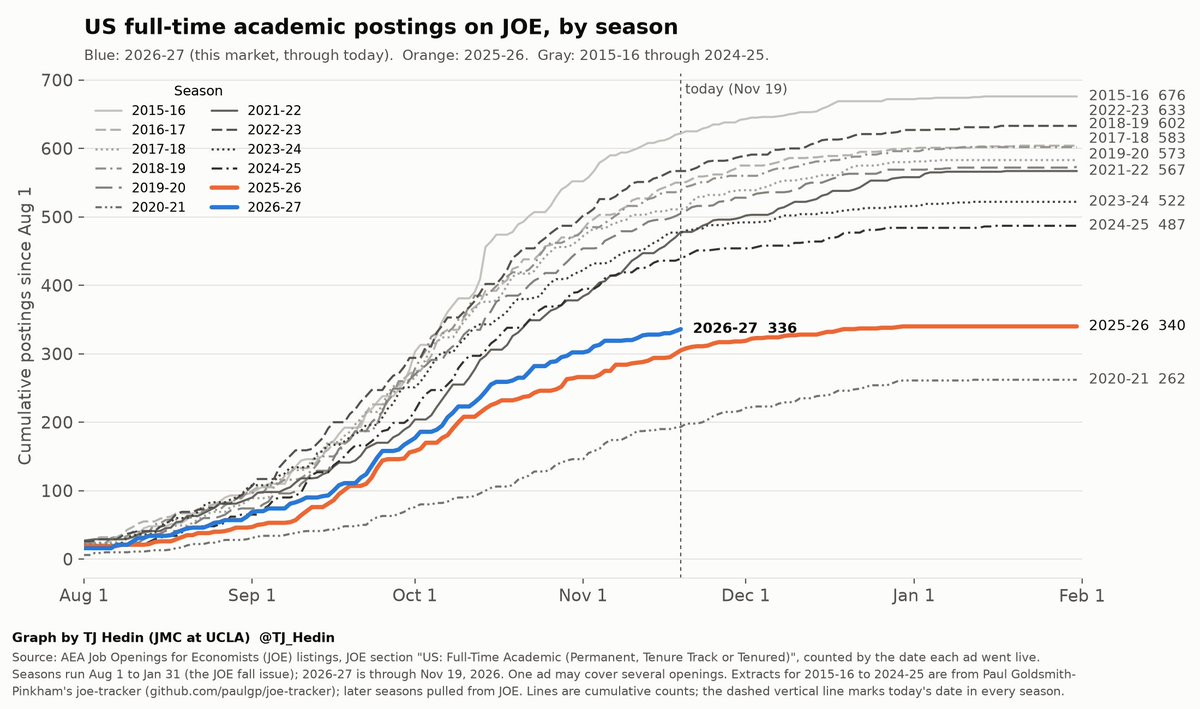
This year's Econ/Biz Job Market has shown how AI is reshaping JMPs.
An unprecedented wave of papers with similar ideas in my subfield.
While we used to debate marginal contributions and distinct framing, my own experience with a literature-mining and proposal agent (fed with the core foundations) revealed an eerie overlap: it had already generated remarkably similar ideas, matching closely even in assumptions and identification. After seeing what AI can output, many current papers leave you wondering where the actual further intellectual contribution lies.
It really forces a hard question: Is AI actually driving innovation, or is it just steering our research to fit whatever material the AI serves up, perhaps packaging it neatly, but flattening true novelty?