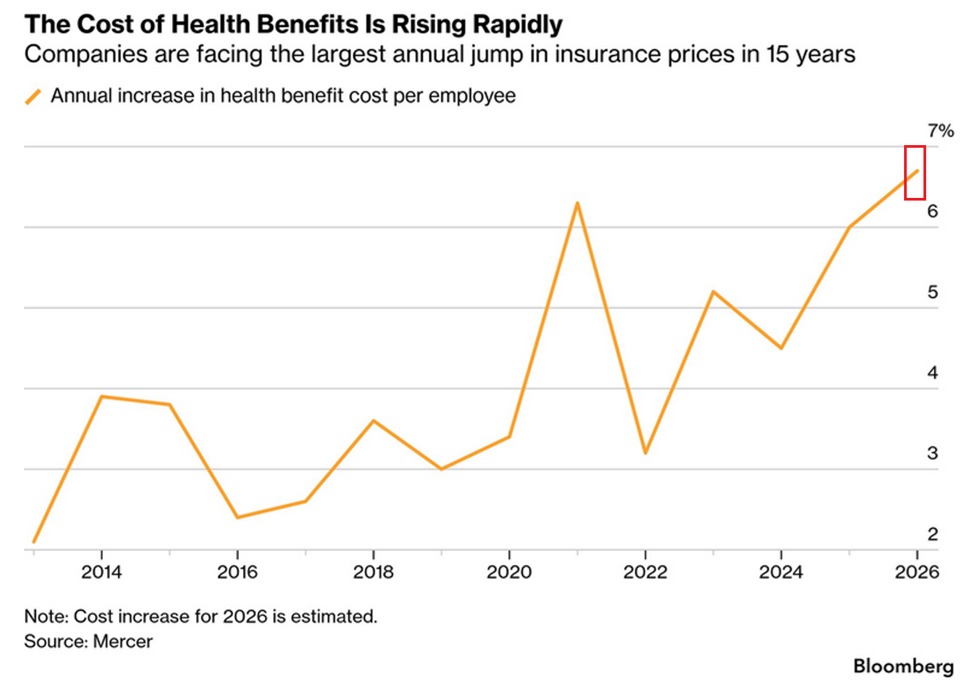
The surge in US health insurance costs shows no signs of slowing:
Health benefit costs per employee are expected to rise +6.7% YoY in 2026, to at least $18,500, the biggest annual increase in 15 years.
This is more than double the increase seen in 2019 or 2022.
Furthermore, health insurers are expected to raise the cost of employer group plans by over +6.0% for the 4th consecutive year.
In response, ~66% of large US firms plan to increase monthly employee premium contributions in 2027.
Workers who frequently visit doctors and fill prescriptions could see healthcare costs rise as much as +8.0% YoY.
US healthcare costs have never been higher.
The best hospital in Central America.
With every medical specialty, the most advanced technology in the world, and top-quality care.
Public. Dignified. Free. For everyone.
Anyone with dual citizenship should be prohibited from holding federal appointed or elected office or any role in the U.S. government inside the United States.
Younger Americans cannot survive with the cost of living as high as it is
This girl shows her gas light is on. She only had enough cash for 2 McDonald’s hash browns, she bas $20 in her bank account
She gets up at 6am to go to work, and still have nothing to show for it
“I'm so sick of America. I'm so sick of our government — I'm so sick of everyone and everything”
This is not the way we are supposed to be living in America. This is not the way we are supposed to be feeling in America
It never used to be like this
The homeownership rate for Americans under age 35 is around 36% as of early 2026, this is significantly lower than previous generations at the same age
About 42% of Gen Z report living paycheck to paycheck, with roughly half saying the high cost of living is their top issue
52% of Millennials say financial pressures are causing them to delay major life decisions like marriage, starting a family or buying a home
Median net worth for Americans in their 20s is roughly $6,600–$26,000
You can’t even afford to start a family anymore in America
Three key trends I am increasingly excited about...
1: Our industry has started caring much more about the security and reliability of the infrastructure, standards and oracles/dependencies that it is built on top of. This shift in focus towards security is already massively benefiting Chainlink because it is built with security and reliability in mind from the start e.g. 16 nodes vs 1 of 1 or 2 of 2 (which is actually often just a 1 of 1 in disguise). This focus on reliability and security makes a better system for everyone in the DeFi/TradFi industry to transact with less risk and also leads to more overall Chainlink adoption over time. The way Chainlink became the leading data oracle is through security and reliability, I think that will happen across all categories where Chainlink deploys services for the same reasons.
We are now clearly seeing this dynamic take place in cross-chain interoperability, with many large users migrating onto CCIP after conducting deeper security reviews of bridging providers, more and more of which are now being published, some telling quotes below:
https://t.co/7ANpmqIlPn
Kraken chose Chainlink CCIP because it offers enterprise-grade infrastructure with strict security & risk management requirements, including:
• ISO 27001 and SOC 2 Type 2 certifications
• Secure by default architecture
• 16 independent nodes
• Native rate limits, and more.
https://t.co/hPnqT7CFcT and https://t.co/QHXnyjO2fp
The analysis covers how Chainlink CCIP delivers strong decentralization, native safeguards, and issuer control as default protocol-level guarantees, which insulates wstETH from a number of attack vectors behind the Kelp / LayerZero exploit.
https://t.co/AObyg1Nunx
Chainlink CCIP has emerged as the standard in cross-chain infrastructure, providing an enterprise-grade framework to secure high-value assets
With over $4Billion migrated in just a few weeks and more on the way, I am clearly seeing the industry's clear preference for security and reliability being a key trend leading to accelerated adoption of Chainlink and CCIP.
2: Chainlink has always continued to build and added many of its best features during down markets, when there is less noise to distract top teams from building. Because Chainlink already has clear product market fit, being able to focus on building the future is a powerful accelerant for future progress and is actually what I and many of the people building Chainlink are here for.
I am very excited about both the use case specific features e.g. collateral management and the increasing number of reusable primitives e.g. verifiable confidential compute in CRE, which are now actively being built, refined and launched with top users. In my experience, during the down market lulls is when the best things get built, and I am truly thrilled to see Chainlink being built to better serve its existing users and entirely new users.
3: The RWA, TradFi Tokenization and Digital Assets industry has now decoupled from crypto prices as a determining factor of its success and is a rapidly growing market of its own. Great news for the technologies, standards and infrastructures that can serve this new and growing demand, of which Chainlink is at the very top of the list. By having the relevant certifications; https://t.co/PlGDKLrJDi, being the historically most secure/reliable option with the largest amount of value enabled and being able to compose multiple key primitives (Data + Interoperability + Identity/compliance + verifiable off-chain orchestration) into full end-to-end solutions like no other platform can, puts the Chainlink platform/ecosystem in a unique place to be adopted by this new and growing market.
This is now becoming increasingly clear in practice through Chainlink's adoption in various parts of the capital markets; from collateral management with some of the most recent examples being...
DTCC using CRE and Data for their production plans; https://t.co/IiXXFfUwJu + https://t.co/sHe6QvquYR
Data providers like SGX using DataLink for key data; https://t.co/P7uPeOzliY
Top asset managers like State Street; https://t.co/Jh08KBnCvN and Fidelity International; https://t.co/06noNUEbEt, being powered by Chainlink on the backend.
The above are just a small number of recent examples, with many more being worked on all across the TradFi ecosystem, from payments, to tokenized equities, to tokenized funds; all of these on-chain finance use cases need multiple Chainlink components working together.
I can't wait for the next stage, where the leading DeFi applications and the top TradFi institutions start interoperating through their use of shared on-chain standards, interoperability connections and data/identity oracles, all of which are being provided by Chainlink, together with existing infrastructures. Solving each of these market's individual problems is already exciting, but helping them merge into the new global financial system is something that I and many others in our ecosystem have been working towards for a while.
If the above sounds like something worth spending many late nights on, and you can see the future I am talking about, this is the best time to join a top team like Chainlink Labs... if you're the best of the best, excited about the future of the blockchain industry, DeFi, TradFi and building the future of the new global financial system, we are excited to work together with you: https://t.co/zhTgEzBUm0.
Great to join the Tech Bar’s Annual Seminar today to discuss the great work the FCC’s talented team has been accomplishing:
✅ Restoring U.S. leadership in wireless
✅ Accelerating infrastructure builds
✅ Boosting America’s Space Economy
✅ Advancing National Security
✅ Protecting Consumersp
Verizon, AT&T and T-Mobile said on Thursday they agreed in principle to form a new JV with an aim to address long-time coverage gaps, especially in rural areas, by using satellite-based technologies.
This comes as the industry increasingly worries about what Elon Musk’s @Starlink Mobile might do to shake up the terrestrial mobile space.
Musk has said he’s not going to put the U.S. terrestrial carriers out of business, but at the same time he’s expanding Starlink and buying up more spectrum...
I asked .@BrendanCarrFCC about SpaceX Starlink strategy: "I would be very hesitant betting against Elon Musk... A lot of people have tried to do that have lost a lot of money along the way. And one of the things with Musk that I have observed from a distance over the years is he's not someone that spends a lot of money acquiring different things. He does a lot of in-house... To see this level of investment by SpaceX/Starlink in spectrum I think speaks to the amount of diligence they've done and the confidence that they have either in direct-to-cell or whatever other innovative use cases they may have" https://t.co/GBXGbEfEgm
Thanks to President Trump, America is leading the world again. 🇺🇸
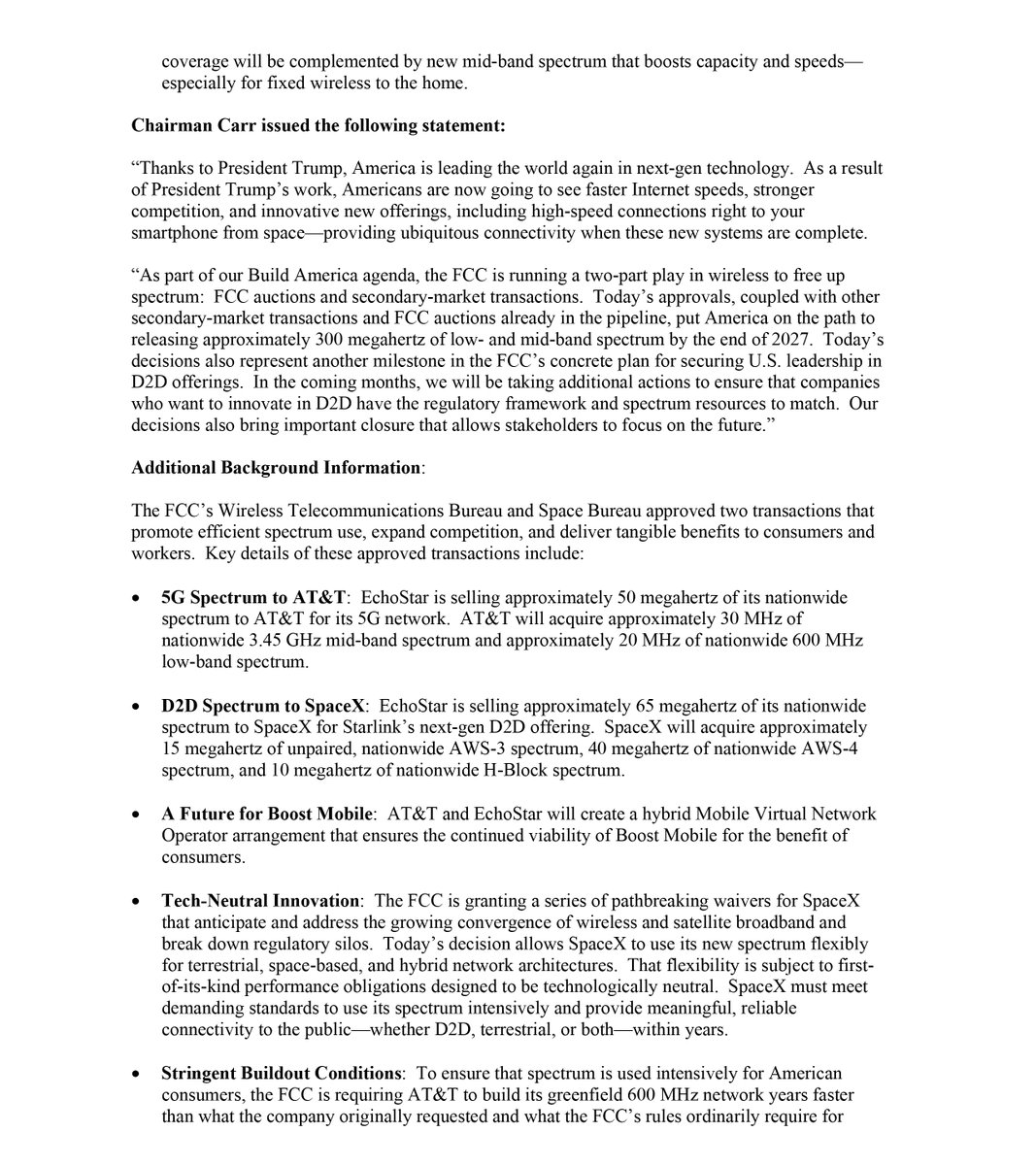
Today, the @FCC approved two major transactions that mean faster Internet, stronger competition, & global leadership in next-gen Internet from space (D2D).
These FCC approvals unlock big wins for consumers!
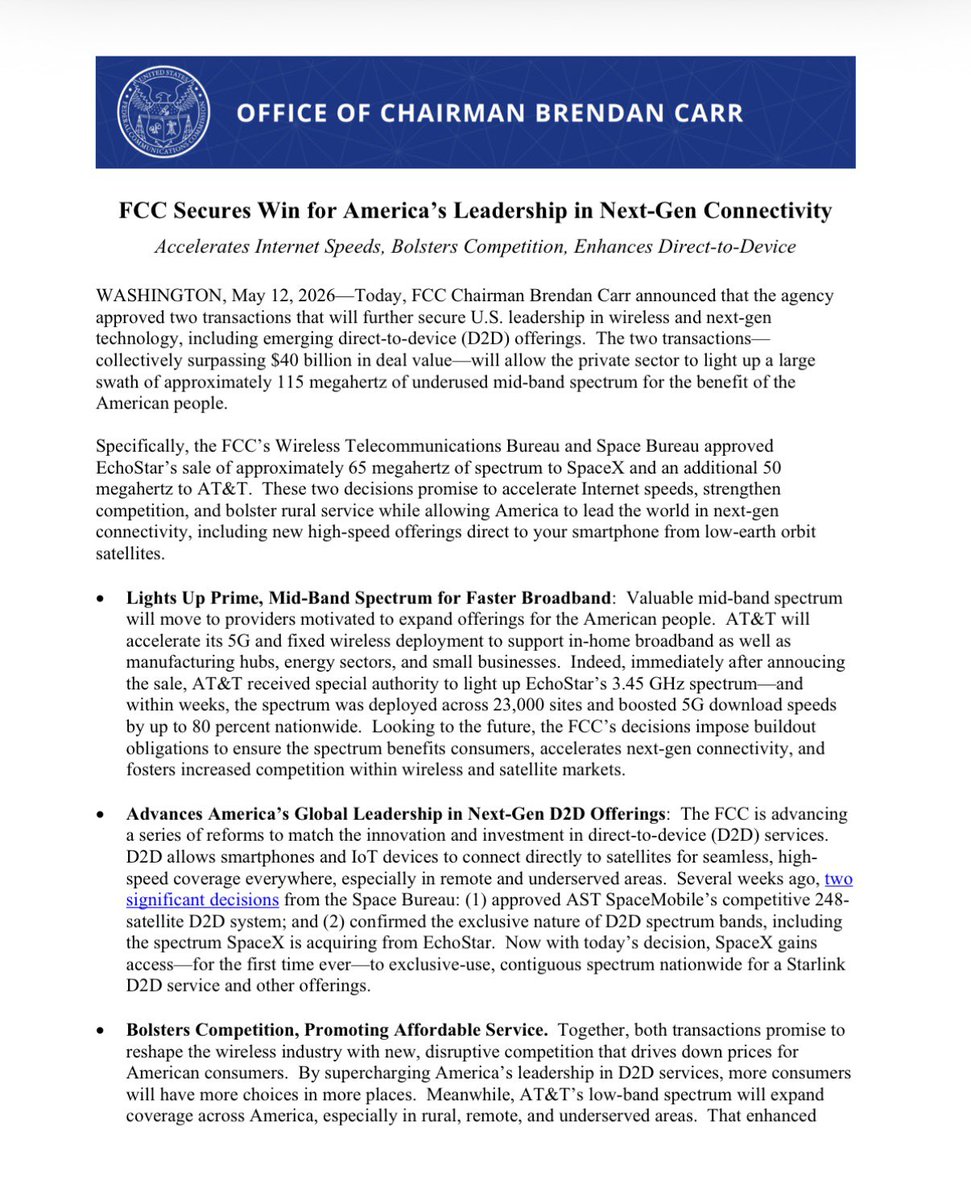
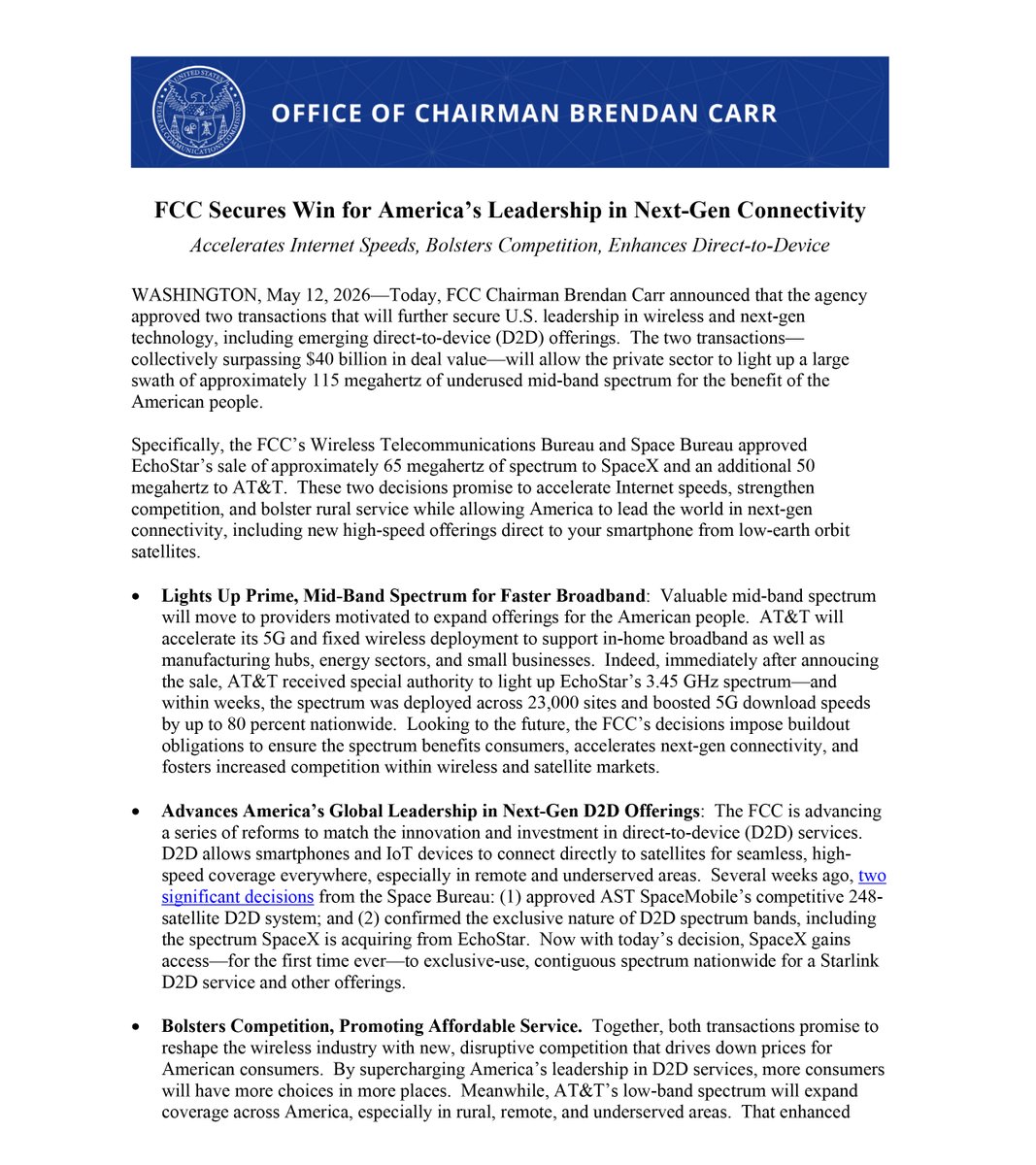
FCC Secures Win for America's Leadership in Next-Gen Connectivity 🇺🇸
Chairman @BrendanCarrFCC announced that the agency approved two transactions that will further secure U.S. leadership in wireless and next-gen technology, including emerging direct-to-device offerings. 🧵⬇️
The Trump Administration is making sure the U.S. leads the way in next-gen technology.
More strong action from @BrendanCarrFCC: "FCC Secures Win for America's Leadership in Next-Gen Connectivity"
Clarity Act is now poised to accelerate the “Bretton Woods 3.0” framework that I’ve talked about.
The yield “ban” is cosmetic & simply something for banks to tout as a victory.
It bans stablecoins from paying you interest for just holding them: the way a savings account does.
But it explicitly allows stablecoins to pay you rewards for using them: buying things, lending, providing liquidity, participating in any program..
Now consider that those rewards can be calculated based on how much you hold & for how long.
I think that’s what we just call interest, but it will now be rebranded under a new name.
So, the implications:
- The fact that there is now a carve-out for stablecoin yield will accelerate the Bretton Woods 3.0 system.
If the ban had been real (no yield in any form) there’s no reason for anyone to hold stablecoins over a bank account. Stablecoin adoption would flatline (especially in Developed Markets) & Bessent’s $3.7T target would be hard to achieve.
This carve out keeps the incentive to hold stablecoins, which keeps the growth flywheel spinning.
- CBDCs can’t compete. No central bank would design its digital currency to pay activity based rewards calculated by balance & duration (too close to monetary policy). However, dollar stablecoins can. So in every market where a CBDC competes against a $ stablecoin, the dollar product is economically superior. The Clarity Act now guarantees that advantage persists.
- The dollar now goes global without permission. The new text allows platforms to pay incentives for payments, remittances, & settlement activity using stablecoins. That’s a subsidy for global dollar adoption funded by private companies (not taxpayers). Meanwhile, increasing Treasury demand in the background.
For example, a Filipino worker now gets a rebate for sending remittances in USDC. There’s an additional incentive for him to now transact in stablecoins, which, unbeknownst to him, purchases American debt behind the scenes. A win-win for global stablecoin users & the American economy (fiscal situation).
The compromise looks like a ban.
But it’s actually a growth mandate.
As I’ve stated, the US government needs stablecoins to scale because it needs someone to buy its debt.
Bretton Woods 3.0