Hand this model vague intent, and you get polished mediocrity at scale. Hand it a precise spec, and you get what used to take a team weeks to do.
The tools are no longer the constraint. Clarity is the constraint now.
Which side of that gap is your organization on?
Anthropic released Claude Fable 5 today.
Everyone will talk about the benchmarks. Here's the part that matters:
This is the first generally available model designed to take entire projects — not tasks. Multi-day autonomous sessions. Code that tests itself.
I've been writing about output engineering — the shift from crafting clever prompts to specifying outcomes, defining what "done" looks like, and reviewing finished work with sharp judgment.
As of today, that's no longer a prediction. It's the job.
The teams that pull ahead won't run the most AI. They'll be the ones with the discipline to shape, interrogate, and raise the standard of what AI produces.
That's output engineering. Not a technical skill — a leadership skill.
Prompt fluency gets you started. Output engineering is what scales you.
Goldman Sachs projects 120 quadrillion tokens per month by 2030. A 24x increase fueled by agentic AI.
To put that in context, the industry is at roughly 5 quadrillion tokens per month today.
6/6 - The deeper question isn’t “was Apple’s security good enough?” It was. The question is: what does security architecture look like when your adversary can iterate at AI speed — and knows how to get the most out of every query?
The teams that develop that output engineering discipline now will be the ones setting the standard — not scrambling to catch up.
That starts with understanding what just happened here — and taking it seriously.
📖 Here’s the article by Marcus Mendes in 9to5Mac:
https://t.co/6UDHov8weQ
1/6 - @Apple spent five years and billions of dollars building Memory Integrity Enforcement (MIE) — hardware-baked memory safety designed to make modern exploits structurally impossible.
5/6 -
4. Human expertise still matters — but the ceiling just moved. Mythos found known bug classes fast and generalized across the problem space. The humans provided novel judgment, exploit architecture, and context that the model couldn't infer alone.
The new unit of attack is: frontier AI + domain expert + output engineering discipline.
I've been in B2B and B2C ecommerce implementation for over a decade — BigCommerce, Shopify, enterprise migrations. The clients I work with aren't asking "Should we use AI?" They're asking:
→ Is our product feed machine-readable?
→ Does our catalog structure make sense to an LLM?
→ Can an AI agent execute a purchase through our checkout?
→ Are we listed in the discovery channels that matter in 2026?
Those are architecture questions, not marketing questions.
Curious what questions your teams are asking. What's the conversation at your organization?
Something shifted in commerce in 2025, and I don't think most leaders have fully processed it yet.
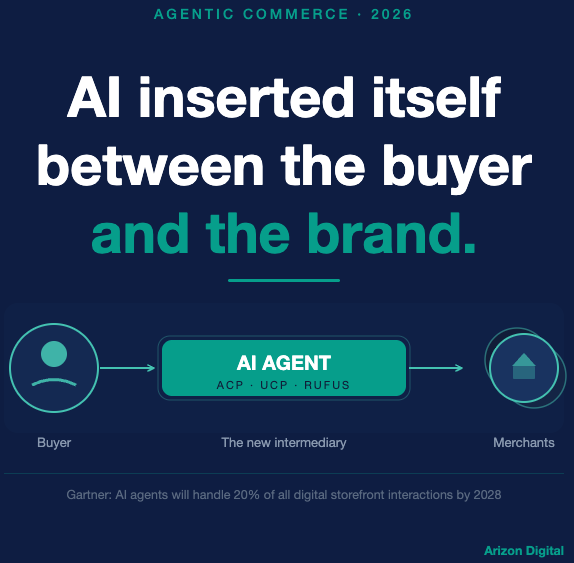
AI didn't just improve the shopping experience. It inserted itself between the buyer and the brand.
Two competing open protocols — OpenAI's #ACP, built with Stripe, and Google's UCP, co-built with Shopify — are now defining how AI agents find and buy from merchants. Amazon is building its own proprietary layer. The standards war is real, and your commerce stack's readiness for either protocol will determine whether AI agents can transact through you at all.
B2B digital commerce in this industry isn't a future problem. It's a present gap — and the window to lead is still open.
What's the biggest friction point you're seeing in how fasteners get bought and sold today?
The fastener industry moves $92 billion a year.
A surprising amount of it still moves through PDFs, phone calls, and spreadsheets.
The B2B buyer has changed. The distribution model hasn't caught up.
The fastener industry has deep, hard-won expertise. The opportunity is to stop keeping that expertise locked in human conversations — and start building it into the way customers buy.
The companies that do this won't just grow. They'll become structurally harder to compete with.