Syrma SGS Technology Ltd: Management informs that the company witnessed potential supply chain constraints due to which margins fell QoQ.
These supply chain constraints are expected to ease only between April and June 2027 (Q1 FY28).
Cost of materials also increased this quarter because of which margins fell down.
Though management has increased their FY27 revenue guidance to 40-45%(which is obviously conservative), they have reduced their margins guidance for FY27.
Management was earlier expecting EBITDA margins of 10.5-11% for FY27, which has now been lowered to 10-10.5%.
Suryoday SFB Q2 FY27 Results & Concall Insights:
AUM grew by a record 35% YoY to 15,000 cr, at par with their guidance of 30-35%, and Disbursements grew by 27% YoY.
Share of Inclusive Finance (Unsecured book) fell from 45% to 41% YoY, and Retail Assets (Secured Book) has risen to 59%.
Major improvement was seen in asset quality this quarter as GNPA & NNPA number halved on a YoY basis. Collection Efficiency also improved from 85% to 94% YoY. Though these numbers have improved, there is still significant room left for asset quality to improve.
NIMs remained stable on a YoY basis, and PAT grew by 150% YoY.
Though CASA ratio fell by 100 bps on a YoY basis, Cost of Funds improved from 7.7% to 7.4% YoY.
As of now, no negative impact has been seen in the asset quality of the unsecured MFI book due to drought situations. However, due to precautionary care, management has decided to not add any new customers from drought-hit areas for the remainder of the year.
Company's portfolio is predominantly concentrated in semi-urban areas rather than rural areas, thereby protecting the bank from any immediate agriculture related impact in the rural areas. However, agricultural shocks have a lagged impact, so it will be important to see how Q3 is executed.
Disbursements which happened in previous years are covered under the CGFMU scheme, which is a kind of government insurance scheme. However, disbursements of FY27 so far have not been covered as the renewal window has not yet opened.
There has been some rise in PAR 30-90 in the unsecured book. Management informed that this segment naturally experiences cash flow fluctuations, and borrowers keep entering and exiting this bucket. The real danger mark is only when it crosses 90+ DPD, which has improved for unsecured book, but risen for secured book.
PAR 90 has increased for secured book, which is primarily due to one or two large transactions slipping into this 30+ or 90+ bucket. Management expressed full confidence in recovering this stuck amount.
Capri Global Capital Q2 FY27 Results & Concall Analysis:
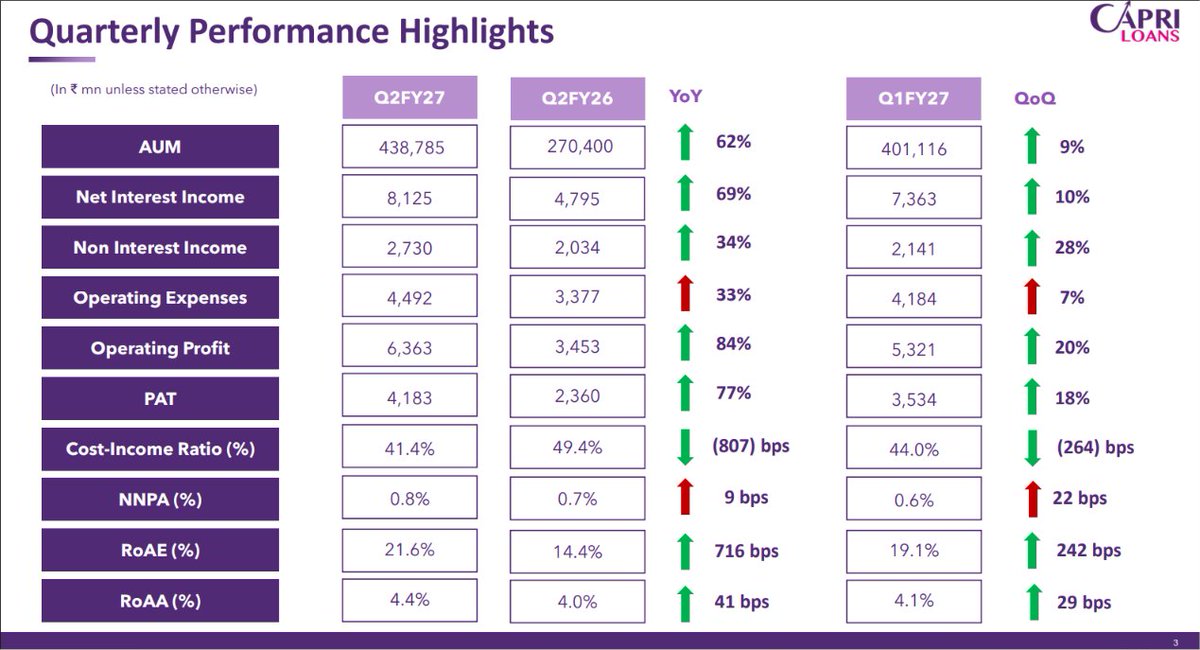
AUM grew by 62% YoY to over 44,000 cr. PAT grew by an even faster rate at 77%.
Talking about the segment wise AUM growth, gold loan grew the fastest, by over 100% and now contributes to approx. 50% of the total AUM. MSME and Housing loans also witnessed decent growth this quarter.
Disbursements grew by 50% YoY to 13,300 cr. NIM witnessed a slight growth on a YoY basis and stood at 9.6%.
Asset quality in the gold loan segment worsened on a QoQ basis. GNPA rose from 0.3% to 1.3% in just one quarter. This is because the company introduced shorter repayment cycles from this quarter. The borrower was earlier adopted to paying EMIs annually and so they could not adjust to this new cycle leading to a spike in NPAs.
But now management has discontinued this shorter repayment cycles, and NPAs will return to their earlier levels from next quarter.
But asset quality in the Construction Finance segment improved a lot on a QoQ basis. It transitioned from 0.7% to 0%, leading to overall GNPA rising by a low amount.
Drought situation has arisen in some states of the country. Only gold loan segment has suffered some stress because of the drought. Other segments have not witnessed any effect.
Other segments like MSME, Housing Finance have stable asset quality and are doing good in terms of growth and disbursements.
As part of branch expansion journey, company added 176 branches this quarter. Branch expansion contributed significantly to helping Capri Global grow its AUM at such a huge rate. They will be adding around 600 branches in FY27, 500 of them will be of gold loans.
AUM per branch has come down this quarter, and this is primarily because of the rapid branch addition.
Credit cost was around 0.8%, and management guides it to remain between 0.6 to 0.9% in this year.
Management is retaining their FY27 AUM guidance of 50,000 cr and they expect PAT to be around 1,600 cr.
FY28 guidance:
AUM - 65,000 cr
RoAE - 19 to 21%
RoAA - 4.2 to 4.7%
#SHANTIGOLD
Shanti Gold is adding a lot of capacity in the business. After their newly commissioned Marol plant, they are now working on setting up a manufacturing plant in Jaipur.
This plant in Jaipur is expected to be operational from November or December.
Both these new plants will around 5,200 kg p.a. of capacity to the business, taking the total capacity to 7,900 kg p.a. , up from earlier capacity of 2,700 kg p.a.
A good utilization level of these new plants will contribute significantly to the top-line.
For FY27, management maintains their guidance of 30-40% volume growth and 50-60% value growth, contributing to a total top-line growth of around 100%.
Yasho Industries
Some things in which we need to be careful after this quarter.
Management has decreased EBITDA margin guidance from 24% earlier to 20-21% now, which is a huge cut.
Rise in cost of raw materials has led to a bit of fall in margins. Management said that they will not be able to fully pass on these costs to customers, which leads us to believe that the company has less pricing power.
Freight costs was another reason why margins fell, and the management says that they can't comment on whether the freight cost may come down in upcoming quarters or not.
Hence, I can sense some challenges in maintaining even this 21% margin level also. Management commentary was very cautious this time.
Apart from this, the new capex which they are doing will be live from Q4 FY28 or beginning of FY29, so a lot of time until capacities get added.
Though company's top-line grew by 90%, and their future revenue guidance is good, but profitability and margins is still something we need to be cautious on.
As of now, there are other companies in the chemical industry which are doing good. I would focus on them rather than Yasho Industries.
@MohammedMo15392 Can't give any buy/sell reco but one thing I can say is that both the companies are doing great as of now, and their future guidance is also very good.
Senores Pharma Q2 FY27 Results & Concall Analysis:
Revenue grew by 25% YoY to Rs 192 cr and EBITDA grew by 38% YoY. EBITDA margins also expanded by 300 bps YoY to 30%.
Despite PAT(22%) growing at a lesser rate than revenue(25%), management remains confident of achieving 50-60% PAT growth this quarter.
Their two subsidiaries, Zoraya and Amerisyn will start contributing to revenue from H2 onwards. Because they were in the setup stage till now, they were incurring huge costs without contributing to the top-line, dragging profitability downwards.
A more meaningful ramp up of both these subsidiaries is expected from FY28 onwards, wherein we can expect that they contribute good numbers to revenue and profits. They are confident of growing revenue by 25% for the next 2-3 years.
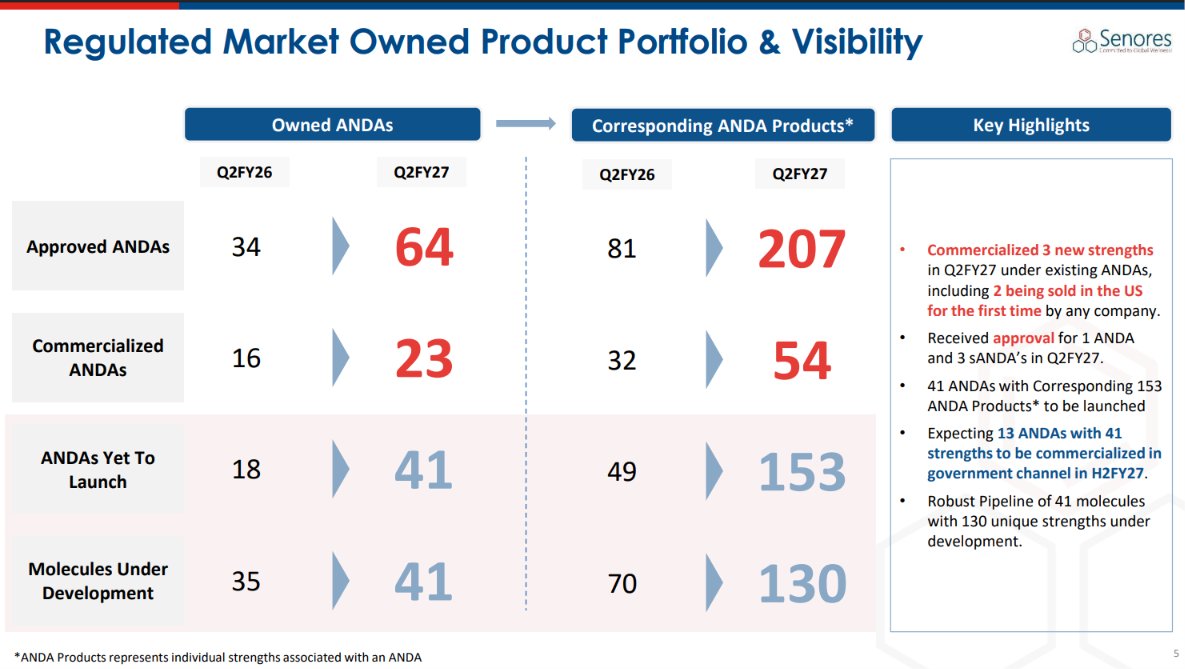
Company's approved ANDA approvals nearly doubled YoY, and it stands at 64 by the end of this quarter. 23 of these 64 ANDAs have been commercialized. The remaining 41 ANDAs are expected to commercialize within the next 6-8 quarters.
Talking about the Emerging Market segment, their EBITDA margins fell down this quarter because of higher revenue contribution from lower margin product. It is again expected to normalize from Q3 onwards. And margins of Regulated market segment is also expected to expand sequentially by 1-2 percentage points in the future.
H2 FY27 will be better than H1 FY27 for the company.
Their Apnar facility is already running at peak utilization levels. They are currently undergoing capex in this plant, which is expected to complete by Q4 FY27. This plant is expected to contribute 100 cr to the top-line this year.
FY27 guidance:
30-40% revenue growth
Atleast 30% EBITDA margin
50-60% growth in PAT
@MohitJhaMarkets Depends ki kitna ache se execute karte hain. Senores ke case me Q3 FY27 se hi subsidiaries top-line me contribute karne lag jayenge. FY28 se to ramp up or fast ho jayega,
Aeroflex Industries
Though change in depreciation method has led to inflated PAT this quarter, Adjusted PAT still grew by over 100% YoY.
Company's capex cycle is worth analyzing. Expansion in SS Flexible hoses has been completed and additional capacity is live from this quarter, and further expansion in SFN Skid Assemblies will also be live by Q3 FY27.
They have also announced a capex of Rs 200 cr to further expand these capacities, which will be live by Q4 FY28. This capex is for Hoses and Skids, and their capacities will become 1.5 to 2x of their current levels by Q4 FY28.
Earlier, management guided that they would reach at 30-35% utilization level of Skid Assemblies plant by the end of the year, but considering the robust demand scenario, they now project to touch 50% level by the end of the year. Flexible hose capacity is already running at 80% utilization level currently.
Guidance:
FY27 - 720 cr revenue (60% growth)
FY29 - 1000 cr revenue (Chances to beat this guidance are high)
FY30 - 1500 cr revenue, with the expanded capacity at peak utilization level
EBITDA margins are expected to be around 25% in the future.
Management has also announced the merger of Hyd-Air into Aeroflex, which is the company's wholly owned subsidiary. The reason behind the merger is that Aeroflex wants to use the existing facilities of Hyd Air to manufacture products which will be sold by Aeroflex. It would also reduce administrative and compliance related costs.
Sky Gold raising funds is one of the best decisions they are taking.
Capital is required to grow at a high rate in the future - Either raise it via debt or equity.
Apart from this, fraud incident at a subsidiary is something we can consider a bit seriously. Because it has wiped out more than 7% of company's PAT this quarter.
If management clarifies that they are taking steps to prevent any such fraud in the future, then it's okay.
Kyuki fraud to ab ho gaya, what they can do is try to prevent any such frauds in the future.
No problems other than this, Q2 numbers were very good.
OneSource Specialty Pharma Ltd
Another great company in the pharma segment, with great guidance for future.
Company is involved in the research, development, and manufacturing of biological drug products in various injectable formats (such as GLP-1 pen injectors, Sterile injectables, Soft Gelatin Capsules, etc.). It also offers end-to-end CDMO services.
The products they manufacture are used to manage chronic conditions like diabetes and obesity, fight bacterial infections, etc.
Revenue grew by 37% YoY to Rs 500 cr, driven by higher capacity, new product launches, and growth across all product segments.
EBITDA margin expanded by 300 bps YoY to 32%, driven by operating leverage.
Company is guiding for Rs 3500 cr top-line and 40% EBITDA margin by FY28 (vs Rs 1400 cr revenue in FY26 with 24% EBITDA margins).
Company currently has one manufacturing site focused on scaling-up of Drug-Device Combination (GLP-1). Two phases of this plant is already operational, and the third one is expected to be operational by start of FY28. FY28 revenue growth will be primarily driven by this increased capacity.
Company is also undergoing a greenfield capex for their softgel product segment.
H2 FY27 will also be better than H1 FY27 for the business.
Its definitely one of the companies you must study.
One thing which I have realized happening in many companies growing at a high rate is that their Accounts Receivables are increasing.
Make sure that an increase in Accounts Receivables is not itself a red flag. Small companies generally have less bargaining power against their customers. So they have to sell goods on debt, they have no other option.
If debtors defaults, it becomes bad debts. Increase in bad debts is a red flag. If you see too much rise in this number, then become a bit cautious.
Apart from this, some companies have also reported an increase in Inventory days, which is also not a red flag by default. Considering the future demand scenario, some management increase their inventory levels before hand only, so that they do not miss on the execution part because of inventory.
Listen to what management says on this part. If they say that their products are not sold, that's why inventory levels have increased, then its a red flag. Otherwise if they have deliberately increased inventory levels, then chill..