It's rare indeed that you find a detailed economic analysis in a Sunday newspaper. But when a "Bold new economic theory" gets this kind of coverage (double centre spread running to 4000 words), we can only describe it as an exceptional occurrence. 1/5
AFRICA SOLAR: 7 months later, and still new records are being set☀️
DRC🇨🇩, Egypt🇪🇬, Mozambique🇲🇿, Zambia🇿🇲 and Zimbabwe🇿🇼 show a particularly new step up...
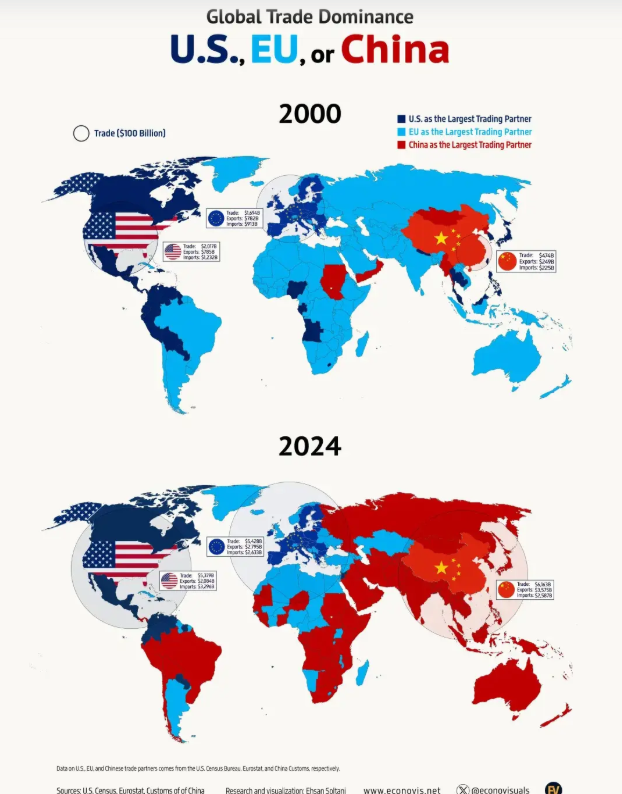
Wow, these maps... actually missed them when first published in August. The EU's challenge is absolutely stark here - global competitiveness. Which can't and won't come from domestic protectionism.
"Modernity itself—the entire project of human development, technological progress, and social organization that has defined the last several centuries—is no longer the exclusive property of the West"
This is essential reading.
Zack Polanski, "It's a tax on assets of 1% on £10m+ or 2% on £1 billion+"
"The most obvious win here is to bring Capital Gains Tax in line with Income Tax"
"The reason why that's important is right now we tax earned income more than we tax unearned wealth"
"If you're a cleaner, you could be paying more tax than the person who owns the building that you're cleaning"
"It's completely absurd. It's a political choice. We can make different political choices"
"When Ruth said it's difficult to find wealth, that there are practical challenges, so let's spend more money on HMRC"
"We keep underspending on the NHS, it shouldn't be a surprise we have a sick population"
"So yes, spend money up front on public infrastructure, on our services, but we're getting that money back, in terms of a much better economy and a healthier population"
"It's outrageous that we would have any more spending cuts"
"People in this country are tired and exhausted"
"They see the cost of living raised and they're not seeing their wages go with it"
"We have wealth in this country that we can redistribute"
"So the idea that people who are already struggling, as a result of political decisions and consequences of the past decade, are going to have to suffer another round of cuts"
"It's not a surprise to me when Nigel Farage talks about connecting with people's fear and anger, that's he doing so well"
"Of course I say this because Reform UK's solutions will make things even worse"
"That's why the Greens are doing so well right now, we're offering hope and some practical solutions"
"To say we don't need to cut spending and actually we need to tax the wealthier in our country more and invest in public services"
As it will be in the western news again this week over spying and trade, let's talk about China.
And in particular, two little-stated but uncomfortable truths. Of superior demand, and their actions to avoid being dependent on others.
And maybe... of western loss of leadership.
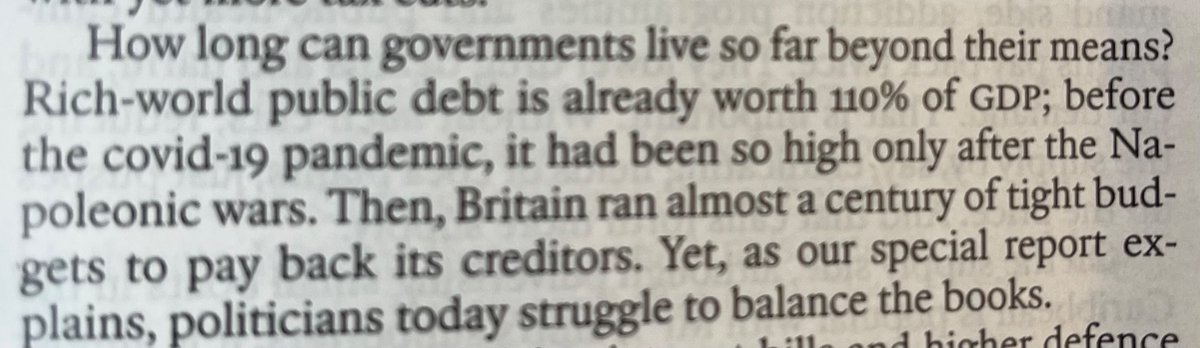
“How long can governments live beyond their means?” asks @TheEconomist.
The answer is simple: a govt that issues its own currency can’t “live beyond its means”. It creates the means. The real limits are our resources, not the Treasury’s spreadsheet.
This old household analogy, that the state must “tighten its belt like the rest of us”, is economic claptrap dressed up as moral virtue.
The last time Britain ran “tight budgets” for a century, as the Economist approvingly recalls, we had no democracy, no welfare state and no safety net. People demanding food, rights or dignity were met with the sword at Peterloo or shipped to Australia like the Tolpuddle Martyrs.
Today’s version is quieter but just as cruel: austerity that guts services, freezes wages and rewards the same corporations and creditors who profit from public contracts, public guarantees, and public infrastructure.
When they say “we’ve lived beyond our means”, what they really mean is you have - and they intend to make sure you pay for it.
The truth is, our economy doesn’t suffer from overspending, it suffers from under-investment in people and planet, & a political class still too scared to use the power of the state for the common good.
It’s a forlorn hope- but this budget the chancellor should balance the economy, not just the books.
What’s the harm of trying? https://t.co/OECckd9aMp
What if the real economic madness of this moment isn’t trying something new but refusing to do so?
Austerity has failed. Inequality is rising. Yet our politicians cling to the same broken ideas.
In this off-the-cuff, spur-of-the-moment video, I ask a simple question: What’s the harm of trying something different? Why not invest? Why not tax wealth? Why not admit that government spending creates money?
It’s time to stop pretending and start trying.
Why vote Reform when it means paying for healthcare? https://t.co/4jKzpQ0gIi
Nigel Farage has openly said he wants to scrap the NHS and replace it with an insurance-based system. That means a two-tier or even three-tier Britain: the rich buy the best cover, others get a second-rate service, and millions will be priced out altogether, dependent on a decidedly third-rate service, if they are lucky to get even that. And meanwhile, the tax cuts Farage wants will almost certainly go mainly to the rich. Why would anyone vote for Reform in that case?
The economic commentators are in a panic this morning. The government, they are saying, has overspent in August. The figure for what they call borrowing is a record for the month for five years. They obviously think that everything is falling apart. This, of course, is nonsense.
The government spent what it had to, and it recorded other expenses – like the cost of some sorts of government borrowing that will not be paid for decades – because it thinks it has no choice.
And the government did not raise as much tax as it wanted, because they think no one wants to pay it.
At the same time, everybody wants more spent on the NHS, education, social care, new housing, investment in industry, solving the migration backlog, climate change, and so much more, so the government did not actually spend enough.
These are the facts. And despite all that, there is, according to the Bank of England, capacity for at least £70 billion more in bond sales (via quantitative tightening) to be made into the financial markets than the government needs to supposedly fund its own expenditure over the next year. In other words, these reputedly wise people think that financial markets want to buy many more government bonds than the government is willing to supply by running a deficit.
The problem for all market commentators is that this is very hard for them to admit. It simply does not fit in to their narrative, when the fact is that government borrowing (which is actually nothing more than government deposit taking) is something that people really want, just as much as they supposedly don’t want to pay taxes and do want the government to spend.
The clear and unambiguous message from financial markets today is, then, that those markets actually want more – and bigger – deficits, which is the exact opposite of what commentators are saying.
In fact, just as recent market data is showing that private savers are pouring money into government-guaranteed cash ISAs, so too is the City desperate to put more money into government bonds, which they, too, know represent the only safe place from them to save in the world when financial markets are going mad, valuations are extreme, and any sense of certainty has long since disappeared.
The message of today is not that there is a crisis of government, but rather a crisis of understanding. The real message from today’s data is one that neither the markets, nor the public, nor the government are yet willing to say out loud and yet it is glaringly obvious if you just appraise the facts..
The truth that the markets and people saving in cash based ISAs are saying is that they think that the government is well under control, doing exactly what people want, and markets and individuals throughout the UK are responding in the only rational way possible: they are committing their savings in the only way that the government guarantees is safe right now, saying in the process that the government is the only person they trust.
The only problem is that market commentators don’t see the world for what it is, or market signals for what they really are, or human behaviour for what it actually represents. Right now, across the UK, massive votes of financial confidence are being cast in favour of the government and its capacity as the banker everybody wants to use to ensure that they have a safe place to deposit their money. And that is why we have high government debt. It is because people want there to be high government debt.
That is the only message we a take from what is happening, and the only one we need to hear. Everything else is ridiculous noise. It’s time the world noticed.
Every action has a reaction. That’s true in life – and in economics. Every pound the government spends becomes someone’s income, which creates tax, confidence and prosperity. Yet politicians and journalists still talk about spending as if it’s waste. In this video, I explain why that’s wrong – and why we need to ask the right question: what possibilities does government spending create?
https://t.co/XvXNnKf4Aq
Steve Keen: A Rebel Economist’s Journey https://t.co/xfT8quNISt In this first podcast-style interview between me and Steve Keen, the author of 'Debunking Economics', Steve recounts how early encounters with neoclassical and neoliberal economics, and the realities of firm behaviour, led him to reject economic fairy tales and become a rebel.
MMT describes how government spending and taxation work in fiat currency economies: no more, and no less. In this video, I explain why critics often get it wrong, why some of its fans overstate its merits, and why understanding it could change how we think about jobs, services, and growth.
https://t.co/b7fhIpoNUl
Underlying problem for G7 governments, they don't actually run the economy as once was the case, but are increasingly expected to step in if anything goes wrong (broadly defined). A combination that is arguably making nobody particularly happy. https://t.co/fsHHajS0TW
New Head Coach - “I am really looking for to be back at the club and to work with an exciting group of players and building success, there a been a buzz round the club speaking with people and I look forward to working with the new president and his committee”
We’re also delighted to introduce our new management committee — a group of passionate volunteers committed to building on that legacy and driving the club forward both on and off the pitch.
Kevin Bridges mocks Labour's assault on the disabled:
"They after disabled people? Single parents. That takes balls."
"And through disabled people's doors. This is your fault, mate. You"
"We could go after tax, avoid multinationals"
"We could go after Vodafone, Starbucks, Amazon, Google"
"But it's your fault, You"
"You're going back to work, mate"
"We don't give a how disabled you are"
"Oh you're paralysed from the neck down? We don't give"
"There will be a farm out there looking for a scarecrow"