My deep love for my creator, Jehovah gives me courage. I am a passionate photographer of the life and beauty in people and nature that God has created.
During the filming of "Indiana Jones and the Last Crusade" in 1988, director Steven Spielberg made a casting choice that immediately intrigued Hollywood. To play Indiana Jones’s father, he cast the former James Bond, Sean Connery. The twist amused everyone, considering Connery was only 12 years older than Harrison Ford. Once cameras rolled, their chemistry exploded into something rare: two generations of action icons elevating each other on and off screen.
Harrison Ford, already deeply immersed in the character by then, had concerns about the tone of the father-son dynamic. Connery walked onto set with a swagger and confidence that quickly set the rhythm. During the first table read, Connery interrupted Spielberg’s direction and quipped, “Let’s make them human, not just heroes.” That comment shifted the film’s tone. Ford later recalled, “Sean could bring dignity to the most absurd scenes, and then, in the next second, throw in a line that had everyone laughing.”
Sean Connery was born on August 25, 1930, in Edinburgh, Scotland. Harrison Ford was born on July 13, 1942, in Chicago. By the time they shared the screen, they had both become household names across continents. On the set of "Indiana Jones and the Last Crusade," their relationship felt more personal than professional. Ford once joked, “He treated me like a misbehaving schoolboy. Off camera too.”
One of the most iconic scenes, when the two are tied back to back in the Nazi castle, became a hilarious memory for the crew. The tight setup required intense coordination. Connery, known for his improvisational instincts, suddenly added a spontaneous "She talks in her sleep" line during a tense moment. It wasn’t in the script. Ford’s stunned double take became one of the film’s best moments. Spielberg kept the camera rolling, and that unscripted line stayed in the final cut. Later, Ford said, “He outfoxed me in the best way possible. I nearly broke character, and it worked like magic.”
The off-screen friendship was real. Connery once invited Ford to a golf outing in Spain during a break from shooting. Ford arrived in dusty cargo pants and a baseball cap, while Connery was in tailored trousers and pressed whites. “You're dressed for combat,” Connery said, laughing, before handing him a proper golf cap. It wasn’t about appearances. Connery liked to keep up standards. Ford appreciated that and quietly adopted the habit of carrying spare shirts for reshoots after that day.
During an interview with Empire, Connery once remarked, “Harrison has a wonderful quality. He listens. In this business, that’s a disappearing art.” Ford reciprocated the admiration, telling Entertainment Weekly, “Sean brought a kind of old-world integrity. He could silence a room with a stare and make a grip laugh in the same breath.”
Their respect deepened after the film wrapped. When Connery received the American Film Institute Lifetime Achievement Award in 2006, Ford presented part of the tribute. He opened with, “I played his son. And I learned more about presence, timing, and grace in a few weeks than I had in years.” Connery, teary-eyed, later told the press, “That boy turned into a hell of a man.”
In 2020, when Connery passed away at age 90, Ford released a short statement: “He was my father… not in life, but in film and in heart.” It echoed a sentiment that had grown well beyond the script of a single movie.
Their collaboration was a lightning in a bottle moment, two stars from different eras finding something deeply human in each other under the desert sun, Nazi chases, and ancient temples. The connection still resonates every time audiences revisit their shared adventure.
#archaeohistories
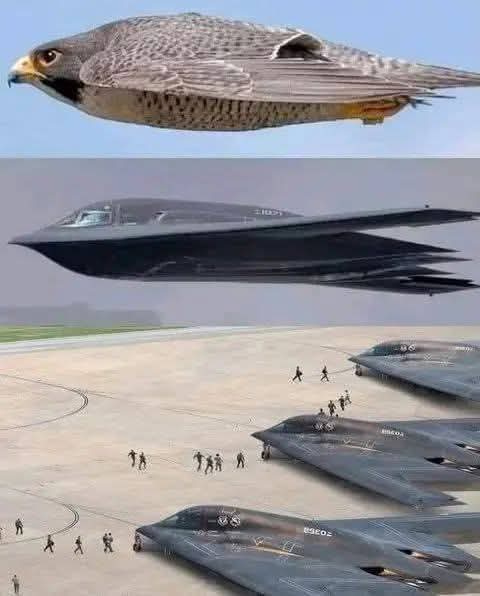
The peregrine falcon holds the title of the fastest creature on Earth, diving toward its prey at astonishing speeds of up to 400 km/h. What allows it to withstand such intense air pressure is a tiny but crucial structure in its nostrils called “tubercles.” These small bony ridges regulate airflow, preventing damage to the bird’s respiratory system and ensuring stability during its high-speed hunts.
This natural design caught the attention of aeronautical engineers. The peregrine’s nasal structure inspired innovations in jet engine technology, particularly in enhancing airflow and reducing turbulence. The lessons drawn from this bird's anatomy have led to significant advances in aircraft speed and control—contributing directly to the design of powerful machines like the American B-2 stealth bomber, a billion-dollar aircraft shaped by nature’s blueprint.
In this lies a powerful reminder of how nature often holds the answers to human progress. The Creator’s wisdom is reflected in even the smallest of His creatures. From a falcon’s dive came inspiration that reshaped aviation—proof that great innovation often begins with humble observation.
#drthehistories
A wooden model ankh (perhaps an amulet) dating to the 12th Dynasty (1981-1802 BC) of the Middle Kingdom :
"Egyptian Christian iconography was influenced in clear ways by the appropriation of images from ancient Egypt. For example, the hieroglyphic sign of the ankh, meaning “life,” was adopted and transformed into a Christian looped cross. Numerous wall reliefs at temples and tombs throughout Egypt showed gods and goddesses holding the ankh before the mouth of a human, offering life. Even when the knowledge of reading Egyptian hieroglyphs diminished, the visual message was clear: the looped cross was a gift from the gods and could be adopted by Christians. The looped cross appears on numerous Christian funerary stelae..."
― Hedstrom, Darlene L. Brooks, 'Archaeology of Early Christianity in Egypt,' in Pettegrew, David K. et al., eds., The Oxford Handbook of Early Christian Archaeology (Oxford Handbooks Online), Oxford University Press, Oxford, UK, 2019.
This piece (12.182.66), which is 15.8cm in length, is now in the Metropolitan Museum of Art, New York, USA.
#archaeohistories
‘Sound’ (loud sound), ‘sound’ (safe and sound), and ‘sound’ (water) are not related.
‘Sound’ (loud) comes from Latin ‘sonus.’
‘Sound’ (safe and) comes from Old English ‘gesund,’ meaning "healthy."
‘Sound’ (water) comes from Old Norse ‘sund,’ meaning “strait."
Getting soooo tired of X. I follow who I choose.
But more and more my X is filled with unfollowed idiotic posts that I have to block.
This morning so far I've blocked 30 or 40 trashy posters.
@ctvedmonton That's strange. I live in Welland which appears to be in the red zone on your map, but a major storm isn't in the forecast here. Only flurries and possibly freezing rain...
@AMAZlNGNATURE Amazing the dog survived with a brain dead driver like that. Neither one has seat belts, but the dog has an excuse: he's git a dog brain.
Hey Canada! Got fresh flakes falling in your area? 🌨️
Tag @weathernetwork + @murphTWN and use #SnowingSomewhere for a chance to be featured on TV! Whether it’s a dusting or a deep drift, we want to see it! 📸❄️
Terracotta Dice from Harappa; an ancient city of Indus Valley Civilization (2600-1800 BC), now in Pakistan.
A cubical dice with 1 to 6 dots was found in rubble during excavations at Harappa between 1995 and 2001. Many dice were also found at Mohenjo-daro, and John Marshall writes: "That dicing was a common game at Mohenjo-daro is proved by the number of pieces that have been found. In all cases they are made of pottery and are usually cubical, ranging in size from 1.2 by 1.2 by 1.2 inches to 1.5 by 1.5 by 15 inches.
The dice of Mohenjo-daro are not marked in the same way as to-day, i.e. so that the sum of the points on any two opposite sides amounts to seven. Instead of that, 1 is opposite 2, 3 opposite 4, and 5 opposite 6. All the examples found are exceedingly well made with well-defined edges; the points are shallow holes averaging 0.1 inch in diameter. The clay of which they are made is light red in color, well baked, and sometimes coated with a red wash.
These dice must have been thrown on a soft surface, such as a piece of cloth, or on dusty ground, for their edges show little sign of wear. It is not yet known whether these objects were used in pairs, but two specimens found in the Dk Area (of Mohenjo-daro), not far from each other, are exactly the same size."
Source - (Marshall, Mohenjo-daro and the Indus Civilization, pp. 551-2)
Lahore Museum, Pakistan
#archaeohistories