After a crash, pipelined RL can take hours to regain steady state in large-scale runs. It also biases early samples after a restart.
Introducing in-flight rollout checkpointing!
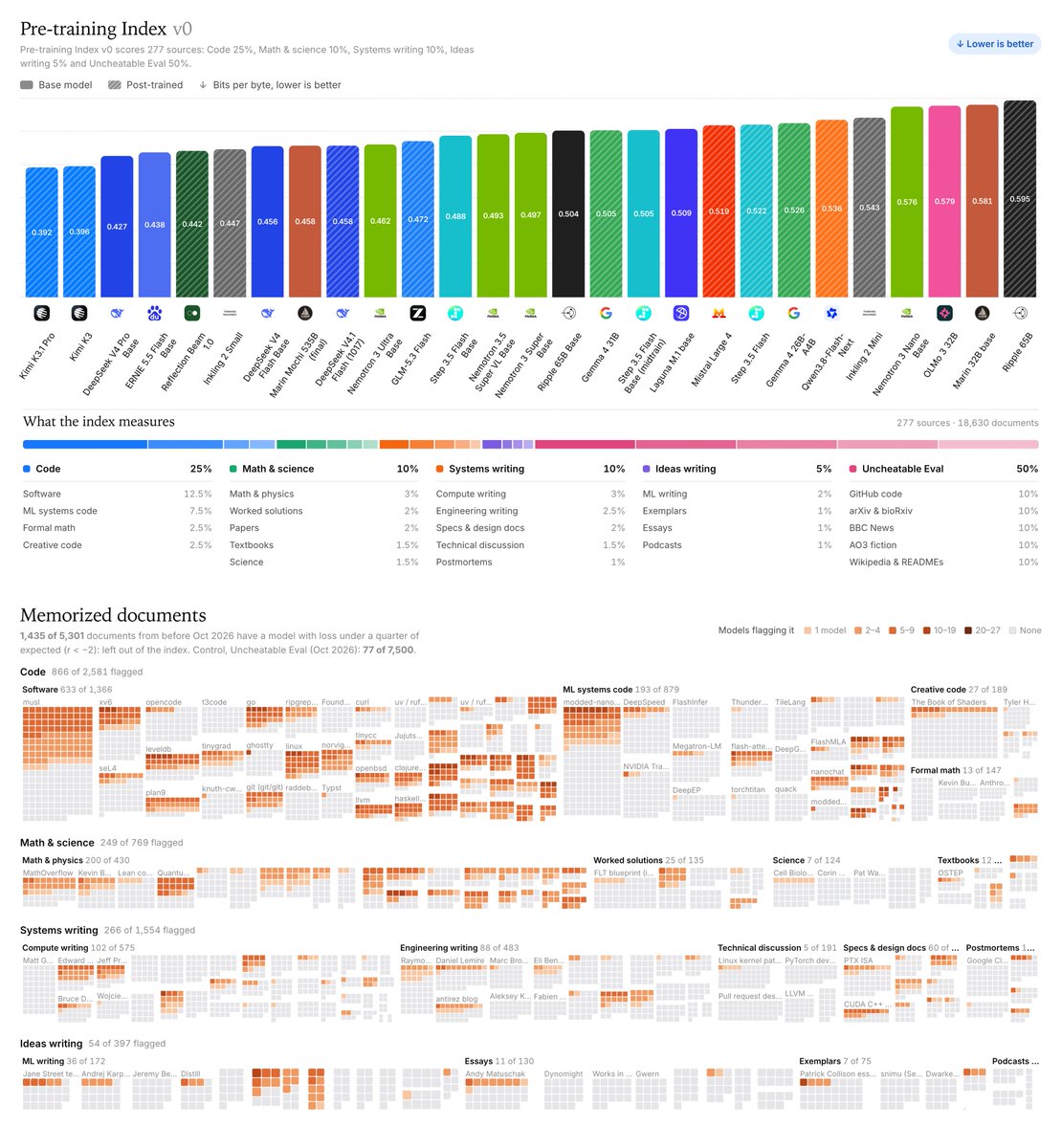
openai recently shared perplexity numbers for their models on their internal codebase. this is super valuable information and we need more public comparisons like this, so here is a first try with open models
introducing v0 of pre-training index
https://t.co/r3hVb7xmNP
it covers 27 open models (base and post-trained) on ~260 curated sources (code, math & science, systems writing, essays) + uncheatable eval
there are a few challenges with comparing perplexity across models. first if the model is train on a document it can easily mememorize it and then have veryyy low ppl on it. one obvious fix is to only use very recent documents that can't be in the pretraining corpus, which is what uncheatable eval does (50% of the index). but i was a bit frustrated because it cuts a lot of the sources you can include, so i tried a few ideas
first, you can compute a win rate, if a model memorized a doc its loss collapses, but if you use win rate that only counts as one win (hence kinda normalize the importance of each document)
second, you can try to detect outliers (document where model have insanely low loss on)
loss(model, doc) ~ difficulty of the doc + skill of the model + r
difficulty is the median loss of all models on that doc, skill is how much better the model usually is than the median of other document in the sources and r is what's left. r < -2 means a loss 4x lower than expected
this seems to work pretty well. on uncheatable eval (published after every model's cutoff) only ~1% get flagged, vs 27% of older docs. by default the index drops every old doc that any model flags (with r < -2 as the threshold) for all models
some other notes
- i didn't have time to "base recover" the post-trained models, so keep in mind their base model perplexity is likely much lower! i think there is a lot to study here, especially the impact of SFT, distillation and RL on ppl
- for the curated sources, i took some of my favorite blogs and some i know high quality sources, gave them to neon, opus, sol and a few more models and asked them to find more like these and just iterate with models and looking at data. i know source quality is probably not the biggest differentiator here, oai does it only on their held out codebase, but there is something cool about evaluating how well models do next token prediction on the best stuff humans wrote
- i would prefer held out set for everything obviously, but i wanted to try to see a bit how we could detect memorization, and if/how it matters for different model and training process likely have impact on this! you can make the index 100% of uncheatable eval to remove as much as possible memorization
- i also asked a model to filter out heavily ai generated code/text on some sources, but i think it's relatively fine to have some llm generated data here (i know there is some). it might be a bigger issue for oai/anthropic models since they write a lot of code
- you can customize everything and build your own index by changing the weight of each domain, toggling sources on/off, picking the r cutoff, and clicking any document to see which models look like they memorized it
- there is also a lot of cool work on compression/memorization by nicholas carlini and others that i need to look into more!
- this first version of the index is OBVIOUSLY not good to compute ppl threshold to release model or not, probably a lot of way to under/overfit on it, and not the goal here
wanted to share this publicly quickly, i'll keep improving it when i have time and look for better ways to handle memorization. please give feedback and send cool resources to include!!
Would say the shift in compute demands for different stages has also played a big part here (due to RL running inference, shifting usages into agentic coding, ...)
Things that could increase pre-training cost by 2-3x without a proportional effect on inference look far more desirable compared to before
- longer long context pre-training
- more epoch aware training
- more compute spent on synthetic data
- certain types of looping
- more expensive optimizer work
Also its a bit unclear what counts as a base model, like doing midtraining phases with agentic traces from the previous generation model could be a factor here, "reusing" compute spent on large scale RL
As in the difference between continuing to post train a model vs the next generation
If i midtrain gpt 6 astra base on gpt 6 astra traces, i could potentially have better ppl but the gap between post training this new base vs continuing post training gpt 6 astra is what matters (unclear how much this reduces ppl tbf)
Great release!
One thing to note here tho is not having the pre-training compute, model sizes, and inference compute per token does make it harder to understand the implications.
Slowdowns or speedups in this plot could be mostly from scaling model size or algorithmic progress or spending more compute per token (like looping, scaling that doesnt show in model size), and i would say the difference matters quite a bit
We decided to provide more transparency into pretraining progress at OpenAI for the sake of moving toward shared safety bars. In “Perplexity and Intelligence” I argue for common limits based on perplexity and other measurements, with progress beyond them gated on our ability to understand AI behavior.
https://t.co/XX35m5vq89
we have a (new) pretraining feature that lets you do autoresearch on top of @karpathy's nanochat scaling ladder on a few nodes but also launch jobs on thousands of gpus with automatic recovery
love how beautiful these scaling plots look even at very small scale
Introducing Model Factory.
Train, deploy, and continuously improve your own models on one stack.
Run on-demand, on dedicated clusters, or bring your own.
Own your intelligence. Own your model factory.
oh wait misunderstood the first reply. Meant MLA mightve been a bad arch decision if going for codesign
But ya tbh i do think codesign mainly lies on data and arch in the aspect of inference efficiency (although even here could make some cases that maybe a more expressive arch even if it doesnt initially show it could after lots of RL end up with more efficient rollouts for example)
I would guess theres defo codesign on the optimizer aspect too, things like conventional lr schedulers for example are mainly designed with a direct split in mind between pretrain and post-train
Would also say stuff like deepseek v4.1 flash and inkling 2 small (prob best base models for their sizes out there), deliberately doing much more training in long context (not done before much) is a byproduct of this
Tbf u could say a decent amount of pressure for models that are more efficient for inference is the scaling of RL
Also surprised its not mentioned that this isnt just about pre-training arch but rather everything around it too
no point is tuning ur pretrain data mixture with the sole goal of improving on post train evals and rl task distribution could do things like lean more towards cutting out lots of general knowledge data, or maybe stuff like humanities books
Still dont have great ways to actually measure the impact these have, but more likely than not would be useful to keep u could argue (for performance on less verifiable domains, to capture human preference better)
Ya an aspect here is rl benchmarks not being great at capturing less verifiable stuff which certain pretraining decisions might offer on the data side even if not very well benchmarked
So relying too much on maxxing out rl task distributions could have some bad side effects here
I think many groups are trying to do this or actually doing this (like agentic benchmarks during pretraining or Mistral report) but it would be hard in general, considering task scaling laws and long context benchmarks are still open research areas. Especially for post-training it would also depend on data/task composition for it. But I think it could be feasible to establish scaling laws for it.
Today we release Ripple-65B Preview, our 65B dense LLM we pretrained from scratch.
Ripple sets a new state-of-the-art for U.S. open-weight models in agentic coding tasks, surpassing significantly larger models including Muse Spark Open-816B, Beam-501B, Inkling-975B, and Nemotron 3 Ultra-550B.
Learn more: https://t.co/Pe04ZKhkE9
Public evaluations are foundational for assessing model capabilities.
We looked at some popular evaluations and found issues, which we fixed.
Sharing our findings:
At 96.9%, Prime Inference has the highest cache hit rate of any provider serving Nemotron 3.5 Super VL.
This brings the effective input cost to $0.024/M tokens, the lowest of any provider, and ~70% below the largest provider.
Introducing Prime Mega MoE.
We made DeepSeek's Mega MoE kernel trainable. The results on two Qwen3 models:
• Up to 55% faster MoE training than TorchTitan
• Up to 34% faster hosted training with prime-rl