Program note:
A 'Sovereign Wealth Fund' (aka the Canada Strong Fund) financed entirely by $25 billion of government-issued debt when the gov't is running deficits, is not a wealth fund. It's a debt fund. A wealth fund would be financed by budget surpluses, which we don't have.
The Federal Budget
"a prototypical Liberal budget, in that it introduces a host of new spending commitments, picks and chooses winners and losers in the economy, expands the government’s reach into areas typically governed by markets, offers vast new subsidies for Cdn content and makes promises everyone knows won’t be kept, such as ending homelessness within a decade. (Note: In 2017, the Liberals came up with a plan to cut homelessness in half, only to see it increase 160%.)"
- Jesse Klien, National Post
The Experiment with QE and Abundant Reserves has been a failure. Let's go back to Milton Friedman. Always ask W.W.M.F.D. What Would Milton Friedman Do? https://t.co/si4dtFmwxw
Canadians are being sold a deceptive picture of the federal government’s finances. That’s what my @financialpost article is about this week.
Prime Minister @markjcarney recently boasted that his government is “on track to balance the operating budget next year, one year ahead of schedule.”
Sounds impressive. Except there’s a rather large problem: the operating budget is a construct of the government’s own making, based on an old accounting trick - that I’ve written about for the last 18 months since the government adopted this horrible practice - that allows it to decide which spending counts and which spending gets moved into another column.
Imagine a couple whose paycheques don’t cover their spending, so they top up the difference every month using their home equity line of credit. One of them has an idea: split the household budget in two. Put the mortgage payments and new roof into an “investment” column. And why not the groceries? After all, well-fed kids grow into productive adults.
Move enough expenses into the investment column and - voilà!!The everyday household budget balances!! Problem solved!!
Except the line of credit keeps growing and the bank still wants its interest.
That’s essentially what the Carney government is asking Canadians to accept with its operating/capital budget framework. And the Parliamentary Budget Officer has, once again, demonstrated how easy it is to pull off this trick.
It starts with defining “capital” and making it so broad that it is easy to shift spending out of the operating budget without changing actual government spending or borrowing. The PBO previously estimated that the federal government’s measure of capital investment in the 2025 budget was overstated by roughly $94 billion compared with international practice.
That’s not fiscal discipline. It’s deceptive accounting presentation.
And here’s why it matters: public debt charges are expected to be $58.7 billion this fiscal year - more than Ottawa expects to collect from the GST. That’s roughly $1,400 for every Canadian, or $5,600 for a family of four. By 2030-31, those interest costs are projected to reach $80.9 billion.
Carney can call expenditures “capital.” He can celebrate balancing the “operating budget.” But none of that changes the amount Ottawa actually borrows or the interest Canadians have to pay.
Debt is debt is debt.
When the fall budget arrives, ignore the deceptive accounting labels and ask the question that actually matters: Is the government genuinely restraining spending and borrowing, or is it simply moving enough expenditures into another column to claim success?
A financially literate household wouldn’t pretend its debt disappeared because it changed the labels in its spreadsheet. Canadians shouldn’t accept that practice from their government either.
https://t.co/EOKoNYpilq
We are seeing a total failure of MMT around the globe.
QE and deficit spending (after 2008 and during COVID) was basically an attempt at Modern Monetary Theory (MMT). In a nutshell, MMT says that we can print and deficit spend at will without any fiscal or economic complications.
So, central banks held interest rates at zero, forcing markets to accept absurdly low rates. At the same time, these central banks printed massive amounts of money and absorbed a lot of this new debt themselves.
MMTers said we could do this with no inflation. Clearly they were wrong. Friedman taught us exactly what would happen, and it did. Inflation took off. The result, central banks were forced to raise rates and stop expanding their balance sheets.
So far, governments have resisted fiscal sanity and are still running massive deficits even though central banks stopped funding them.
The result? In the past 3 months, 10-year bond yields are up 50 bps in the UK, 90 bps in France, 72 bps in the US, and more than 40 bps in Germany.
Governments were already too big in 2008, but this crazy experiment over the past 18 years has pushed things toward a breaking point.
France proposes to freeze government pay and pensions, and raise some taxes and we should expect more movement toward austerity in other countries soon.
MMT is basically Keynesianism on steroids. It didn’t work. The fix is a revival of Austrian, supply-side economics. Smaller governments, lower tax rates, tighter money, and less regulation. Some will say this is a pipe dream. But it is the only way out.
When David Eby became premier in Nov, 2022 - the province had a surplus of $5 billion.
Since then there has been 4 full letter-grade downgrades (2 - Moody's + 2 - S&P), with additional negative outlook revisions pushing the total "downgrades/negative actions" to 5–6.
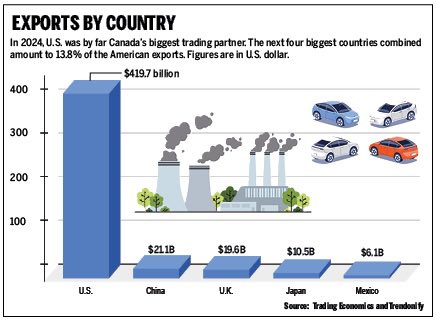
This chart that we published earlier this year shows Canada’s biggest export markets in 2024.
Serious question for all those arguing we don’t need the U.S., don’t need a deal, can pivot to other markets…
Who will replace the $400 B USD we sell them each year?
"How can the federal government balance a budget without actually reducing the deficit?
Simple! Just change what you call the spending.
I’ve been writing for almost two years about the federal government’s decision to deceptively divide its budget into “operating” and “capital” spending - and, more importantly, about its extraordinarily broad definition of what qualifies as capital."
- Kim Moody, tax expert, FCPA, FCA and TEP, Founder Moodys Private Client
I've been watching too many people try to dunk on Poilievre on this issue.
Look into the deals Norway, Iceland and Switzerland have with the EU. Closest thing to "associate membership."
And they pay into EU programs, through their national governments, but have no say, no vote.
“The result will be as cynical and dishonest and unnecessary an election call as I have witnessed in more than 40 years of covering B.C. politics.”
- Vaughn Palmer, Vancouver Sun
#bcpolitics
Numerous misleading headlines stated "Canada's GDP grew 3.3% in second quarter"
Fact: Canada's GDP grew 0.8% in Q2 - it is only going to be 3.3% annual growth if the next 9 months continues to compound a the same rate as Q2 -
Not going to happen given Stats Can's initial forecast for July is 0.0% growth
The Warsh speech, in spite of him wanting less in the way of news, is actually creating more news than a Powell speech. Why? Because Powell didn’t address anything that mattered. Money didn’t matter. He dodged questions about why inflation happened. Warsh is actually talking about real monetary policy.
Yesterday, when the Treasury announced buybacks, and the bond market rallied…I got sick to my stomach. It’s rearranging the chairs on the decks of the Titanic. The real problem - Deficits (all over the world). Governments have lost their minds. No amount of financial engineering will fix this. The only thing that will fix it is to stop spending. If governments actually raise taxes to levels needed to fund their current drunken largesse, they will kill all growth and make problems even worse. The other problem with all this spending, is that we are borrowing from savers and giving it to consumers. We are eating our seed corn. In addition to all this, we are not hearing about the losses in pension funds, insurance companies, banks, and central banks in Europe or Japan or the US. They are huge. Pension funds bought debt at negative interest rates and now face huge losses. To repeat: The only way to fix this is to stop spending. Or, somehow miraculously to lift growth rates. But, governments are larger as a share of GDP and this has reduced growth rates. Keynesianism works in the reverse way people are taught in school. It’s crushes growth in the long-term even though it feels good in the short-term. The US’s $40 trillion in debt is a long-term problem…issuing 3-month T-bills doesn’t make it a short-term problem. Buying back long-term bonds doesn’t make it a short-term problem. Governments have to start facing reality and stop pursuing short-term, feel-good, nonsense solutions. Again: Cut the size of government…it’s the only real solution.
The mandatory Canada Pension Plan contribution rate for self employed is 11.9% of the first $74,600 of pensionable net business income, plus an additional 8% on the next earnings up to a max of $85,000 income
🚨🇨🇦 Why the Canadian dollar keeps falling. The actual reasons.
📌 Recession: only G20 nation in one
📌 Rate differential: Bank of Canada cutting, US holding
📌 Capital flight: $1 trillion out in a decade
📌 Trade risk: CUSMA uncertainty, China EV friction with Washington
📌 Productivity collapse: less machinery than a decade ago
📌 Energy handicapped: carbon tax kills competitiveness
📌 Debt expanding: $3.2B grocery announcements with no funding source
Currency markets don’t watch press conferences.
They watch fundamentals.
Every Canadian fundamental is pointing the wrong direction.
Your grocery bill isn’t just inflation.
It’s a falling dollar making every import more expensive permanently.
#CdnPoli #CAD #Recession #Carney
Milton Friedman on inflation:
“Inflation is just like alcoholism. In both cases when you start drinking or when you start printing too much money, the good effects come first. The bad effects only come later.”
“That’s why in both cases there is a strong temptation to overdo it: to drink too much and to print too much money.”
“When it comes to the cure, it’s the other way around. When you stop drinking or when you stop printing money, the bad effects come first and the good effects only come later.”
“That’s why it’s so hard to persist with the cure.”
So what exactly is the problem with letting citizens have a say?
Oh right.
Control. Power. Greed.
And it is no surprise who is paying for articles like these.
What I do not understand is how these people sleep at night. Is the money really worth it?
Is it worth undermining public debate?
Is it worth dismissing citizens?
Is it worth sacrificing the interests of future generations?
Is it worth trying to convince people that democratic participation is somehow dangerous?
Judging by the full-blown fear and disparagement campaign now underway, I think we are getting our answer.
So thank you for coming out and showing everyone exactly what you stand for.