The Graham Lab is now on Bluesky! Follow us on Bluesky at @grahamlab.bsky.social to hear about our recent work, thoughts, and group activity. Posts will now appear on both Bluesky and X.
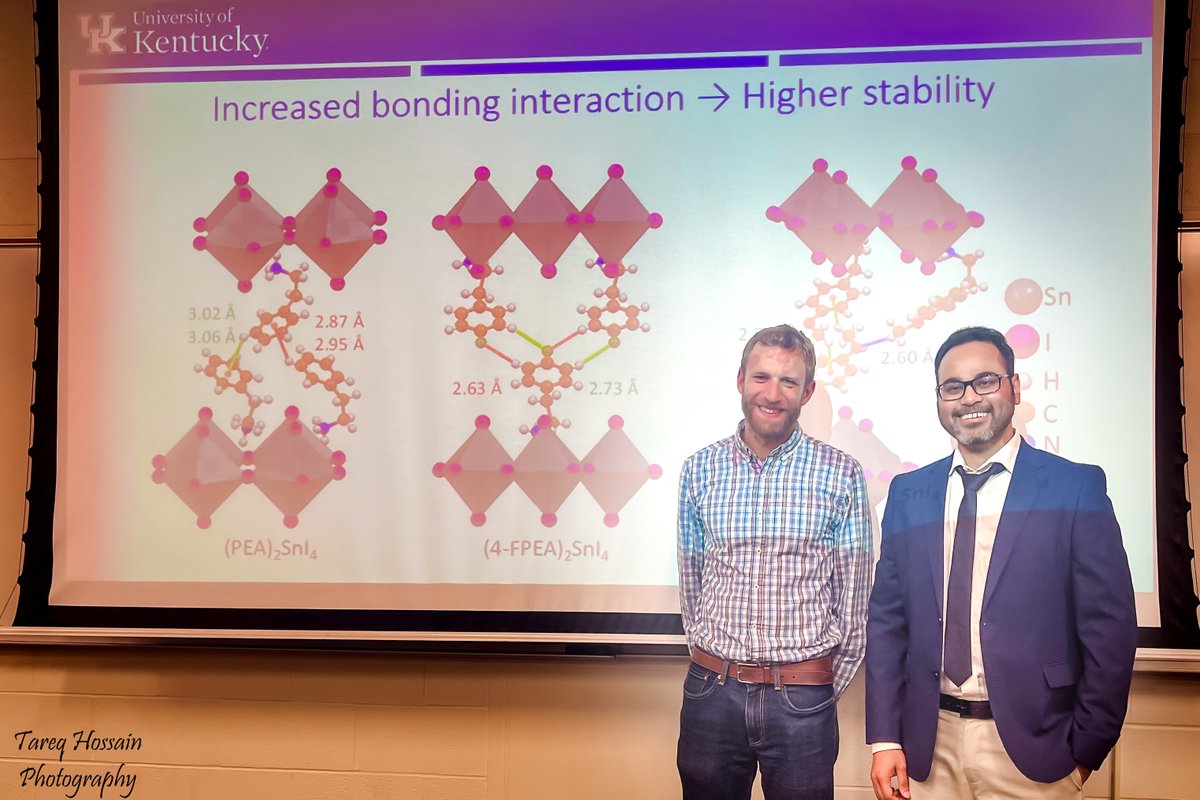
Key points: Strong intermolecular interactions in the organic layer, low steric hindrance around the ammonium group, horizontally oriented inorganic sheets, and high hydrophobicity all lead to increased stability.
Increasing the stability of organic metal halide perovskites remains a major challenges. Led by Tareq Hossain, @SSM_Tareq , we show how the ammonium cation structure can be used to increase stability in 2D tin halide perovskites: https://t.co/X7ciDRuIG0
Congratulations to Augustine Yusuf for leading the work and thanks to MRS Communications for including Ken Graham as an Early Career Distinguished Presenter at the 2023 Fall MRS Meeting.
The counterion can significantly influence the electronic and thermoelectric properties of doped conjugated polymers. Here, we show that the counterion size plays a role in determining whether the Seebeck coefficient changes sign upon heavy doping. https://t.co/aI9ieU79aL
means that all carriers are effectively free, regardless of counterion size. In this high doping regime, morphology dominates the electrical and thermoelectric properties. Great collaboration with the groups of Chad Risko and Aron Huckaba. @cmrisko @SimpleChem
Does counterion or dopant size matter in doped organic semiconductors? It depends on the doping regime. At low doping levels large counterions lead to reduced Coulomb interactions and more delocalized charge carriers on the polymer backbone. https://t.co/1vlk2bk7WQ
More delocalized carriers result in higher electrical conductivities with larger dopants in the low doping regime. In the high doping regime the Coulomb interactions become insignificant due to an increased dielectric constant and flattening of the energy landscape, which
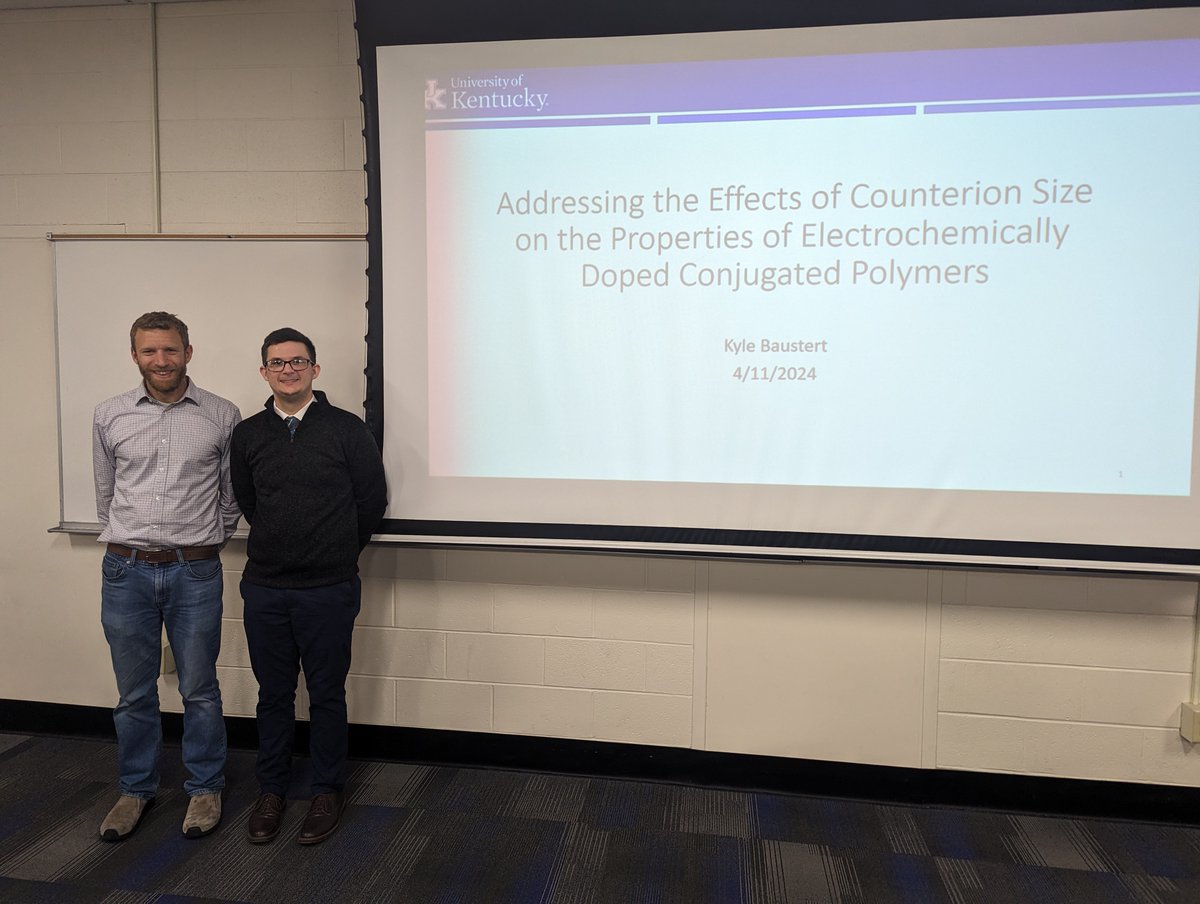
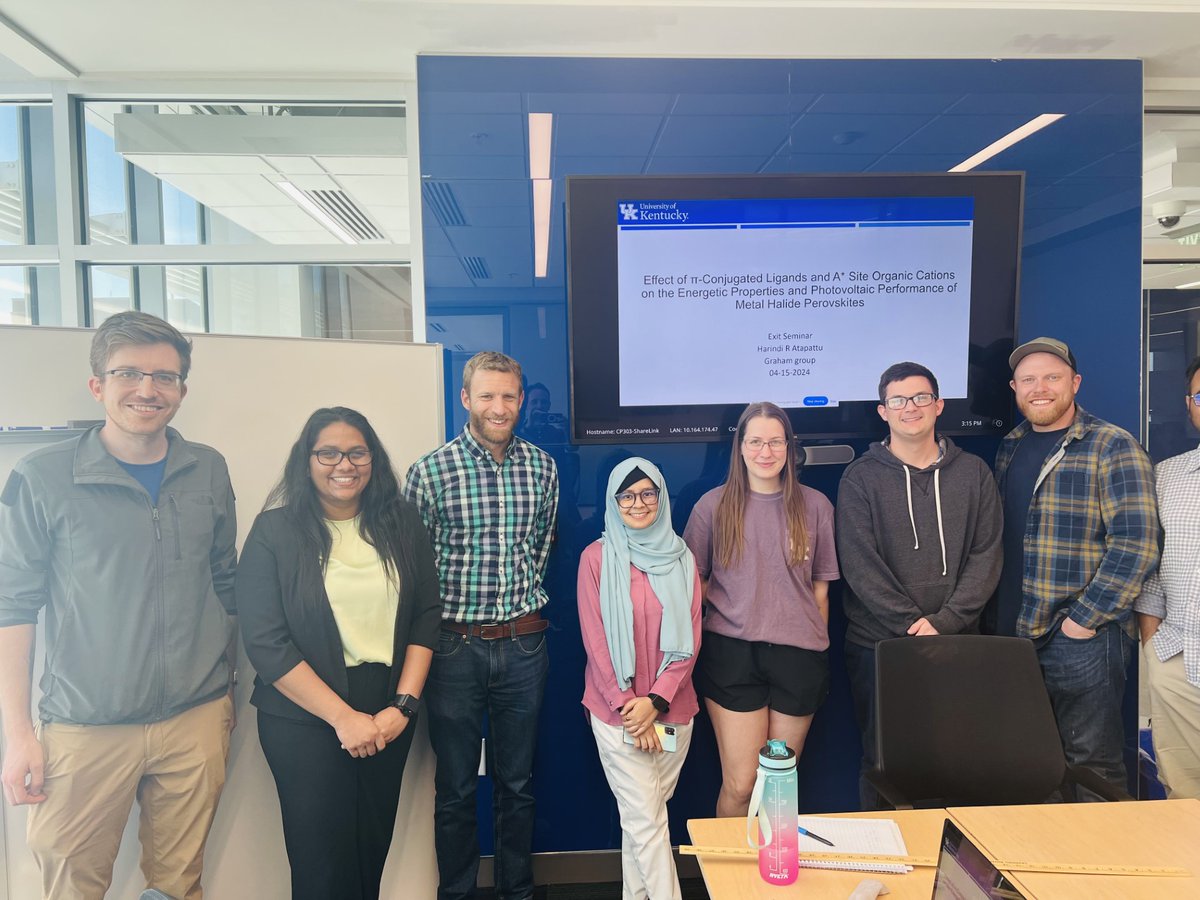
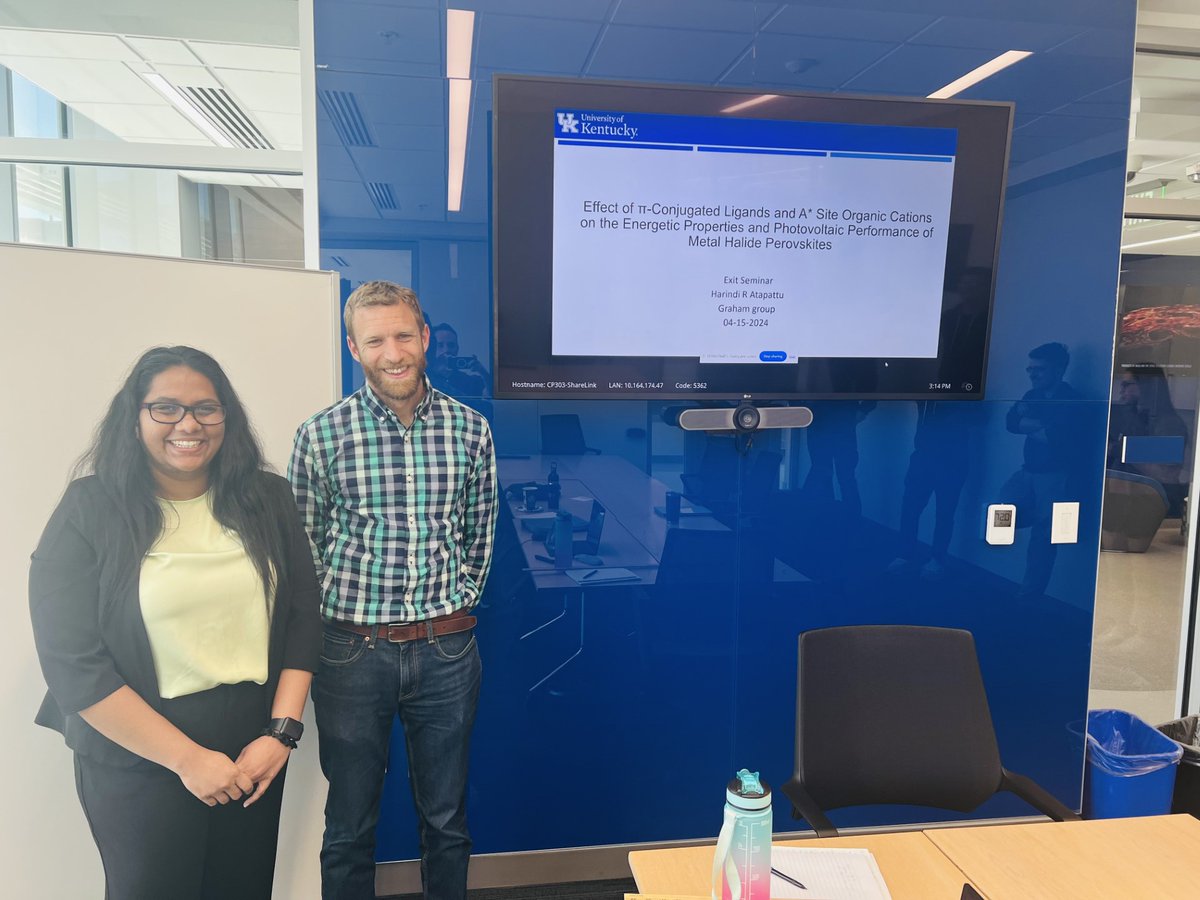
Congratulations to Harindi Atapattu, Kyle Baustert, and Tareq Hossain for defending their PhD dissertations! All have done excellent work in the group and will be greatly missed. @harindi92@SSM_Tareq
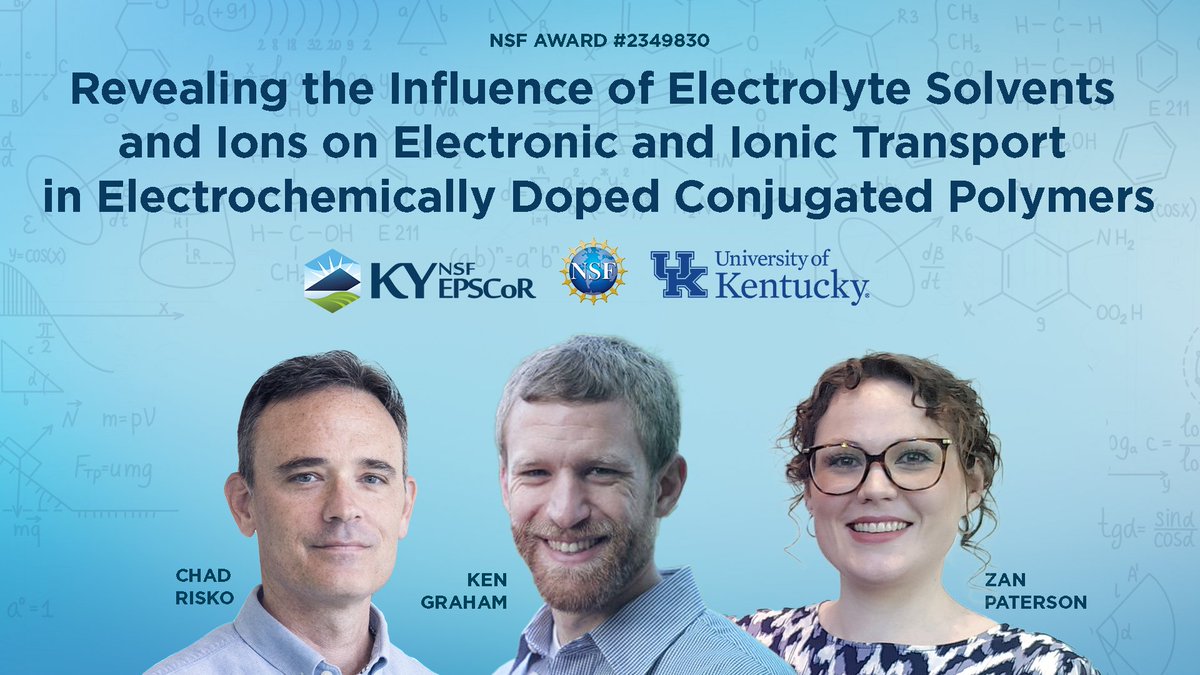
Congrats to @GrahamLabUKY, @zan_paterson, and @cmrisko on their NSF award!
UK Interdisciplinary Team Granted NSF Award to Build Insights into Mixed Electronic-Ionic Transport, STEM outreach in Kentucky
Read more: https://t.co/BR7jvwWCtY
Congratulations to Joy Syed for successfully defending his dissertation today! Joy began his PhD working on silver nanowire composites for transparent electrodes and finished with setting up a system for TAS and investigating defects in Sn halide perovskites.
Great collaboration with Matt Beard and the Luther and Zhu groups at NREL. Big thanks to Matt and Rebecca for hosting Tuo and Ken at @NREL. @pioneertataliu @mbthz@JM_Luther@ukychem
Tuo’s work on tuning interfacial energetics in perovskite solar cells is now published in Cell Rep. Phys. Sci.! https://t.co/7TTUymSjgc Here, we show the dominant influence of surface ligands on perovskite solar cell performance is in how they shift the interfacial energy gap.
ligand is due to the larger interfacial energy gap, as measured during stepwise UPS measurements and supported by differential capacitance measurements. This increased interfacial energy gap leads to a higher open circuit voltage in the PV cell at a given carrier density.
Surface ligands are commonly used in perovskite solar cells, with many ligands forming 2D phases. Here we show that ammonium containing ligands that do not easily form 2D phases result in significantly improved stability in perovskite solar cells. https://t.co/YsY5S58iOQ
structure PSC with a fluorinated anilinium derivative. An encapsulated device at 85°C and 50% relative humidity shows a 1500+ hour T85. Great collaborative work led by So Min Park, Mingyang Wei, and Jian Xu. @sominpk@harindi92@JonTPham@cmrisko@tedsargentNU_TO
Ligand reactivity is tuned primarily through sterics, with anilinium derivatives favoring surface adsorption and phenethylammonium favoring 2D phases. Through tuning the ligand reactivity and surface passivating ability, we demonstrate a certified PCE of 24.09% for an inverted