Reasoning by analogy is fast. It's also where most decisions quietly go wrong.
Two disciplines correct for it: first principles thinking (strip a problem to its foundations and rebuild from there) and second-order thinking (trace a decision's consequences past the obvious first effect).
They get treated as interchangeable. They're not. One looks backward into a problem's foundations to build something new. The other looks forward into a decision's consequences to avoid being blindsided by what it sets in motion.
A first principles thinker asks what is actually true. A second-order thinker asks, and then what.
New piece, with the Musk/Tesla battery example, Howard Marks on first-level vs second-level thinking, and where the two disciplines actually meet:
https://t.co/GCpa0ywgq6
The easiest defence of what happened to the Post Office in South Africa is also the least honest: that digital disruption made the outcome unavoidable. It didn’t. This disruption was the condition, and what actually happened inside the Post Office was the cause. https://t.co/qhHdZ1H4Jf
There’s always inherent risk in financial transactions and supportive structures.
I hear echoes here of the 2008/09 financial market crisis. That time showed us that it doesn’t matter if this is regulatory disclosed; the structures in 2008/09 had oversight.
Arrangements like this always work until they don’t work, and then when the music stops, everyone is looking for a chair. But, there aren’t any.
Beware the hand that offers too much to be true!
People think #AI is smarter than it really is. It can predict and copy patterns well, but it doesn’t truly think, understand, or reason like humans do.
Venture capitalist Marc Andreessen’s philosophy he explained, is: “Move forward. Go! … People who dwell in the past get stuck in the past.”
Silicon Valley generally ignores that reflection and introspection were actually central to the emergence of modern society.
Read more here - https://t.co/JP1PHDM4q9
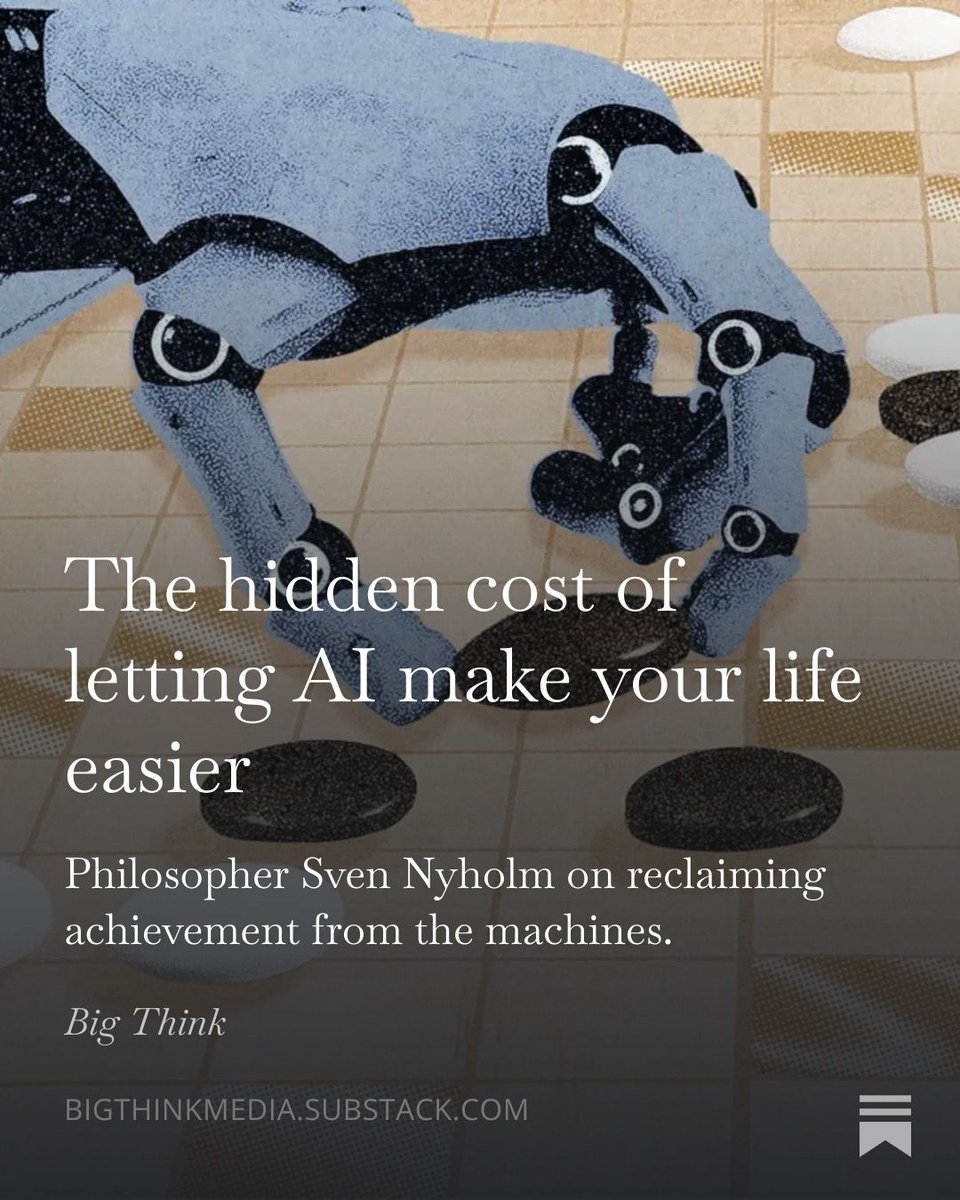
A top AI researcher warns that most people are using AI in ways that actually weaken their thinking.
Vivienne Ming’s experiment found that only a small minority use AI to challenge and improve their ideas — the rest risk long-term cognitive decline.
She urges users to adopt “hybrid intelligence” to avoid this trap.
Read more here - https://t.co/pNcb815iqR
We should all have heard at some time what the Peter Principle is. Well, here are a few lesser known principles and laws you've probably never heard of.
Here - https://t.co/wlIekeNOcV
Why affirmative action (DEI) still divides South Africans.
It is a policy that has entrenched race even deeper into society, harmed growth, and after more than 30 years as an official government policy, it has outlived its purpose.
https://t.co/CDBZR6x4FN
#SouthAfrica#DEI
@JohnCleese They have five children between them, and thankfully, they are, by my review, all adults now.
There may, however, be a case worth investigating to see if their adult children have the same opinion about child abuse.
Wow, what alternative do parents have in South Africa!
You seem to be saying that it’s the parent’s fault if their children die in transit while using a taxi, and parents should spend more money than they do to avoid their death.
Can you be that heartless. I can’t be reading this right.
@ErnstRoets@MaxduPreez I was watching Julius’s court case yesterday, so I have learned a lot!
I have to say @MaxduPreez that in this case the evidence against you for stalking @ErnstRoets online is overwhelming!
Maybe Julius’s social worker friend can help you with this problem.
Remember that this is the same Christine Lagarde who was convicted in 2016 in the Bernard Tapie affair.
As France’s Minister of Finance, she approved private arbitration in a dispute over Tapie’s Adidas sale. This resulted in a €403 million public payout that was later found fraudulent and had to be repaid.
The special court convicted her for failing to challenge the award despite the expert advice she received. Interestingly, no penalty, fine, jail time, or criminal record was imposed.
While she was found guilty in a court of law, she continues to deny any wrongdoing and now holds a high position at the European Central Bank.
Shakespeare aptly observed, “Methinks the lady doth protest too much,” meaning that repeated denials can ironically make guilt seem more probable, as innocent people usually don’t feel compelled to over-insist on their innocence as she does.
As a European public figure, and given her questionable past record, any comments she makes are questionable because she has proven to lack judgment, which has affected her integrity and credibility.
@wideawake_media Yesterday it was 87 billion euros. What will it be tomorrow?
My heart bleeds for European tax payers. Find a peaceful solution and stop feeding the fire!
AI can now generate entire worlds from text prompts.
What does this mean for how we think, create, and connect?
Could AI rewire Gen Z’s attention span?
Read more - Big Think https://t.co/2pkqWtJIuy
#AI#GenZ