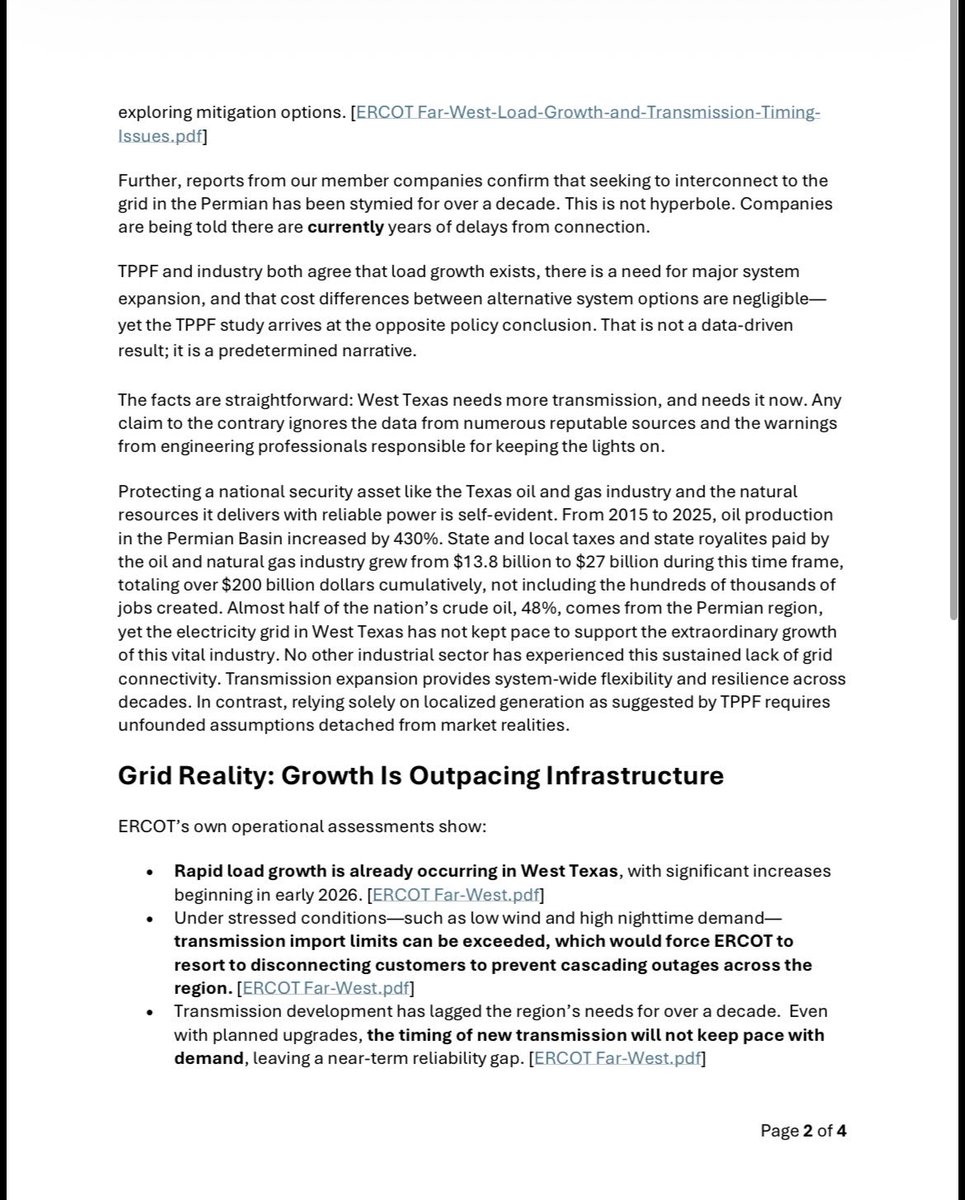
Whoever wrote the letter either didn’t read @TPPF’s report or doesn’t understand it. The report correctly and unequivocally demonstrates that STEP is unreliable, unaffordable, and unnecessary. TPPF has said consistently that the PUC should expedite local transmission in the Permian Basin. What Texas and the Permian Basin do not need is a massive $33 billion project that creates no new generation, increases costs, and ignores property rights. Better alternative plans exist that provide the energy the PB needs. Lawmakers should pause the STEP proposal and consider those plans before pushing Texas further in the wrong direction.
Hmm…why do west TX oil and gas operators desperately want more grid power? They have all the nat gas they need (basically $0 cost).
If you had an endless supply of fuel to make electricity, would you still want to bring in power from hundreds of miles away, just because?
Busy day on the electricity front: the O&G associations sent this letter today to #txlege leadership/PUC/ERCOT backing the transmission buildout to West Texas, criticizing the @TPPF white paper from the other week.
Background on this 765-kV issue and that paper: https://t.co/lmB68lUf9G
A Texas-built drone boat just made history, executing the first sea drone rescue in combat.
This is what happens when you let businesses innovate and give them freedom to build.
Texas companies are leading the world and strengthening our nation. Texans take care of America.
https://t.co/mmgGZT4dBV
James Stockdale spent seven and a half years in the Hanoi Hilton. He was tortured fifteen times. He disfigured his own face with a razor so the North Vietnamese could not use him for propaganda.
He built a tap code that turned solitary confinement into a network. Prisoners who could not see each other kept their sanity through the walls.
Stockdale was a Navy commander when captured. He became the highest-ranking American prisoner of war in Vietnam. That rank made him a target.
The North Vietnamese wanted him to sign confessions. They wanted propaganda broadcasts. They wanted him on camera endorsing statements against the American war effort. Stockdale refused every request.
The refusal cost him. He endured physical coercion fifteen times. Rope bindings, beatings, and painful positions left permanent damage to his legs. He spent four years in solitary confinement. Two years were in leg irons.
When guards said he would be paraded before journalists, he went to his cell. He used a razor to slash his scalp. He beat his face with a wooden stool. Swelling and bruising made him unfilmable. The guards found him bloodied and abandoned the plan.
On another occasion, when guards threatened to harm other prisoners if he did not comply, he broke a window and cut his wrists. It was not surrender. It was a signal he would rather die than comply. The guards treated him and reduced their demands.
Stockdale’s greatest achievement was building a community inside the prison. He developed a tap code using a five-by-five grid of the alphabet. Each letter corresponded to its row and column, tapped in two sequences.
Messages traveled through walls, under doors, and between buildings. Prisoners who could not see each other communicated. They shared news, jokes, and orders. Stockdale passed commands down the chain and received information back.
The tap code gave structure, leadership, and the knowledge they were not alone. He established rules: resist as best as possible. Do not volunteer information. Recover after every interrogation. The rules gave broken men a framework to regain dignity. Resilience, not perfection, was the goal.
Stockdale was released on February 12, 1973. He walked out of Hoa Lo with permanent leg injuries. He was awarded the Medal of Honor.
He said, “You must never confuse faith that you will prevail in the end with the discipline to confront the most brutal facts of your current reality.”
The people of Normandy showing up for our World War II veterans! What an honor it was to be there with them today! Thank you to the Best Defense Foundation for all you do for our Greatest Generation 🙏🇺🇸
The US now has 42 companies trying to develop and deploy SMRs. That’s way too many. A big shakeout is coming. But that didn’t stop Hadron Energy, a rank SMR startup, from going public last week. And two more SMR companies are planning to go public over the next few months. Here’s my latest: https://t.co/V5NTWCJr1n
Matthew McConaughey reveals the difference between a nice guy and a good man
"A nice guy gets along. They don't necessarily have discernment or judgment, not sure what they stand for or stand against. It's like yes, yes, yes, sure"
"A good man has ideals that they stand for and they stand against. And when they're tested, a good man is not a nice guy"
"Being a good man is a lot harder for good reason. Not going to be the most popular. Not going to be always the most affable"
"It also doesn't mean you got to be a dick. It just means sometimes you got to go, I believe in this, this is for me, and that is not for me"
"A good man's not looking for trouble. But if it comes, and if something he cares about was trespassed on, a good man does what he can to stop that"
84 years ago today, a pilot running out of fuel made a decision that won the Pacific War. Most Americans have never heard his name.
June 4, 1942. Six months after Pearl Harbor, Japan's navy is undefeated. Four of the carriers that burned Pearl, Akagi, Kaga, Soryu, and Hiryu, are steaming toward Midway to finish off the US Pacific Fleet.
At 7:52 AM, Wade McClusky launches from USS Enterprise leading 32 Dauntless dive bombers. Here's the detail nobody mentions: McClusky is a fighter pilot. He'd been given the air group weeks earlier and had barely flown a dive bomber in combat. Now he's leading every SBD the Enterprise has at the most important target in the Pacific.
9:20 AM. He arrives at the intercept point where the Japanese fleet is supposed to be.
Empty ocean. Nothing for miles.
The Japanese had turned. Nobody knew where. And now McClusky owns the worst math problem in naval aviation: his fuel is bleeding away, and every minute he keeps searching, he condemns more of his own pilots to ditch in open water where nobody will find them.
Doctrine is clear. Turn back.
McClusky keeps going. He works a search pattern, squeezing miles out of dying fuel tanks.
9:55 AM. Far below, a single Japanese destroyer is cutting a white scar across the ocean at flank speed. It's the Arashi, racing to rejoin the fleet after depth-charging the American submarine Nautilus. Think about that. A failed sub attack is about to give away the entire Japanese navy.
McClusky reads the wake like an arrow and follows it.
10:02 AM. The horizon fills with the entire Japanese strike force. Four carriers, their decks crammed with planes being refueled and rearmed. Fuel lines snaking everywhere. Bombs stacked in the open.
And here's the miracle: the sky above them is empty. Minutes earlier, American torpedo squadrons had attacked at sea level and been annihilated. Torpedo 8 lost all 15 planes. One survivor, Ensign George Gay, watched what came next while hiding under his seat cushion in the water. Those doomed pilots dragged every Japanese fighter down to the waves. The door upstairs was wide open.
10:22 AM. McClusky pushes over from 14,500 feet. Both squadrons follow him down onto Kaga. It's actually a mistake, doctrine said split the targets, but Lt. Dick Best catches it mid-dive, pulls out with two wingmen, and goes after Akagi alone. His single bomb pierces the flight deck into the packed hangar. It's enough.
By 10:28, Kaga, Akagi, and Soryu, the third hit simultaneously by Yorktown's bombers, are floating infernos. Six minutes. Three carriers that attacked Pearl Harbor, gone. Hiryu follows them to the bottom that evening.
The cost of McClusky's gamble was real. Many Enterprise bombers never made it home, some shot down, others swallowed by the sea when their tanks ran dry. McClusky himself was jumped by two Zeros on the way out, took five bullets through his shoulder, and still flew his shot-up Dauntless back to the Enterprise.
Admiral Nimitz said McClusky's decision "decided the fate of our carrier task force and our forces at Midway." Japan never won another major battle.
One borrowed pilot. One destroyer's wake. One choice to keep flying when every gauge said go home.
Mach will be vital to the safety and future of free societies.
As an outlier in defense innovation, Mach has proven with unprecedented speed to flight, production trajectory, and contract success that rebuilding America's industrial base is of prime importance. The team's mission-first ethos drives this strategy with urgency and operational discipline.
This aerial view of energy service and logistics yards in Midland/Odessa highlights why the Permian Basin is a dominant force in energy production. Critical parts, services, labor, repair/refurb, manufacturing, assembly - nearly every input required for efficient manufacturing production of oil and gas is contained in a tight knit support ecosystem. Honed through decades of vision and refinement, few industries in the world concentrate execution and capability firepower as seen in the Permian Basin.
California is the poster child of expensive energy policies—gas $2 higher than the national average, reliance on foreign oil imports, aggressive ‘clean energy’ taxes on every gallon at the pump.
That’s not the result of any global crisis, it’s the result of bad energy policies.