ED Australian Institute for Progress. Online pollster, political commentator and occasional strategist. Surfer, father and musician. Pronouns: your choice.
@PeterOfPerth@JEChalmers Hadn't looked into that. I know they have a whole lot of gas off New Brunswick that could be extracted and exported to markets faster and more cheaply than ours. Something else to think about with loons running around wanting higher taxes on our oil and gas.
Canada is awkward for @JEChalmers’ housing-tax story. It has a 50% CGT inclusion rate and negative gearing. Yet housing affordability is improving rapidly as migration pressure falls under Mark Carney’s left-wing government. The problem isn't tax it's demand. Fix demand, Jim and Albo.
One quarter of private sector growing faster than the government. Not a lot to hang your case on. And they aren't paying back debt, they're adding to it. The debt they inherited was much less than the debt we have now. The data centres are going to make our energy poverty even worse. The Liberals would not have let the energy system get to this desperate spot.
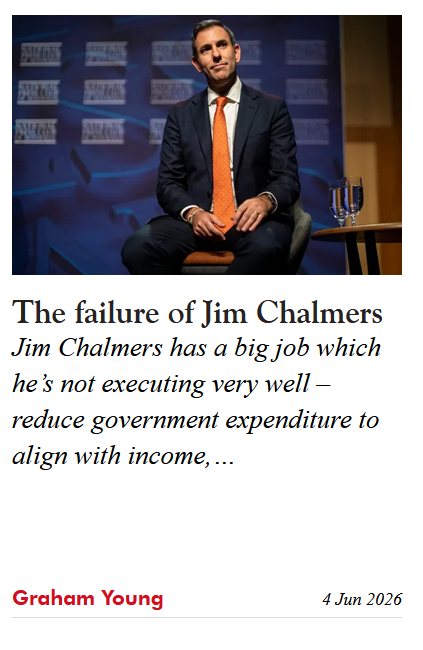
Jim Chalmers has a big job, but does he even know what it is? Instead of reducing government expenditure to align with income, repaying debt, and increasing economic growth he's running as fast as he can in the other direction. Worse he's torching his reputation over minor revenue increases in property taxes. My latest from The Spectator.
@AbdulKhalid25@JEChalmers No one buys a property for the deductions. So there's your problem. It is the same as Australia. The only difference is we allow depreciation as an expense and they don't.
@timritchie@iL1keTurtles Political economy I'd guess from your comments. That's not economics. And if you leave silly comments on my thread and I have time I'll call you out.
@iL1keTurtles Government is less productive than the private sector so reduce size of government and private sector can expand. Bigger economy different mix.
Why did the Allies refuse to negotiate with Hitler, even when Germany begged for terms?
Because they had done it before. And it created Hitler.
In November 1918, World War I ended not with Germany's defeat on its own soil, but with an armistice, a ceasefire negotiated while the German army was still intact and standing on foreign territory. No Allied soldier had marched through Berlin. The German public never saw their army broken.
That gap between reality and perception became the most dangerous lie of the 20th century: the Dolchstoßlegende, the "stab-in-the-back" myth. The story that Germany's army was never truly beaten, that it was betrayed from within by politicians, socialists, and Jews who signed a shameful peace. It was false. But it was potent. And a failed Austrian corporal named Adolf Hitler rode that grievance all the way to the Reich Chancellery.
The Allies of WWII understood this with absolute clarity. They were not going to make the same mistake twice.
The doctrine: Unconditional Surrender.
In January 1943, at Casablanca, Roosevelt announced the policy that would define the rest of the war. No terms. No armistice. No negotiating Germany's fate at a table. Only total, unconditional capitulation. Churchill backed it. Stalin, who was watching the Red Army bleed by the millions on the Eastern Front, demanded nothing less.
This time, Germany would be defeated completely, occupied entirely, and forced to confront its own defeat with no room left for a betrayal myth. The fight would end in Berlin, not at a railway car in a French forest.
The Germans tried anyway.
As the war turned, the peace feelers came, each one revealing how badly Berlin wanted an off-ramp.
In 1941, Rudolf Hess, Hitler's own deputy, flew solo to Scotland in a delusional bid to broker peace with Britain. The British didn't treat him as a diplomat. They locked him up for the rest of his life.
In 1944, the July 20 plotters tried to kill Hitler partly in the hope that his removal might unlock a separate peace with the West while continuing the war against the Soviets. The bomb went off. Hitler survived. The conspirators were hanged, some with piano wire.
In 1945, Heinrich Himmler, the architect of the Holocaust, secretly tried to surrender to the Western Allies alone, cutting out the Soviets, using a Swedish intermediary. The answer was no. The coalition would not be split.
Notice the pattern. Every German overture aimed at the same prize: peel the Western democracies away from the Soviet Union. Divide the alliance. Survive to fight another day.
The Allies never took the bait. Not once.
Hitler shot himself in a bunker on April 30, 1945, as Soviet troops fought block by block through Berlin. Days later, the surrender came, unconditional, exactly as demanded. Signed at Reims on May 7, ratified in Berlin on May 8. No terms. No myth. No ambiguity about who had won and who had lost.
This time, the German people would not be able to tell themselves a comforting lie. The Reich was occupied, divided, and forced to reckon with what it had done.
There's a reason the post-1945 peace held while the post-1918 peace collapsed into something far worse within a generation. A defeat denied is a defeat that festers. A grievance left alive is a grievance that gets weaponized.
The Allies didn't refuse to negotiate out of cruelty. They refused because they had learned, at a cost of tens of millions of lives, that some enemies cannot be appeased, and some victories must be total to mean anything at all.
History doesn't always rhyme. But the people who ignore it tend to repeat the worst verses.
@Sycorax2020@JEChalmers It's all relative. As a central banker he's also partially responsible for the mess by pushing interest rates too low, and then leaving them there for far too long. But yes, better understanding than the Commonwealth government and Treasury.
@AbdulKhalid25@JEChalmers What do you mean? Who said "unlimited", but interest and cash expenses, yes. Not like Australia where they want to pretend landlord's don't have expenses.
You can always depend on The Australia Institute (not). So by not stealing taxes through inflation you actually put taxes up? Not bloody likely. Labor has a whole ecosystem of grifters in a symbiotic relationship with them. They'll do whatever it takes to keep their host alive.
New analysis by The Australia Institute reveals that if the Howard Government had introduced the current Liberal policy of indexing tax brackets to inflation to counter bracket creep, Australians would be paying significantly more tax today.
Read more 👇
https://t.co/lJMqGJx684
Here's the relevant part of the transcript, which was all about housing taxation. Symonds is not the most articulate speaker, but I don't think he is making a claim about general taxation. You have to be prepared to interpolate a bit to understand what he is saying all the way through the interview.
JOHN SYMOND: If you haven't got a good deposit, you're buying for to live in do your best to get into homeownership, because we've still got us, New Zealand, has got the best tax system in the world as far as your own home goes. There's no tax, there's no inheritance tax. That's the good news.
The bad news is that we're the highest taxed country in the world on everything else and my advice would be – be very careful right at the moment. I mean, these proposed new taxes are going to have to go through Parliament first. Wouldn't surprise me if they back off a bit, because really, it's got the ability to sink the economy and people are, you know, people won't be able to afford even worse than what it has been of homeownership – especially first home–buyers and my advice is – do not take, do not get yourself into any property if you only have got 5 per cent.
You're exposing yourself. You're punting on the roulette table. If it drops, you're in big trouble. What about you and I let's buy a property, and you know, we say we break up. Who is going to pick up?
@DrCraigEmerson He's a smart man, so in that case he misspoke, as they say. And it is the highest in the world, so let's talk about whether pricing yourself out of the international capital formation market is smart when you are making so many other things unattractive to investors.
@25MMCC@DrCraigEmerson Happy to help you out with a more recent properly constructed graph. You can't compare Australia to the rest of the OECD unless you adjust for the compulsory superannuation levy. And our tax take is heading in the wrong direction.
No it's not real because it's not a cost, and you're spouting a left-wing talking point. When you pay more tax than you are obliged to and the ATO refunds it there is no cost to the ATO as they were never entitled to the money in the first place. That's at least partly recognised by the new system where losses will be carried forward, and the figure will not end up being that much less as it will reduce future taxation.