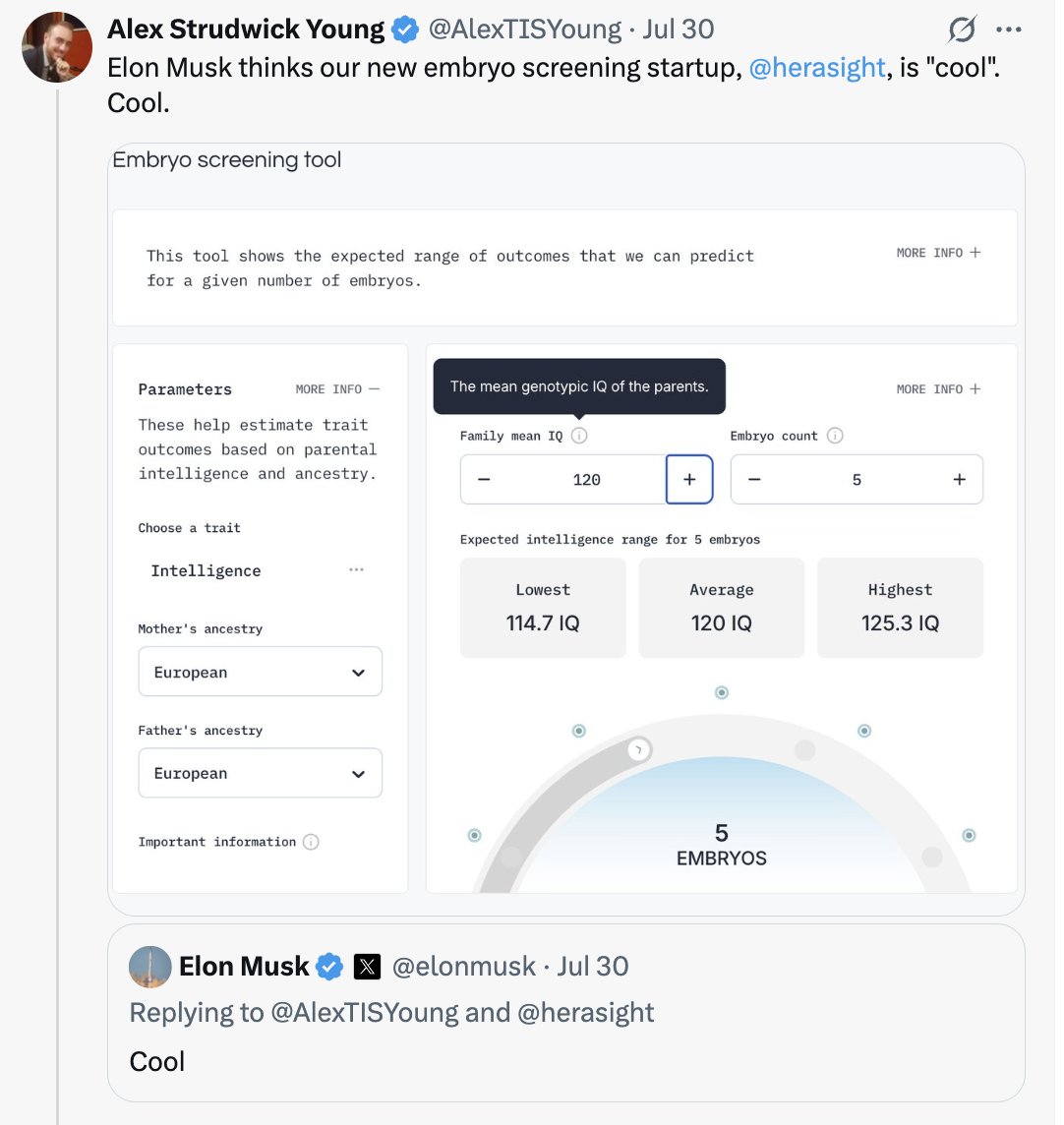
A few thoughts on Herasight, the new embryo selection company. First, the post below and the white paper imply that competitors like Nucleus have been marketing and selling grossly erroneous risk estimates. This is shocking if true! 🧵
These embryo-selection startups are clearly feeding into an alt-right ecosystem that revels in techno-futurism much as such movements have in the past. GWAS participants & parents navigating IVF deserve better than being used as tools to attract the attention of edge lords.
It is depressing, but all too predictable, how swiftly we’ve gone from the Social Science Genetic Association Consortium offering reassurances about the uses of behavioural polygenic scores to one of their lead authors marketing embryo selection for IQ
Herasight, named after the goddess who threw her disabled child off a mountain, seems focused on public outreach using embryo selection for IQ to win over far rightwing pseuds & techbros
I wrote a bit about the two very interesting studies of siblings/families from last week. Tan et al. family GWAS (https://t.co/MWjNKZJUiC) and Sidorenko et al. sibling heritability estimates (https://t.co/DfPWuWA9R1). A few surprising findings summarized here: 🧵
@AlexTISYoung@SashaGusevPosts It's also not obvious why one would be interested in that particular LATE, so it seems easiest to say that unbiased estimates of the effects from family studies require that heterogeneity in effect sizes is random wrt genotypes. 4/n
@AlexTISYoung@SashaGusevPosts As you say, we show that for a single causal allele, family studies provide an unbiased estimate of the average allelic effect in the children of heterozygotes (a LATE). But I don’t think that's what people think of when they hear that it is an “unbiased estimate of a DGE” 3
Looking for examples for class of STRUCTURE-style bar plot of hunter gather, early farmer, and steppe ancestry proportions for Europeans. Arranged temporally to shows various turn overs. Looking for something broad in temporal scope but simple enough to talk undergrads through.
Two new chapters from my free online book in human genetics out this weekend!
These complete Part 3 of the book, on human population structure and history:
3.3: Inferring human prehistory from genetic data [this thread]
3.4: Ancient DNA [next thread]
https://t.co/GHMPCTv6BL
Excited to share this new preprint with @spence_jeffrey_ and @DocEdge85 in which we developed a method to infer demographic history and mutation rates from millions of genomes, and applied it to gnomAD v4 data. Read on for a brief thread!
https://t.co/gLVQ77Sa5M
@SashaGusevPosts@jrossibarra Even in simple cases we never got it fully calibrated, nor have better implementations done so IIRC, as while better it not the right model for > amounts of drift. So many people take just an emp. outlier approach, show overlap reasonable genes, but avoid strong abs # statements