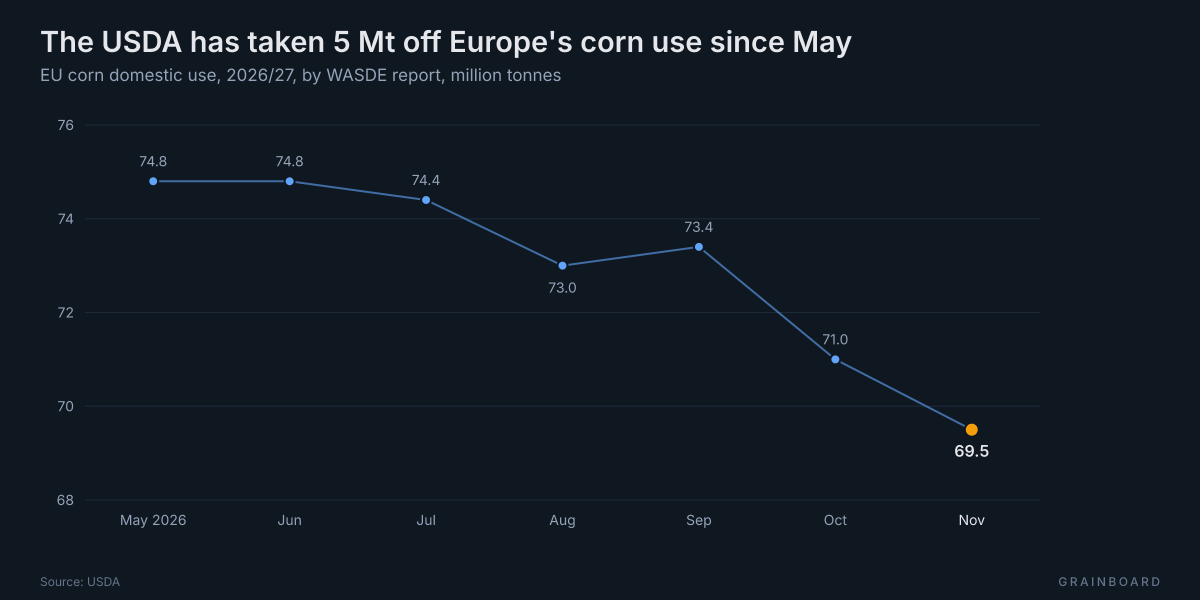
South America has 4 Mt more corn in this month's WASDE, and the USDA still cuts Europe's imports by 1 Mt. Brazil keeps most of its extra crop for its own use, and Ukraine, the nearest supplier, loses 2 Mt of exports to a railway that cannot move its harvest faster.
Several of them are markets French wheat rarely reaches, and nobody else is stepping in: Canada's extra wheat has gone to Asia and Latin America, Argentina's old crop to Brazil, Indonesia and Chile.
French wheat loadings ran 13 to 26% behind a normal season through the summer, then caught up in five weeks on a smaller crop. What changed is who is buying: West and North African customers that Russia and Ukraine can no longer reach by sea.
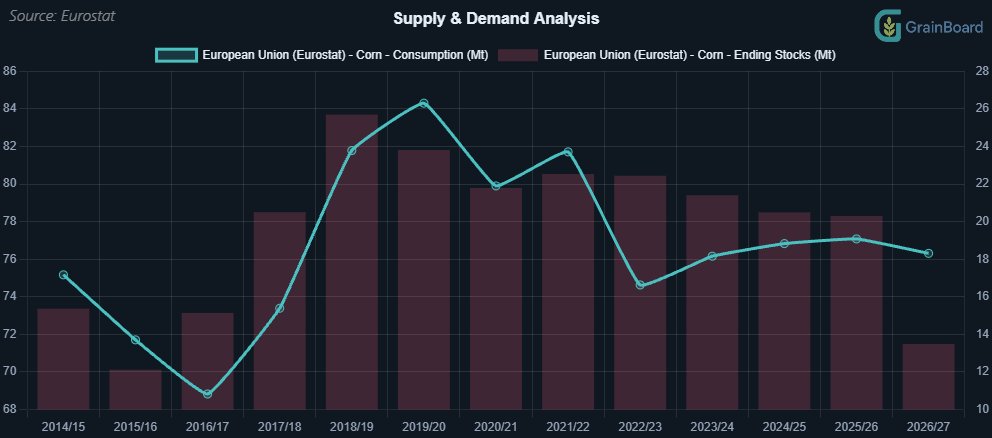
But prices are pushing buyers the other way. March corn on Euronext sits 30.75 €/t above wheat, and US corn lands in Spain at 244 $/t against about 289 for March Euronext. Everything points feed buyers toward wheat and imports, and this balance has them barely moving.
The Commission took another 1.3 Mt off EU corn on Friday, to 47 Mt, about 6 Mt below the 2022 drought, and raised feed use to 58.74 Mt in the same report. That is more than the 58 Mt the EU ended up feeding in 2022/23, and stocks drop to 13.5 Mt, about nine weeks of use.
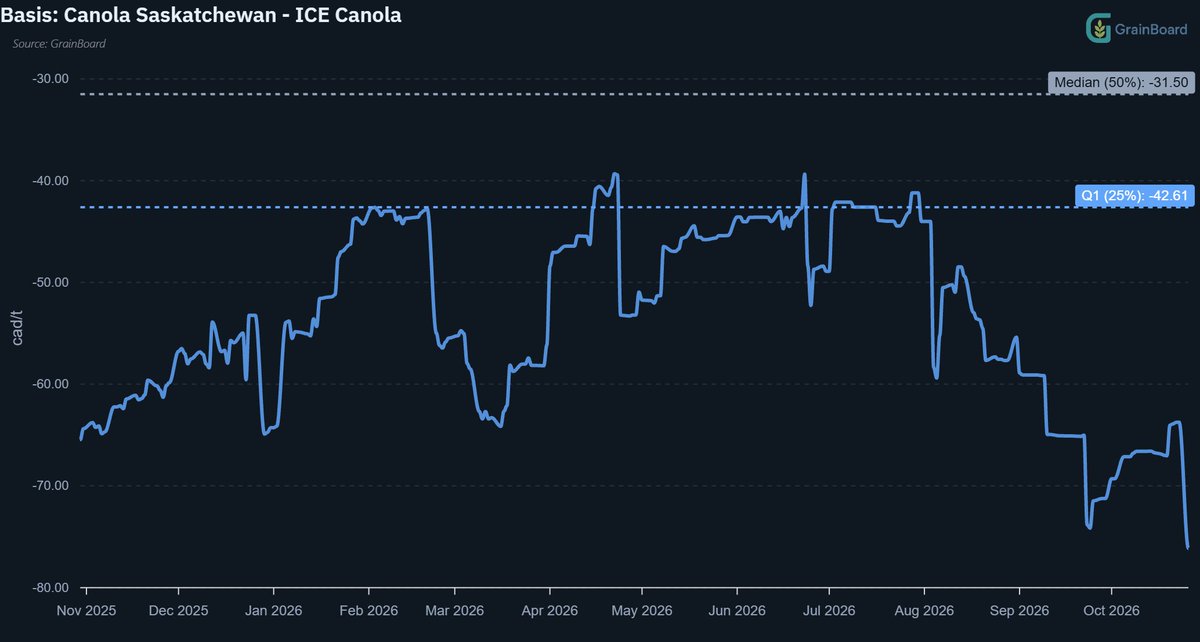
And yet the price is falling. ICE canola has lost about 5% in dollars since the end of September, no more than soybeans, while Saskatchewan farmers get 76 CAD/t under futures, 10 less than a year ago. A harvest is being sold hard, and it is hiding the demand underneath.
Canada is going through its canola faster than its own balance sheet allows. Crushers took 2.47 Mt in August and September, 17% of the year's domestic programme where those two months usually take 13 to 15%, and seed exports are running 15% above their usual pace.
Ethanol does most of the pulling. Plants used 21.8 Mt of corn in 2024/25, almost three times 2020/21, and are running 22% above last year so far. This season's exports already show it: 28% of the programme shipped by end-September, against more than 40% in a normal year.
Conab's first look at 2026/27 puts Brazil's corn crop at a record 148 Mt and still has it exporting less than in 2022/23. The extra grain goes to Brazil's own users: domestic use rises 6.5 Mt, almost twice the 3.5 Mt the crop gains.
The price is already sending them elsewhere. At the end of June, French corn at its own port cost the same as Argentine corn landed in Europe, 255 $/t. It is now at 348, about 88 over both Argentine and US cargoes.
FranceAgriMer cut the French corn crop again this week, to 6.63 Mt, half of last year, and its new balance leaves France's EU neighbours with about a third of the corn they bought from it last season: 1.83 Mt against 5.22, while French domestic use barely moves.
The USDA barely touched exports, still 83.8 Mt, while sales cover 23% of it against 34% this time last year. Getting there takes about 1.3 Mt a week, more than last season managed when the US shipped 87 Mt.
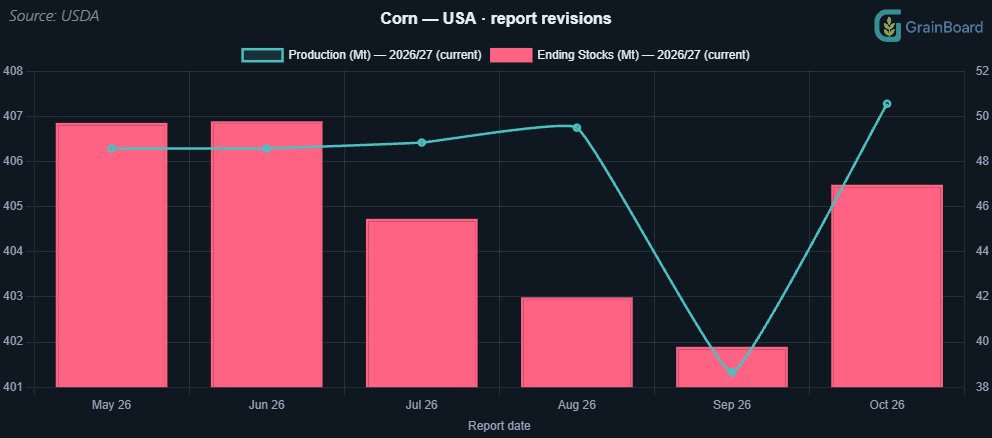
Most of the tightening the US corn balance went through this summer has just been undone. Projected ending stocks, cut from 49.7 Mt in May to 39.8 in September, are back at 47 after the October WASDE.
The old-crop part was known since the September 1 stocks count. The surprise is the crop: after two months of falling ratings, the USDA found a 181.2 bu/ac yield where the trade expected 177.7, and production is back above May at 407 Mt.
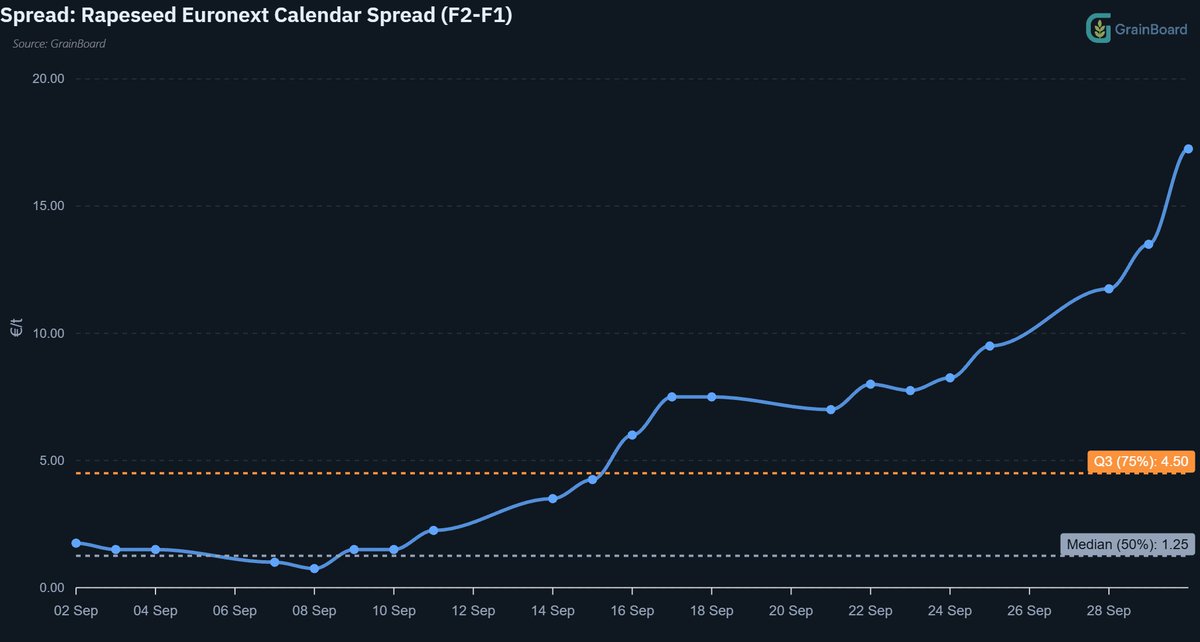
Nobody wants to take delivery of rapeseed in November. Euronext's November contract has lost 31 €/t in two sessions while February barely moved, and it now trades 46.5 €/t under it, against 17 a week ago and almost level a month ago.
It is European rapeseed, not the oilseed complex. The canola and soybean curves have not moved this week, both still where they usually sit in early October.
It is not the crushers' margin holding things up, at its widest since 2023. Yet an Australian canola cargo landed at Rouen last week, while the French seed waits in the silos.
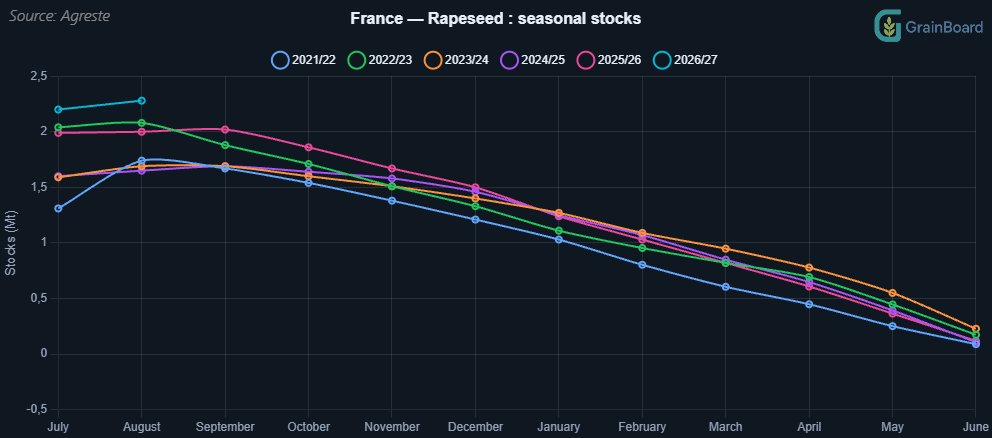
French collectors ended August still holding more rapeseed than at any time since 2018, Agreste showed this week. The seed farmers sold them over the summer has not moved on, a month after it already looked stuck at the end of July.
The futures market has stopped counting on it moving soon. Euronext now prices November rapeseed 17 €/t under February, against 1 €/t three weeks ago, which pays collectors to store rather than sell, while the canola and soybean curves have kept their usual shape.