This is a brand new package of Jimmy Dean bacon
The marked weight on the package is 12 ounces
If you take the unopened package and put it directly on a scale the weight is only 10.6 ounces, and that’s with the package
I looked up the law. In the United States the marked net weight on bacon packages must reflect only the weight of the bacon itself, excluding the packaging
Under FDA rules the packaging must be excluded
We are being robbed blind
Private Carlton Barrett was possibly the smallest man in his regiment.
5 feet 4 inches tall. 125 pounds.
On the morning of June 6, 1944, he landed at Omaha Beach in neck-deep water, machine gun fire cutting the surface all around him. He made it to shore.
Then he turned around and went back in.
A soldier was drowning. Barrett pulled him out. Then another. Then another. For hours, under constant fire, this 125-pound man waded back into the surf again and again, pulling drowning men to safety and physically carrying the wounded to evacuation boats offshore.
But he didn't stop there.
He ran dispatches the full length of the fire-swept beach. He found soldiers paralyzed by shock and calmed them back into action. He appeared wherever the crisis was worst, doing whatever needed doing, treating rank and personal safety as irrelevant details.
He did this for hours without stopping.
His Medal of Honor citation says his courage had "an inestimable effect on his comrades." That is military understatement for: this small, anonymous man held that section of beach together through sheer force of will.
He survived the war.
His comrades later said his life darkened after he came home. He lived quietly and died in 1986 in California, largely unknown outside of military history circles.
5 feet 4 inches. 125 pounds. He went back in.
Remember him.
When the President of France visited the United States in April 1960, he asked the FBI to help him find a man.
The man he was looking for was an American citizen. He was sixty-four years old. He had been awarded fifteen French military decorations and — six months earlier, in a ceremony in Paris — had been made a Knight of the Légion d'honneur, the highest civilian honor France can give. The medal had been pinned to his chest by the President himself, who had publicly called him un véritable héros français. A true French hero.
The FBI located the man within a few days.
He was operating an elevator at Rockefeller Center in New York City.
The elevator operator's name was Eugene Bullard. He had been born in Columbus, Georgia, in 1895, the son of a man whose own father had been a slave.
He had run away from Columbus at the age of eleven, after watching a white mob nearly lynch his father.
He spent the next several years drifting through the American South. At sixteen, he stowed away on a German freighter at Norfolk, Virginia. He landed in Aberdeen, Scotland. From there he made his way to London, where he learned to box. By 1913, at eighteen, he was prizefighting in Paris.
When Germany invaded France in August 1914, Bullard was nineteen years old. He had no legal obligation to fight. He had no French citizenship.
He went to the recruiting office on October 19, 1914, and signed up for the French Foreign Legion.
He spent the next eighteen months as an infantryman in some of the worst fighting of the war — at the Somme, at Champagne, at Verdun. He was wounded three times. The third wound, on March 5, 1916, tore open his thigh and left him with permanent damage to his leg.
He was twenty years old. The doctors told him he would not return to the infantry.
He decided he wanted to fly.
In a Paris café in the spring of 1916, while he was recovering, Bullard mentioned to three white American friends that he was thinking of joining the French air service. A Mississippian named Jeff Dickson laughed.
Gene, Dickson said, you know damn well there aren't any Negroes in aviation.
Bullard answered: Sure do. That's why I want to get into it. There has to be a first to everything, and I'm going to be the first.
Dickson bet him two thousand dollars he would not make it.
Bullard took the bet. He earned his pilot's license on May 5, 1917. He won the bet.
He reported to the front in August 1917 and flew approximately twenty combat missions over the next three months in a SPAD VII. The fuselage was painted with a bleeding heart pierced by a knife and the French phrase Tout le Sang qui Coule est Rouge — All Blood that Flows is Red.
He carried, on every combat flight, a small capuchin monkey named Jimmy in the front of his flight jacket.
The French press began calling him L'Hirondelle Noire — the Black Swallow.
When the United States entered the war in 1917, Bullard immediately applied to transfer to the U.S. Army Air Service.
His application was rejected.
The U.S. Army Air Service had a policy, in 1917, of not accepting Black pilots. The other American pilots flying for France in his unit, all of them white, were transferred to the U.S. Air Service.
He was the only one who was not.
For the next twenty years, he was one of the most familiar faces in the Montmartre nightlife of Paris between the wars. He owned a nightclub called L'Escadrille. He spoke fluent French, English, and German. Hemingway drank there. Fitzgerald drank there. Langston Hughes drank there. Josephine Baker performed there. Louis Armstrong was a personal friend.
When Germany invaded Poland in 1939, Bullard was forty-four. His fluent German and his ownership of a nightclub frequented by German officers made him useful to the French Resistance. He became an intelligence agent — eavesdropping in his own bar on conversations between German officers who did not know he understood every word.
When France fell in June 1940, friends in the Resistance smuggled him across the Spanish border before the Gestapo could arrest him.
He came back to the United States for the first time in twenty-eight years.
He arrived in New York with thirty dollars in his pocket and a permanent limp.
He did not return to a hero's welcome. He returned to a country that had no idea who he was.
He worked at a perfume counter. He worked as a security guard. He worked at the Staten Island shipyards. By the late 1940s, he had taken the job that he would hold for most of the rest of his life.
He operated the elevator at Rockefeller Center.
He was wearing the elevator uniform on the day a producer from NBC came down from the studios upstairs to ask if he was the man Charles de Gaulle had been looking for.
A few weeks later, NBC sent a film crew to interview him in the lobby. The studios where NBC produced The Today Show were on the floors above. He had operated the elevator that took the network executives up to those studios every morning for nearly ten years. He had not been recognized as he did it.
He went back to operating the elevator the following Monday.
He died of stomach cancer on October 12, 1961, three days after his sixty-sixth birthday.
He was buried in the French War Veterans' section of Flushing Cemetery, in Queens, in the uniform of the French Foreign Legion. The casket was draped with the French flag.
In 1994 — thirty-three years after his death — the United States Air Force formally commissioned Eugene Jacques Bullard as a Second Lieutenant, posthumously.
It was the first commission the U.S. military had ever offered him.
He had been the first Black combat pilot in American history.
The French had been calling him a hero since 1917.
The Americans got around to it in 1994.
A Nazi commander loaded his pistol, pressed the cold metal barrel directly against the forehead of an American soldier, and gave a chilling ultimatum: "Order the Jewish soldiers to step forward, or I will shoot you right now."
What happened next in that frozen prisoner-of-war camp changed history forever, yet the man who stared down death kept it a secret for the rest of his life.
It was January 1945, and the bitter winter of World War II was at its peak. Inside Stalag IX-A, a notorious German prison camp near Ziegenhain, thousands of American soldiers were trapped behind barbed wire. Among them was Master Sergeant Roddie Edmonds, a twenty-five-year-old from Knoxville, Tennessee. As the highest-ranking non-commissioned officer in his section, Edmonds was responsible for the lives of 1,275 men.
One day, the camp commander, a fanatical Nazi major named Siegmann, issued a terrifying directive.
He ordered that the following morning, all American prisoners of Jewish faith must step out of the ranks during roll call. Everyone knew what this meant. Separating the Jewish soldiers was the first step toward sending them to extermination camps.
Inside the dark, freezing barracks, the prisoners panicked. Some of the Jewish soldiers considered stepping forward willingly to protect their Christian brothers from Nazi wrath. But Edmonds refused to let that happen. He looked at his men and gave a clear, definitive order: "Tomorrow, everyone steps forward. Everyone."
The next morning, the ground was thick with snow. Major Siegmann walked out onto the parade ground, expecting to see a small, isolated group of Jewish soldiers standing apart from the rest. Instead, he stopped dead in his tracks. All 1,275 American soldiers had stepped forward together in perfect unison.
The commander turned red with anger and stormed over to Edmonds. "They cannot all be Jews!" Siegmann screamed.
Edmonds stood completely still, looked the Nazi straight in the eyes, and replied: "We are all Jews here."
Enraged, Siegmann drew his Luger pistol and pressed it against Edmonds' forehead. The tension was suffocating. Hundreds of men held their breath, waiting for the gunshot. But Edmonds did not blink.
"According to the Geneva Convention, we only have to give our name, rank, and serial number," Edmonds said, his voice steady and calm. "If you shoot me, you will have to shoot all of us. And when the war ends, you will be tried for war crimes."
Edmonds knew the German army was collapsing and the Allies were advancing. Siegmann knew it too. The Nazi commander looked at the wall of unified men, realized he could not break their spirit, and slowly lowered his gun. He turned around and walked away without saying another word.
Because of that moment of defiance, two hundred Jewish-American soldiers survived the Holocaust. When the war ended, Edmonds returned to Tennessee, married his sweetheart, and raised a family. He never bragged about his actions, never looked for medals, and never even told his own children what he had done. To him, protecting his men was simply his duty.
Decades after his death in 1985, his son uncovered the truth by talking to the survivors. In 2015, Edmonds was officially recognized as Righteous Among the Nations, the highest honor Israel bestows upon non-Jews who risked their lives to save Jews during the Holocaust. He remains the only American soldier to ever receive this recognition.
True heroism does not look for applause, and love will always be louder than hatred.
By standing together in the snow, those soldiers proved that when we refuse to abandon each other, ordinary human beings can become absolutely invincible.
That bread you're tossing to the ducks malnourishes the adults and can leave the babies unable to fly for the rest of their lives.
Bread is junk food for a duck. It fills them up so they quit foraging for the bugs, plants, and seeds that actually feed them.
In a growing duckling, a diet that heavy in empty carbs makes the wing grow too fast and twist at the joint. The feathers jut out sideways, the wing never works right, and the bird is grounded for good. It's called angel wing, and in an adult it can't be undone.
It doesn't stop at the birds. A pond where people dump bread gets crowded and aggressive, ducklings never learn to find their own food, and the soggy leftovers rot into algae blooms and draw rats.
If you want to feed them, give them food, not filler: cracked corn, oats, halved grapes, chopped lettuce, a handful of thawed peas.
Better yet, just watch them. A healthy pond already feeds its ducks. They were doing fine before the bread showed up.
Best Buy corporate reached out and issued a refund.
I appreciate them doing that.
But it's unfortunate I had to write a post that got millions of views to get a refund in a case where Best Buy is so clearly responsible.
Before I wrote the post, Best Buy corporate did nothing but stonewall us.
The way we were treated before vs after the post couldn't have been more different.
The people at our local Best Buy store were great. They wanted to help. But corporate doesn't give them the ability to.
Corporate also prevents store managers from providing contact information to customers with legitimate issues who need to reach someone at corporate.
I never want to publicly call out a company. But sometimes they give you no other choice.
What's sad is this happens to people who don't know how to write a viral post.
It also happens to people who can't afford to buy another camera while they wait months for a resolution that may never come.
So while I appreciate the refund, it should've happened long before I found the time to write about it weeks later.
I drove to 648 Grassmere Park to see it for myself.
I had no idea what was about to be built 50 yards from the @nashvillezoo.
A data center. Right against the treeline where the animals my kids grew up visiting are kept.
I’m not anti-technology…
The phone you’re reading this on is tied to one of these somewhere. We all live in this now.
But here’s the thing nobody’s telling you: a low hum doesn’t stop at a wall. It goes right through it. And the zoo’s own CEO says it’d sit 50 yards from animals they’ve spent decades trying to protect and breed.
No study. No rules. No vote. Just a rushed permit.
You don’t have to hate the future to say: not like this.
The petition’s in my bio. Takes 10 seconds.
Right now, 10 seconds is the whole fight. 🐆
🚨 WOW! Erin Brockovich completely destroys the AI data center narrative. She confirms these massive facilities emit a non-stop, 24/7 deafening noise that is literally driving local residents crazy!
She exposes the total lack of environmental oversight. Pure corruption!
Bought a $1,742.80 camera online from BestBuy.
The FedEx delivery driver stole it. FedEx admitted it.
But BestBuy won’t give a refund. They said we need to “work with local law enforcement.”
Thought everyone should know if you buy from @BestBuy and a @FedEx driver steals what you paid for, your money is gone. Neither company will make it right.
I’ve spent over $30K at BestBuy and will never spend another penny there.
This is a devastating interview.
Scott Pelley tells the NYT that Bari Weiss directly put a “thumb on the scale” for Trump over the killing of Renee Good.
Here’s his explanation of exactly what happened.
Breaking News:
For the first time ever, Mister Rogers’ Neighborhood has officially launched a YouTube channel.
Full episodes. Classic Clips. 100% wholesome.
💗
Tonight, as I do every year at this time, I’ll be raising a glass to a scared young man, who 82 years ago was preparing to go ashore on the beaches of Normandy as part of an event code-named Operation Overlord.
D-Day.
I can’t imagine what was going through his mind. I’d be scared to death and I’m sure he was too. But in that first wave was a 21-year-old Private First Class from Henry County, VA by the name of Allen Homer Sink.
Fortunately, he would survive that initial wave, participate in battle until it ended in August, then come home to marry and raise a family of four, including two daughters after the war ended.
He would also become my father-in-law until his death in 2006.
His nickname for some reason was “Hank” and when I asked him how he got it, he said some guy in the Army said he “looked like a Hank.” From the time I first met him, he was a salt-of-the-earth man who was never afraid of anything. He was a carpenter by trade, and he’d stand up on the tallest roofs, grab bumblebees with his bare hands when they tried to persuade him to move elsewhere, and never be bothered by anything.
His hands were tough and leathery, but he was a softie. He spoiled his children, complained when my mother-in-law would gripe about something involving one of his alleged misdeeds, and always thought he was fooling everybody when he snuck around the back of the house and lit a cigarette, a habit everyone opposed but he could never part himself from.
He could talk your ear off for hours at a time, and I always suggested he become a greeter at Wal-Mart when he retired because then he could talk all day to strangers and none of them would – like his wife and daughters often did – tell him to be quiet for a few moments. Yet for all his love of talking, there was one subject he just wouldn’t discuss.
June 6, 1944. Omaha Beach.
In 1998, when he was 76 years old, the subject came up again. The movie “Saving Private Ryan” came out and the beginning was gruesome. Reviews said it was incredibly realistic to what really happened that day. I asked Hank if he wanted to go see it.
“No,” he shook his head. “I don’t ever want to see any of that again.”
He did offer that he remembered the night before when troops were loaded into the boats for the amphibious assault. He said it was raining and that once everyone was in place, they gave everybody ice cream and told them to try to get some sleep. Then the next thing he knew, they were waking everybody up telling them to stay low and head for the beach.
No, that doesn’t sound like somebody drugged the ice cream. Not at all.
That’s all he would say about the subject, and he never said another word about it until the final months of his life. Alzheimer’s would gradually rob him of his mind, and as his condition deteriorated, memories of the past would briefly spill out. One evening he thought I was his commanding officer and he was back at Normandy. It is the only time I ever saw him where he appeared to be scared. Ever.
It reminds me every day of something I had unknowingly taken for granted. The greatest generation did fight in and win World War II, then did incredible things over the next 50 to 60 years after the war. But many carried unspeakable memories from the War, ones they would never talk about and carry inside them to their graves. Those veterans lost a piece of themselves in battle they would never, ever, get back.
I mean, how can you at the tender age of 21 storm a beach, see friends die only a few feet from you, wonder each night if you will wake up alive the next morning and then return home a year later and try to pick up on the same normal life you had before you left? I told him once that after seeing “Saving Private Ryan”, I understood why he was never afraid of anything; after you’ve made it through something like that, everything else pales in comparison.
So tonight, I raise a glass to Hank and the 150,000-plus men, who like my father-in-law, were very young, very scared, and still charged that beach, paying a price that even for the survivors would last the rest of their days.
Rest In Peace...
Of the 56 men who signed the Declaration of Independence, Abraham Clark may have paid the highest personal price. Almost nobody knows his story. Buckle up.
He was a New Jersey farm kid considered too frail for farm work, so he taught himself math, then surveying, then law. He never got rich from it because he kept defending poor farmers who could not pay him. His neighbors called him "the Poor Man's Counselor."
In the early hours of July 4, 1776, while Congress debated independence in Philadelphia, Clark wrote a letter to a friend with one of the most chilling lines of the Revolution: "Perhaps our Congress will be exalted on a high gallows."
He signed anyway.
Then the British made it personal. Two of his sons were officers in the Continental Army, and both were captured. They were thrown onto the prison ship Jersey in New York Harbor, the deadliest place of the entire war. More Americans died on British prison ships than in every battle of the Revolution combined.
One son got it even worse. He was locked in the dungeon and given no food except what other starving prisoners could push through the keyhole of his cell.
The British reportedly offered Clark a deal: renounce the Declaration, switch sides, and your boys go free.
He refused.
Here is the part that breaks me. Clark sat in Congress through all of it and never once brought it up. No special pleading, no favors. Congress only found out through other channels and threatened retaliation against a British officer, which finally got his son out of the dungeon.
After the war, he kept choosing the little guy. He fought for debt relief for struggling farmers and refused to support the Constitution until he was assured a Bill of Rights would protect ordinary citizens.
In September 1794, at age 68, the self-taught surveyor who outlasted the British Empire died of sunstroke after a long day working on his own farm.
No statue on the National Mall. No musical. Just a small town in New Jersey called Clark, and most people who drive through it have no idea why.
Some men signed the Declaration with ink. Abraham Clark signed it with his sons.
One man in California has spent 57 years recording the sounds of natural places. Much of what he's recorded no longer exists.
His name is Bernie Krause. He started as a folk musician and an early pioneer of the Moog synthesizer. In 1968, he began carrying recording equipment into rainforests, deserts, coral reefs, African savannas, and research sites associated with scientists like Jane Goodall and Dian Fossey.
The Wild Sanctuary archive now contains more than 5,000 hours of recordings and over 15,000 identified species. Krause coined the term "biophony" to describe the collective sound of living organisms in a habitat and helped establish the field of soundscape ecology.
Through thousands of recordings, he observed that healthy ecosystems often partition acoustic space, with different species occupying different frequencies and times of day. On a spectrogram, an intact habitat can resemble a densely layered musical score.
When Krause revisited many of the places he had recorded decades earlier, he found that over half had become silent, severely degraded, or so altered by human activity that their original biophonies could no longer be heard. His archive preserves sounds from ecosystems that have been transformed or lost.
On this night in 1781, one man on a horse saved the American Revolution from losing Thomas Jefferson, Patrick Henry, and half of Virginia's government in a single morning.
You were never taught his name.
June 3, 1781. The British had chased Virginia's entire government out of Richmond. Jefferson, in his final days as governor, and the legislature had fled to Charlottesville, thinking they were safe in the foothills.
They were wrong.
That evening, 26 year old militia captain Jack Jouett was at a tavern in Louisa County when roughly 250 of the most feared cavalry in the British army came pounding down the road. Their commander: Banastre Tarleton, nicknamed "The Butcher," the man whose dragoons had cut down surrendering Americans at Waxhaws.
There was only one place they could be going. Charlottesville. 40 miles away. And the capture of Jefferson, the author of the Declaration of Independence, would be the prize of the war.
Jouett couldn't outrun them on the main road. So he didn't use it.
He swung onto overgrown backwoods trails and the abandoned Old Mountain Road, riding 40 miles through the dark with only the full moon for light. Legend says low hanging branches whipped and scarred his face for life.
Tarleton stopped his men for a 3 hour rest. Jouett never stopped.
Before sunrise on June 4, he came up the mountain to Monticello and woke Jefferson. Then he rode down into Charlottesville and warned the legislature.
Jefferson got out with minutes to spare. British dragoons were coming up his mountain as he left. The legislature escaped over the Blue Ridge to Staunton. Tarleton caught only seven stragglers, one of them a frontiersman serving in the legislature named Daniel Boone.
Paul Revere rode about 12 miles in 1775 and got captured before reaching Concord. Longfellow wrote him a poem and made him immortal.
Jack Jouett rode 40 miles, lost nothing, saved everything, and got a thank you gift of two pistols and a sword from the Virginia Assembly.
No poem. No fame. Almost no memory.
In 1976, Greek-American Stamatis Moraitis was told by doctors that he had advanced lung cancer and only six to nine months to live.
Rather than undergo aggressive treatment, he and his wife returned to his birthplace, the Greek island of Ikaria, expecting to spend his final days there.
At first, he was weak and spent much of his time resting. But surrounded by family, friends, and the slower pace of island life, he gradually became more active.
He began gardening, walking, tending vineyards, enjoying homegrown food, drinking local wine, and spending hours socializing with neighbors.
Months passed, then years. Instead of deteriorating, Moraitis grew stronger and continued living an active life.
He eventually outlived his prognosis by nearly four decades, passing away in 2013 at the age of 102.
His story became famous around the world because Ikaria is one of the planet's renowned "Blue Zones," regions where people live exceptionally long lives.
Researchers have linked the island's longevity to a Mediterranean diet, daily physical activity, strong social connections, low stress levels, and a close-knit community lifestyle.
Moraitis later joked: "I just forgot to die."
“The students who cannot read a 20-page article today are the voters who will not be able to read a bill, or the jurors who cannot follow a closing argument, tomorrow.”
Ladies and gentlemen, I regret to inform you that I have become an international incident. Apparently a major British tabloid has moved on from covering royals and is now covering a guy with a phone and a social media account. If they’re tracking my gift baskets, I assume my grocery list is next. 🤣
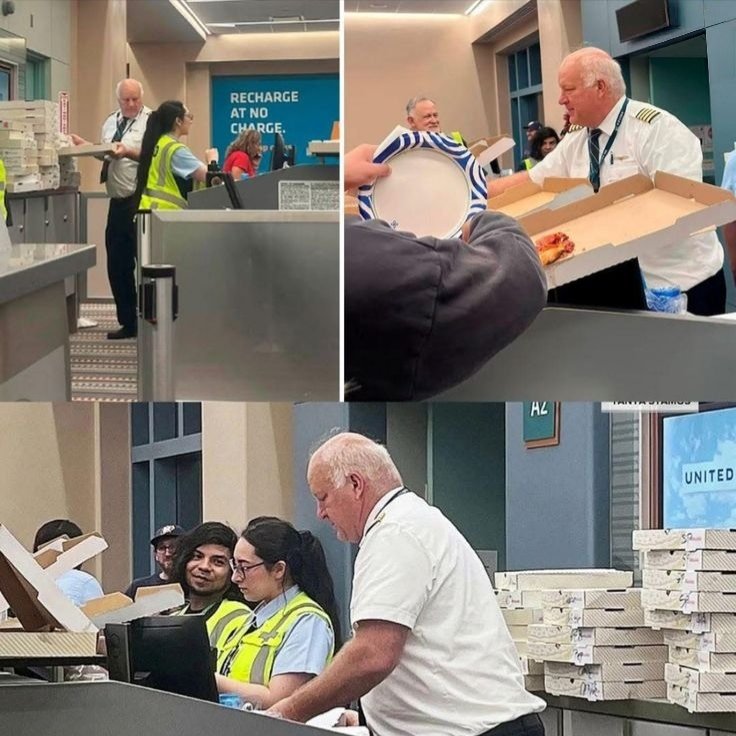
In September 2024, a United Airlines flight traveling from San Francisco to Houston was forced to make an emergency diversion to Albuquerque, New Mexico, after a passenger experienced a medical emergency onboard.
After the passenger received medical attention, the flight was unable to continue immediately because the crew eventually reached their federally mandated duty-time limits.
As a result, approximately 150 passengers were left waiting at the airport for nearly seven hours while a replacement crew was arranged.
Although passengers were provided with food vouchers, many airport restaurants had already closed for the night.
Seeing the situation, the flight's pilot took matters into his own hands and ordered around 30 pizzas for everyone at the gate.
Passengers later said the pilot personally helped hand out the pizzas and made sure every passenger was served before taking any food for himself.
Photos of the moment quickly spread online, with many praising the captain for his kindness and leadership during a frustrating delay.
United Airlines later acknowledged the incident and commended the pilot for going above and beyond to care for his passengers.
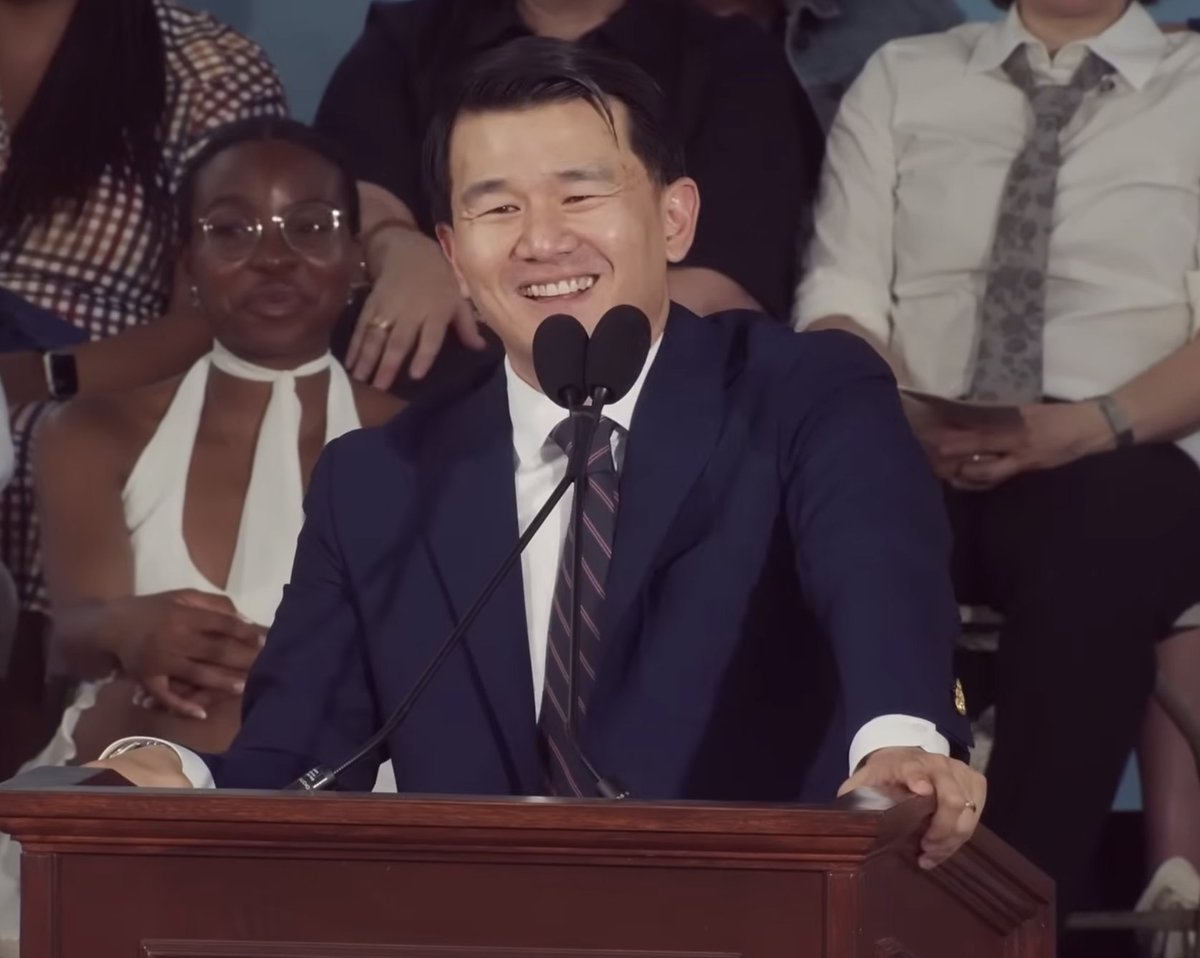
Ronny Chieng had one message for Harvard grads during his commencement speech: destroy AI.
"Look, a lot of other respected graduation speakers in colleges around America are talking about you guys needing to master AI for the future. I'm here to tell you the mission of your generation is to destroy AI...
"And I know, I know there's someone sitting out here right now who’s just like, 'Well, you know, what about the use of AI to pioneer breakthroughs in medicine and physics?' Well, first of all, shut up, nerd. I'm not talking about that. Obviously, if you're using it for that purpose, you're not the problem.
"I'm talking about the accumulation of cognitive debt due to excessive use of large language models according to a study by MIT published in 2025. That's right, MIT. MIT did that study. I guess you guys were too busy giving each other A's. Feel free to boo MIT, by the way, and AI, and yourselves, I guess.
"Look, this is actually good news, okay? This is why you guys shouldn't be scared of AI, because I think AI is just going to end up making mediocre people dumber. Have you heard how dumb people brag about how they use AI? They're always like, 'Hey, did you know that AI can now read my email, summarize it, and drop a response?' Yeah, you know who else can do that? Me. I can do that. You can't do that? How useless are you? You need artificial intelligence just to match me? I'm a dumb*ss who couldn't get into Harvard.
"From what I can see, getting an actual advantage from AI in the future will require a minimum escape velocity of intelligence that I'm assuming you guys from Harvard have. Everyone else who can't match that is just going to get dumber, and that's when you run up the score on them, assuming we still have a functioning society, of course.
"But to run up the score, you’re going to have to master your craft. And AI can be the fuel, but fuel is useless if you can't kindle the fire. For example, I recently used AI to use regression analysis to prove that a certain race of people are mathematically terrible at sports. I won't say which race, but thank you for not inviting Hasan Minhaj to Harvard. My point is, learning the fundamentals still matter. If I didn't know what a regression analysis was, and if I wasn't fundamentally racist, would I have been able to do any of that? No.
"Untalented people love bragging about using AI to help them draft their speeches and their scripts and their podcasts and their promo videos for UFC fights at the White House, which to be fair, even if they had filmed that for real, it would still have looked like AI. But what they're missing is this: the creating is the fun part. The best part of comedy writing is figuring out the puzzle pieces of a joke and getting the self-regard from having accomplished a difficult thing. Why would I want AI to take that away from me?
"You know what problem I want AI to solve? I want the problem of AI making everything look like sh*t. I want AI to solve that problem. How about that?
"Or how about, can AI take away the part of comedy writing where my TV pilot gets passed on and when I ask if I can pitch it to someone else, the network says, 'We don't want it, but we also don't want anyone else to have it. We just want you to be sad.' Can AI solve that?
"I recently tried to introduce my friend to Buddhism through a book called Buddhism Made Simple. It was literally a book about Buddhism made simple. And instead of reading it, he used AI to summarize it in 10 seconds. Believe it or not, he didn't reach enlightenment. It turns out speed running Buddhism is completely missing the point.
"And I know this platitude is almost worthy of AI, but the reason shortcuts to skip to the end aren't always good is because the journey isn't just how we acquire skills. The journey is the point of all this. It is! It turns out maybe the real Harvard was the friends we made along the way.
"Look, I know this won't apply to everyone's industry, but I'm just saying whatever your chosen profession is, please don't let AI rob you of the fun part of it.
"I think your generation's upcoming battle won't be humans against AI. That's at least two months away. It's going to be people with substance versus people with shallow knowledge. It’s going to be mastery versus faking it. It's going to be people with good taste versus tacky. I trust you will put in the work necessary to be on the right side of those battles."