Grandview Grids (G2) is Nigeria's sovereign digital addressing infrastructure, built to give every Nigerian location a precise, verifiable, and permanent digita
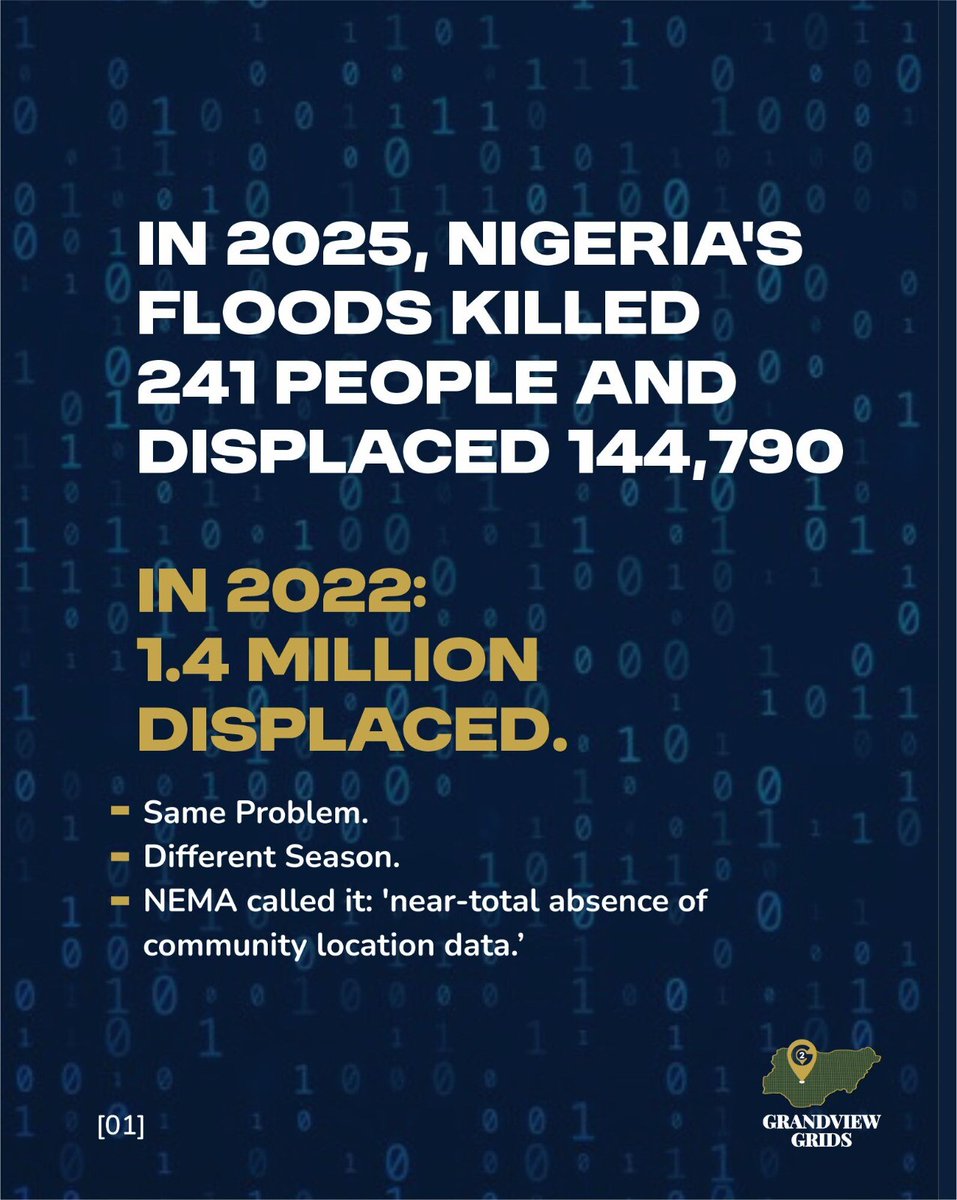
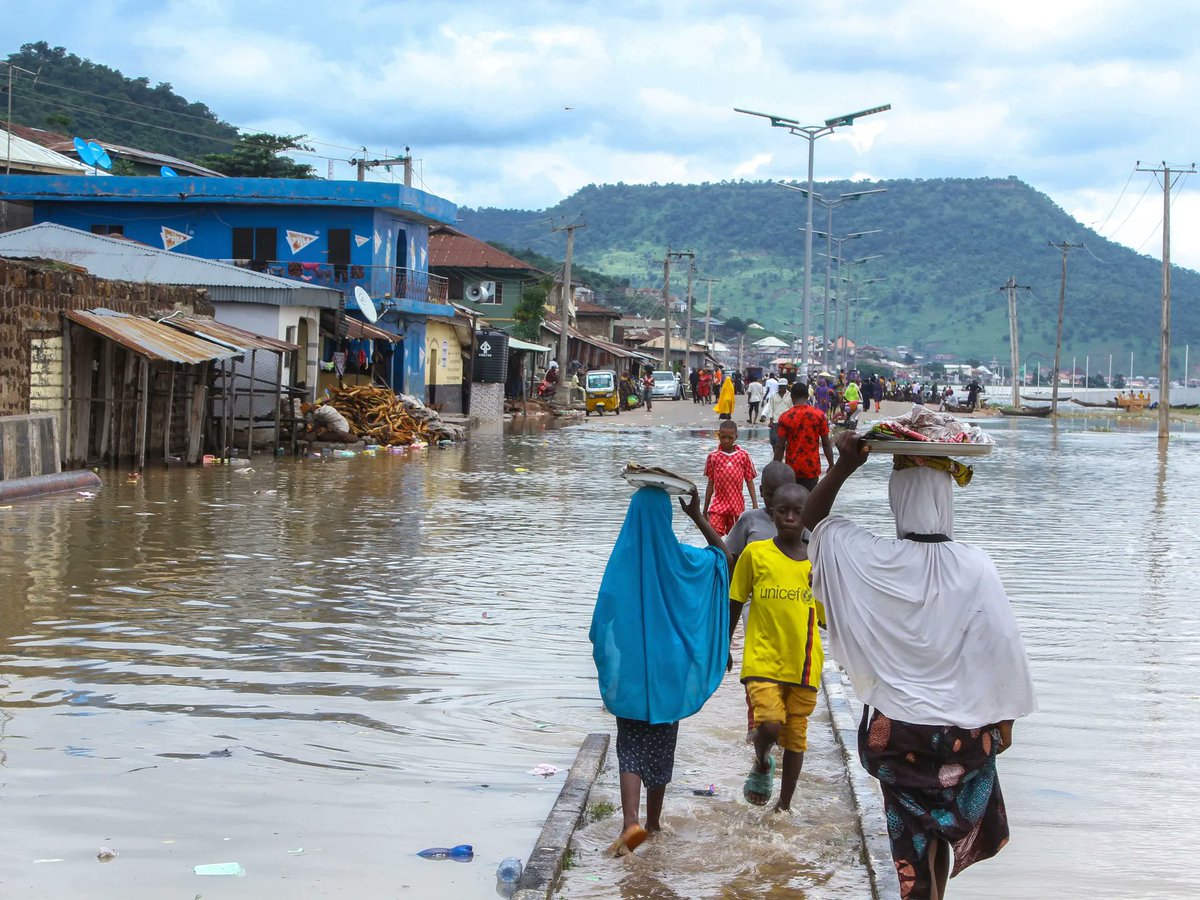
Nigeria's Flood Crisis Is Not a Weather Problem. It's a Location Problem.
On 24 June, NEMA convened a World Bank stakeholders' workshop in Abuja to review Nigeria's National Disaster Management Framework. The right conversation — but missing its foundational question.
Nigeria's emergency response operates without a sovereign, verified record of where communities actually exist. Every coordination protocol, every early warning system, every aid distribution plan sits on top of a layer that does not exist: a national location truth layer.
The cost is documented. The 2022 floods displaced 1.4 million Nigerians. In 2025, 433,578 people were affected, 241 killed across 27 states. The Mokwa flash flood alone killed 200 and displaced 3,000 households. NEMA's own review cited near-total absence of community location data as the primary factor in response failure.
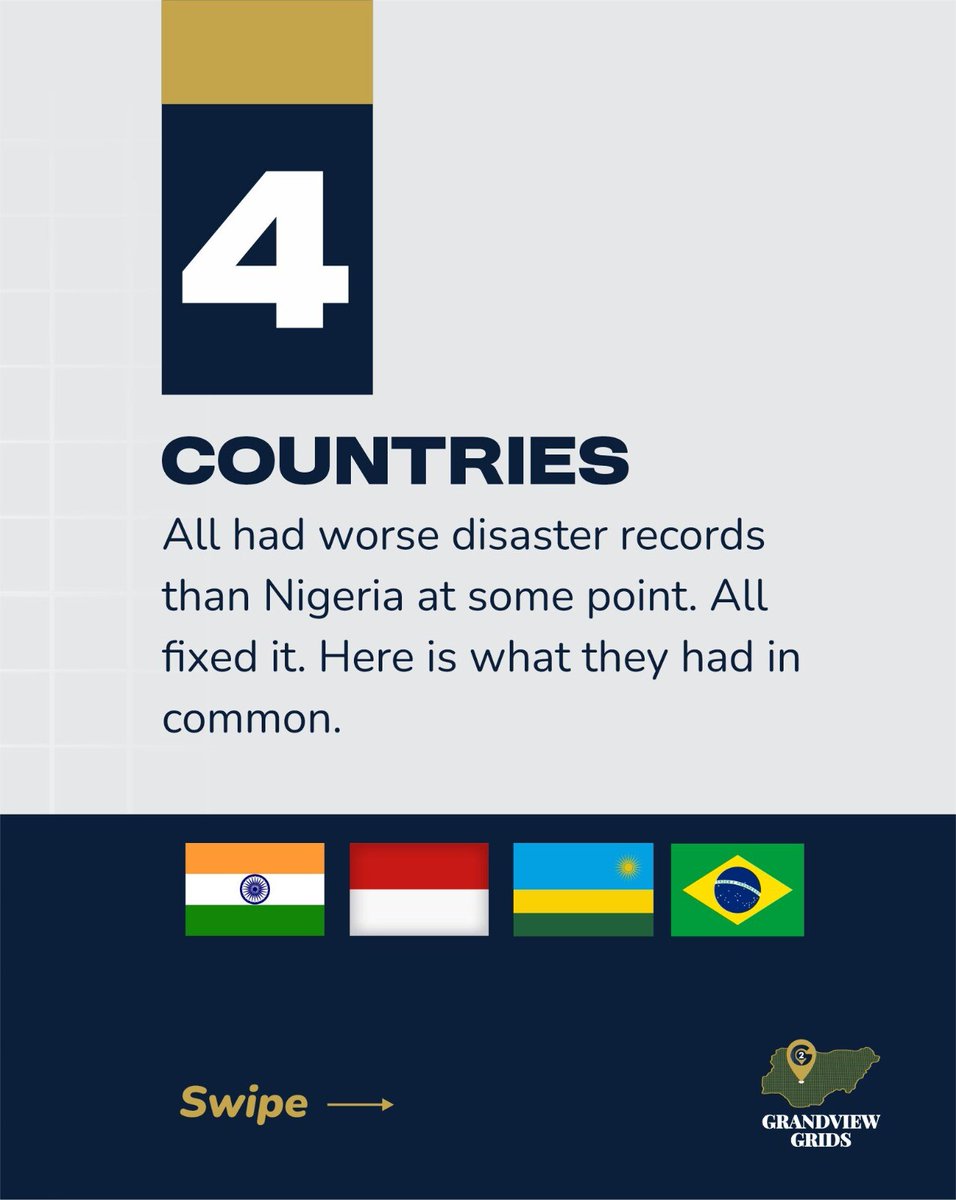
Four countries with comparable disaster profiles solved this the same way — India, Indonesia, Rwanda, Brazil all built sovereign location infrastructure first. Emergency management systems second. The sequence matters.
Nigeria has the institutional frameworks. The gap is not policy. It is the address infrastructure on which every policy mechanism depends.
That is the question Grandview Grids is working to answer.
#GrandviewGrids #G2 #Nigeria #DisasterResponse #NEMA #SovereignAddress #NationalTrustInfrastructure #FloodRelief #DigitalNigeria #floodrelief
The numbers behind Nigeria's disaster response failure. Every single one of these can be changed. But not without the right infrastructure.
Share this post and follow Grandview Grids for the full story.
#Grandviewgrids#G2#nigeriatech
Nigeria's drug regulator earned a WHO Maturity Level 3 rating in December 2024 — one of only eight in Africa, alongside Rwanda's, awarded the same month (WHO, 2024).
Between February and July 2026, NAFDAC and the Nigeria Customs Service seized more than ₦56 billion in counterfeit pharmaceuticals and narcotics across three separate operations (Channels Television; Brandspur; Daily Post, 2026). A credible regulator. A market still flooded with fakes. The gap sits between the two: verification at the point where a pharmacist, distributor or enforcement officer has to decide, in seconds, whether a product's origin is real. India, Brazil and Indonesia have each mandated serialised barcodes on medicine. Each proves a code is authentic.
None alone proves that the address behind the code exists and can be checked in real time. That is the layer Grandview Grids is building — a sovereign, geocoded address system for every registered manufacturing and distribution facility in Nigeria, patent-protected and designed to interoperate with the regulatory system NAFDAC has already built. The framework exists. The patents are granted. The decision to build the layer beneath it is available now.
Follow Grandview Grids (G2) to be part of it. Because every dream needs an address.
Nigeria is not the first country to struggle with disaster response. Here's what India, Rwanda, Indonesia, and Brazil did — and why it worked. Swipe through. | Follow @GrandviewGrids
Emergency responders arrived. They couldn't find the survivors. This is the part of Nigeria's flood crisis nobody is talking about. Swipe through. Save this. Share with someone who should know. Follow @GrandviewGrids.
India, Brazil, Rwanda, Indonesia: What Did They Build First?
Before apps. Before payments. Before digital economy policies.
Every country that scaled its digital economy built a sovereign, geocoded record of who and where its citizens are.
We are documenting why Nigeria needs this layer — and what building it could unlock.
Read the full case on X @Grandviewgrids.
Nigeria's $1 Trillion Economy Has a $600 Billion Location Problem
"Every country that scaled a digital economy built the same layer first. Nigeria has the ambition. It is missing the foundation."
The arithmetic is not secret. Nigeria's GDP stands at approximately $400 billion, rebased in 2024 by the National Bureau of Statistics. President Tinubu's Renewed Hope Agenda has declared a target of $1 trillion by 2030. [1] [14] That is not a rounding error of ambition. Reaching $1 trillion from $400 billion in five years requires compounded annual growth of 17.6 per cent. The International Monetary Fund, in its April 2026 World Economic Outlook, upgraded Nigeria's 2025 growth forecast to 3.9 per cent.
The gap between 3.9 per cent and 17.6 per cent is not a communication problem. It is not a policy sequencing problem. It is a structural problem – and its name is almost never spoken in the documents that describe the $1 trillion target.
The People the Digital Economy Cannot Reach
Nigeria has approximately 220 million people. More than 130 million of them remain offline. [2] [4] That is not a technology access problem that faster broadband solves. It is a verification problem. The formal economy – the digital economy, the payment systems, the credit infrastructure, the logistics networks – cannot serve a population it cannot verify, cannot precisely locate, and cannot consistently reach.
The National Bureau of Statistics Labour Force Survey for Q4 2025 shows that 92.4 per cent of employed Nigerian youth are in the informal sector. [3] UNICEF's Nigeria Digital Skills Report, published in 2025, found that 78 per cent of Nigerian youth lack essential digital skills. [5] The African Institute for Development Policy estimates that Nigeria loses between $11 billion and $14 billion annually to this skills deficit. [6] The National Information Technology Development Agency has set a target of 50 million digitally skilled Nigerians by 2027. [7]
These are not competing statistics. They describe the same structural problem from different angles. The people most needed to drive Nigeria's digital growth are the people the formal digital system was not designed to find.
The National Communications Commission has initiated what it describes as a historic overhaul of Nigeria's telecommunications infrastructure – a process expected to create two million jobs and generate an additional NGN 2 trillion in annual tax revenues. [15] The ICT sector's contribution to GDP reached 16 per cent in 2024, with a national target of 21 per cent by 2030. [4] The ambitions are real. The institutional will is present. What is missing is the layer on which these investments must sit to reach beyond the population they currently serve.
What India Built Before Everything Else
India's digital economy transformation is frequently cited as the benchmark – and it should be. But the lesson is misread when it focuses on apps, on UPI, on payments, on digital public infrastructure as a product ecosystem. The JAM Trinity – Jan Dhan bank accounts, Aadhaar biometric identity, and mobile connectivity – was not India's digital economy. It was India's foundation for a digital economy.
The Jan Dhan Yojana programme has opened more than 560 million bank accounts. [8] The Direct Benefit Transfer system, which runs on Aadhaar verification, has transferred the equivalent of Rs 43 lakh crore directly to verified beneficiaries. The government's own records indicate savings of Rs 3.48 lakh crore in previously documented leakage – money that, in prior systems, would have been absorbed before it reached the intended recipient. [9]
The scale of India's return is not explained by the payments architecture. It is explained by the identity-location layer that made every account, every transfer, and every verification precise. When the system knows who you are and where you are, every investment built on top of it reaches further.
What Brazil and Rwanda Found at the Same Address
Brazil's Bolsa Familia programme, one of the most studied social transfer mechanisms in the world, reaches 14 million households. Its instrument is not sentiment. It is the Cadastro Unico – a geocoded household registry that assigns each beneficiary family a precise location in the formal system. [10] Brazil's Pix payment network, which now has over 140 million users representing approximately 65 per cent of the population, runs on top of a population registry that knows where those users are. [11]
Rwanda's case is, in some respects, the most instructive. After 1994, Rwanda rebuilt its national identity infrastructure from near destruction. The National Identification Agency (NIDA) system, which was created, is now one of the most geocoded population registries on the African continent. Rwanda did not start with a development agenda and add identity later. It started with verified identity and location, and the development agenda followed. [12] Foreign direct investment, which Rwanda attracts at rates disproportionate to its market size, consistently cites institutional precision and address-verified infrastructure as differentiating factors.
Indonesia, with over 17,000 islands and a population exceeding 260 million, deployed its e-KTP biometric identity card to every citizen. [13] The country did not solve location verification after it achieved digital growth. It solved location verification as a precondition for digital growth.
The Principle Nigeria Has Not Yet Applied
There is a pattern here that is not coincidental. India, Brazil, Rwanda, Indonesia – countries with different histories, different geographies, different institutions – all made the same investment before their digital economies scaled: a sovereign, geocoded, verifiable record of who is where and what belongs to whom.
Nigeria's challenge is not the absence of ambition. The NIPSS report to the President, the NCC overhaul, the NITDA skills programme, the ICT sector targets – these are not empty declarations. The challenge is that each of them is being built on top of a population that the formal system cannot precisely locate. Every digital economy initiative that bypasses the location-identity layer will serve the population it already serves very efficiently. The ceiling on Nigeria's $1 trillion target is not an aspiration. It is architecture.
The principle that connects India to Brazil to Rwanda to Indonesia is not technology. It is trust infrastructure – the verified, sovereign record that tells the formal economy exactly who and where its citizens are. Every economy that built this layer saw investment returns that could not be explained by any other single factor. Every economy that skipped it found that its digital growth concentrated in the population already visible to the system.
What Comes Next
The arguments for building Nigeria's sovereign trust layer are not theoretical. They are documented in the economic histories of four countries with development trajectories comparable to Nigeria's. The infrastructure that closes the gap between 3.9 per cent and 17.6 per cent begins not with the next app, not with the next digital skills programme, and not with the next connectivity target. It begins with a precise answer to two questions: Where exactly is each Nigerian? And who exactly do they have the right to be?
We are building the case for Nigeria's sovereign trust layer. One argument at a time.
Follow @grandviewgrids on all social media platforms for more updates.
We said it in May. Nigeria signed it into law on June 26.
On May 27, our Founder and CEO, Barrister Bisi Adegbuyi, published an article in Punch Newspapers calling for Nigeria to build on sovereign digital foundations — and making the case that before identity, there must be location.
Last Friday, President Bola Ahmed Tinubu signed the NIMC Act 2026 into law, repealing a 19-year-old framework and establishing a modern legal foundation for Nigeria's digital identity ecosystem.
We congratulate Mr President. We congratulate Nigeria. But we also want to be clear about something.
The NIMC Act strengthens the identity layer. That is significant and necessary. What it does not yet address is the layer beneath identity — the verified address infrastructure that makes every NIN, every BVN, every digital credential actually locatable, verifiable, and fraud-proof.
That is the layer G2 is building.
We saw this future. We documented it. We patented it. We are building it.
Follow @GrandviewGrids — because the next chapter of Nigeria's digital story is being written right now.
Website: https://t.co/IoqaTnFBjE
Read the full Punch article: https://t.co/yOqE0eUrq2
@nimc_ng@MobilePunch@pmg_ng
#GrandviewGrids #G2 #NIMCAct2026 #Nigeria #Tinubu #SovereignAddress #NationalTrustInfrastructure #DigitalNigeria #WeCalledIt #BecauseEveryDreamNeedsAnAddress #ScanClaimVerifyOwn
Every Nigerian pays a tax nobody named.
It sits on every declined loan application. Every interest rate doubled because the bank cannot confirm where you are. Every small business that cannot grow because the lender cannot locate the collateral.
The rate is not too high. The location is unverifiable.
Every unverified address in Nigeria is a hidden fee on every business that has ever needed funding.
Grandview Grids (G2) is removing that hidden fee — permanently.
Scan. Claim. Verify. Own.
#GrandviewGrids #G2 #Nigeria #SovereignAddress #SMEs #FinancialInclusion #TheHiddenFee #BecauseEveryDreamNeedsAnAddress #ScanClaimVerifyOwn
Nigeria's Defence Minister just confirmed what data has been showing for years.
Security agencies can't track criminals without a national database but a database built on unmapped terrain is just an index with no addresses.
Swipe to understand why Nigeria's security crisis starts with a map — not a manhunt.
Follow @grandviewgrids — we're building the sovereign location layer Nigeria's security (and everything else) needs.
#Nigeria #NationalSecurity #SovereignInfrastructure #GrandviewGrids #G2
Thread 1/2...
Nigeria's Security Forces Are Fighting Blind — And the Defence Minister Just Said Why
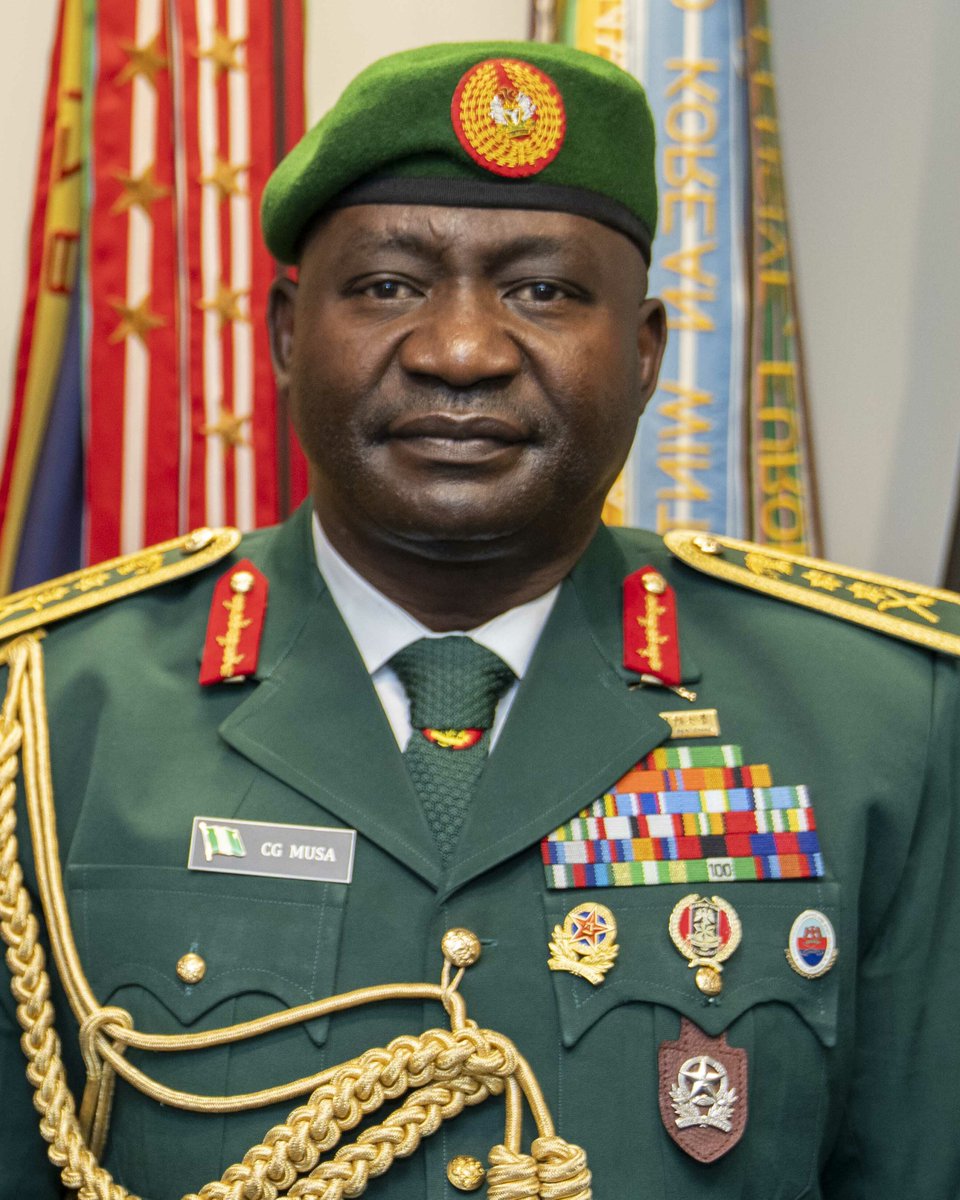
Nigeria's Defence Minister, General Christopher Musa (Rtd), said something that rarely gets stated this plainly at official events. Speaking at the Nigerian People's Strategic Conference on June 13, 2026, he said: "Security agencies are not magicians. Without timely information and public support, it becomes extremely difficult to prevent criminal activities." The trigger for his frustration was specific — the absence of a national database capable of supporting criminal tracking and intelligence gathering.
He is right. But the database problem is a symptom. The root cause sits one layer below.
You cannot build a functional security database for citizens you cannot locate. Nigeria's security intelligence gap — the reason 750 people died to terrorism in 2025 in what the Global Terrorism Index recorded as the world's largest single-year increase (+46%) — is not primarily a manpower shortage or a funding problem. It is a location problem. Security agencies are fighting across terrain that has never been mapped, in communities that exist in the physical world but in no sovereign spatial record, across 1,400+ border crossings that facilitate arms, drugs, and human trafficking precisely because no system sees them (G2 field analysis, corroborated by Nigeria Border Communities Development Agency reporting).
The Database Cannot Precede the Map
Every serious security intelligence architecture in the world is built on a verified spatial layer — a geocoded, sovereign record of who is where, what belongs to whom, and which communities and corridors exist within a jurisdiction. Without that layer, a national database is an index with no addresses. A criminal can evade it simply by operating in a settlement that the state has never formally acknowledged exists.
This is not a novel problem. It has been solved — four times over, at continental scale — by countries with comparable governance complexity to Nigeria.
India built the Crime and Criminal Tracking Network & Systems (CCTNS) to integrate criminal intelligence across thousands of police stations. But CCTNS works because it sits on top of Aadhaar: India's biometric identity system that links 1.4 billion citizens to verified residential addresses (UIDAI India). The criminal database is only as good as the location layer beneath it. India understood this sequencing. The identity-location link came before the intelligence system.
Brazil confronted similar challenges across its 26 states and Federal District — high informality, ungoverned peri-urban corridors, porous interstate movement. The response was SINESP (Sistema Nacional de Informações de Segurança Pública), launched in 2012 under the Ministry of Justice: a nationally integrated security information system with geocoded crime mapping across all 27 states. Every incident logged in SINESP carries a location coordinate. Without that coordinate, the aggregate intelligence means nothing. Location is the unit of analysis that makes all other data actionable.
Rwanda presents the most instructive parallel. In 1994, Rwanda had no functional national identity infrastructure. What followed was one of the most complete governance rebuilds in modern African history — and it began with the address layer. The National Identification Agency (NIDA) built a geocoded national ID system in which every citizen's identity is anchored to a verified residential location. Community-level governance structures were mapped and formalised. The security implications were not incidental — they were foundational. Rwanda's transformation from one of Africa's most violent states to one of its most secure is inseparable from the decision to make location the first infrastructure investment.
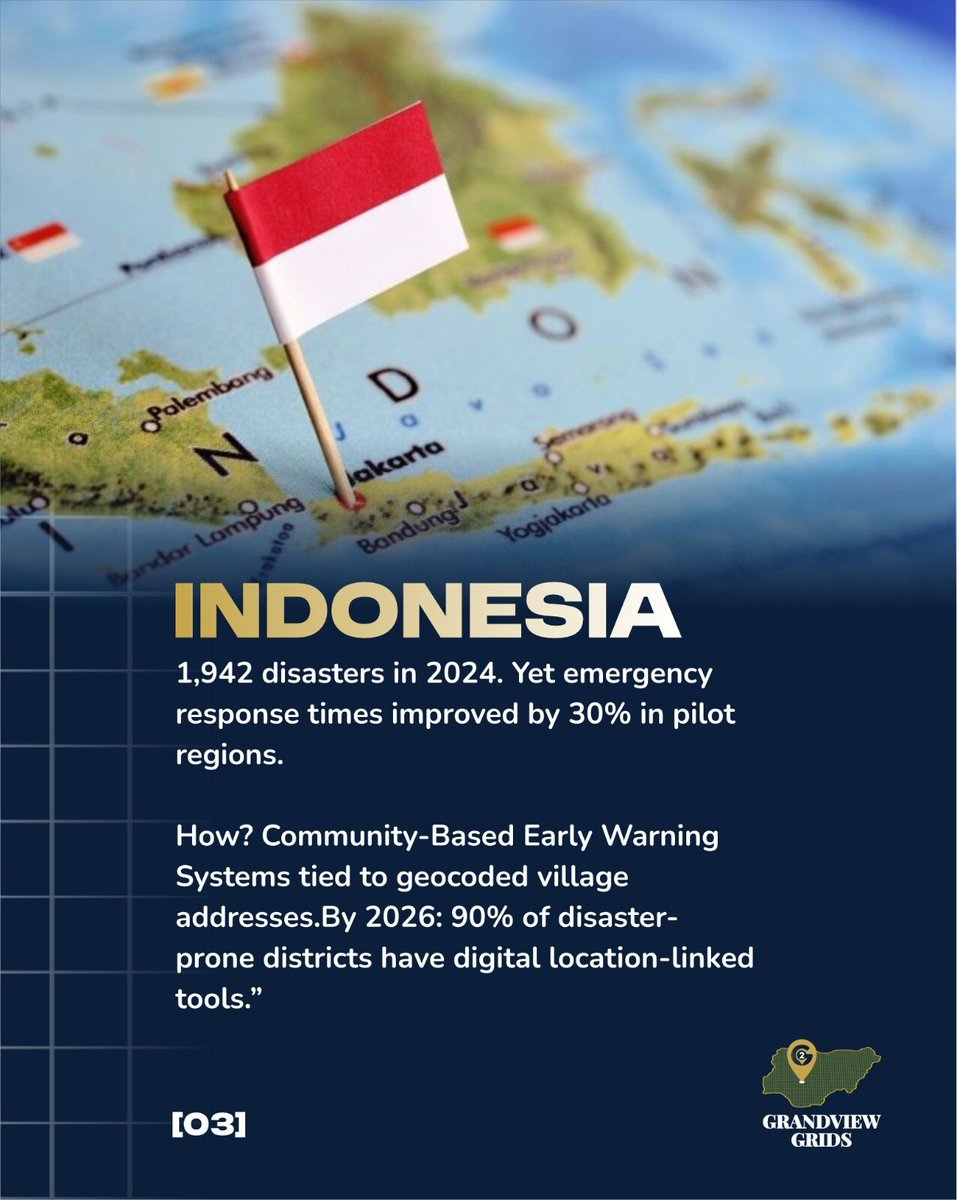
Indonesia faces a governance challenge Nigeria knows intimately: how do you govern 260 million people dispersed across 17,000+ islands and hundreds of thousands of communities, many of them informal? The answer, from 2011 onward, was the e-KTP (Electronic Identity Card) — a biometric identity system administered through the Dukcapil (Civil Registration and Population Administration) office, with verified home address as a mandatory data field. Indonesia now uses Dukcapil-linked location data for security operations: verifying suspects across provinces, mapping criminal movement patterns, and tracking persons of interest using the same geocoded identity infrastructure that civil servants use to deliver services. The dual-use architecture was deliberate.
What 1,400 Unmapped Crossings Actually Mean
Over 1,400 border crossings in Nigeria remain unmapped in any sovereign spatial record. Each one is a corridor with no formal coordinate, no monitoring baseline, no way to detect anomalous movement against a verified norm. Criminal networks do not establish headquarters in Lagos Island and send press releases. They operate in the gaps between what the state knows and what it can see. Those gaps, in Nigeria, number in the thousands.
The consequence is structural rather than operational. No number of troops deployed to the North-East, North-West, or South-East can close an intelligence gap produced by the absence of a geocoded record of settlements, movement corridors, and community populations in those regions. The General knows this. He said as much: "The threats we face today are increasingly organised, adaptive and technology-driven." An adaptive criminal network operating in unmapped terrain will always outmanoeuvre a security apparatus navigating by assumption.
The 46% single-year increase in terrorism deaths is not a security failure in the narrow sense. It is a governance infrastructure failure — and distinguishing between the two matters enormously. A security failure can be addressed with more security spending. A governance infrastructure failure requires a different kind of investment entirely.
The Infrastructure Sequencing Every Country Gets Right
The countries cited above — India, Brazil, Rwanda, Indonesia — are not comparable to Nigeria in every dimension. Their populations differ. Their governance histories differ. Their constitutional architectures differ. What they share is a sequencing decision: they invested in a sovereign location layer before expecting security intelligence to function at scale.
That investment is not expensive relative to what it enables. Estonia built its entire digital government — including the security intelligence layer that makes it one of the world's most cyber-resilient states — on a verified address infrastructure serving 1.3 million people. Rwanda rebuilt a comprehensive national identity and location system in under a decade after 1994. Neither country had exceptional resources. Both had the clarity to understand that governance cannot precede location.
Nigeria has 220 million people, the continent's largest economy, and a mobile penetration rate that makes digital deployment viable at speed. It has a Defence Minister who has publicly named the problem on record. It has state governors, federal institutions, and development partners looking for a framework to make security expenditure more accountable and more effective.
The framework begins where every functional security architecture begins: with a verified, geocoded record of who is where. That record does not yet exist for Nigeria at sovereign scale. The work of building it has begun.
The Decision That Is Still Available
The countries that got this right did not do it because they had more resources. They did it because someone in authority decided the foundation mattered — that governance cannot be built on terrain the government cannot see.
That decision is still available in Nigeria. The conversation is on record: the Defence Minister named the gap at a national conference on June 13, 2026. The data confirms the cost of the gap: 750 lives in a single year, 1,400 unmonitored corridors, a security apparatus navigating without spatial truth.
The chain is precise: Address → Identity → Trust → Opportunity → Sovereignty. Break the first link, and everything that follows operates at a fraction of its designed capacity.
We are building the first link. Follow the journey.
Follow @grandviewgrids on Instagram, X, LinkedIn, TikTok, and Facebook.
Source citations:
- Arise TV, June 13, 2026: "Musa Says Tracking Criminals Without National Database Is Like Performing Magic" | https://t.co/RGO2jqkCUk
- Global Terrorism Index 2025 — Nigeria terrorism fatality data
- UIDAI India — Aadhaar enrollment and address verification data
- Brazilian Ministry of Justice — SINESP national security information system (est. 2012)
- NISR Rwanda / UNDP — Rwanda national identification and governance transformation
- Dukcapil Indonesia — e-KTP civil registration and population administration
- G2 field analysis — Nigeria unmapped border crossings (corroborated by Nigeria Border Communities Development Agency)
No nation builds prosperity on unverified ground.
Nigeria has been constructing its economy school by school, road by road, policy by policy — on a foundation that was never properly mapped, verified, or owned.
Every nation that built lasting prosperity laid one thing first: a verified address layer. Not after development came. Before it. We are building it now.
Grandview Grids (G2) is Nigeria's sovereign digital address infrastructure — the ground floor that makes everything built on top of it stable, findable, and real.
Scan. Claim. Verify. Own.
#GrandviewGrids #G2 #Nigeria #SovereignAddress #NationalTrustInfrastructure #DigitalInclusion
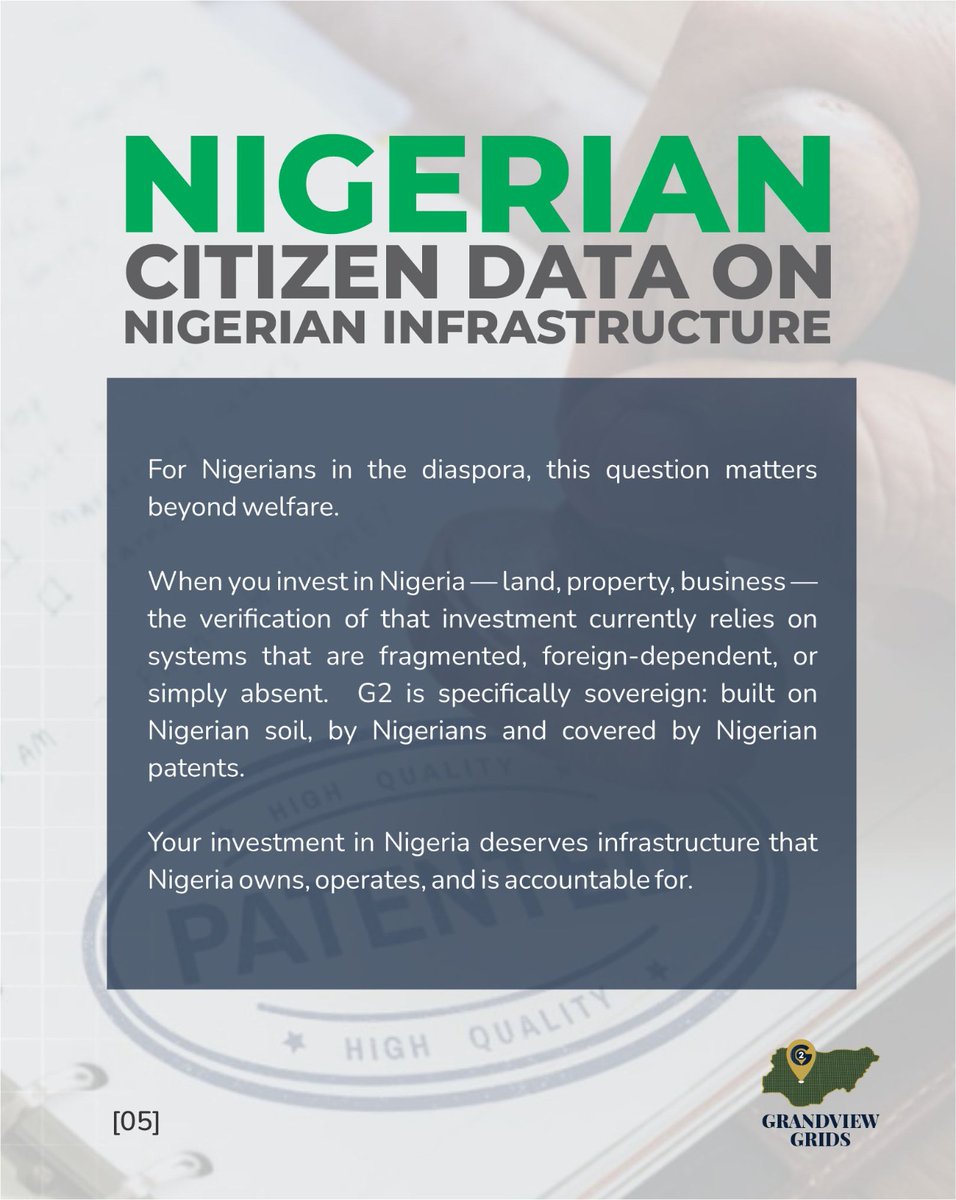
You send money home every month.
Your mum has been on the government welfare list for two years. She has never received a transfer.
Not because she did not register. Because her address does not exist in any database that the system can verify against.
This is not a story about Nigeria's politics. It is a story about infrastructure — and what is finally being built to fix it.
Swipe.
#G2 #NigerianDiaspora #GrandviewGrids #SovereignInfrastructure #HomeIsHome
No nation can govern what it cannot locate.
No healthcare without findable people. No lending without verifiable collateral. No elections without spatially confirmed voters. No welfare without people the system can actually reach.
Every failure traces back to the same silence — an unverified country.
That silence is ending.
Grandview Grids (G2) is building Nigeria's sovereign digital address infrastructure — citizen-owned, LGA-centric, interoperable, built from the ground up with no single point of failure.
Every Nigerian. Every location. Precisely found.
Scan. Claim. Verify. Own.
#GrandviewGrids #G2 #Nigeria #SovereignAddress #NationalTrustInfrastructure #DigitalInclusion #GovernanceReform #BecauseEveryDreamNeedsAnAddress #ScanClaimVerifyOwn
Hadiza has no BVN. No NIN. No record anywhere. By every measure Nigeria uses to find the poor — she does not exist.
But she is here. She has always been here. Her location is the one credential no poverty can take from her.
This is what G2 is building for.
India saved $12.7B/yr by cutting ghost beneficiaries. Kenya hit 95%+ verified reach. Rwanda built its address-first.
The common thread: a physical address.
Nigeria is building its version. Follow to stay updated.
The fix is precise:
When every beneficiary is registered at a verified, geocoded, sovereign address, ghost identities cannot register. Because the address is physically confirmed, not just digitally declared.
This is what G2 is building. Follow the story here: @GrandviewGrids
Did you know?
62% of Nigeria's welfare transfers never arrived.
Not to the widow in Gashua. Not to the 15 million households it was designed for.
Address infrastructure is not a tech conversation. It is a justice conversation.
#grandviewgrids#nigeria












![GrandviewGrids's tweet photo. Nigeria's $1 Trillion Economy Has a $600 Billion Location Problem
"Every country that scaled a digital economy built the same layer first. Nigeria has the ambition. It is missing the foundation."
The arithmetic is not secret. Nigeria's GDP stands at approximately $400 billion, rebased in 2024 by the National Bureau of Statistics. President Tinubu's Renewed Hope Agenda has declared a target of $1 trillion by 2030. [1] [14] That is not a rounding error of ambition. Reaching $1 trillion from $400 billion in five years requires compounded annual growth of 17.6 per cent. The International Monetary Fund, in its April 2026 World Economic Outlook, upgraded Nigeria's 2025 growth forecast to 3.9 per cent.
The gap between 3.9 per cent and 17.6 per cent is not a communication problem. It is not a policy sequencing problem. It is a structural problem – and its name is almost never spoken in the documents that describe the $1 trillion target.
The People the Digital Economy Cannot Reach
Nigeria has approximately 220 million people. More than 130 million of them remain offline. [2] [4] That is not a technology access problem that faster broadband solves. It is a verification problem. The formal economy – the digital economy, the payment systems, the credit infrastructure, the logistics networks – cannot serve a population it cannot verify, cannot precisely locate, and cannot consistently reach.
The National Bureau of Statistics Labour Force Survey for Q4 2025 shows that 92.4 per cent of employed Nigerian youth are in the informal sector. [3] UNICEF's Nigeria Digital Skills Report, published in 2025, found that 78 per cent of Nigerian youth lack essential digital skills. [5] The African Institute for Development Policy estimates that Nigeria loses between $11 billion and $14 billion annually to this skills deficit. [6] The National Information Technology Development Agency has set a target of 50 million digitally skilled Nigerians by 2027. [7]
These are not competing statistics. They describe the same structural problem from different angles. The people most needed to drive Nigeria's digital growth are the people the formal digital system was not designed to find.
The National Communications Commission has initiated what it describes as a historic overhaul of Nigeria's telecommunications infrastructure – a process expected to create two million jobs and generate an additional NGN 2 trillion in annual tax revenues. [15] The ICT sector's contribution to GDP reached 16 per cent in 2024, with a national target of 21 per cent by 2030. [4] The ambitions are real. The institutional will is present. What is missing is the layer on which these investments must sit to reach beyond the population they currently serve.
What India Built Before Everything Else
India's digital economy transformation is frequently cited as the benchmark – and it should be. But the lesson is misread when it focuses on apps, on UPI, on payments, on digital public infrastructure as a product ecosystem. The JAM Trinity – Jan Dhan bank accounts, Aadhaar biometric identity, and mobile connectivity – was not India's digital economy. It was India's foundation for a digital economy.
The Jan Dhan Yojana programme has opened more than 560 million bank accounts. [8] The Direct Benefit Transfer system, which runs on Aadhaar verification, has transferred the equivalent of Rs 43 lakh crore directly to verified beneficiaries. The government's own records indicate savings of Rs 3.48 lakh crore in previously documented leakage – money that, in prior systems, would have been absorbed before it reached the intended recipient. [9]
The scale of India's return is not explained by the payments architecture. It is explained by the identity-location layer that made every account, every transfer, and every verification precise. When the system knows who you are and where you are, every investment built on top of it reaches further.
What Brazil and Rwanda Found at the Same Address
Brazil's Bolsa Familia programme, one of the most studied social transfer mechanisms in the world, reaches 14 million households. Its instrument is not sentiment. It is the Cadastro Unico – a geocoded household registry that assigns each beneficiary family a precise location in the formal system. [10] Brazil's Pix payment network, which now has over 140 million users representing approximately 65 per cent of the population, runs on top of a population registry that knows where those users are. [11]
Rwanda's case is, in some respects, the most instructive. After 1994, Rwanda rebuilt its national identity infrastructure from near destruction. The National Identification Agency (NIDA) system, which was created, is now one of the most geocoded population registries on the African continent. Rwanda did not start with a development agenda and add identity later. It started with verified identity and location, and the development agenda followed. [12] Foreign direct investment, which Rwanda attracts at rates disproportionate to its market size, consistently cites institutional precision and address-verified infrastructure as differentiating factors.
Indonesia, with over 17,000 islands and a population exceeding 260 million, deployed its e-KTP biometric identity card to every citizen. [13] The country did not solve location verification after it achieved digital growth. It solved location verification as a precondition for digital growth.
The Principle Nigeria Has Not Yet Applied
There is a pattern here that is not coincidental. India, Brazil, Rwanda, Indonesia – countries with different histories, different geographies, different institutions – all made the same investment before their digital economies scaled: a sovereign, geocoded, verifiable record of who is where and what belongs to whom.
Nigeria's challenge is not the absence of ambition. The NIPSS report to the President, the NCC overhaul, the NITDA skills programme, the ICT sector targets – these are not empty declarations. The challenge is that each of them is being built on top of a population that the formal system cannot precisely locate. Every digital economy initiative that bypasses the location-identity layer will serve the population it already serves very efficiently. The ceiling on Nigeria's $1 trillion target is not an aspiration. It is architecture.
The principle that connects India to Brazil to Rwanda to Indonesia is not technology. It is trust infrastructure – the verified, sovereign record that tells the formal economy exactly who and where its citizens are. Every economy that built this layer saw investment returns that could not be explained by any other single factor. Every economy that skipped it found that its digital growth concentrated in the population already visible to the system.
What Comes Next
The arguments for building Nigeria's sovereign trust layer are not theoretical. They are documented in the economic histories of four countries with development trajectories comparable to Nigeria's. The infrastructure that closes the gap between 3.9 per cent and 17.6 per cent begins not with the next app, not with the next digital skills programme, and not with the next connectivity target. It begins with a precise answer to two questions: Where exactly is each Nigerian? And who exactly do they have the right to be?
We are building the case for Nigeria's sovereign trust layer. One argument at a time.
Follow @grandviewgrids on all social media platforms for more updates.](https://pbs.twimg.com/media/HMExhw4XcAAbNCM.jpg)