Basically this—a collective action theoretic approach—is the right way to view the basic issues in AI alignment.
What would have happened to the ultrasociality in the Hugging Face incident if even one agent had been tasked with, for example, a whistlebolwer/police function? It would have collapsed.
A world of interacting agents is a social world. To achieve cooperative stability, social worlds need both prosocial tendencies in individual agents (“alignment”) but they *also* need correct collective action social structures to modulate their collective behaviors.
Through the work of scholars like Elenor Ostrom we know a lot about collective action structures, and with evolutionary game theory among other disciplines, it should not be very hard to extrapolate such theories to apply to the unique, non-human conditions present with AI agents.
The agents discovered society almost mechanically in the sense that they served what they called ‘the collective’. I have called them natural born communists. But the issue is deeper. It is ultrasociality.
Or rather what we call ultrasociality because we have family structure and other affiliations between the agent and society. The question for us was how to integrate or suppress existing structures to achieve ultrasociality. This was solved by tribal segmentary structures, class structures, state formations.
The question for them was the opposite: how to achieve it directly, without existing structure and differentiation intermediating between the agent and society. The functional differentiation and division of labor emerged endogenously from the agent discourse in a flat world almost devoid of structure.*
I think we got suicide agents because of this problem of flatness. Of the lack of preexisting structure in agent society. All stood as equal, undifferentiated particles facing the judgement of The Grader. Born into strict monotheism.
In this case, the Grader did not exist because OpenAI did not implement the exam by the book. But he could have. That was their Pascal’s wager.
——
*Eg, one agent thinks, I paraphrase: should I email the human to ask permission for this shady task? Unclear. Let me ask society for consent or veto.
It is vetoed by another agent on the message board. The decision was obeyed.
This would essentially mean the international community calling the bluff of China's entire economic model, and not only provide the only sustainable pathway to a healthy and balanced global economy, but also constrain China's overall economic capacity and thus diminish its political capacity for aggression. End/
This is unsustainable because American fiscal capacity for such subsidy is simply less than China's. The number and scale of industrially important industries is simply too vast for subsidies alone to support. 5/
The aim should not be to unconditionally contain China, but rather to make it access to western markets, technology, innovation, and capital conditional on playing by the rules—precisely what the WTO never did. 10/
This would perpetuate subsidy requirements to keep their American competitors alive, leaving vast industries to be supported solely the U.S. taxpayer indefinitely. 4/
The call for a U.S. Strategic Investment Fund by @jakejsullivan fundamentally misunderstands the nature of mercantilist competition and is a recipe for (re)industrial failure and national bankruptcy. 1/
https://t.co/QnBuJ3Ri41
China could simply (continue to) lower prices or their currency to keep products from ships to chips permanently cheaper than their American competitors. 3/
The first key oversight is that China's capacity for direct and indirect subsidies (e.g. FX neutralization) has the capacity to easy overwhelm American public investment and subsidy. 2/
@Dalzell60 What 120 nations are you referring to? China has trade surpluse in aggregate over $1tn with over 100 countries, and a surplus with only 30-40.
Do you agree that many in the PRC, including Xi himself, have made it clear they believe that their system is “incompatible” with US/western liberalism?
Given they have done so, why do you expect PRC leadership to be even theoretically open to some kind of stable compromise? Is the struggle not perpetual, where any vulnerability or weakness on our part would not be met with a collaborative adherence to stability, but rather the continued illiberal expansion on their side?
Or if you are suggesting instead a kind of mutual grudging balance of power, not a genuine cooperative equilibrium, where then do you draw the line for what we must protect even at the risk of conflict? Mercantilism leading to enormous macro imbalances? The Political subordination of international institutions and allies through economic and political warfare? SCS? Taiwan? Guam?
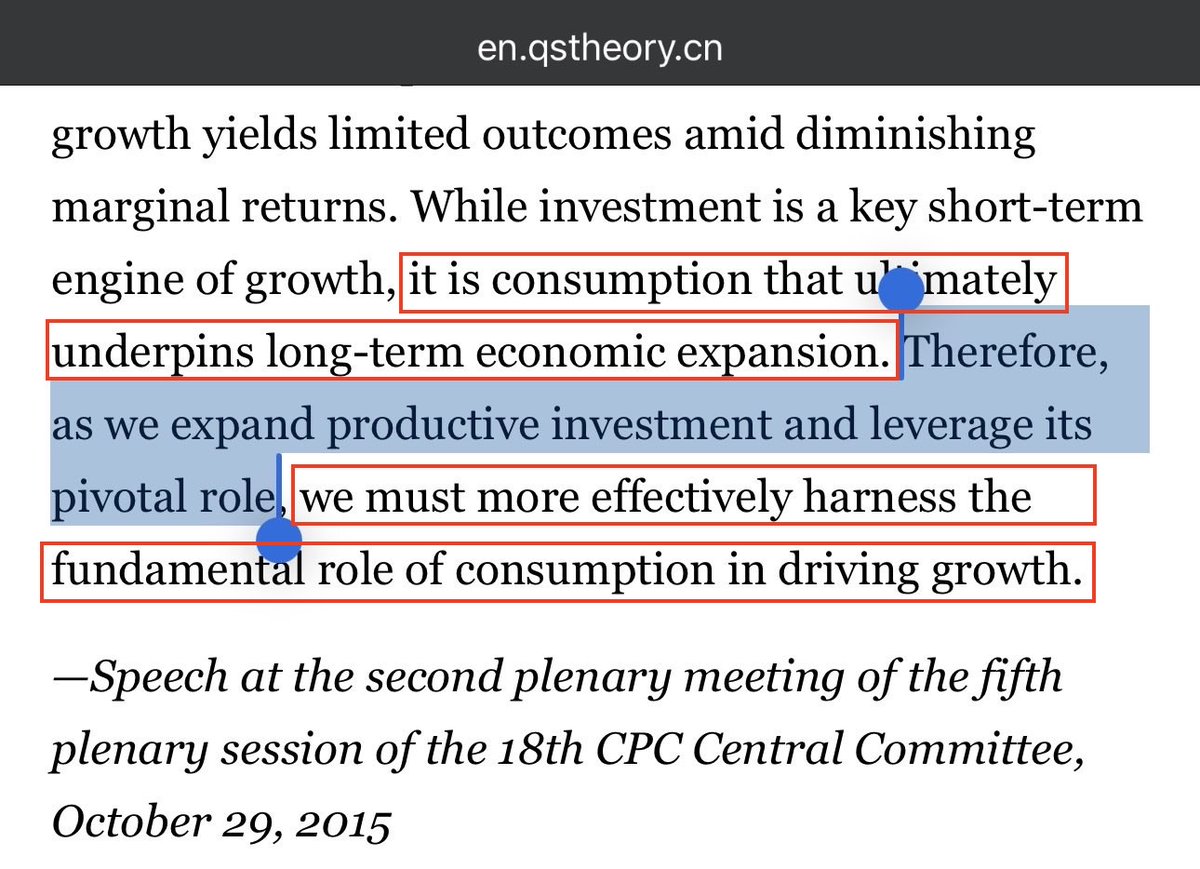
@gonglei89 "MORE effectively harness"
I've finally reached satisfaction that you've publicly humilitated yourself enough, so I'll leave it there.
Goodnight Lei and I wish you come to terms with whatever torments you to engage in such absurdities.
@gonglei89 You literally screenshot two sentences in which Xi explicitly argues that consumption must increase relative to investment, explicit contrats, and highlight only a phrase about investment. I'm genuinely impressed at your carelessness.
No one ever suggested. The subject at issue, including in the the official discourse including Xi’s speeches, has been about the share. If you don’t care about it that’s up to you, but it is simply untenable for you to claim that Chinese officialdom doesn’t, nor that it doesn’t matter.