On July 8th my colleagues and I discussed “The Essential Societal Role of Livestock, Today and Tomorrow” for the Livestock Symposium at the 2025 Meeting of the American & Canadian Societies of Animal Science in Hollywood, FL.
The presentations were recorded and videos are now available.
We wouldn't formulate swine diets using calories and crude protein alone.
Why accept less sophisticated measures when evaluating how we nourish people?
It's time to reconnect grasslands, ruminants & human metabolic health.
A Forage Renaissance? 🌱
https://t.co/wpwFJ4E29E
#ForageRenaissance #MetabolicHealth
High insulin can cause insulin resistance, and a healthy person can develop it in just a few days.
Insulin resistance is usually described as the starting problem, with high insulin as the body's way of making up for it. That's partly true. When tissues respond poorly to insulin, the pancreas does release more to keep blood glucose in range.
The relationship also runs the other way. When researchers gave healthy young people a steady infusion of insulin for about four days, raising it only to levels the body reaches in everyday life while keeping blood glucose normal, they became measurably insulin resistant. Their bodies cleared less glucose in response to insulin, mainly because less of it was stored as glycogen. Their pancreas also responded less to a rise in blood glucose afterward.
A similar change showed up when insulin was raised a different way. When the researchers infused glucose for three days so the volunteers' own pancreas released more insulin, the amount of glucose their bodies stored in response to insulin also fell, even though their total glucose uptake didn't change.
The researchers concluded that high insulin should be viewed as a cause of insulin resistance that keeps itself going, in addition to being a response to it.
This matters because insulin often runs high for years before blood glucose looks abnormal. If high insulin makes cells less responsive, then a way of eating that keeps insulin elevated from morning to night keeps feeding the problem, even while glucose readings look fine.
If someone is hoping to restore insulin sensitivity, it's clear that bringing insulin down deserves as much attention as bringing glucose down, and that starts with how much and how often a person eats foods that call for a lot of it.
A week ago I was still in South Africa.
Despite the global voices advocating for a "plant-based" diet, the reality is that Africa's food supply (per FAOStat data) is the MOST plant-based region. Not unrelated, the regional rates of malnutrition (stunting, wasting, protein-energy imbalance, micro-nutrient deficiencies, and chronic/metabolic diseases) are the greatest.
Hopefully the policy efforts to address the latter will incorporate a perspective of human nutrition informed by the carbohydrate-insulin model and metabolic health.
"What is 'food'?" is not an trivial question, yet its definition is frequently assumed.
There's more to nourishment than nutrients.
https://t.co/pU2HS11cKy
@TheNoakesF
Vegan pregnant women are at risk for
➡️ Higher rate of small-for-gestational-age birth (~ lower maternal protein intake and composition)
➡️ Lower intake of calcium, vit B12, vit D, DHA, choline
https://t.co/nUk05idQX2
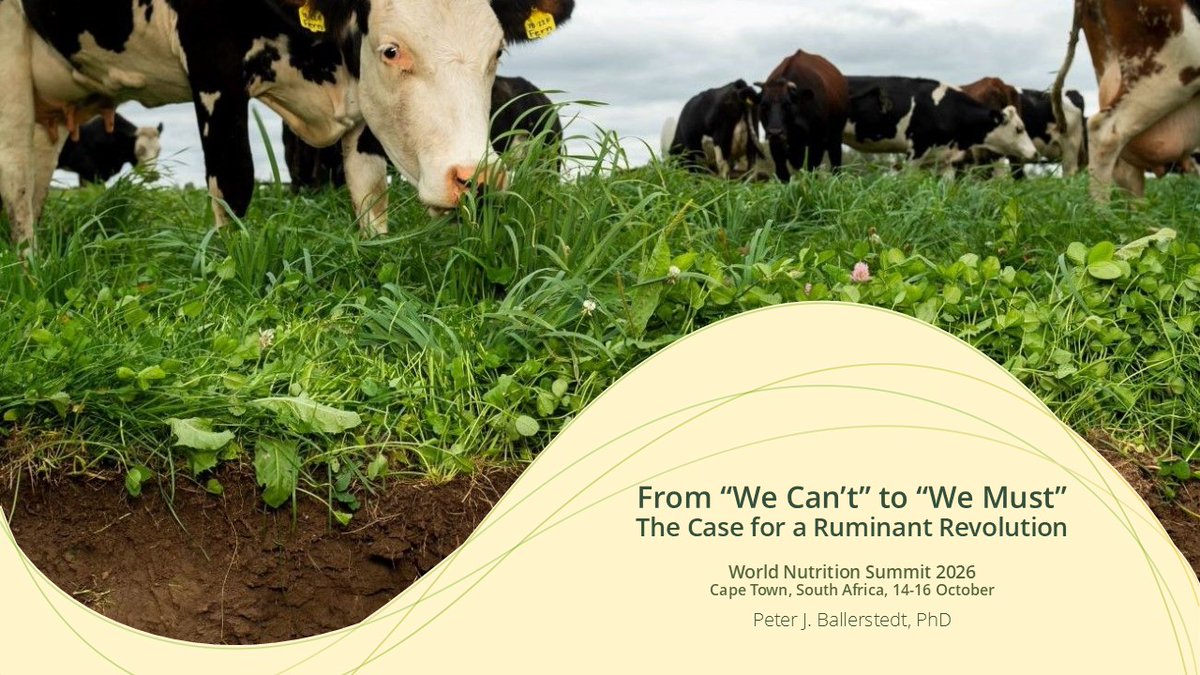
Today at the World Nutrition Summit in Cape Town:
From “We Can’t” to “We Must”: The Case for a Ruminant Revolution.
“If humans require better nourishment, the job of agriculture is not to explain why the required food cannot be produced. The job is to increase the biological productivity of the system until it can.”
We need to move beyond producing calories to nourishing humanity.
Scan the QR code for my presentation PDF (with speaker notes) and individual slide images. @TheNoakesF NS2026itionSummit
🔍 #Evidence and #slogans are not the same thing.
When it comes to #meat, #nutrition and #EnvironmentalSustainability, public debate is often driven by catchy headlines and simplified messages. Reality, however, is more complex.
https://t.co/1Xq0vXBh7R
If humans require better nourishment, the job of agriculture is not to explain why the required food cannot be produced. The job is to increase the biological productivity of the system until it can.
There's still time to register for the World Nutrition Summit 2026!
https://t.co/bH8Ci2fgYU
@TheNoakesF
It’s a reality of aging that we need more dietary protein to keep muscle mass. If you're over 65, the source of your protein may matter as much as the amount.
Researchers gave older adults two meals with the same amount of protein and the same calories. One was built around beef, and the other was vegan. After the beef meal, muscle protein synthesis was about 47% higher. After the vegan meal, it barely moved from where it was before eating (PMID 37972895).
As we age, muscle gets harder to build and easier to lose. We need to make high-quality animal protein the anchor of every meal.
Therapeutic carbohydrate reduction (TCR) now has a peer-reviewed implementation guideline.
Published today in the Journal of Metabolic Health (JMH)!
https://t.co/XkpIdJAzkr
Developed to help address the growing epidemic of metabolic dysfunction.
Dieticians say restrict fat & especially saturated fat.
Don't eat red meat but oily fish is good, they say.
But oily fish has 2x the fat and 1.5x the sat fat of steak! 🤔