Fighting for 🇨🇦 jobs and tariff-free trade with our American friends on the world’s biggest podcast.
Thank you @joerogan for an amazing show.
Full episode: https://t.co/m3SKOhGuWT
Open challenge to anyone:
Vibe-code an alternative Cardano node from scratch in any language except Haskell (could probably allow haskell as well, but there's too much risk that it's just a straight fork).
Vibe-coded will mean that:
1) the entire git history is visible from the start of the project
2) 90% of commits include their model and prompt in the commit message, with a "Coauthored by" tag-line from the model, such as what Claude code sometimes attaches
3) if it is written in the language of an existing alternative node effort (rust, go, typescript, C++, C#, etc.) then the MOSS and JPlag scores indicate low structural similarity
4) the above two are subject to reasonable third party remediation
Deliver a spec-compliant block producing node ready for main net any time before Amaru or Dingo claim to have done this, or the next year, whichever is later.
This means it supports all node-to-node miniprotocols and all node-to-client miniprotocols implemented by the haskell node at the time you make the claim, matches or beats the Haskell node in average memory usage across 10 days, agrees on tip selection to within a generous 2160 slots for the entirety of that 10 days, can recover without human intervention from a power-loss event at any time, and agrees with the Haskell node on all block, validity, chain-tip selection behavior.
Give me a 1 month grace period in case I'm busy with other obligations, before I start testing your node. Then, from the time I start testing, give me 5 days.
If, in those 5 days, I *am* able to:
1) get your node running and sync from either a recent mainnet mithril snapshot or genesis up to tip and
2) produce a valid block accepted by other nodes on preview or preprod
3) Execute the node to client blockfetch and txsubmission miniprotocols
4) get your node running in a private testnet including 2 other haskell nodes
and I *cannot* either:
1) find a transaction for which your node and the haskell node disagree on the validity, or
2) find a block for which your node and the haskell node disagree on the validity, or
3) find a sequence of blocks produced by the devnet for which your node disagrees with the haskell node on the correct consensus tip
I will personally pay you $5000 in USDCx or USDM, and vehemently campaign alongside you for retroactive funding from the treasury at the same market rates being proposed by any of the current funding proposals.
I would offer more, but I've been making below market rate for my skills for 5 years in an effort to survive in this ecosystem, so I can't actually afford much more myself.
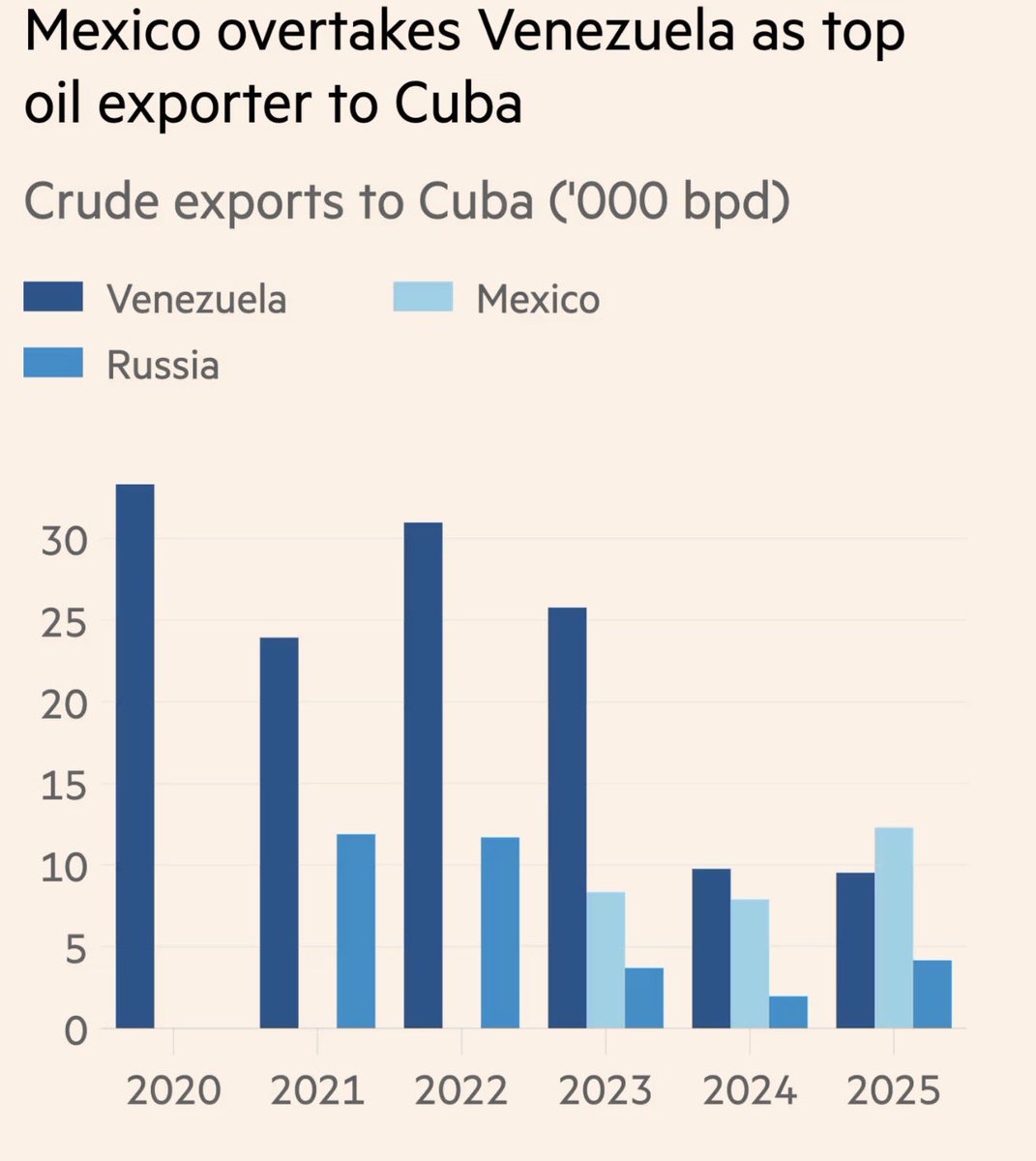
🚨BREAKING @FT —> Mexico overtakes Venezuela as top oil exporter to #Cuba.
Make no mistake: if the Sheinbaum government continues to gift free oil to the terrorist dictatorship in Havana, there will be severe consequences as we renegotiate the USMCA Free Trade Agreement!
What you are actually doing here is to bribe nokia to put these jobs into Canada by paying hundreds of thousands of dollars per job from taxpayer money. What this does is to lower the cost basis of nokia per employee. This has been going on for decades, called FDI which all civil servants think is a good thing. I spent a lot of time explaining to civil servants in ottawa that its not good for our economy that American and Oversees branch offices can employ Canadians at half the cost to all the canadian companies around them due to these subsidies. We should not do them at all, they are toxic, at least in the tech sector.
It's never meat to be this way, but the situation that very often arises is: It's strictly worse inside of Canada to be a Canadian company compared to a company headquartered everywhere else.
This is a bad situation, because the fruits of the subsidized labor will accrue to the wealth of other countries and not Canada. It's tax payer money invested into locking up scarce high tech talent in jobs where they no longer contribute to the Canadian economy directly. Why