Patriarch of Jerusalem Dositheos Notaras (1655 - 1731), from Trikala of Korinthia, could easily spark debates on 2026 X...
But, he was right...
"I do not deny that among other nations as well, and especially among the Latins, there have been men of the highest wisdom. Yet these men either said nothing wise of their own, or, if they did, they took their principles from the springs of Greece. And this is not so praiseworthy, since it was most truly said by him who said that the whole achievement belongs to the one who first discovered the principle...
Copernicus is praised as the inventor of a new system; but let them look in Plutarch's Opinions of the Philosophers and see that this was the doctrine of Philolaos the Pythagorean, and indeed of the Pythagoreans generally..."
"δέν ἀρνοῦμαι πώς ἐστάθησαν καί εἰς ἄλλα ἔθνη, καί μάλιστα εἰς τούς Λατίνους, μέγιστοι ἄνθρωποι εἰς τήν σοφίαν, ὅμως αὐτοί ἤ οὐδέν σοφόν εἶπον οἴκοθεν, ἤ ἄν εἶπον ἔλαβον τάς ἀρχάς ἐκ τῶν πηγῶν τῆς Ἑλλάδος, καί τοῦτο δέν εἶναι τόσον ἐπαινετόν ἐπειδή καί ἀληθέστατα εἶπεν ἐκεῖνος ὅπου εἶπεν ὄλον τό κατόρθωμα εἶναι ἐκείνου οπού ηὖρε τήν ἀρχήν …
...Ἐπαινεῖται ὁ Κοπέρνικος ὡς ἐφευρέτης νέου συστήματος, ἀλλά ἄς ἰδοῦν εἰς τά ἀρεσκόμενα τοίς φιλοσόφοις παρά Πλουτάρχω, ὅτι αὐτή ἦτον γνώμη Φιλολάου τοῦ Πυθαγορείου καί ἁπλῶς τῶν Πυθαγορείων..."
@UYakubi@ibrahimkaragul Are muftis in Turkey being elected by the people or appointed by the state? If it's the 2nd (which it is) then stfu, hypocrite Esek Turk
@ahmet34341453@ibrahimkaragul Talks about perverts the descendant of the sodomized boys of the Enderun and the slaves of the harem with the blacks and the muted. Turks are a sodomized nation
@ibrahimkaragul Turks are the descendants of the sodomized boys of the Enderun, the bastards who were taken from their parents and became janissaries or the weaklings who couldn't stand the Turkish barbarity and converted to become Turks and traitors of their kin. It's a shame to be a Turk..
@EvinchGunay@YusufErim34@MackieMesser11 Since when are donkeys writing International Law? If your donkey doesn't satisfy you, this doesn't mean that Turkey has any say on the Greek islands and sea with its stupid claims and brain-dead arguments.
P. S. Find another donkey, stupid fk Esek Turk
@notborngestern@Khaledhzakariah BS. Turks had to let the Greeks and other Christians live because they were the only ones civilized, doing the complex activities in the society.Without them production AND taxes would have collapsed.That's what the Caliph told the Sultan when he wanted to kill them after Lepanto
"ἡ Ἑλλὰς μένει τε καὶ ζήσεται - Hellas both remains and shall live"
The Macedonian Anastasios Michael, said it...and he was right.
1710 AD:
《“But the sun,” say the Sirens of songs, “has now looked skeptically at her[Greece].”
“But let flow on,” she says, “the ever-turning cycle or dice-game of all human affairs, wherever and however it wishes. It may indeed already have been able to alter the outward form of Hellas, and perhaps may again do so; but her nature it never can alter, just as neither her position - much less her glory.”
“So long as the things beneath the moon are governed by the same elements, and the heavenly bodies unfold their circular motions according to their appointed courses and revolutions, their approaches and recessions, their retrogradations and deviations, their eclipses, and again their new risings (perhaps signifying — perhaps even bringing about — all this change among sublunary things), Hellas both remains and shall live.”
Ἀλλ’ ὁ ἥλιος, φασιν οἱ τῶν ἀσμάτων σειρῆνες, ἄλλως ἤδη ταύτην
παρενέβλεψεν. Ἀλλὰ ῥείτω, φησὶν αὕτη, ὁ τῶν ἀνθρωπίνων ἀπάντων
ἀγχιστρόφως κατορχούμενος κύκλος ἢ κύβος ὅποι καὶ ὅπως ἂν βούληται.
Σχῆμα Ἑλλάδος ἀλλοιῶσαι καὶ ἤδη ποτὲ δεδύνηται, ἀλλὰ καὶ πάλιν ἴσως
δυνήσεται, φύσιν δ’ οὐδέποτε, καθάπερ οὐδὲ θέσιν, μήτι γε δὴ τὴν δόξαν.
Ἔστ’ ἂν τοῖς αὐτοῖς τὰ ὑπὸ σελήνην διοικεῖται στοιχείοις, αἱ αὐταὶ τῶν
κατ’ οὐρανὸν ταῖς τεταγμέναις φοραῖς, καὶ περιφοραῖς, προσεγγισμοῖς τε καὶ ἀποστάσεσιν, ὑποδρομαῖς, καὶ παραδρομαῖς, καὶ ἐκλείψεσι, καὶ πάλιν νέαις (ταῖς τὴν περὶ πάντα ταύτην τῶν ὑπὸ σελήνην μεταβολὴν ἴσως αἰνισσομέναις, ἴσως δὲ καὶ συνεπαγομέναις) ἐπιτολαῖς ἀνελίσσονται ἐγκύκλιοι κινήσεις, ἡ Ἑλλὰς μένει τε καὶ ζήσεται. 》
@FuatNalcioglu As a Turkish Cypriot I wonder: are you a descendant of the sodomized boys of the Enderun, the bastards who were taken from their parents and became janissaries or the weaklings who couldn't stand the Turkish barbarity and converted to become Turks and traitors of their kin?
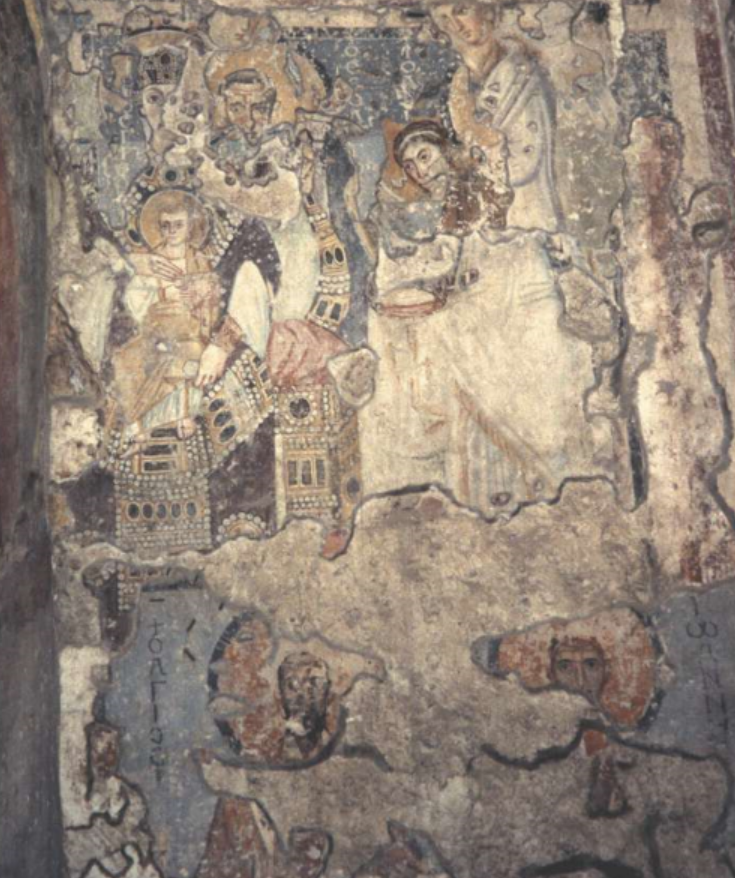
When Rome spoke Greek...
Two unique frescoes from Santa Maria Antiqua, Rome, from the 7th century, during the peak of 'Byzantine Papacy' era.
On the left Saint Anna (Η ΑΓΙΑ ΑΝΝΑ) holding Mary and on the right a palimpsest wall, with different layers of frescoes from that era with Mary and several Greek Church Fathers (e.g. Ioannes Chyrostom).
It's interesting to quote an interesting passage from 'Rome in the eighth century : a history in art / John Osborne, The British School at Rome, Cambridge University Press, 2020'.
"Perhaps not surprisingly, Rome in 700 was very much a bilingual city. It was not a case of Latin or Greek, of separate communities which may have had little or no interaction, but rather one of Latin and Greek, of a clergy and élite laity that was comfortable in both languages, although the communities of immigrant monks perhaps somewhat less so. Even if Latin remained the official language of the Roman church, Greek was the common tongue employed by many members of the senior clergy, and the vast majority of the popes between 685 and 750. A telling insight into the nature of the papal court in the time of Pope John VI (701–5) is provided by Stephanus in his biography of Wilfrid, the Anglo-Saxon cleric and abbot of Hexham and Ripon. Wilfrid had journeyed to Rome in order to appeal the decision of the Council of Austerfield (702) to remove him as Bishop of York, and Stephanus comments that John and his clergy spoke Latin to the visitors but conversed among themselves in Greek: ‘inter se graecizantes et subridentes’. Clearly the pope and his colleagues could function effectively in both languages, but, at least on this occasion, spoke Greek among themselves. It was this dual language proclivity with strong Greek roots that characterized Roman identity in 700. It permeated literary culture well into the early ninth century; and, as we shall see, this is further reflected in the legacy of the city’s material culture, for example, in the inscriptions, both painted and carved, which were placed in the church of Santa Maria Antiqua. The Greek language also lies at the heart of the formal development of papal ceremonial in the years around 700, with many of the words used in the Ordo Romanus I, the official protocol for papal processions and services during Easter week, constituting simple transliterations of Greek terms and phrases. In their apparent obsession with the privileges accorded to various offices and ranks, the Ordines Romani also make extensive use of military terminology, indicating what John Romano has described as a blurring of the boundaries between the army and the church."
@atr0t0s@D_abdulkader 2/2 15 χρόνια ξεσηκωνομασταν ώσπου πήραμε την ελευθερία μας. Οι Εβραίοι 2000 χρόνια περίμεναν να ελευθερώσουν την Ιερουσαλήμ και πολεμάνε απέναντι σε 300 εκατομμύρια Άραβες. Η παραίτηση δεν είναι διπλωματία αλλά αποδοχή ήττας. Κι εσύ είσαι είσαι από αυτούς που έχουν ήδη χάσει..
@atr0t0s@D_abdulkader 1/2 Φίλε, αν κουβαλάτε τέτοια μυαλά στην Κύπρο, όχι μόνο δεν θα δείτε ελεύθερο το βόρειο τμήμα αλλά σύντομα θα χαθεί και το νότιο. Τι σημαίνει ότι είμαστε λίγοι; Οι Έλληνες το 1821 ήταν ελάχιστοι απέναντι σε μια αυτοκρατορία που ήταν από το Σουδάν ως την Ουγγαρία. Στην Κρήτη κάθε
One of the basic elements of ethnic identity is the perception of community and its shared pillars that differentiate the ethnos/genos from its surroundings.
Language was and is one of these basic pillars, and Greeks throughout their history shared their perception of the geographical extent of their homoglossoi co-nationals.
One such example is the monk Pachomios Rousanos (Παχώμιος Ρουσάνος / 1508-1553) from Zakynthos, fierce Orthodox and when it comes to the area of language fierce anti-vernacularist as well.
In an essay criticizing the fellow Heptanesian scholar Ioannikios Kartanos' "Anthos" - a work of stories from Old and New Testament in vernacular - Pachomios is challenging the usage of calling koine the dialect he used in his work, which had many Corfiot dialectal types, since it didn't utilize vernacular idiomatic ones from the rest of the Greek speaking world.
Despite the archaizing names used by Pachomios, his list of contemporary Greek speaking geographical areas is revealing:
"And how is it that the common language was composed only according to the dialect of the Phaeacians, and not according to the general language of all the Hellenes—that is, of the Cephallenians, Cretans, Cypriots, Rhodians, Aeolians, Bithynians, Pontians, Propontians, Thracians, Macedonians, Thessalians, Myrmidons, Euboeans, Boeotians, Athenians, Peloponnesians, Aetolians, Epirotes, and the above mixed?"
«Πῶς δὲ καὶ κοινὴ ἡ κατὰ τὴν διάλεκτον μόνη τῶν Φαιάκων συντεθεῖσα, καὶ οὐ κατὰ τὴν καθόλου τῶν πανελλήνων, ἤτοι Κεφαλλήνων, Κρητῶν, Κυπρίων, Ροδίων, Αἰολέων, Βιθυνῶν, Ποντίων, Προποντίων, Θρακῶν, Μακεδόνων, Θετταλῶν, Μυρμιδόνων, Εὐβοέων, Βοιωτῶν, Ἀττικῶν, Πελοποννησίων, Αἰτωλῶν, Ἠπειρωτῶν καὶ τῶν ἀναμίξ;»
----------------------------------------------
The map, version of the Map of Greece (Totius Graeciae Descriptio), by the Corfiot - with family roots from Monemvasia, Peloponnese - Nicholaos Sophianos (16th century).
@IFalay93217@ParvumPrincipi Is it true that by being a Turk you're automatically retarded? Because I have seen no Turk with an above average intelligence. Must be the donkey that you mate with, Esek Turk. Back to your stable now
@balammir@ParvumPrincipi You mean it's like the Ottomans saying that the Turks were ignorant, peasants and even donkeys? The difference is that some Greeks had political reasons to call the Macedonians barbarians (those who didn't, they considered them Greeks) while the Ottomans did so by themselves...
@NZARK0123@ParvumPrincipi You can speak about Makedonia when you start to even understand and read at the same language the real Macedonians spoke. Till then you're just an imposter, a funny clown pretending to wear a crown
@SireneOznur Civilization depth she says and they cannot even read whatever uninteresting thing their ancestors wrote even a century before. Turks are a joke of a nation. A nation that was made because the European powers did not want the restoration of the Greeks as the true heirs of Rome..
@secapalite@ParvumPrincipi You are the bastard son of the Greeks. Turks are the descendants of the sodomized boys of the Enderun, the bastards who were taken from their parents and became janissaries or the weaklings who couldn't stand the Turkish barbarity and converted to become traitors of their kin
As a Greek of course he rejected the Translatio Imperii interpretation of the so-called Holy Roman Emperors. But what did this concept state?
"This interpretation of Translatio implied that the empire had been transferred from hand to hand and place to place, from Romans to Greeks and from Greeks to the Germans (or Franks)". This was due to the crowning of Charlemagne as Emperor by pope Leo III in 800AD.
On the other hand, Eastern Romans (Byzantines) argued (correctly) that the Pope had no authority to name an Emperor and that the imperial authority transferred by Constantine the Great from Rome to Constantinople was still in effect.
John III Doukas Vatatzes wrote to Pope Gregory IX: "The imperial authority was transferred by Constantine the Great from Rome to our race (Greek genos), and in us alone it remains.
Of course these concepts are too complex for the simple minded nationalist turks who have now discovered the "Roman not Greek" propaganda...
https://t.co/aCthbZeZbk


![Alyunan00's tweet photo. "ἡ Ἑλλὰς μένει τε καὶ ζήσεται - Hellas both remains and shall live"
The Macedonian Anastasios Michael, said it...and he was right.
1710 AD:
《“But the sun,” say the Sirens of songs, “has now looked skeptically at her[Greece].”
“But let flow on,” she says, “the ever-turning cycle or dice-game of all human affairs, wherever and however it wishes. It may indeed already have been able to alter the outward form of Hellas, and perhaps may again do so; but her nature it never can alter, just as neither her position - much less her glory.”
“So long as the things beneath the moon are governed by the same elements, and the heavenly bodies unfold their circular motions according to their appointed courses and revolutions, their approaches and recessions, their retrogradations and deviations, their eclipses, and again their new risings (perhaps signifying — perhaps even bringing about — all this change among sublunary things), Hellas both remains and shall live.”
Ἀλλ’ ὁ ἥλιος, φασιν οἱ τῶν ἀσμάτων σειρῆνες, ἄλλως ἤδη ταύτην
παρενέβλεψεν. Ἀλλὰ ῥείτω, φησὶν αὕτη, ὁ τῶν ἀνθρωπίνων ἀπάντων
ἀγχιστρόφως κατορχούμενος κύκλος ἢ κύβος ὅποι καὶ ὅπως ἂν βούληται.
Σχῆμα Ἑλλάδος ἀλλοιῶσαι καὶ ἤδη ποτὲ δεδύνηται, ἀλλὰ καὶ πάλιν ἴσως
δυνήσεται, φύσιν δ’ οὐδέποτε, καθάπερ οὐδὲ θέσιν, μήτι γε δὴ τὴν δόξαν.
Ἔστ’ ἂν τοῖς αὐτοῖς τὰ ὑπὸ σελήνην διοικεῖται στοιχείοις, αἱ αὐταὶ τῶν
κατ’ οὐρανὸν ταῖς τεταγμέναις φοραῖς, καὶ περιφοραῖς, προσεγγισμοῖς τε καὶ ἀποστάσεσιν, ὑποδρομαῖς, καὶ παραδρομαῖς, καὶ ἐκλείψεσι, καὶ πάλιν νέαις (ταῖς τὴν περὶ πάντα ταύτην τῶν ὑπὸ σελήνην μεταβολὴν ἴσως αἰνισσομέναις, ἴσως δὲ καὶ συνεπαγομέναις) ἐπιτολαῖς ἀνελίσσονται ἐγκύκλιοι κινήσεις, ἡ Ἑλλὰς μένει τε καὶ ζήσεται. 》](https://pbs.twimg.com/media/HI1Nya6bwAAKtBc.jpg)