Hier, 1ère journée thématique de ĺa Société Francaise de Parasitologie, à tours et hybride. Un moment très chouette et tres convivial avec un contenu scientifique de très haut niveau. Merci à tous les participants, orateurs et spectateurs ainsi qu'aux sponsors.
New paper today:
A novel RFLP-PCR method for the rapid diagnosis of Echinococcus multilocularis and different Echinococcus granulosus sensu lato species from tissue samples
https://t.co/z0oge4bl4A
Abstract: Both alveolar echinococcosis and cystic echinococcosis are zoonotic diseases affecting thousands of humans in Europe annually. Five Echinococcus species are known to be endemic in Europe, but with varying relative importance in humans and animals. In order to identify these Echinococcus species from tissue samples, an RFLP-PCR method was developed and validated in accordance with the French quality standards for molecular diagnostics (NF U47-600-2). Amplification by PCR of about 846 bp from the 12S ribosomal RNA gene was followed by a single digestion step with three restriction enzymes (AccI, DdeI and HinfI). The RFLP-PCR method distinguishes Echinococcus multilocularis, E. granulosus sensu stricto, E. equinus, E. ortleppi and E. canadensis in six specific profiles composed of two or three bands. Each profile is specific for the species, except an additional specific profile from genotype G8 of E. canadensis. Species from other genera of the Taeniidae family correspond to two other types of profiles. Additionally, in silico analyses predicted three specific additional profiles for the other four Echinococcus species. The limit of detection of the method including DNA extraction is estimated to be a minimum of 1,000 copies. Total specificity and sensitivity were obtained by testing a panel of 73 and 79 DNA samples previously identified by sequencing. This RFLP-PCR technique is cost-effective, simple and rapid to implement, making it suitable for use in large epidemiological studies, as well as for single diagnostic purposes targeting tissue samples, such as cysts or worms, without requiring sequencing.
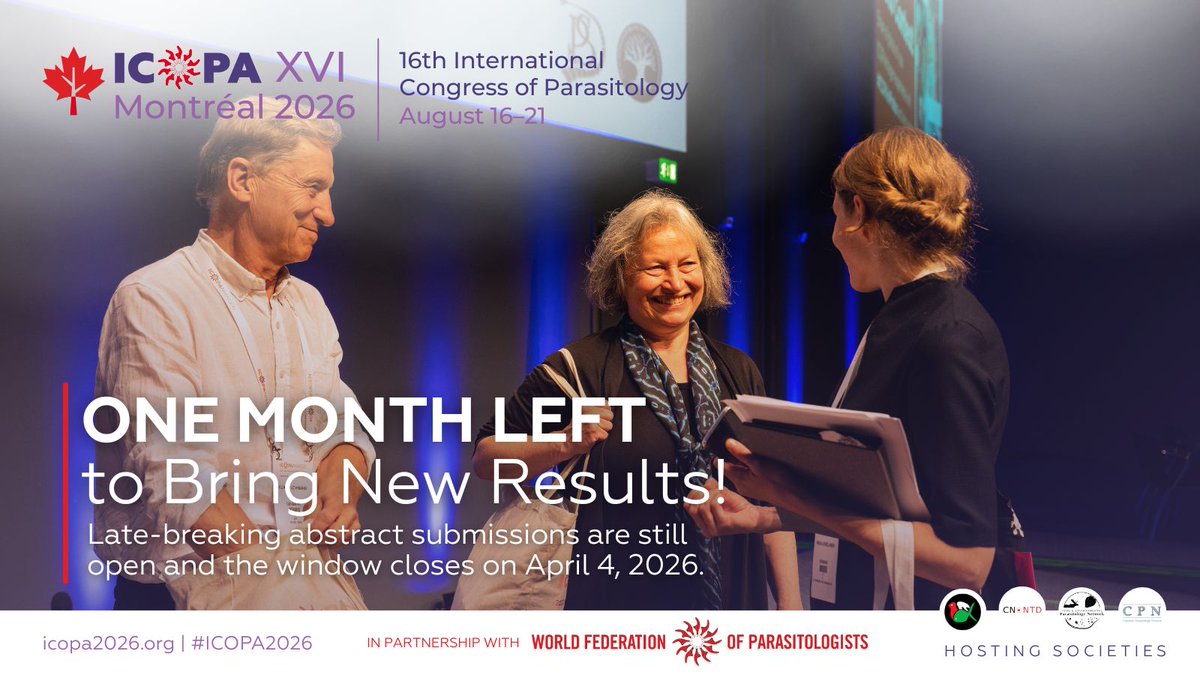
1 month left for late-breaking abstract submissions for #ICOPA2026!
New results, updated analyses, or ongoing work deserve a platform. Submitting means sparking discussions with an audience that cares about the same questions you do.
🔗 https://t.co/KBbWTFdSgZ
@WorldFedPara
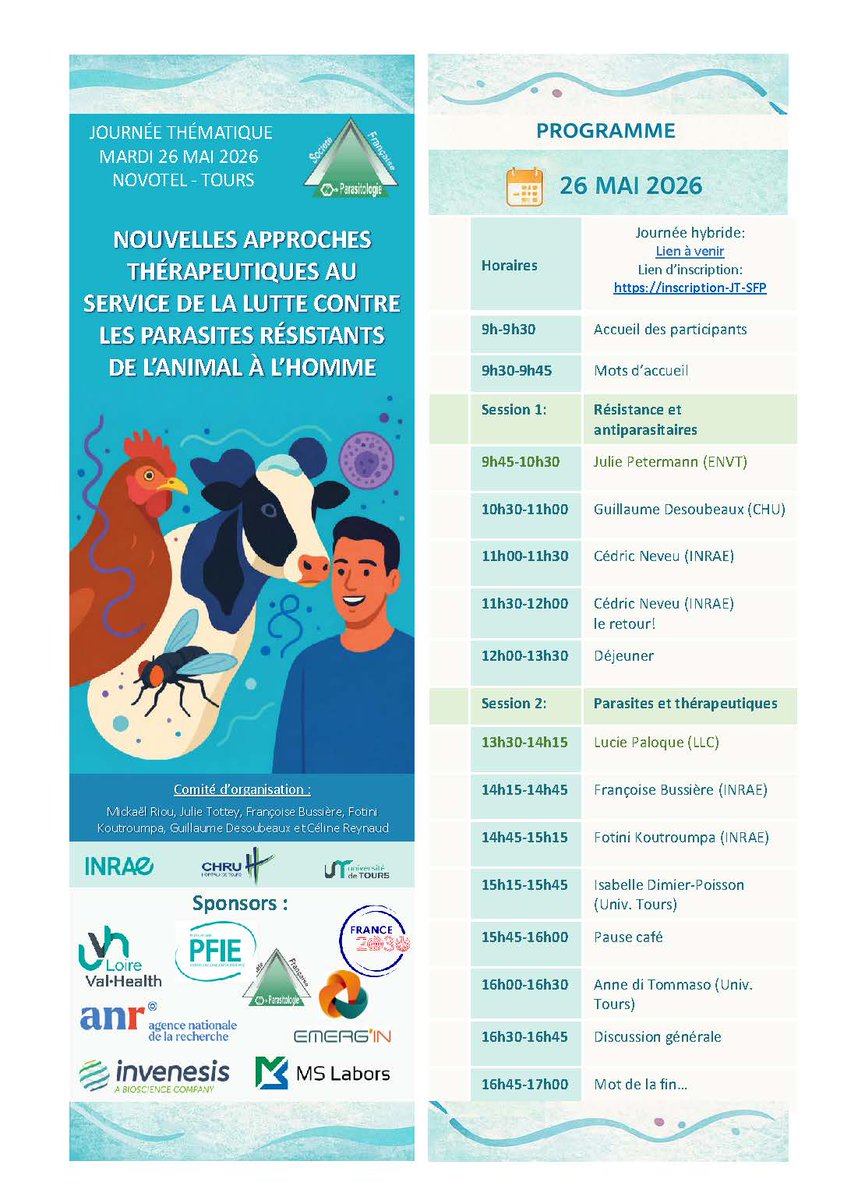
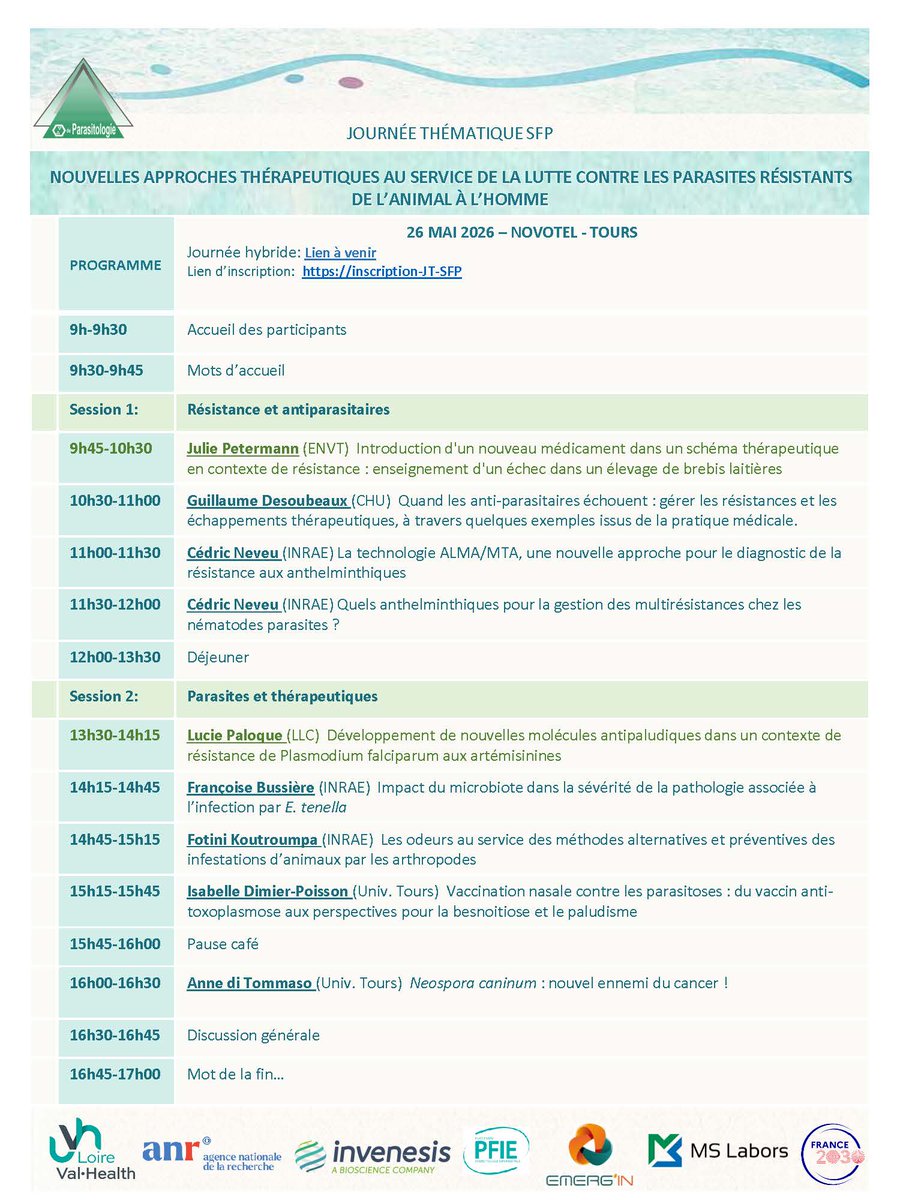
Journée thématique:
Nouvelles approches thérapeutiques au service de la lutte contre les parasites résistants de l’animal à l’homme
Jeudi 26 mai
https://t.co/2LjQibjYp4
#ICOPA2026 abstract submissions close tomorrow!
If you want your research discussed, challenged, and built on by the global parasitology community, this is the moment.
🔗 https://t.co/KBbWTFdSgZ
#Parasitology@WorldFedPara
Un point important sur ces vers collés sur les poils des chiens et des chats est qu'il ne s'agit pas de parasitisme, mais de phorésie, comme l'expliquent clairement les auteurs
#ICOPA2026 is backed by hosting societies with long-standing commitments to parasitology research, education, and collaboration.
Meet the societies supporting the congress 👉 https://t.co/dGRB8UH5Mj
#Parasitology@WorldFedPara@csz_scz@CPN_Symposium
Abstract deadline extended to 16 Feb 2026!
If you’ve been refining results or waiting on that last analysis, now’s the moment to put your work on the #ICOPA2026 program.
Make your research part of the conversation 👉 https://t.co/ZRlUKLrS1V
#Parasitology@WorldFedPara
First pick at #ICOPA2026: companies that confirm early get more exhibition space options (6-12 sqm) and a broader choice of sponsorship packages (Platinum-Bronze).
🔗 Learn more: https://t.co/ZZrnJlnmc2
#Parasitology#GlobalHealth
𝗖𝗼𝗻𝗴𝗿𝗲̀𝘀 𝗮𝗻𝗻𝘂𝗲𝗹:
Société Française de Parasitologie
Société Française de Mycologie Médicale
5ème Journée Franco-Maghrébine de Parasitologie-Mycologie
Marseille, 28 au 30 avril 2026
https://t.co/PFNRNL6kU3
Now in press in Parasite:
𝗣𝗿𝗼𝗰𝗲𝘀𝘀𝗶𝗻𝗴 𝗮𝗻𝗱 𝗺𝗼𝘂𝗻𝘁𝗶𝗻𝗴 𝗽𝗵𝗹𝗲𝗯𝗼𝘁𝗼𝗺𝗶𝗻𝗲 𝘀𝗮𝗻𝗱 𝗳𝗹𝗶𝗲𝘀: 𝗮 𝗰𝗼𝗻𝘀𝗲𝗻𝘀𝘂𝘀 𝗴𝘂𝗶𝗱𝗲𝗹𝗶𝗻𝗲
This paper will be published with translations in several languages!
Stay tuned... https://t.co/yMsdEkYflU
Abstract: This article provides a comprehensive guide for the processing and mounting of phlebotomine sand fly specimens, which is crucial for species identification and pathogen detection and isolation. It discusses a range of techniques suitable for both field and laboratory settings. The guide includes detailed instructions on sand fly collection, handling, covering, and euthanasia (recommending dry freezing or CO2 over chemicals) as well as conservation strategies, such as cold storage and preservation in ethanol. The quality of preparation of certain anatomical structures (genital organs, head and wings) is essential for their proper microscopic observation and is described in this work. The article also presents detailed sample processing, including the clearing process with agents such as potassium hydroxide then Marc-André solution. The mounting process compares different media, emphasizing their optical properties and preservation potential. Hoyer fluid (also known as chloral gum) is recommended for quick observation, particularly for spermathecae, due to its clarity, although it is not suitable for long-term storage. Other media discussed include polyvinyl alcohol, Euparal®(for limited water tolerance), and Canada balsam (a hydrocarbon-soluble medium), with the latter two offering long-term preservation capabilities. Innovative molecular biology approaches such as DNA sequencing and MALDI-ToF, which require particular attention to sample processing, are also addressed. Furthermore, short video clips illustrating various mounting techniques as well as translations in 33 different languages are provided, allowing the guideline to reach the diverse needs and expectations of the global scientific community.
13ème JOURNEE DE PARASITOLOGIE-MYCOLOGIE CLINIQUE
Jeudi 16 octobre 2025
[détails dans l'image]
Organisation : Dr Sophie BRUN
Comité scientifique : Dr Sophie BRUN, Dr Anthony MARTEAU
Service de Parasitologie-Mycologie, hôpital Avicenne AP-HP,
AP-HP. Hôpitaux universitaires Paris Seine-Saint-Denis - Tél : 01 48 95 56 51/54
Programme
8h45 : ouverture de la journée
9h00 : Dr Arezki Izri, Dr GérômeBohelay
9h00-9h45 : Dr A. Izri : quoi de neuf à propos de la gale ?
9h45-10h30 : Dr G. Bohelay : Démodécidose : manifestations cliniques et dermocopiques,
thérapeutique.
10h30-11h00 : pause café
11h00 : Dr Anthony Marteau, Dr Aoun
11h00-11h45 : Dr A. Marteau : Actualités du paludisme
11h45-12h30 : Dr O. Aoun : Du Tchad à la Côte d'Ivoire : Tribulations tropicales d'un médecin
militaire en Afrique subsaharienne
12h30 : déjeuner libre
14h00 : Dr Emma Oliosi, Dr Mohamed Ben Romdhane
14h00-14h45 : Dr E. Oliosi : Infections urinaires à Candida spp. : faut-il traiter, et comment ?
14h45-15h30 : Dr M. Ben Romdhane : Imagerie pulmonaire des mycoses
15h30-15h45 : pause-café
15h45 : Dr Sophie Brun, Dr Marianne Ranorohasimanana
15h45-16h30 : Dr S. Brun : Actualités sur les teignes du cuir chevelu en France
16h30-17h15 : Dr M. Ranorohasimanana : Mycoses exotiques: quand y penser ?
17h15 : Evaluation des connaissances (QCM)
17h30 : Fermeture de la journée











![SFParasitologie's tweet photo. 13ème JOURNEE DE PARASITOLOGIE-MYCOLOGIE CLINIQUE
Jeudi 16 octobre 2025
[détails dans l'image]
Organisation : Dr Sophie BRUN
Comité scientifique : Dr Sophie BRUN, Dr Anthony MARTEAU
Service de Parasitologie-Mycologie, hôpital Avicenne AP-HP,
AP-HP. Hôpitaux universitaires Paris Seine-Saint-Denis - Tél : 01 48 95 56 51/54
Programme
8h45 : ouverture de la journée
9h00 : Dr Arezki Izri, Dr GérômeBohelay
9h00-9h45 : Dr A. Izri : quoi de neuf à propos de la gale ?
9h45-10h30 : Dr G. Bohelay : Démodécidose : manifestations cliniques et dermocopiques,
thérapeutique.
10h30-11h00 : pause café
11h00 : Dr Anthony Marteau, Dr Aoun
11h00-11h45 : Dr A. Marteau : Actualités du paludisme
11h45-12h30 : Dr O. Aoun : Du Tchad à la Côte d'Ivoire : Tribulations tropicales d'un médecin
militaire en Afrique subsaharienne
12h30 : déjeuner libre
14h00 : Dr Emma Oliosi, Dr Mohamed Ben Romdhane
14h00-14h45 : Dr E. Oliosi : Infections urinaires à Candida spp. : faut-il traiter, et comment ?
14h45-15h30 : Dr M. Ben Romdhane : Imagerie pulmonaire des mycoses
15h30-15h45 : pause-café
15h45 : Dr Sophie Brun, Dr Marianne Ranorohasimanana
15h45-16h30 : Dr S. Brun : Actualités sur les teignes du cuir chevelu en France
16h30-17h15 : Dr M. Ranorohasimanana : Mycoses exotiques: quand y penser ?
17h15 : Evaluation des connaissances (QCM)
17h30 : Fermeture de la journée](https://pbs.twimg.com/media/GuZbSvJX0AAUdpr.jpg)


