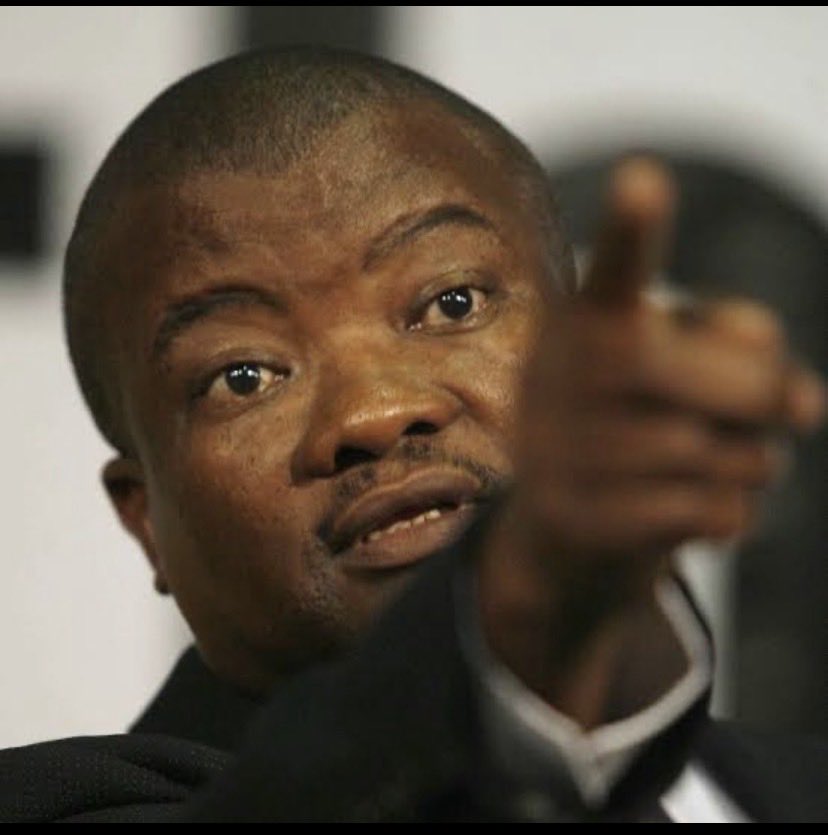
😂 The irony is priceless. That’s exactly what many EFF leaders have had to do for years—swallow whatever comes from Malema. The moment you publicly disagree with him or challenge his authority, your political future is on the line. Suddenly everyone becomes quiet, not because they have no opinions, but because crossing Malema often comes with consequences. Loyalty in the EFF too often looks less like healthy internal democracy and more like unquestioning obedience. So mocking someone for not pushing back is rich when your own movement has spent years defending one man, no matter what he says or does.
I wouldn’t dismiss the possibility. The ANC isn’t the electoral force it once was, the DA has a loyal voter base, and if enough undecided voters rally behind one opposition party instead of splitting their votes, Helen Zille could surprise many with an outright majority. Politics is full of upsets. She also announced her intention to run for Mayor of Johannesburg well before most other parties unveiled their candidates. That early declaration has given her more time to shape the conversation, campaign, build momentum, and present herself as a clear alternative while others are only now introducing their candidates. In politics, an early start can be a significant advantage.
[WATCH] IMPORTANCE OF PODCASTS AS TOOLS OF ENGAGEMENT
Most of the leaders of the ANC go to podcasts and some such as Cde Mathews Phosa and President Thabo Mbeki who I appreciate even write letters engaging us as the leadership of the ANC. Cde Mbeki sends letters and sometime you may not like what he is saying but that is part and parcel of engagement. He can stand on a podium and say that I wrote to SG Mbalula and he didn’t respond. They can do that not current NEC members, who have certain duties and obligations.
We can’t kill the messengers whether it’s Mac G or Ndlozi, whom are doing a great job in the space. We can’t have problems with them because it’s up to members to go, they just invite people. Podcasts add to the public discourse and they are not regulated. That’s why they can get away with things that normally one wouldn’t on traditional media, it’s an unedited space. Mac G podcast is called chillers, so people naturally chill and say everything. We can’t be at war with podcasters when they just simply doing their job. So when one goes there one must be circumspect but also add to the discourse which enriches the debate culture in our society on various issues.
#RegisterToVoteANC
#LGE2026
Funny how some people can debate men all day, but the moment it’s a woman they resort to body-shaming and cheap insults. If your politics can’t survive scrutiny without degrading women, then it’s your argument that’s bankrupt. Attack ideas, policies and facts—not a woman’s appearance.
One of the biggest obstacles to Black liberation is blind political loyalty. Too many of us are always ready to show up for politicians, defend party agendas and fight fellow citizens, while those in power continue enjoying privilege regardless of who suffers. Real liberation begins when people stop being political cheerleaders and start demanding results. Until we value accountability over party colours and personalities, we’ll keep recycling the same disappointments.
😂😂😂the training company was called Global Forex Institute (GFI), which Sandile Shezi co-founded with George van der Riet. GFI marketed beginner seminars followed by paid advanced training courses. Somewhere in Sandton Protea Hotel Balalaika, ain’t that sure about the hotel name but somewhere there
This isn’t a political analysis—it’s hero worship. Every major political movement needs funding and organisation. Turning one politician into a superhuman who somehow operates above reality doesn’t strengthen your argument; it weakens it. Facts are more persuasive than fan fiction.
We dodged a bullet here.
During the struggle, she chose to run to Nigeria; we didn't send her there.
Our parents stood and fought.
We liberated ourselves.
The DA loves preaching accountability until allegations land at its own doorstep. If these claims about Ian Cameron are true,
who instructed whom, what was discussed, and what was the intended outcome?
The DA’s apparent hostility toward Black advancement is beyond imagination. 😪
Well, that’s a wrong conclusion. The problem isn’t that South Africa’s minimum-wage and BEE policies are “too strong”; the deeper problem is that our economy isn’t producing enough productive, labour-intensive jobs.
If businesses can only compete by paying poverty wages, exploiting undocumented workers and cutting corners, then we haven’t created a sustainable economy—we’ve created a race to the bottom.
The better solution is industrialisation, cheaper and more reliable electricity, lower logistics costs, easier access to finance for small businesses, skills development and incentives for companies that create decent jobs. Government should make it cheaper to produce and employ, not cheaper to exploit.
And immigration policy must be enforced properly. We can’t blame migrants for an economic model that creates the conditions for exploitation in the first place. Hold employers accountable for illegal employment, while creating a legal, regulated pathway for workers where genuine labour shortages exist.
The goal should be simple: more factories, more businesses, more productive workers and better-paying jobs—not a larger pool of desperate people competing to work for less.
Stop lying to yourself, sir. MKP attracting criticism doesn’t automatically mean it is making the “right decisions.” people are angry because they can see political opportunism, incompetence and empty symbolism for what it is.
What makes this even worse is the constant chopping and changing of leadership, which raises serious questions about stability, governance and internal democracy. And when leadership positions start looking like they can be handed to relatives and loyalists, the liberation project becomes dangerously close to the very patronage politics it claims to oppose.
Zuma’s decision to elevate his son into a senior leadership position is particularly difficult to defend. What political or leadership experience had he demonstrated to justify such a position? If the answer is essentially family name and proximity to Zuma, then how is that different from the dynastic politics MKP claims to reject?
@Markosonke1 If Ramaphosa’s legal options are exhausted, shouldn’t his conscience be guided by the Constitution, the law and his duty to the country—not by personal or political considerations?
My problem with these interviews with ANC veterans is that, after decades in politics, many still refuse to tell the full truth. They come onto platforms years later, blame every ANC leader, expose every faction and suddenly present themselves as innocent observers—as if they were never part of the system they are now condemning.
Let’s be honest: some of these veterans only become brave after they have been pushed out, sidelined or politically stabbed. While they had influence, access and protection, they kept quiet. They protected leaders when it suited them, defended decisions they now condemn, and participated in the very political culture they pretend to have discovered today.
And the hypocrisy is glaring. Yesterday, some of them were fiercely protecting Zuma and singing his praises. Today, they are repositioning themselves around Cyril Ramaphosa and speaking as though they have always stood for accountability and clean politics. Tomorrow, if Cyril turns against them, we’ll probably get another interview exposing everything they conveniently refuse to say today.
These veterans cannot keep presenting themselves as the conscience of the movement while avoiding their own accountability. You cannot spend decades inside the machine, help build the culture, benefit from the system, remain silent when it suits you, and then suddenly become a whistleblower when the political winds change.
If they really want to tell the truth, then tell the whole truth: who did what, who knew what, who benefited, who protected whom—and what role did you personally play?
lol you kidding neh😂🤦🏽👇🏽
Nationalisation of mines — the clearest policy evolution
2009: Malema advocated 60% state ownership of mines, with the remaining 40% held privately. He explicitly said this would be done through partnerships with private companies.
Land — rhetoric versus implementation
2011: Malema explicitly rejected “willing buyer, willing seller” and called for land to be taken without compensation.
2013: When the EFF was launched, land expropriation without compensation was described as a non-negotiable principle.
Should I continue ?