It is unfortunate that NASA’s team and the broader space community have to endured distractions like this. There are extraordinary opportunities and some risks ahead and so the focus should be on the mission. With many reporters and other interested parties reaching out, I want to help bring some clarity to the discussion... unfortunately, that means another long post:
I have met Secretary Duffy many times and even flew him in a fighter jet at EAA Oshkosh--probably one of the coolest things a cabinet secretary can do. I have also told many people I think he has great instincts and is an excellent communicator, which is so important in leadership. If there is any friction, I suspect it is more political operators causing the controversy.
This isn't an election or campaign for the NASA Administrator job, the Secretary is the leader and I will root for his success across his many responsibilities. We both believe deeply in American leadership in the high ground of space--though we may differ on how to achieve that goal and whether NASA should remain an independent agency.
It is true that Athena was a draft plan I worked on with a very small group from the time of my initial nomination through its withdrawal in May. Parts of it are now dated, and it was always intended to be a living document refined through data gathering post-confirmation. I would think it is better to have a plan going into a responsibility as great as the leadership of NASA than no plan at all.
It is also true that only one 62-page version of the plan (with unique header/footer markings) was delivered in hard copy back in mid-August to a single party. I learned it was leaked to reporters and across industry last week. It seems some people are letting politics get in the way of the mission and the President’s goals for space. Personally, I think the “why” behind the timing of this document circulating--and the spin being given to reporters--is the real story.
While the full plan exceeded 100 pages, it centered around five main priorities that I will summarize below, including some specifics on the topics attracting the most interest. There is the question--why not release the entire document? Well, one party is clearly circulating it, so I am sure it is only a matter of time before it becomes public--in which case, I will stand behind it. I think there are many elements of the plan that the space community and NASA would find exciting, and it would be disappointing if they never came to fruition. Mostly, I just don’t think the space community needs to debate line-by-line while NASA and the rest of the government are going through a shutdown. I will say everything in the report is consistent with my Senate testimony, my written responses to the Senate for the record, and all the podcasts and papers I have ever spoken to on the subject.
- Reorganize and Empower
Pivot from the drawn-out, multi-phase RIF “death by a thousand cuts” to a single, data-driven reorganization aimed at reducing layers of bureaucracy between leadership and the engineers, researchers, and technicians--basically all the “doers”. Align departments tightly to the mission so that information flows for quick decision-making. One example, which was mischaracterized by a reporter, was exploring relocating all aircraft to Armstrong so there could be a single hierarchy for aviation operations, maintenance, and safety. From there, aircraft like T-38s would operate on detachment at JSC. Other goals of the reorganization, would be to liberate the NASA budget from dated infrastructure that is in disrepair to free up resources to invest in what is needed for the mission of the day. And maybe most importantly, reenergize a culture of empowerment, ownership, and urgency--and recalibrate a framework that acknowledges some risks are worth taking.
– American Leadership in the High Ground of Space
Put more astronauts in space with greater frequency, including rebooting the Payload Specialist programs to give opportunities for the NASA workforce--especially on opportunities that could unlock the orbital economy--the chance to go to space. Fulfill the 35-year promise and President Trump’s Artemis plan to return American astronauts to the Moon and determine the scientific, economic, and national security reasons to support an enduring lunar presence. Eventually, transition to an affordable, repeatable lunar architecture that supports frequent missions. When that foundation is built, shift resources toward the near-impossible that no one else will work on like nuclear electric propulsion for efficient transport of mass, active cooling of cryogenic propellants, surface power, and even potential DoD applications. To be clear, the plan does not issue a directive to cancel Gateway or SLS, in fact, the word “Gateway” is used only three times in the entire document. It does explore the possibility of pivoting hardware and resources to a nuclear electric propulsion program after the objectives of the President’s budget are complete. On the same note, it also seeks to research the possibility that Orion could be launched on multiple platforms to support a variety of future mission applications. As an example of the report being dated, Sen. Cruz’s has subsequently incorporated additional funding in the OBBB for further Artemis missions--which brings clarity to the topic.
- Solving the Orbital Economy
Maximize the remaining life of the ISS. Streamline the process for high-potential science and research to reach orbit. Partner with industry (pharmaceuticals, mining, biotech, etc) to figure out how to extract more value from space than we put in--and critically attempt to solve the orbital economy. That is the only way commercial space station companies will have a fighting chance to succeed. I don’t think there is anything controversial here--we need to figure out how to pay for the exciting future we all want to see in space.
– NASA as a Force Multiplier for Science
Leverage NASA’s resources--financial (bulk buying launch and bus from numerous providers), technical, and operational expertise to increase the frequency of missions, reduce costs, and empower academic institutions to contribute to real discovery missions. The idea is to get some of that $1 trillion in university endowments into the fight, alongside NASA, to further science and discovery. Expand the CLPS-style approach across planetary science to accelerate discovery and reduce time-to-science... better to have 10 x $100 million missions and a few fail than a single overdue and costly $1B+ mission. I know the “science-as-a-service” concept got people fired up, but that was specifically called out in the plan for Earth observation, from companies that already have constellations like Planet, BlackSky, etc. Why build bespoke satellites at greater cost and delay when you could pay for the data as needed from existing providers and repurpose the funds for more planetary science missions (as an example)? With respect to JPL, it was a research request to look at overlaps between the work of the laboratory and what prime contractors were also doing on their behalf. The report never even remotely suggested that America could ever do without the Jet Propulsion Laboratory. Personally, I have publicly defended programs like the Chandra X-ray Observatory, offered to fund a Hubble reboost mission, and anything suggesting that I am anti-science or want to outsource that responsibility is simply untrue.
– Investing in the Future
The congressionally mandated “learning period” will eventually expire, and the government will inevitably play a greater role in certifying commercial missions (crewed and uncrewed) just like they do with aircraft, ships, trains, etc. NASA eventually should build a Starfleet Academy to train and prepare the commercial industry to operate safely and successfully in this future space economy, and consolidate and upgrade mission control into a single “NORAD of peaceful space,” allowing JSC to become the spaceflight center of excellence and oversee multiple government and commercial missions simultaneously. Other investments for the future included AI, replacing dated IT systems, and ways to alleviate the demand on the Deep Space Network.
- Closing
This plan never favored any one vendor, never recommended closing centers, or directed the cancellation of programs before objectives were achieved. The plan valued human exploration as much as scientific discovery. It was written as a starting place to give NASA, international partners, and the commercial sector the best chance for long-term success. The more I see the imperfections of politics and the lengths people will go, the more I want to serve and be part of the solution... because I love NASA and I love my country 🇺🇸🚀
Here's a deep dive into how NASA squandered a huge advantage in the space race with China, and a realistic solution to still win the short- and long-term competition.
https://t.co/UPsK3Z9DSl
A review in Nature, by @candice_odgers, asserts that I have mistaken correlation for causation and that “there is no evidence that using these platforms is rewiring children’s brains or driving an epidemic of mental illness.” Both of these assertions are untrue.
https://t.co/NNEKAA1UcH
@zachmrausch and I have been collecting the published studies on both sides since 2019, organizing them, and making them available for public viewing and commenting, in multiple Google docs available here:
https://t.co/GvMJ0ZPgBs
In the “social media and mental health” doc, we currently list 22 experimental studies (16 of which found significant evidence of harm) and 9 quasi-experiments (8 of which found evidence of harm. Odgers cited only the 9th one.) We also examine the many meta-analyses and review papers. I lay out the evidence for causality (not just correlation) and walk the reader through the Google doc in this post at After Babel:
https://t.co/uecKw3Nniw
People really need to stop saying that the evidence is “just correlational.” Sure, there are a lot of correlational studies (79 in our Google doc, of which 64 found significant correlations with variables related to poor mental health.) But there are also many experiments supporting my claims of causation.
I’ll write a post at https://t.co/1lMdJWH1FR in April responding more fully to the arguments of the skeptics (including Odgers). For now, I point interested readers to a post in which I laid out 6 problems with the way that the skeptics have conceptualized the debate:
https://t.co/zCuS8QiJ28
I just want to note two more problems with Odgers’ review.
First: She says that I am offering a simplistic one-factor explanation: it’s social media! But I am not. My story is about two major factors (end of the play-based childhood, rise of the phone-based childhood), each of which has many components that bring a variety of harms to different children in different ways. My book is full of lists of causal pathways. There is no one causal pathway that, on its own, explains “the kind of large effects suggested by Haidt.” Yet when you add up all the different ways that the phone-based childhood is harming different kids, some of which we learned about in that Senate hearing on January 31, you end up with a lot of kids being harmed in many ways, and these many harms combined can easily explain the “large effects” even though most pathways affect only a subset of kids.
Yet Odgers and the other skeptics focus intently on studies that operationalize social media in one crude way (total # of hours per day), and then correlate that number with some measure of anxiety, depression, or other mental ailment. When the correlations turn out to be around r = .15 for girls (which is actually a number we agree on, as I explain in the previous link), the skeptics conclude that this is not large enough--by itself--to explain the epidemic, so social media must be only a trivial contributor to the epidemic. This is an error caused by an overly narrow operationalization of a complex phenomenon: the radical transformation of daily life that happened for teens between 2010 and 2015. Only a sliver of the story is captured by the crude measure of “hours per day” on social media.
The skeptics’ skepticism would be more compelling if they had an alternative explanation for the multi-national decline in mental health that happened in the early 2010s, but they do not. Odgers claims that the “real causes” of the crisis, from which my book “might distract us from effectively responding,” are the lingering effects of the 2008 Global Financial Crisis, which had lasting effects on “families in the bottom 20% of the income distribution,” who were “also growing up at the time of an opioid crisis, school shootings, and increasing unrest because of racial and sexual discrimination and violence.”
I agree that those things are all bad for human development, but Odgers’ theory cannot explain why rates of anxiety and depression were generally flat in the 2000s and then suddenly shot upward roughly four years after the start of the Global Financial Crisis. Did life in America suddenly get that much worse during President Obama’s 2nd term, as the economy was steadily improving?
Her theory also cannot explain why adolescent mental health collapsed in similar ways around the same time in Canada, the UK, Australia, and New Zealand, as Zach and I have shown:
https://t.co/1nPnVDOVW0
Nor can she explain why it also happened in the Nordic countries, which lack most of the social pathologies on Odgers’ list:
https://t.co/89lYWyxmey
Nor why it also happened in much of Western Europe:
https://t.co/JbFeBZyAKN
Nor why suicide rates for Gen Z girls (but not alway boys) are at record levels across the Anglosphere:
https://t.co/IAlumsFxE6
I just can’t see a causal path by which America’s school shootings, lockdown drills, inequality, or racism caused girls in Australia to suddenly start self-harming or dying by suicide at the same time as American girls.
In short: There is a great deal of evidence for my claims that something terrible is happening to teens in many countries, and that a major contributing factor is the sudden international arrival of the phone-based childhood. I lay out this evidence––with hundreds of footnotes––in chapters 1, 5, 6, and 7 of The Anxious Generation. I have also laid it out in many posts at https://t.co/0gyIphzDbF. All along, Zach and I have “shown our work” in public Google Docs and Substack posts, and we have invited others to critique it. Zach has made supplemental files for every chapter in The Anxious Generation, which give links to the datasets and data points that he used to create the graphs in the book. We invite you to check our work:
https://t.co/LMHKq60xfy
Our work has benefited from cordial, normal, academic debates with the skeptics. We will continue to welcome their critiques. But please, everyone, stop saying that the evidence is “just correlational.”
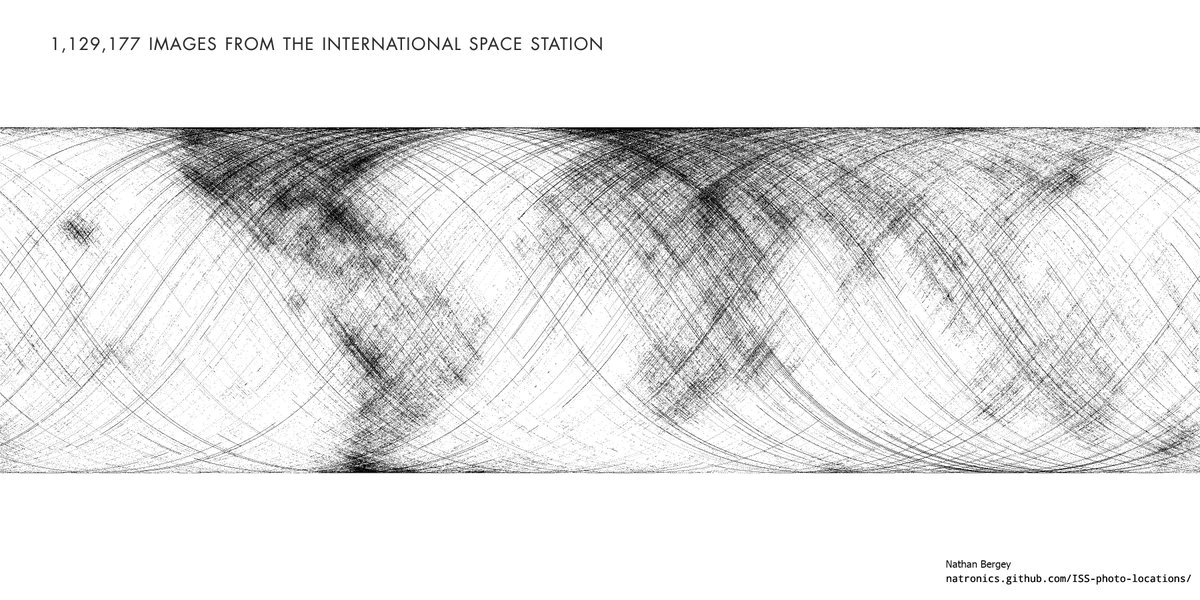
Data mining ISS imagery in an unusual way.
Nathan Bergey, then a visiting scholar at Portland State University in Oregon, plotted on a blank map of Earth, the location of the Space Station at the moment each of more than 1.1 million astronaut photographs were taken. A new vision of Earth’s geography emerged. The continents appear in ghostly outlines, and places of striking beauty are thick with dots. Regions of constant cloud cover and featureless reaches of the mid-ocean are rarely captured.
Parsed in this manner, nothing of the photographic subject remains, only the fact that a human being, driven by something intangible—curiosity, awe, aesthetic delight, perhaps even a moment of homesickness—chose to release a camera’s shutter.
Map assembled in 2013 from 1,129,177 astronaut images from ISS, Expeditions 1-34, see Nathan’s data at: https://t.co/PsW78craSr
Massively under-reported science story because there's so much going on right now but...it turns out that we might have figured out what's causing this very scary spike.
Quick thread, on how WE'VE BEEN ACCIDENTALLY GEOENGINEERING FOR DECADES...but then we stopped:
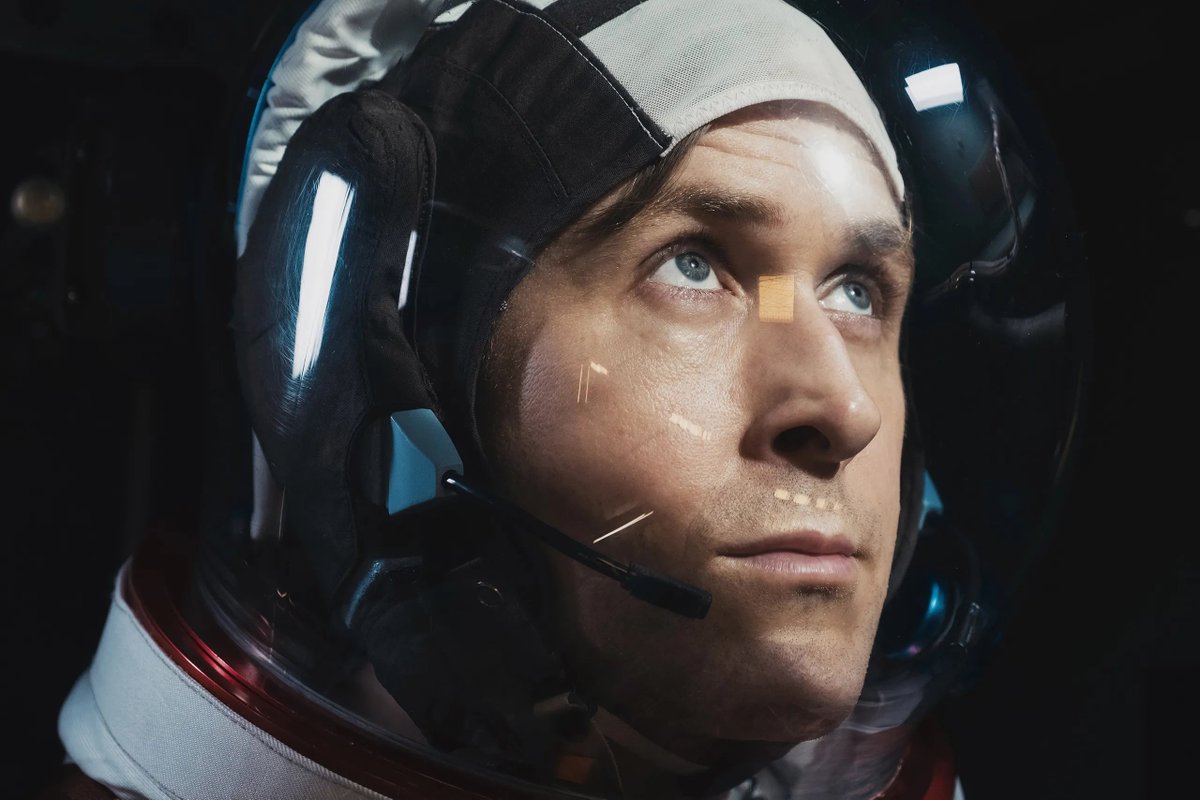
Rewatched FIRST MAN after reflecting on its spiritual link to #Oppenheimer & MAN...what a fucking triumph. Criminally underappreciated. This somber, melancholic meditation on masculinity is truly one of the most profound, horrifying, visceral cinematic experiences I've ever seen.