In @Journal_INDOPAC, @MBazilian & I discuss the concept of "mineral power" & how a state’s mineral power influences its military power. We assess the US in early 20th century & China in early 21st century, finding mineral power helps enable military power. https://t.co/CUsY9kk7GM
3/3 Today, the US military is at a greater risk of severe mineral shortages if a US-China war were to unfold: the United States has limited mineral stockpiles; low domestic mineral production; and heavy mineral import reliance, including on its great power rival, China.
1/3 In @ArmyUPress's January-February 2025 edition of Military Review, I discuss how the US military risks a mineral shortage in a potential US-China conflict. Such a shortage could severely undermine the US war effort and impact the war’s outcome. https://t.co/F1rQh41p3C
2/3 Despite the US being the world's dominant mineral producer during World War I, World War II, and the Korean War, the US military experienced mineral shortages during these wars due to increased defense production, expanded export controls, and contested shipping routes.
🚨 Securing America’s Mineral Supply Chains: A Bipartisan Opportunity 🚨
Strengthening U.S. mineral supply chains is one of the few areas of agreement in Congress—and there’s real potential for impactful action in the next term. A great article from @GregWischer and @MBazilian at @coschoolofmines laying out 5 bipartisan steps lawmakers can take to boost national security, economic growth, and sustainability.
#WeCanDoThis #CriticalMinerals #Bipartisan #NationalSecurity #MiningPolicy
5 Bipartisan Actions to Protect America’s Mineral Supply Chains - Congress needs to make sure critical resources are protected. https://t.co/X7IatN7mvo
In @_RCEnergy, @MBazilian, @JaharaMatisek, & I argue the USG should use the DPA—as it did in the Cold War—to build a mineral stockpile. The DPA inventory could sell minerals to the DIB amid shortages & acquire minerals from US producers to boost output. https://t.co/01N4XDPbm6
“A trade association representing US graphite producers filed petitions…asking for investigations into whether Chinese companies are violating anti-dumping laws….The industry group hopes to trigger punitive tariffs of as much as 920% on Chinese graphite” https://t.co/KDhuSpv5lt
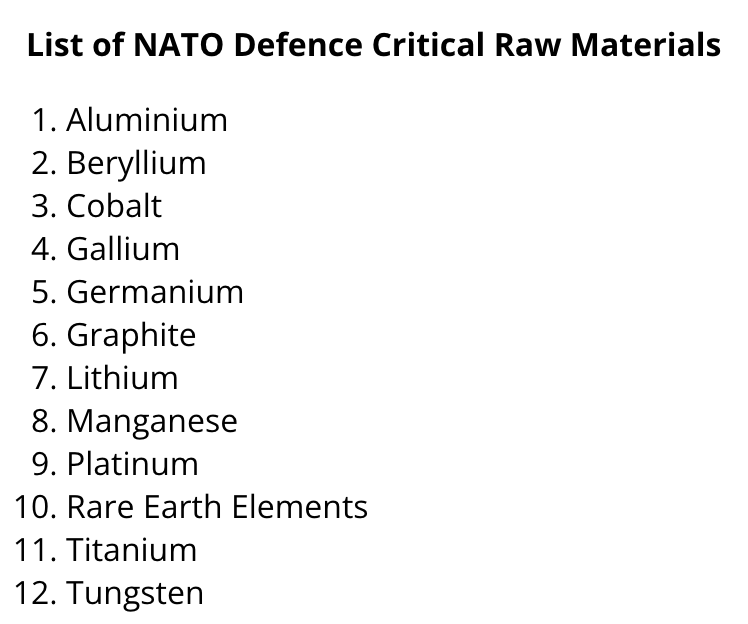
NATO published "a list of 12 defence-critical raw materials essential for the Allied defence industry" & "to the manufacture of advanced defence systems and equipment." BUT, this list excludes minerals consumed in large volumes by militaries: copper, lead, zinc, nickel, chromium.
Trump’s team is reportedly considering imposing Section 232 tariffs on mineral imports. Here’s my proposal from Aug on how the admin should use both tariffs and tariff rate quotas to maximize US reserve extraction and target US refining self-sufficiency: https://t.co/OSHYKbdjZ3
Trump should impose 232 tariffs on all “EV supply chain” imports including batteries, critical minerals and charging components, according to document. Trump should negotiate exemptions with friendly nations, the team urged.
@benchmarkmin@MBazilian 3/3 Other policies we think the Trump admin may consider are:
-Reverse public land orders (e.g., Boundary Waters) that ban mining in mineral-rich areas
-Enhance Buy American mineral reqs for govt procurement & Buy America reqs for govt-funded projects
-More mineral stockpiling
1/3 Trump’s team is reportedly considering:
-Imposing broad tariffs on EV supply chain imports such as minerals
-Waiving enviro reviews for federally-funded EV infrastructure projects including mineral production;
-redirecting $ from programs like EV charging to mineral projects
SCOOP: Trump’s transition team is recommending sweeping changes to cut off support for EVs and charging stations and to strengthen measures blocking cars, components and battery materials from China, according to a document seen by Reuters. w/@c_kirkham Here's a 🧵w/ details
2/3 In Nov for @benchmarkmin, @MBazilian & I discussed how the Trump admin may adopt such policies:
-Sec 232 tariffs on mineral imports
-New NEPA rule expediting permitting
-Directing more funds (IRA, ATVM) from EV & battery projects to mineral projects
https://t.co/MMpC441nyc
In @RCDefense, @MBazilian, @JaharaMatisek, & I discuss how the US can fortify its defense base against mineral export bans: stockpiling minerals of course, but also signing right-of-first-refusal offtake agreements for uncontracted mineral production. https://t.co/4xxS2FSRUI
Memo from @WHCommsDir says Biden admin will "continue taking action to protect our lands & waters...." Based on the actions of past Dem admins, these actions could include national monument proclamations and public land orders withdrawing tracts of land from mineral development.
✔️Biden will “continue taking action to protect our lands and waters and continue our climate ambition alongside state, local, and tribal and business leaders.”
✔️New commutations and pardons
@ExnerPirot The US "plan" was not to halt DPA funding for Canadian mineral projects, but halting DPA funding for Canadian mineral projects is one possible policy response to Canada's threats. I doubt the USG wants to give money to mineral projects in a country threatening export controls.
If Canada wishes to threaten mineral export controls against the US, the US can threaten to halt disbursements of DPA grants to Canadian recipients, pause reviews of other Canadian projects considered for DPA grants, & restrict US mineral exports to Canada https://t.co/IBuS1kBF4d
@ExnerPirot If tariffs result in increased US mineral production, the resulting US economic and national security benefits will far exceed the ~$65 mil in DPA grants committed to Canadian mineral projects. Also, if the DPA grants are phased, the incoming admin could also halt a lot of the $.
In @rc_markets, @epistemic_war & I discuss how the US can respond by threatening to (1) halt $$$ disbursement of DPA grants to Canadian recipients, (2) pause reviews of Canadian projects considered for DPA grants, & (3) restrict mineral exports to Canada. https://t.co/IBuS1kBF4d
Canada appears to be threatening export controls on critical minerals to the United States over the current tariff row. Canadian Deputy PM Freeland:
https://t.co/rurNS1KmTf
Full quote: “Some premiers proactively identified products that their provinces produce and export to the United States and which the US relies on and should be considered as part of the Canadian response. This included some critical minerals and metals.”
https://t.co/QLblTxDpJJ
Canada appears to be threatening export controls on critical minerals to the United States over the current tariff row. Canadian Deputy PM Freeland:
https://t.co/rurNS1KmTf