I have created this account to share my public writing. I write about free speech, university contretemps, political ideologies past and present, among other topics.
Hand-off would happen if AI systems got good enough to automate culture and labor, and AI labs want to build such systems. Competition would ensure that they continue development until the job is done. I believe AI researchers and developers when they say they oppose hand-off, but no AI lab has proposed a plan to prevent it. The only plan that would work is to stop building what they sell.
I'm amazed that people blithely assert this kind of cynical garbage. Survey research, and just ordinary experience, demonstrate abundantly that many, many people derive fulfillment, joy, and a sense of self-respect from their work.
We are indeed going to face a crisis of meaning if AI makes us all economically and intellectually expendable.
This is embarrassingly daft: “There are many human mathematicians who are far better than me. Now instead of N entities that are better than me, there are N+1 entities that are better than me. What's the big deal?”
Versions of this thought pop up in my replies all the time. "I wasn't the best at what I did anyway, so what difference does the arrival of AI make?"
This is a very bad argument. In the fully human world we used to have, due to mankind's limitations, one could still make important contributions in one's line of work without being the best at it. Even the best person could only cover a tiny fragment of a field, only had so much bandwidth and time and energy. Therefore an enormous number of competent people could make objective contributions to research, scholarship, professional life, etc. Progress in a field required a whole community, and the most brilliant person in it accomplished only a small portion of what was achieved overall.
AI has no such limitations. It is available everywhere all at once. It does not eat, sleep, or take a day off. Once it is more capable than the best human being, there will be no way even the brightest person can contribute.
And, of course, one cannot admire the accomplishments of the machine, or share in its joy, or be proud to belong to be its colleague or compatriot or friend. One cannot be inspired by what it produces or try to emulate it.
One would think all this is so obvious it doesn't need stating. But apparently it does.
Richard Borcherds: AI is already better than me at mathematics, and soon there may be no reason to employ me.
“It's better at research, it's better at teaching.”
“There are currently things that I can still do better than AI, but I don't think it will last for very much longer.”
“This really is the biggest event ever in mathematics. We've suddenly had several hundred major problems solved.”
“It's a little bit disturbing to realize that I've spent my entire life training hard to do something which AI is now better at.”
“On the other hand, there are many human mathematicians who are far better than me.”
“Now instead of N entities that are better than me, there are N+1 entities that are better than me. What's the big deal?”
@lymanstoneky For all of human history, we've lived in a world where you can work intellectually to change the world for the better. AI is built to change this. Whatever idea you think up to change the world, AI could have done better. You are profoundly wrong.
https://t.co/DXujagXFC9
AI should be thought of as an anti-intellectual technology. With each advance it drives the value of knowledge and expertise closer to zero. It eliminates the difference between the intelligent and learned, on the one hand, and the idiotic and ignorant, on the other.
Before AI, it was valuable to have expertise in an area. Now that AI has expertise in all areas at once, being an expert is about as much better than zero expertise as having one hair vs being bald.
The AI accelerationists were wrong about the technology, wrong about China, and wrong about voters. In @WSJopinion, Bruce Reed and I argue that the past month has exposed all three mistakes, and that this exposure opens a window for a much-needed bipartisan approach to AI.
1) Technical: They said that the "doomers" were wrong and AI wouldn't improve fast enough to need regulation. This is obviously false: AI systems are finding critical software vulnerabilities, and they are doing a rapidly growing share of AI research themselves.
2) National Security: They advocated for selling chips to China. Now, after the Jensen Huang scandal, both parties see the risk, and even the Trump administration has reversed course by adding new restrictions.
3) Politics: They tried to re-run the crypto playbook, spending tens of millions against candidates who backed AI regulation. But voters knew better, and the political salience of AI risk was too high for even their money to overcome.
All three trends will continue, if not grow stronger. To meet the moment, we should slow down AI development from its accelerating trajectory, strengthen export controls on compute, and heed voters' calls for meaningful regulation. It's time to act.
https://t.co/8cBc4CJQZZ
Good to see the Chief AI Officer at Meta staking out a clear stance against "handover" and human disempowerment, and emphasizing that that looks like the default path we're on. If we want a different future, we need to fight for it.
I actually think it there is major substance behind the distinction between the overarching field of AI (including AlphaChess, Waymo, Google Translate, Spotify Discover Weekly) and the subfield of generative AI (LLMs, image, video, and audio generation models).
Many classical AI/ML methods use training data to learn from labels or actions. Site owners largely didn't feel violated that Google's ML models were training on internet data to improve search results, because the web pages they produced were not in direct competition with Google's search models.
However, generative AI has a different, more competitive relationship with its training data. If you're training an image generation model on a bunch of artist's work, the availability of this model has a direct impact on the market for human-made art. This is why Udio and Suno are getting hammered in the courts -- the music industry is one of the most litigious, and Suno's music generation serves as a substitute for listeners in a way that Spotify's Discover Weekly algorithm is not.
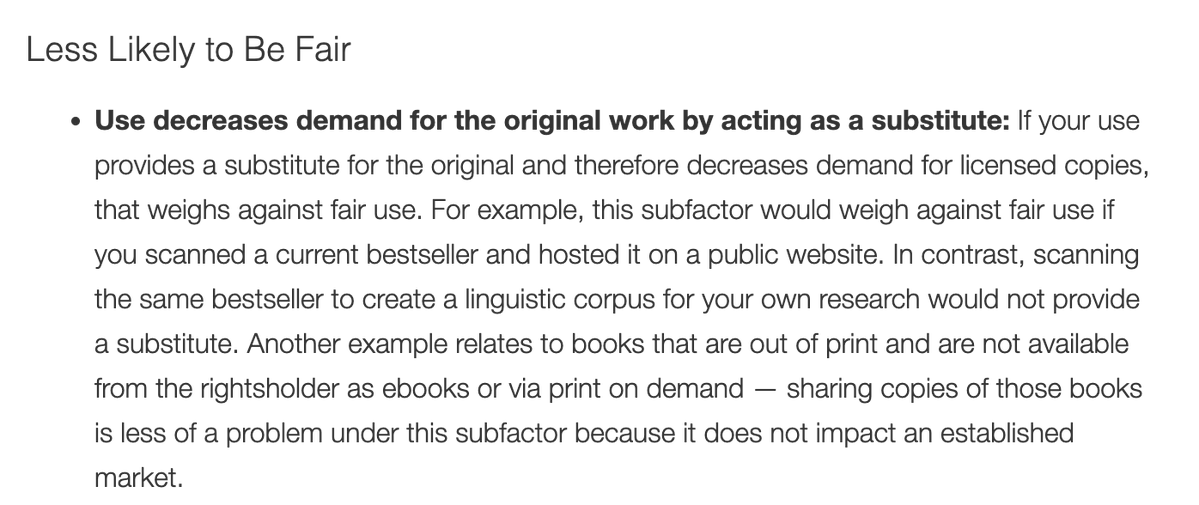
Copyright law addresses this directly: if use of copyrighted material substantially decreases the market demand for such material, then it's much harder to make the case for fair use. This is not a problem for classical AI but largely a new problem introduced in the era of generative AI.
PAUSE ADVANCED AI DEVELOPMENT BEFORE IT’S TOO LATE
If some of the world's leading scientists are concerned about artificial intelligence becoming independent of human control with potentially catastrophic results, shouldn't we do everything in our power to prevent it?
Nobel Prize winner Dr. Geoffrey Hinton, the Godfather of AI, says that AI poses a 10% to 20% chance of wiping out humanity.
Mark Winer, an AI safety and physics researcher: “AI is progressing much faster than we thought. It’s a difficult situation, and we don’t have answers. We could be heading toward a catastrophe.”
Paul Christiano, an OpenAI Foundation Board member: A one-in-three chance that AI would be able to overthrow a government within the next year, and a coin flip that the current path would lead to an irreversible loss of human control within three years.
This is scary stuff. The new Democratic majority must stop the greed of the Big Tech oligarchs, pass a national data center moratorium, pause advanced AI development and ban the development of superintelligence.
@zainpasha@GregoryConti19 ok but computers couldn't make the software themselves. the promise of AGI is it can do literally anything a human can do, and better. what jobs will it create that it can't do itself but a human can.