I was asked how "How is there left over energy if AI is in the stack?" and how it is all managed.
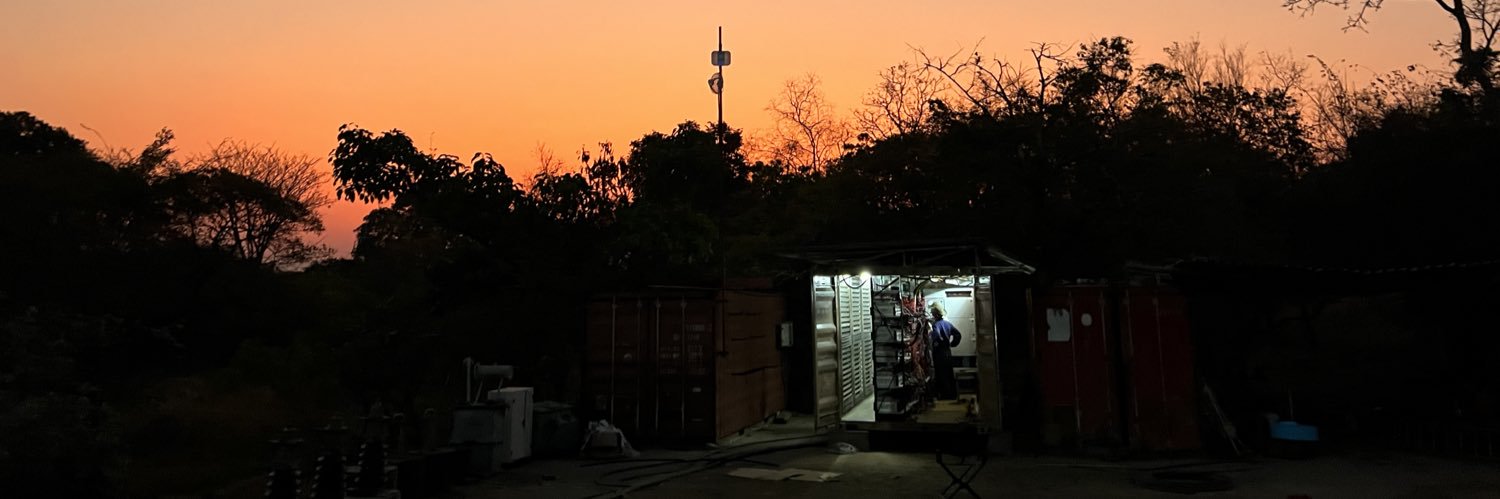
So, here's my explainer video on how a Gridless site uses every watt as we layer in AI:
- The community gets their power first
- AI is set to a known/firm block
- Bitcoin miners buy whatever is left so that nothing is wasted.
600M Africans lack electricity, not because they can’t afford it, but because they don’t have it. If Bitcoin mining lets new energy be built near them, we need more of it.
– @whiteafrican , CEO, @GridlessCompute
More at #ATSNBO, 10-11 Feb 2027.
🔗 https://t.co/eQZ7LG15EU
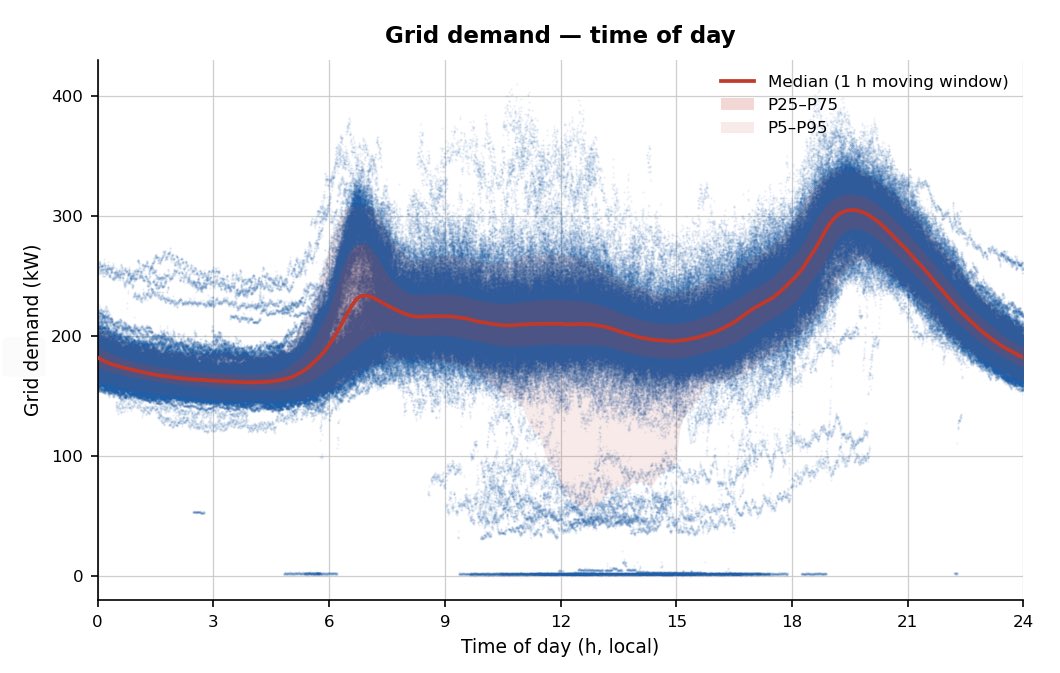
A visualization in 15s resolution and a time span of about 18 months, plotted on a 24-hour day, of the grid demand on our Zambia community site.
(Not shown is the generation line ~500-700kW. Everything between that generation line and above the dark blue is usable by bitcoin mining)
The Genesis Workshop 1.0, organized by Open Source Guild(OSGuild), we brought hands-on Bitcoin mining education to Mauritius 🇲🇺 university students, connecting them with real open source infrastructure.
@dzeg5 traveled all the way from Kenya 🇰🇪 to introduce participants to Bitcoin mining, Stratum V2,Bitaxe Gamma and Mujina the open-source, Linux-based mining firmware developed through the @256FOUNDATION open-source mining initiative.
Using Bitaxe Gamma kits from @SoloSatoshi, participants got to explore mining hardware firsthand. Some students even mined Bitcoin for the first time, turning technical concepts into a real experience.
This is what OSGuild,Genesis Workshop is about: creating opportunities for young developers to learn, experiment, and become contributors to the global Bitcoin open-source ecosystem.
From Kenya 🇰🇪 to Mauritius 🇲🇺, we're building connections, growing communities, and bringing open-source Bitcoin mining to the tropical island of Mauritius 🇲🇺.
Thank you to @btrustteam for supporting The Genesis Workshop 1.0.
The journey has started here in Mauritius.
In the wake of the National Treasury of Kenya 🇰🇪 gazetting Virtual Asset Service Provider (VASP) regulations, Robert Kirubi (@rkirubi) has been working behind the scenes to help Kenyan institutions see how Bitcoin mining can catalyze infrastructure development and how businesses can benefit from utilizing bitcoin.
In my conversation with Robert, we discussed these topics as well as how Kenya has been primed for broader Bitcoin adoption thanks not only to the new law but to the foundation for Bitcoin that's been laid in the country by grassroots initiatives and companies like @GridlessCompute, @AfribitKibera, and @btc_dada (among many others).
According to Robert, broader Bitcoin adoption in Kenya can lead to the country as a whole becoming more sovereign and less reliant on foreign loans. But for that to happen, a certain amount of coordination must happen between public and private institutions, which is something that Robert has been dedicating much of his time and energy to as of late.
As Robert wrote in a piece he recently shared with me, Kenya is "at the threshold," and what comes next regarding Bitcoin adoption will play a major role in shaping the country's future.
Luckily for Kenya, it has people like Robert advocating for Bitcoin and connecting the dots so that more and more of his countrypeople can benefit from it.
On the Bankability of Things...
From sugar mills and power plants to AI data centers, expensive infrastructure gets built by selling its future output before it exists.
https://t.co/oVMsVdGPcP
Hack4freedom is coming to Nairobi 🇰🇪
From Sept 22 to Oct 5, we’re bringing our two-week bitcoin and freedom technology bootcamp + hackathon for women developers to Kenya.
This edition is hosted in collaboration with @DadaDevs, who are helping us bring Hack4freedom to life in Nairobi☺️ Special thank you to @marcelorraine & @wandiology for making this possible.
Women developers in Nairobi, this is for you.
✅Apply: https://t.co/uPrGZCQoh6
📆 RSVP on Evento: https://t.co/CIlerJF9cW
🧡 Sponsored by @btrustteam@SoapboxTech@evento_so
@david_seroy Depends on the site, but on the offgrid sites they are just a thin 10-20% of the compute load. It can go up/down depending on what that sites demand might look like.
It's four years now at Gridless, and a wild ride it has been. Thank you everyone for your support along the way!
Here's a long-read on how we're thinking about the future.
https://t.co/2QoJrv9WwT
🚨 @HRF’s Bitcoin Development Fund is granting more than 500 million sats to 16 freedom tech projects worldwide
Bitcoin and Nostr development, self-custody, censorship-resistant comms, privacy tech, decentralized mining, and more
🧵 here on the killer projects we are funding:
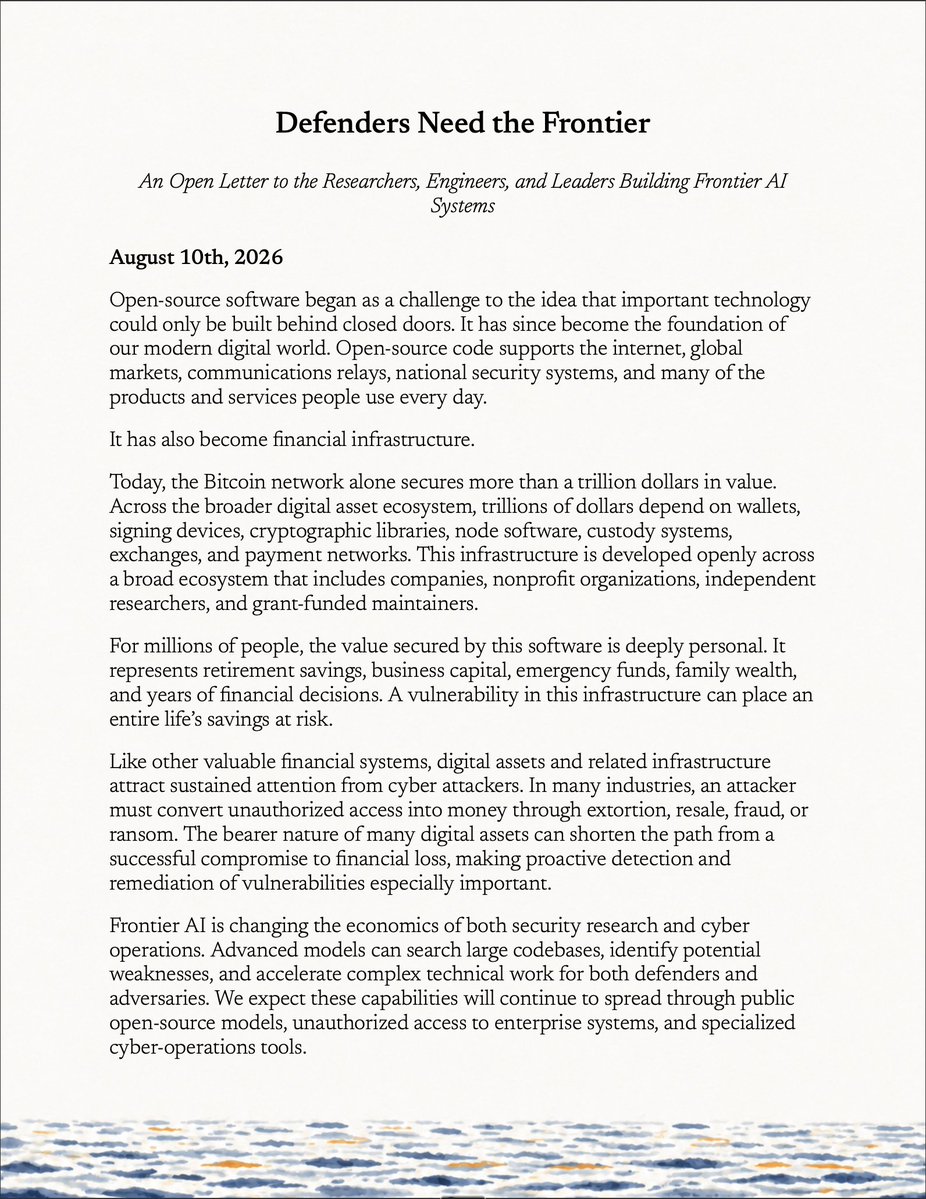
Today, Bitcoin Policy Institute and a broad coalition from across the digital-asset ecosystem are publishing an open letter calling on the world’s leading AI labs to provide qualified open-source defenders with trusted access to frontier AI models.
The past several weeks have made the need for this abundantly clear. The people defending digital-asset infrastructure and open-source software need access to the latest AI capabilities to perform comprehensive security reviews and stay ahead of increasingly sophisticated adversaries.
The coalition includes open-source development organizations, major custodians, treasury companies, payment services, security firms, capital allocators, and others whose businesses and customers depend on the integrity of open-source infrastructure and libraries.
Open-source defenders often occupy the least privileged position in the AI security landscape. They have limited access to the strongest internal cyber models and are frequently blocked by guardrails when using publicly available frontier systems for legitimate security research. As a result, they often resort to less capable open-weight alternatives.
We are urging frontier AI labs to establish a clear, trusted pathway for qualified open-source and digital asset defenders to access their strongest capabilities, with sufficient compute and secure environments to conduct meaningful security reviews. Frontier AI could become one of the most powerful defensive technologies ever developed, but only if defenders get fair access to those systems.
It’s time to give defenders the tools they deserve.
Read the open letter, add your organization, or sign as an individual on our website at https://t.co/cUTwQ5ugXJ
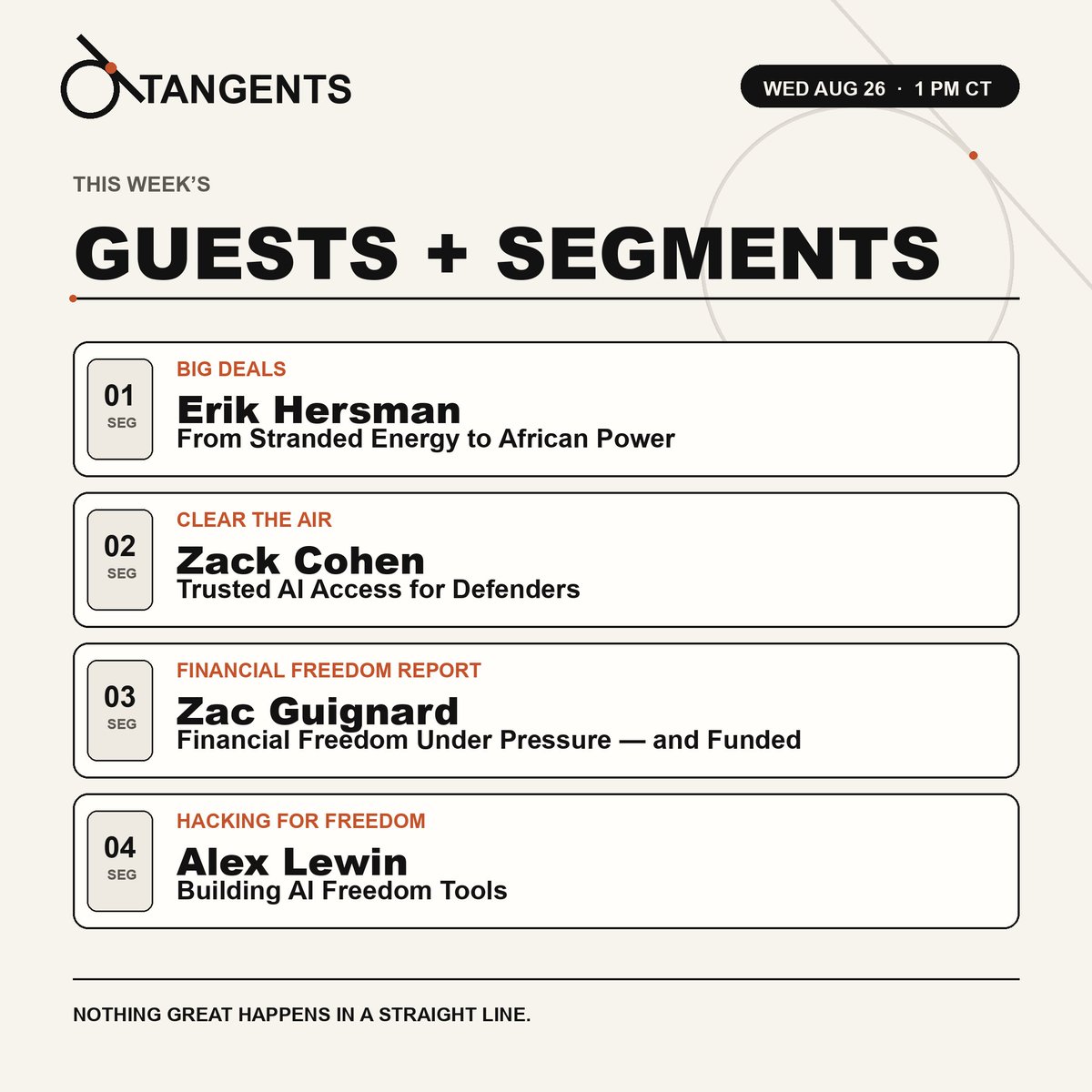
How can Bitcoin miners partner up with mini grids to help grow and strengthen the local electrical infrastructure?
Erik Hersman explains how they do it at @GridlessCompute