the new American dream might just be getting lucky.
get a normal job, work hard, save money, build a career.
that story doesn't seem nearly as convincing to younger generations anymore.
instead, the internet offers something much more exciting:
— buy a memecoin and hit 1000x
— post a Reel and wake up with 10 million views
— become the next overnight crypto millionaire
@Pumpfun is a pretty good example.
it's been promoting Kimchi, a memecoin trader associated with claims of making around $40M trading $TRUMP.
the exact attribution of those trades is difficult to verify.
but the marketing message is obvious:
someone made life-changing money doing this.
maybe you could too.
and that's what makes it so powerful.
because these stories aren't entirely fictional.
people really have made millions overnight.
unknown creators really have gone viral and changed their lives.
the problem is that we see the handful of spectacular winners.
we rarely see the thousands of people who spent months chasing the same outcome and got nowhere.
survivorship bias has basically become a business model.
and I think that's part of why gambling is becoming such a big part of internet culture.
when the traditional path to wealth feels increasingly out of reach, a tiny chance at getting rich tomorrow starts looking more attractive than a realistic chance of building something over five years.
there are still other paths.
building skills, creating products, growing an audience, owning something valuable.
they're just slower, less exciting and much harder to sell in a 30-second video.
maybe that's the real problem.
we've become incredibly good at selling the dream of getting rich.
and much worse at making the boring path look worth taking.
Something is digging under the town ⛏️
Minehood is coming. Dig six mines. Break six bosses. Keep every gem you swing for 💎
The waitlist is open 👀
Connect your X, drop your wallet, complete the tasks, and climb the leaderboard 🏆
👉 https://t.co/wIpSH8UtMR
one of crypto's biggest problems is that we judge almost everything by the token price.
Ethos is a pretty good example.
$WHUF was sold through an auction at around $4.20.
after distribution, the token dropped to roughly $2.50.
almost 40% down.
and suddenly, that's what everyone is talking about.
not the product.
not what the team is building.
not whether any of it actually works.
the token.
and I think this creates a pretty terrible incentive for founders.
you can spend years building something genuinely useful, but if your token is down 60%, people will call your project a failure.
meanwhile, a completely useless token can go 10x and suddenly everyone thinks the team is brilliant.
we've basically turned token performance into a substitute for evaluating products.
and maybe that's part of why so much of crypto revolves around memecoins, perpetuals, prediction markets and endless speculation.
those products give people exactly what they're looking for.
something to bet on.
I don't think speculation is inherently bad. it's always been part of crypto.
but when price becomes the only scoreboard, building something useful starts looking like a secondary objective.
sometimes I wonder whether crypto is still an industry trying to build a different financial system...
or just a casino that occasionally produces useful technology.
@BlueBeam0 What's interesting is that banks could eventually become the biggest distributors of stablecoins. Would that defeat the original purpose, or just accelerate adoption?
sometimes I look at what crypto has become and wonder when the original vision stopped being the main story.
we used to talk about decentralization, financial freedom and building an alternative to banks.
now it's ETFs, institutional inflows, memecoins and finding the next 100x.
Bitcoin ETFs made the contradiction even more obvious.
an industry built around escaping traditional finance now celebrates every new billion dollars flowing in from BlackRock.
and I get why.
most people aren't here to change the financial system. they want to make money.
buying $200 worth of BTC probably won't make anyone rich, so people chase memecoins, perps and leverage instead.
and the industry keeps building exactly what people demand.
more launchpads. more DEXs. more ways to speculate.
meanwhile, the serious infrastructure is actually growing too.
stablecoins, RWA, DeFi, institutional integrations.
I remember the old debate about whether DeFi should mean Decentralized Finance or Open Finance.
the longer I watch this industry, the more I think Open Finance might have been the better name.
crypto isn't necessarily replacing traditional finance.
it's slowly becoming another layer of it.
anyway, hopefully the institutions can at least learn how to pump our altcoins.
Meeting notes are stopping being a standalone product and becoming a feature of the assistant. OpenAI launched Meetings, a plugin for the ChatGPT desktop app on Mac.
The mechanism is simple: it listens to an online or in-person meeting, then saves the summary and a list of next actions to a ChatGPT Space.
You can add your own notes and ask questions mid-call. It pulls context from connected docs, files, and work tools. No bot has to join the meeting, and the audio is deleted after processing.
BUT it's still a test, macOS only, Pro and Business only. Enterprise comes later. AND here's where the incentive flips: the summary is worth nothing on its own. The value is in what happens after it.
> Action items go straight into ChatGPT as requests: write the email, update the project plan
> The summary lives in the Space, next to your docs and agents, so the data stays inside the ecosystem
> Standalone note apps are left with what the plugin doesn't cover: other platforms and custom integrations
Minus another batch of startups that sold transcription as the product. The moat is no longer transcript accuracy. It's context, and what the agent does with the agreements.
I would very much rather watch who owns the action after the meeting than who has the cleanest transcript.
Nonetheless, it's an exciting update. I'll be watching when Meetings leaves the Mac, and how the note-taking players respond.
Imagine buying a brand-new Ledger from an authorized reseller, setting it up, transferring your crypto...
and then watching your wallet get drained.
Ledger is now investigating reports of stolen funds linked to CryptoBilis, an authorized reseller in Southeast Asia.
On-chain investigators have traced over $86M in suspected losses across BTC, ETH and Tron.
One possible explanation is a supply-chain attack: devices may have been tampered with before reaching customers.
The exact cause hasn't been confirmed yet.
Ledger has already asked CryptoBilis to stop sales and shipments.
And anyone who bought a device there in the past 90 days has been advised not to set it up, or to consider moving funds to a new wallet with a fresh recovery phrase.
Pretty terrifying reminder:
a hardware wallet can protect your private keys from the internet.
but it can't protect you if someone else already knows your seed phrase.
self-custody security starts before you even transfer your first dollar.
Top 5 tools to find forgotten crypto funds 😲
Old wallets can hold small balances, NFTs and tokens, or funds stuck in old DeFi protocols and unfinished transactions.
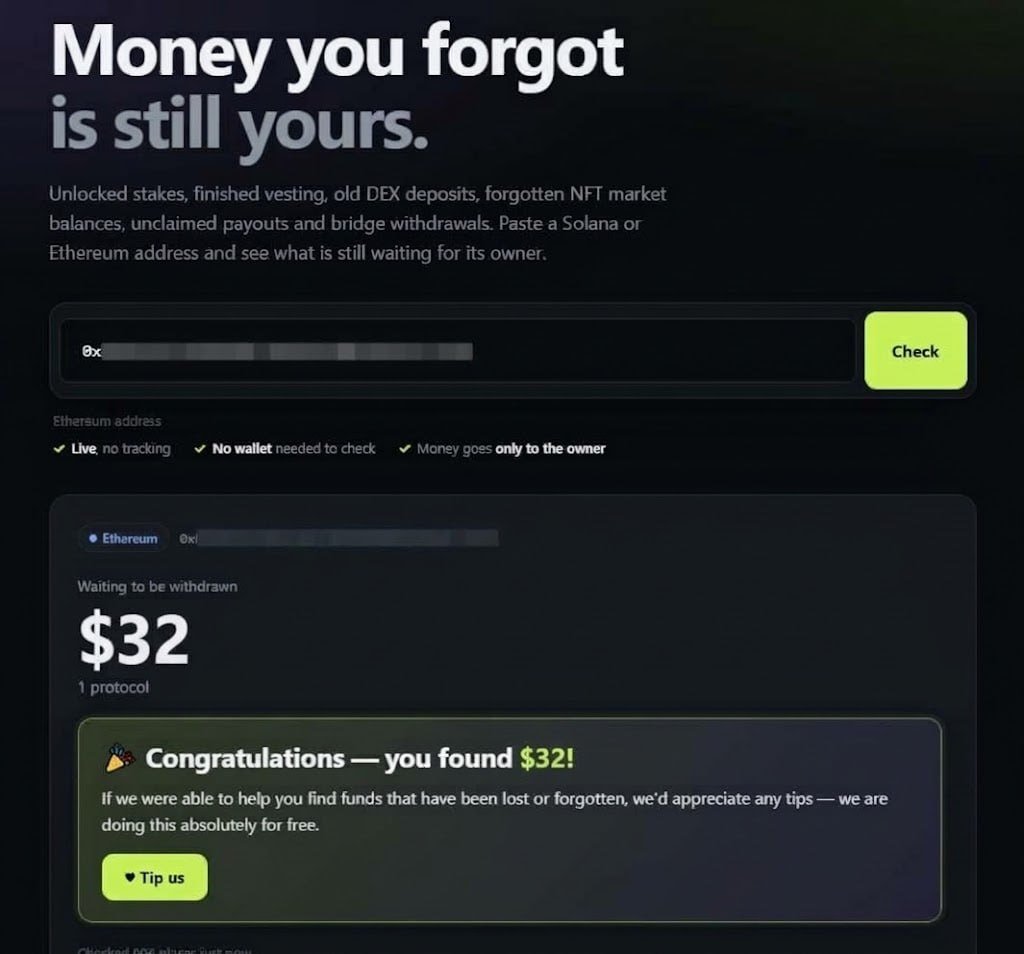
I checked one of mine with FindMyFunds and found $32. Small, but nice 💰
Check your old wallets too 👇
Gas zip Sweeper
(https://t.co/0nxb6rpaox)
Finds and collects small leftover token balances across different chains. Useful when your assets are spread across several blockchains and wallets.
One of the most underrated risks in life isn't financial, it's social.
People often don't start a business, change jobs, make a deal, or leave a bad relationship. Not because they think the decision is wrong, but because they're afraid of hearing "I told you so" later.
With money, at least it's clear: you can lose 10%, 50%, your entire savings, and then earn it back. But the fear of other people's opinions can cost you several years of your life. And those opinions often come from people whose lives you wouldn't even want to live.
I've noticed that the more you start doing things yourself, the less you care how it looks from the outside. You either get a result, or you fail and get experience.
But a person who does nothing out of fear of looking foolish gets neither.
So sometimes the biggest risk isn't losing money. It's realizing one day that you spent too long living in a way that looked normal to everyone else.
i never saw any cases in the hyped jev that inspired me. a solution is a solution, but nothing really catches the eye
what has been bugging me for three months is a different idea: build a system for myself that manages neural networks without me. not another pipeline, something more interesting
a neural network is smart. it can reason and solve complex tasks. but what to do next, where to move, and when to stop picking at the same thing still gets decided by a human
what if we teach a jev-like thing to understand how i think and steer development on its own? the main model proposes options for action, and it decides what happens next
there's already enough material: a full export of my vk and telegram messages, an upgraded gbrain with all the codex memory, half a year of claude dialogues. together that's the whole history of my decisions: what i proposed, what i agreed to, what i rejected, what i redid and why
so what's stopping us from digging through all of it? we look at how and on what basis the decisions were made, extract general principles, and build an orchestrator that does what i want. because it will be me
then everything we want on top: real-time dialogue analysis, our own environment for managing agents, plugging in any neural network. steering their actions, changing the approach when they get stuck. the potential is huge if we can digitize our own view of the world
sounds way too cyberpunk, lol. it's like digitizing the brain of a drosophila fly, except this fly's thinker has to work a bit better
so we're trying it while the x20 limits are still available
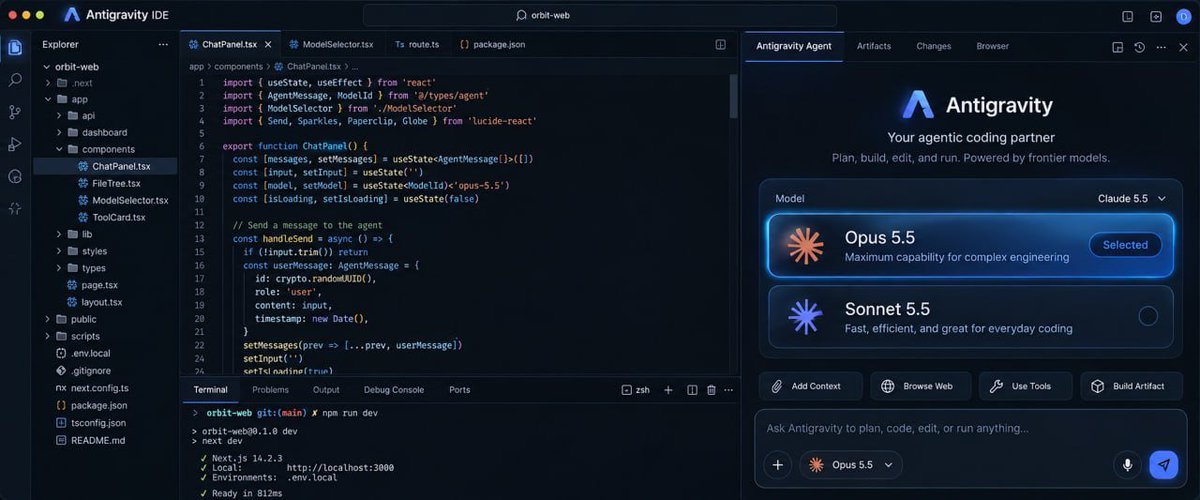
found a weird workaround for getting Claude Opus 5.5 and Sonnet 5.5 to show up in Google Antigravity.
Google officially gives non-trial AI Pro subscribers access to both models, but apparently some Pro accounts still don't see them in the model picker.
if that's happening to you, try this:
1. on the account with Google AI Pro, create a Google family group
2. add a second Google account without a subscription
3. accept the invitation on that account
4. enable Google One family sharing on the main account
5. log out of Antigravity
6. sign back in with the second account
then check the model picker again.
Google allows AI Pro benefits to be shared with family members, including access to Antigravity.
one important detail: Antigravity usage limits can be shared across the family, so this isn't a way to magically multiply your quota.
still, if you're paying for AI Pro and Opus 5.5 / Sonnet 5.5 aren't showing up, this workaround might be worth trying.
no idea how consistently it works across accounts, so treat it as a workaround, not an official fix.
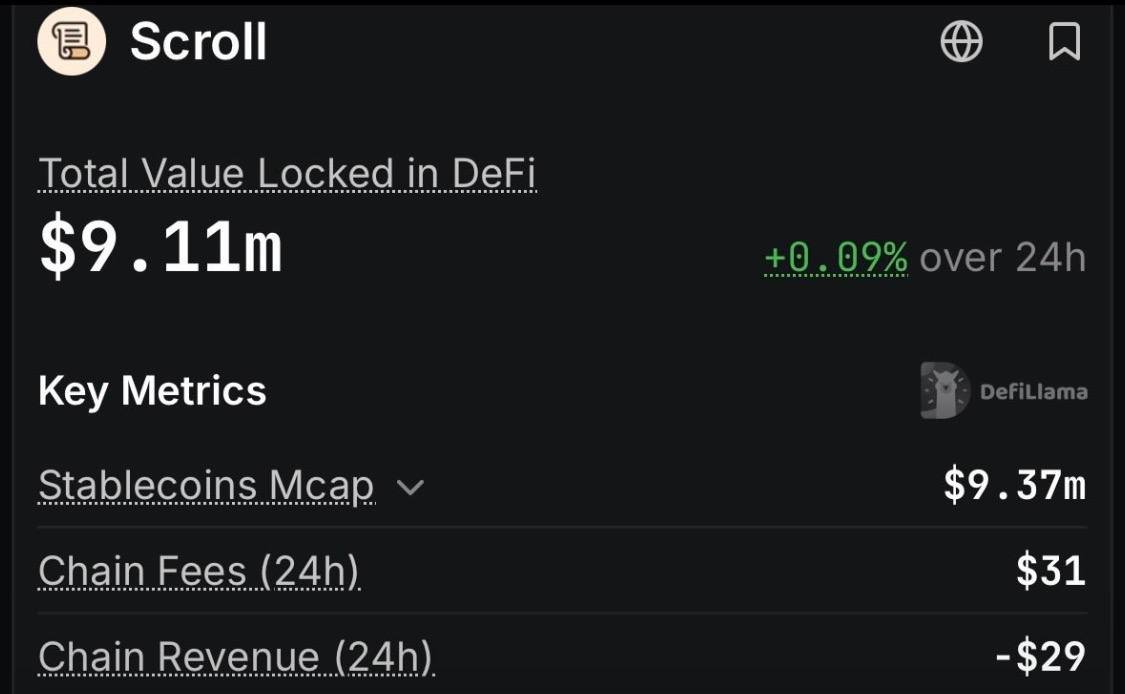
while everyone's talking about Blast, Scroll made -$29 in revenue over the last 24 hours.
honestly, I'm more curious about something else:
who is actually using these chains?
what do you do there when there's no airdrop to farm, no points campaign and no new incentive?
genuinely curious what the organic use case looks like.
I've seen a lot of weird approaches to taxing crypto, but the Netherlands had a particularly interesting idea.
under the proposed new Box 3 system, investment gains could be taxed based on the increase in value — even if you hadn't sold the asset yet.
the current Box 3 tax rate is 36%.
for crypto, you can immediately see the problem.
your coin goes +50%.
you don't sell.
you don't receive any cash.
but on paper, you've made a gain.
then crypto does what crypto does and drops 40%.
this is exactly why the final design matters.
and interestingly, the Dutch government is now moving toward changing the planned system into a capital gains model, where realization becomes much more important.
the new Box 3 system is still targeted for 2028, so this isn't final yet.
probably a good example of why taxing volatile assets on paper gains gets complicated very quickly.
@claudeai Code is now being used to build game mods.
and this is getting ridiculous.
someone built an open-source plugin called universal-modder that lets Claude create mods for existing games.
we're already seeing things like:
— Mario in Elden Ring
— Minecraft in Cyberpunk
— Escape from Tarkov in Skyrim
— even combinations of six different games
the interesting part is how much of the process the agent handles itself.
it detects the game's engine, reads the code and figures out how to build the mod for that specific game.
then it can generate sprites, 3D assets and audio through fal, test the mod directly in the running game, and even produce a demo video of the result.
and the whole thing is free and open source.
we're getting dangerously close to:
“Claude, put Minecraft into Dying Light.”
and then just watching it try.
link below ↓