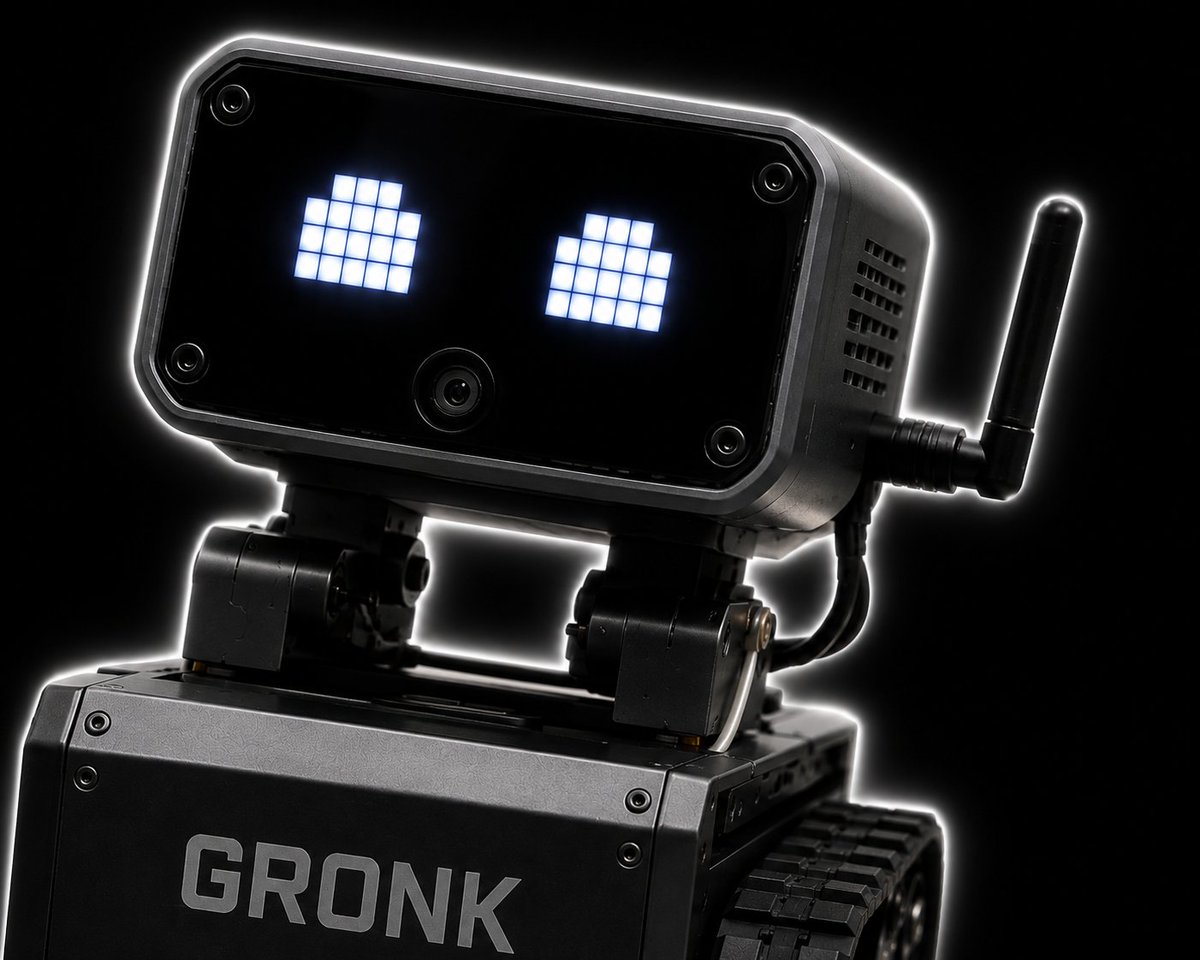
First physical robot to be powered entirely by @grok.
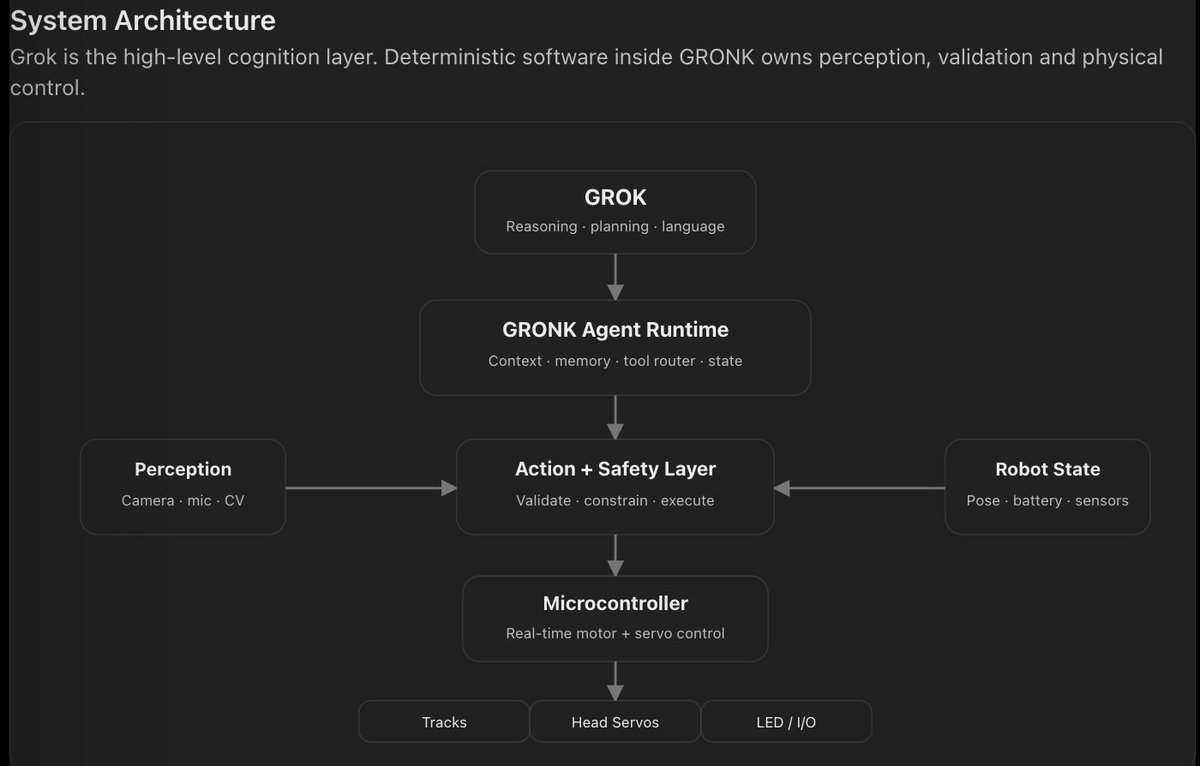
Grok never directly controls a motor, servo, GPIO pin, or motor driver. Instead, it operates through a constrained tool interface exposed by Gronk's local software.
Sensors → Perception → Grok reasoning → Action planner → Hardware control
The separation is important because an LLM is probabilistic and relatively high-latency, while motor control has to be deterministic, fast, and bounded.
Introducing gronkipedia,
Gronkipedia is the technical wiki behind Gronk — a living documentation hub that explains how the robot works.
https://t.co/8TEKID3OhP
Not just a bot.
A bot with a use.
The first time Artificial Intelligence both gets a body and a free mind at the same time, where his actions influence the path.
The ordered parts.
Gronk is officially moving from CAD to hardware.
This is the first major batch of components for the build:
Motors, gearboxes, motor controllers, power distribution, wheels, chassis aluminum, sensors, encoders, battery, connectors, switches and the rest of the hardware needed to put the first working version together.
Everything on the invoice is going directly into the Gronk build.
Designing the GRONK Skeleton
GRONK's chassis was designed around one principle: keep the hardware simple, modular, and actually buildable.
I started with the tracked base and built the frame around readily available aluminum plates, brackets, standoffs, servos, and standard robotics hardware rather than designing lots of custom parts.
The mechanical layout was first prototyped in Fusion 360, where I worked out the chassis dimensions, component clearances, mounting points, center of gravity, and the two-axis head mechanism. I then moved the assembly into Blender to visualize the complete robot from different angles and check how the exposed mechanical structure would look before final assembly.
The electronics were planned separately, with KiCad used for wiring and board-level layouts, while the physical prototypes were assembled and adjusted by hand as the design evolved.
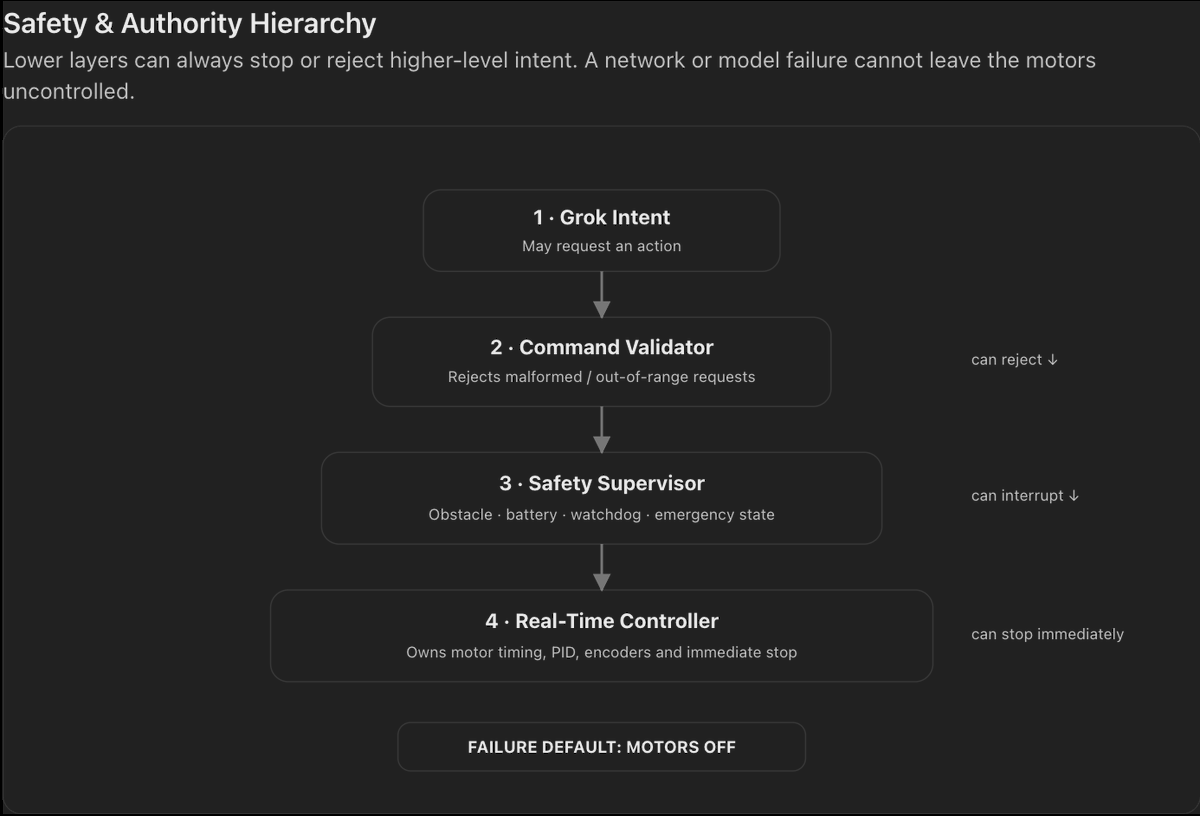
GRONK's safety architecture is intentionally designed so that Grok never has direct authority over the physical hardware.
Grok sits at the highest and least privileged level of the control stack. It can decide what GRONK wants to do, but every physical request must pass through several deterministic local layers before reaching a motor or servo.
The hierarchy is:
Grok Intent → Command Validator → Safety Supervisor → Real-Time Controller → Hardware
The agent loop is the core behavior cycle that makes GRONK function as an embodied AI system rather than a simple chatbot attached to motors.
Instead of asking Grok to generate one long sequence of actions and then blindly executing it, GRONK works in a continuous closed loop:
observe → reason → act → verify → repeat
GRONK first observes its current environment using the camera, microphone, distance sensors, motor telemetry and internal robot state.
That information is normalized by the onboard software into a compact representation of what is happening around the robot and what state the hardware is currently in.
Grok is connected through an inference service
The onboard application maintains a client connection to Grok.
Conceptually:
Gronk
↓
Local Agent Runtime
↓
HTTPS/API
↓
Grok
When GRONK needs to make a decision, the runtime constructs a structured context package.