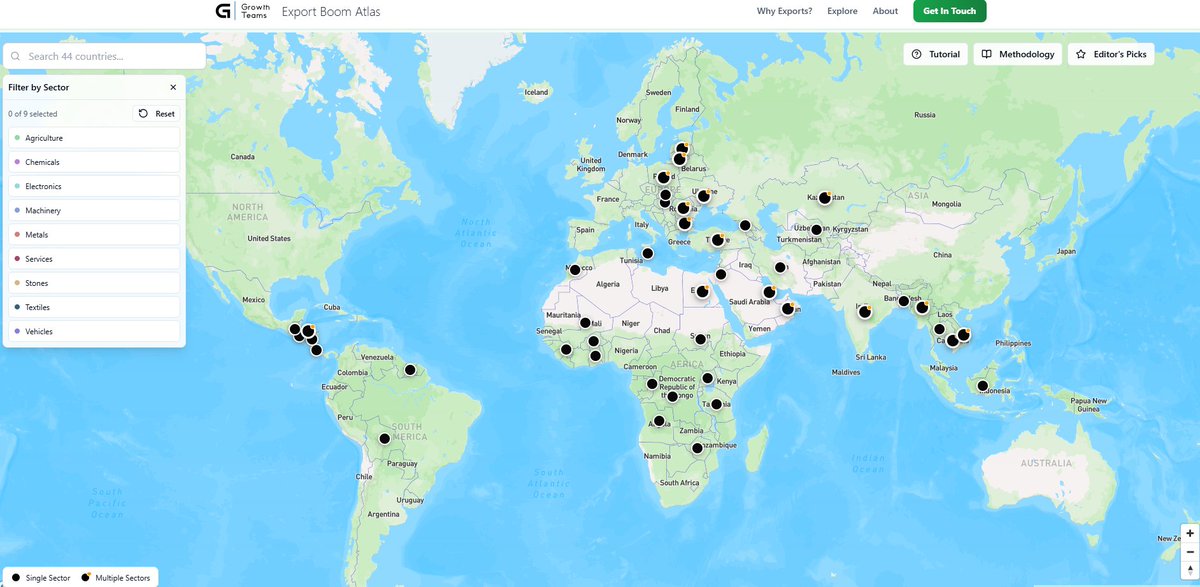
Check out the new *Export Boom Atlas* from @GrowthTeams–an interactive map of 80+ export booms from developing economies, showing how countries from Vietnam to Morocco to Costa Rica achieved rapid sector-level growth that created jobs and prosperity.
🌍 https://t.co/VBWpaAXYTN
👉 Read our full case study in the new Export Boom Atlas: https://t.co/PaqaSIKN5o
🌍 Explore the stories behind 80+ export booms in developing countries: https://t.co/bAr8IvRANb
(7/7)
📈 Electronics became Vietnam’s export engine.
Vietnam’s story shows how the right incentives, anchor investors, and timing can catalyze transformation.
The next chapter? Strengthening the capabilities of domestic firms to capture more value at home.
(6/7)
💥 The turning point came in 2008.
Samsung invested $600M in its first major mobile phone factory. Today, Samsung employs 130,000 workers, contributes 13% of GDP, and anchors an electronics ecosystem that barely existed decades ago.
(5/7)
🌏 Global supply chain shifts opened a window.
Rising labor costs in China—and later U.S.–China trade tensions—pushed manufacturers to diversify. Vietnam had the policy environment and industrial base ready to catch the wave.
(4/7)
🏭 Industrial parks + incentives pulled in global players.
Zones like Saigon Hi-Tech Park provided the reliability multinationals needed—infrastructure, land access, and fast setup. Local governments layered on tax incentives, strengthening competitiveness for FDI.
(3/7)
🏛️ Reforms opened the door.
Doi Moi (“renovation”) reforms shifted Vietnam from a planned to a market economy. The 1987 Law on Foreign Investment allowed 100% foreign ownership, and new investment procedures made Vietnam far more attractive to global firms.
(2/7)
🇻🇳 In less than three decades, Vietnam’s electronics exports surged 4,700-fold—from $29M to $138B—turning the country into the 6th largest tech manufacturer globally. Electronics now make up 34% of total exports, up from just 6% in 1995.
Here’s how it happened 🧵👇 (1/7)
Most successful cases of economic development in modern history have involved a surge in exports.
Now, we can understand export-led development much better thanks to the new Export Boom Atlas, which maps 82 export booms.
Super excited to see this out!
Link in replies.
As global trade shifts and traditional development paths narrow, understanding how export success happens has never mattered more.
Transformation isn’t a miracle. It’s a pattern we can study, adapt, and build on.
(6/7)
From medical devices in Costa Rica 🧬
To automotives in Morocco 🚗
To processed nickel in Indonesia ⚙️
Each story shows how the right mix of leadership, policy, investment, and global opportunity turned potential into transformation.
(5/7)
That’s why we built something new.
Introducing the Export Boom Atlas–a searchable map of 80+ case studies of rapid export growth across 9 sectors and 40+ developing countries since 1995. 🌍
(4/7)
Bangladesh’s garment factories now employ 4M people (80% women).
India’s IT boom turned an inward-looking economy into a global services powerhouse.
Vietnam is now the world’s 6th largest electronics exporter.
(2/7)
📈 Where have export take-offs transformed economies?
🚀 Check out the Export Boom Atlas from @GrowthTeams - an interactive map showing how countries from Vietnam to Morocco to Costa Rica achieved rapid sector-level growth that created jobs & prosperity: https://t.co/gOyFyQrn3J
Lessons from across countries, including Cambodia, Peru, and Tunisia show that specific practices–small trusted groups, dedicated technical staff, and regular meetings–make this collaborative process effective.