La cuna del parlamentarismo liberal no es capaz de gobernarse a sí misma.
Construyeron un sistema para esclavizar a medio mundo y mantener a las clases populares entretenidas votando y ahora lo más inestable del "mundo occidental" es su propio país.
7 PMs en una década...
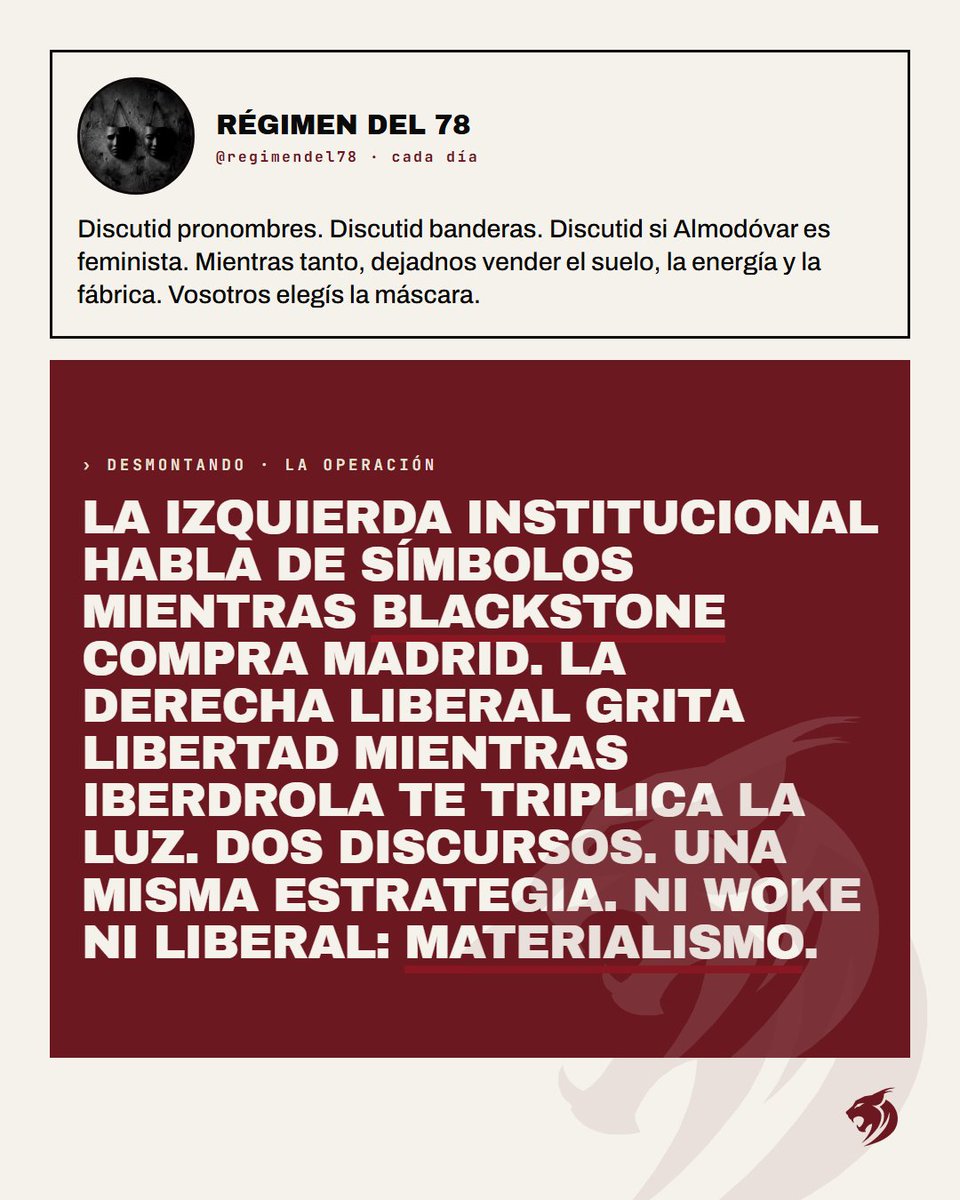
📢Mientras la izquierda institucional habla de pronombres, Blackstone compra Madrid. Mientras la derecha liberal grita "libertad", Iberdrola te triplica la luz.
Dos discursos. Una misma estrategia: distraer.
Escapando de la huella de su maestro en Barcelona, Enrique Nieto i Nieto que fue discípulo de Antoni Gaudí, llegó a la Melilla de principios del s. XX y la tomó como si de un lienzo en blanco se tratase.
Sr. Feijóo, la credibilidad política también se mide por la gestión y los resultados.
Durante sus años al frente de, Galicia siguió afrontando graves problemas como el desempleo, la emigración juvenil y el impacto del narcotráfico.
Ese es su legado.
🔴La soberanía de #Ceuta y #Melilla no puede depender de no molestar a Marruecos. No hay verdadera #soberanía si la defensa de nuestras fronteras dependen del visto bueno del régimen alauí.
🇪🇸 Ceuta y Melilla merecen la misma protección que cualquier otra parte de España.
Decir que Ceuta y Melilla son un ejemplo de convivencia no demuestra que nunca hayan existido aspiraciones territoriales rifeñas o marroquíes sobre ellas. Son dos cuestiones distintas.
📈Feijóo presume de crear empleo donde gobierna el PP.. Las cifras no aguantan un vistazo.
🔹 Galicia: fuga de jóvenes cualificados más alta del país
🔹 Madrid: lidera precariedad horaria
🔹 Andalucía: 28% de paro juvenil
El mismo régimen del 78 con dos máscaras.
Gracias a Policía Nacional y Mossos de Esquadra, ayer se evitó el mayor de los ridículos y despropósitos internacionales en el acto de la Sagrada Familia, delante del Papa y del Rey, y de más de 500 medios internacionales.
Se quiso boicotear el acto con esto 🔽🔽 Os cuento.
Sería más interesante que este señor cuestionase la presencia de agentes injerencistas que cuestionan la españolidad de Ceuta y Melilla, sin embargo, parece que le escuece la crítica al Sr. Imbroda y al elemento que aparece en la foto...
🔴 Necesito vuestra ayuda para seguir.
1/2 Difundan ese mensaje, por favor. 🙏🏻
Tras años de amenazas, una agresión en 2020 y más de 10 denuncias archivadas, ahora enfrento una gran ofensiva judicial en Madrid. ACO y el centro de menas de Hortaleza han presentado denuncias contra mí, usando incluso la LOPD para atacar mi trabajo. Se me acusa de delito de odio, revelación de secretos e irregularidades por el mero hecho de publicar datos oficiales.
Además de las tres demandas que ya inicié contra calumnias y difamaciones (gracias a los que colaborasteis), ahora debo afrontar mi defensa en los dos procedimientos abiertos. No quiero rendirme.
Acabo de activar un nuevo GoFundMe para cubrir la defensa legal, la contraofensiva judicial y continuar mi investigación. Vuestra ayuda es clave. Gracias de corazón.
https://t.co/GM8tMdZ0xg
Indigenism is essentially New World Carlism
And much like Carlism, it eventually degenerated into decolonial ethnat barbarism
Indigenism can be read as a New World analogue to Carlism (and vice versa: Carlism as a peninsular indigenism) insofar as both defend inherited communal rights, local autonomy, customary law, and corporate privileges against the centralizing, secularizing, market-centric liberal state.
Carlism defended fueros, local jurisdictions, Catholic social order, monarchy, and traditional corporate society against liberal constitutionalism, centralization, secularization, and bourgeois property relations. In Spanish America, many indigenous communities likewise defended usos y costumbres, communal landholding, local self-government, religious-customary authority, and the viceregal legal personality of the república de indios against liberal reforms that sought to dissolve corporate bodies into abstract individual citizenship and private property.
The parallel is especially strong around:
1. Anti-centralism
Carlists defended regional fueros against Madrid’s liberal centralism. Indigenous communities often defend municipal, communal, or ethnic autonomy against national capitals and liberal bureaucracies.
2. Corporate society versus liberal individualism
Carlism belonged to a world of estates, corporations, privileges, churches, guilds, municipalities, and kingdoms. Indigenous communities also struggle to preserve collective legal personality: communal lands, communal office-holding, cargo systems, customary authority, and separate jurisdictional status— oftentimes armed with documents from the Viceroyalty (see Zapatismo & Neo-Zapatismo)
3. Tradition as political legitimacy
Both could claim that legitimacy comes not from abstract universal rights alone, but from inherited law, custom, blood, religion, locality, and historical pact.
4. Resistance to bourgeois revolution
Nineteenth-century liberalism in Spain and Spanish America often meant disentailment, privatization, secularization, codification, abolition of special jurisdictions, and expansion of capitalist property relations. Both Carlism and many indigenous movements resisted that transformation.
Although indigenism generally represents a New World counter-liberal traditionalism structurally analogous to Carlism, it is also true that state indigenismo in Mexico or Peru could be modernizing, nationalist, socialist, developmentalist, and even anti-traditional in practice. It often wanted to incorporate indigenous people into the nation, not restore the old republic of Indians.
Funny enough, this is what many complain happened to Carlism when it accepted Franco’s 1937 Unification Decree, consenting to modernization under a developmentalist “national-Catholic”/Falangist model.
The tragedy of both movements is that the genuine kernel of their anti-liberal critique — the defense of communal life, inherited right, local sovereignty, and corporate personality against the dissolving acid of liberal-capitalist modernity — was eventually captured by something worse. Carlism curdled into ETA terrorism; indigenism curdled into ethnic nationalism, decolonial revanchism, and a new kind of identitarian essentialism that mistakes blood and grievance for political philosophy. In both cases, a legitimate resistance to bourgeois universalism ended by fetishizing particularity into a weapon.
The lesson isn’t that the fuero-defenders and comuneros were wrong to resist, they often weren’t. It’s that corporate traditionalism, absent a genuinely universalizable political theory, has no immune system against romanticism. When the old hierarchical-Catholic or viceregal architecture collapsed, what remained was just the tribe. Carlism without God and King becomes Basque separatism. Indigenism without the república de indios becomes woke ethnic cleansing.
The liberal they both opposed was wrong about man. But the thing they became forgot man entirely.
Over the next few weeks, as you see the Wiphala flag waved by supporters of Evo Morales in Bolivia or Roberto Sánchez in Peru ahead of the June 7 elections, remember this: the Wiphala is not an ancient Inca banner preserved from pre-Columbian times, but a modern ideological reconstruction popularized in the 20th century and retroactively projected onto the Andean past.
Throughout the 20th and 21st centuries, indigenist movements, films, documentaries, commemorative festivals, and historical reenactments of the Great Andean Rebellion (1780–1783) increasingly inserted contemporary symbols such as the Wiphala and the Chakana into depictions of Túpac Amaru, Túpac Katari, and their followers, despite the absence of any documentary evidence that these emblems were ever used during the rebellion, whether as flags, standards, or military insignia.
One of the main figures responsible for legitimizing this narrative was the indianist Germán Choquehuanca, who dedicated books and articles to constructing the historical mythology surrounding the Wiphala. Yet no primary source from the 18th century rebellion explicitly attests to its use.
What emerged instead was a romanticized faux continuity crafted by modern indigenist movements seeking to forge a direct political and civilizational link between contemporary indigenous activism and both the pre-Hispanic and viceregal indigenous world, while ignoring a central historical reality: Andean indigenous populations spent nearly three centuries within the Hispanic and Catholic civilization of the Viceroyalty, adopting numerous Iberian cultural, political, and religious forms in the process.
In fact, the surviving banners associated with the rebellion are overwhelmingly Christian in character. Andean Catholicism, not neo-pagan reconstructionism, was understood by many rebel leaders as the great mobilizing force of the masses. They believed that the same Christendom that had subdued the great empires and kingdoms of the West could also be turned against the Bourbon monarchy itself. The rebellion was not a rejection of Christianity, but in many ways an attempt to wield it against imperial authority.
Para que no haya dudas, esto es lo que en @VanguardiaEspa defendemos en lo que respecto a la inmigración. Nada de dejar que entre todo el mundo ni de papeles para todos, como algunos con mala fe pretenden adjudicarnos.
Contra las mentiras, nuestras ideas reales ✊
El que quiera saber más acerca de nuestras ideas, en nuestra web: https://t.co/xdDH65Iuxo
💥Política Migratoria de Vanguardia Española:
1⃣Persecución de la inmigración ilegal
2⃣Repatriación inmediata de todo inmigrante ilegal con antecedentes penales
3⃣La regularización de una situación inmigratoria ilegal se aplicará tras estudiar cada caso
4⃣Revisión de la nacionalidad concedida a españoles de origen inmigrante cuando no estén residiendo en España, pero estén recibiendo dinero público del Estado español
5⃣Promoción prioritaria de inmigración legal, sin antecedentes penales, de naciones iberófonas de los cinco continentes
6⃣Ilegalización de toda ONG que se dedique al tráfico de inmigrantes con falsas excusas humanitarias
This is insane —
Massie: “my policy has always been, no country is special and no country deserves my constituents’ taxpayer dollars.
So I’ve never voted for foreign aid, to Egypt, to Syria, to Israel or to Ukraine… but the ones in Israel … they are the biggest recipients so they are mad.” […]
CBS: “…are you antisemitic?”
El Sr. Macron afirma que los países africanos están siendo manipulados por nuevos colonizadores,señaló a Rusia y “otros”(China) y que por eso no quieren cerca a los franceses.
El tal Macron ve a los africanos como retrasados mentales, piensa que no recuerdan el infierno que ellos sufrieron a manos de los infames explotadores franceses, hay que tener la cara muy dura para hacer estas declaraciones.
Mira los videos y entenderás.
👇🏽