According to Reuters on March 24, Asian equities saw US$50.45 billion in foreign outflows in March, the biggest monthly exodus since at least 2008, while Brent crude surged as much as 65%. That was the market’s warning sign: oil shock and geopolitical risk were starting to dominate sentiment. Last week’s price action in Bursa Malaysia confirmed it. The FBM KLCI closed at 1,720.71 on March 20, then 1,716.68 on March 25, 1,710.89 on March 26, and 1,712.65 on March 27. In other words, the index didn’t bounce hard — it drifted lower and stayed weak. Now look at this week: on March 30, The Star reported that the FBM KLCI gapped down to 1,702.08 at the open, while Apex said elevated oil prices, a firmer US dollar, ringgit weakness, and continued foreign outflows are likely to cap upside for Malaysian equities. My view: The Reuters warning from last week has not faded — it has been confirmed by the market. For Bursa Malaysia, the near-term bias still looks weak to slightly bearish, while the more resilient pockets are likely to remain energy-related names rather than the broad index. This is also consistent with Reuters’ latest report that Brent climbed to US$115.66 on March 29 as the conflict widened. (Reuters) Follow me for more breakdowns on Bursa Malaysia, sector rotation, and the stocks behind the story. #BursaMalaysia #MalaysiaStocks #KLCI #MarketAnalysis
Most people will chase the wrong stocks today.
Smart money is already moving.
I’ve narrowed it down to 3 setups:
– YTLPOWR
– SUNWAY
– INARI
I’ve shared my exact entry in WhatsApp.
Only for serious traders.
According to Bernama on March 28, the FBM KLCI fell 8.06 points last week, closing at 1,712.65 versus 1,720.71 a week earlier. But the Bursa Malaysia Energy Index actually rose 4.48 points to 798.29. That tells me energy has already started to outperform the broader market.
The latest local signal points the same way. According to The Star on March 30, Bursa Malaysia opened lower with the FBM KLCI gapping down to 1,702.08, while Apex Research said upside for Malaysian equities is likely to stay capped by high oil prices, a firmer US dollar, ringgit weakness, and continued foreign outflows. But the same report also said energy-related stocks could remain supported by higher crude prices, and Apex explicitly said it favours the energy sector, especially upstream oil & gas.
There is also a very clear stock-level example. According to The Star on March 30, Petronas Chemicals was a major winner in March, with its market capitalisation rising 93%, or about RM22.4 billion, to RM46.5 billion, far outperforming the broader Bursa Malaysia.
My view:
The broad market still looks weak.
But Malaysia energy stocks still look relatively strong.
So if I’m looking at Bursa Malaysia right now, I’m not buying the whole market. I’m watching the part that is still being supported by the oil shock — especially upstream O&G and energy-linked names. That is my inference from last week’s sector performance and the latest local reporting. (BERNAMA)
Follow me for more breakdowns on Bursa Malaysia, energy stocks, and the names behind the move.
#BursaMalaysia #MalaysiaStocks #OilAndGas #EnergyStocks #KLCI
According to The Star on March 30, Bursa Malaysia opened lower as oil futures hovered above US$115, with the FBM KLCI gapping down to 1,702.08, or 10.57 points below last Friday’s close. The report also cited Apex Securities, which said elevated oil prices, a firmer US dollar, ringgit weakness, and continued foreign outflows are likely to cap upside for Malaysian equities.
Last week’s market action already pointed in the same direction. According to Bernama on March 29, the FBM KLCI fell 8.06 points over the week, closing at 1,712.65 versus 1,720.71 a week earlier. In other words, Bursa Malaysia did not break higher last week — it stayed soft under external pressure.
My conclusion:
Last week’s weakness was the warning.
This week’s gap-down is the confirmation.
For now, Bursa Malaysia still looks like a weak-to-sideways market with a slightly bearish bias, while the more resilient pockets are likely to be energy, commodities, and selected defensive names rather than the broad index. This is my inference from the latest local market reporting.
Follow me for more breakdowns on Bursa Malaysia, sector rotation, and the stocks behind the story.
#BursaMalaysia #MalaysiaStocks #KLCI #MarketAnalysis
Malaysia isn’t in a clean broad-based bull market right now. It’s in a selective market.
According to Rakuten Trade, the FBM KLCI is still in a near-term consolidation phase, while its year-end 2026 target remains at 1,800, with 7.9% earnings growth expected for corporate Malaysia. That tells me the base case is not collapse — it’s rotation.
The strongest structural theme is still semiconductors. According to Reuters, about 7% of global semiconductor trade passes through Malaysia, and the country accounts for roughly 13% of global chip assembly, testing and packaging. So Malaysia is not the purest way to play memory or HBM — but it may be one of the most interesting ways to play the backend of the AI boom. (Reuters)
The second theme is data centres + power. Malaysia is already attracting large-scale digital infrastructure investment, including Google’s US$2 billion data centre and cloud investment. Reuters has also reported that Malaysia may need to add 6–8GW of gas-fired power capacity by 2030 to meet rising electricity demand from data centres. My read is simple: the data centre story is real, but the better trade is not “buy everything.” It’s to focus on the companies linked to grid upgrades, utilities, gas, and infrastructure execution. (Reuters)
The third theme is plantation, but I would treat it as more tactical than structural. According to MPOC, crude palm oil prices are expected to stay above RM4,450/tonne in the near term, supported by elevated energy prices and a favourable POGO spread. But Reuters also reported that Indian buyers have recently stepped back, betting that the war-driven rally will ease. So yes, plantation can still work — but this looks more like a price-driven trade than a clean long-duration trend.
My view: Malaysia’s market right now is about picking the right pockets of strength, not buying the whole index. If I had to rank the opportunities, I would put AI-linked semiconductors and advanced packaging first, data-centre-linked power and infrastructure second, and plantation as a tactical commodity trade third. That ranking is my inference based on the sector drivers above. (Reuters)
Malaysia is not a market to buy blindly. It’s a market to buy selectively.
Follow me for more breakdowns on Bursa Malaysia, sector rotation, and the stocks behind the story.
#BursaMalaysia #MalaysiaStocks #KLCI #Semiconductors #DataCenters #Plantation #MarketAnalysis
🇲🇾According to Reuters on March 24, Asian equities saw US$50.45 billion in net foreign outflows in March, the largest monthly outflow since at least 2008, as investors reacted to oil shock fears and geopolitical tension. The same Reuters report said Brent crude surged as much as 65% this month to US$119.5 per barrel. That tells me the market’s current energy narrative is being driven first by macro stress, not by isolated company stories. Then, according to Reuters on March 25, the market flipped again. As ceasefire hopes improved, Brent crude fell 5.9% in a single day to US$98.28 per barrel. So this is clearly not a clean, one-direction energy rally. It is a fast-moving, headline-driven market where sentiment can reverse almost overnight. According to Bernama on March 24, Perdana Petroleum managing director Jamalludin Obeng said sustained higher oil prices could improve the economics of upstream oil and gas projects, which in turn could increase demand for offshore support vessels, offshore logistics, and marine support services. He also said that if instability in West Asia continues, South-East Asia may need to increase production to help support global energy demand. To me, that is one of the clearest signals this week: if the energy theme works in Malaysia, the first beneficiaries may not be every oil and gas counter, but the upstream support and offshore service names tied to actual activity. At the same time, according to The Star on March 25, citing CGS International Research, every US$10 increase in average oil prices could add around seven basis points to Malaysia’s annual CPI. The same report said prolonged high oil prices could increase fiscal pressure through the RON95 subsidy mechanism, potentially forcing changes in subsidised fuel pricing or the monthly quota structure. In other words, higher oil is not a pure positive for Malaysia. It may help parts of the energy complex, but it also raises inflation and policy risk for the broader market. There is another important angle here. According to The Star on March 25, MBSB Research maintained a US$90–US$100 Brent assumption and kept a neutral call on Malaysia’s oil and gas sector, while saying that upstream-support players would benefit from a potential pickup in activity if oil prices remain elevated. I think that matters because it reinforces the idea that this is not a “buy everything energy” setup. Even within the sector, the stronger case is selective, not broad-based. My view: I am interested in Malaysia’s energy space this week, but I am not blindly bullish on the whole board. My bias is toward selected upstream services, offshore support, marine logistics, and energy infrastructure names rather than chasing every stock that happens to move with oil headlines. That is because if crude stays elevated, project economics improve and service demand can be repriced higher. But if ceasefire momentum builds and oil cools further, the first names to lose strength will likely be the ones that only rallied on fear, not on business visibility. This is my inference from how oil, sentiment, and sector research have moved over the past few days. So my conclusion is straightforward: Malaysia energy is still worth watching this week, but only if you can separate who benefits from oil, who benefits from activity, and who is just moving on emotion. That difference matters more now than ever.
Follow me for more breakdowns on Malaysia energy stocks and the logic behind them.
If you want my deeper breakdown of the Malaysia energy names I’m watching next, comment “Malaysia Energy” or send me a DM. I’ll share the stocks and the logic behind them.
🇲🇾According to Reuters on March 24, Asian equities saw US$50.45 billion in net foreign outflows in March, the largest monthly outflow since at least 2008, as investors reacted to oil shock fears and geopolitical tension. The same Reuters report said Brent crude surged as much as 65% this month to US$119.5 per barrel. That tells me the market’s current energy narrative is being driven first by macro stress, not by isolated company stories.
Then, according to Reuters on March 25, the market flipped again. As ceasefire hopes improved, Brent crude fell 5.9% in a single day to US$98.28 per barrel. So this is clearly not a clean, one-direction energy rally. It is a fast-moving, headline-driven market where sentiment can reverse almost overnight.
According to Bernama on March 24, Perdana Petroleum managing director Jamalludin Obeng said sustained higher oil prices could improve the economics of upstream oil and gas projects, which in turn could increase demand for offshore support vessels, offshore logistics, and marine support services. He also said that if instability in West Asia continues, South-East Asia may need to increase production to help support global energy demand. To me, that is one of the clearest signals this week: if the energy theme works in Malaysia, the first beneficiaries may not be every oil and gas counter, but the upstream support and offshore service names tied to actual activity.
At the same time, according to The Star on March 25, citing CGS International Research, every US$10 increase in average oil prices could add around seven basis points to Malaysia’s annual CPI. The same report said prolonged high oil prices could increase fiscal pressure through the RON95 subsidy mechanism, potentially forcing changes in subsidised fuel pricing or the monthly quota structure. In other words, higher oil is not a pure positive for Malaysia. It may help parts of the energy complex, but it also raises inflation and policy risk for the broader market.
There is another important angle here. According to The Star on March 25, MBSB Research maintained a US$90–US$100 Brent assumption and kept a neutral call on Malaysia’s oil and gas sector, while saying that upstream-support players would benefit from a potential pickup in activity if oil prices remain elevated. I think that matters because it reinforces the idea that this is not a “buy everything energy” setup. Even within the sector, the stronger case is selective, not broad-based.
My view: I am interested in Malaysia’s energy space this week, but I am not blindly bullish on the whole board. My bias is toward selected upstream services, offshore support, marine logistics, and energy infrastructure names rather than chasing every stock that happens to move with oil headlines. That is because if crude stays elevated, project economics improve and service demand can be repriced higher. But if ceasefire momentum builds and oil cools further, the first names to lose strength will likely be the ones that only rallied on fear, not on business visibility. This is my inference from how oil, sentiment, and sector research have moved over the past few days.
So my conclusion is straightforward: Malaysia energy is still worth watching this week, but only if you can separate who benefits from oil, who benefits from activity, and who is just moving on emotion. That difference matters more now than ever.
If you want my deeper breakdown of the Malaysia energy names I’m watching next, comment “Malaysia Energy” or send me a DM. I’ll share the stocks and the logic behind them.
#BursaMalaysia #MalaysiaStocks #KLCI #OilAndGas #EnergyStocks #MarketAnalysis
🇲🇾According to Reuters, hyperscalers are expected to spend at least US$630B on data centers and processors in 2026, while Nvidia sees the revenue opportunity for Blackwell and Rubin AI chips exceeding US$1T by 2027. The AI chip cycle is still very real.
But here’s the part most people miss: according to Bank Negara Malaysia, memory accounts for only around 7.5%–8% of Malaysia’s semiconductor exports, versus roughly 23% globally. So Malaysia is not the cleanest direct HBM winner.
Malaysia’s real edge is elsewhere. Reuters reports that about 7% of global semiconductor trade passes through Malaysia, and the country accounts for roughly 13% of global chip assembly, testing, and packaging. That makes Bursa Malaysia one of the most interesting markets for backend AI semiconductor exposure.
The latest trade data backs it up. According to DOSM, E&E products made up 48.0% of Malaysia’s exports in January 2026 and 46.4% in February, with February E&E exports rising 28.5% YoY to RM60.8B.
My view:
The best Malaysia chip trade is not “buy memory.”
It’s buy where AI demand meets packaging, testing, automation, materials, and GPU server assembly.
That’s why I’m watching names tied to advanced packaging, OSAT, test equipment, and AI server buildout far more closely than the obvious hype trades.
The real winners may not be the loudest names.
They may be the ones sitting quietly in the backend of the AI boom.
Comment “Malaysia Chips” or DM me if you want the watchlist I’m tracking next.
#BursaMalaysia #MalaysiaStocks #Semiconductors #AI #AdvancedPackaging #DataCenters
Most traders react.
Quant traders measure.
I’m less interested in opinions and more interested in probabilities, structure, and repeatable signals.
Quant trading is not about guessing the next candle.
It is about building a system that can survive noise, control risk, and exploit patterns at scale.
No emotion.
No chasing.
Just data, discipline, and execution.
If you want to see how I read setups through a quantitative lens, DM “quant”.
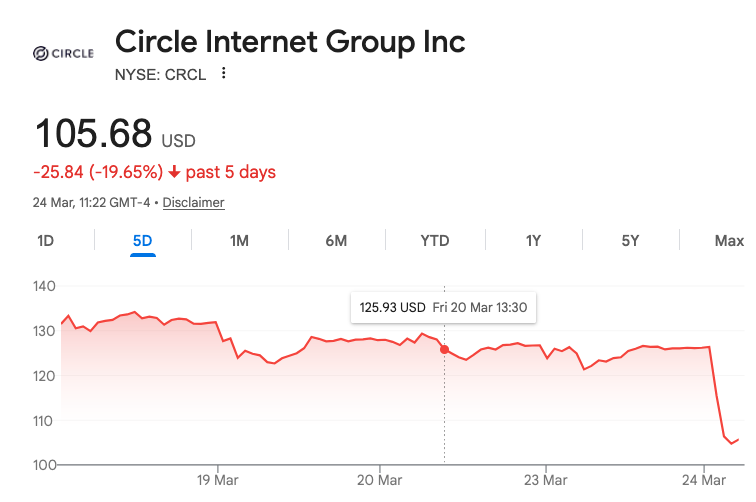
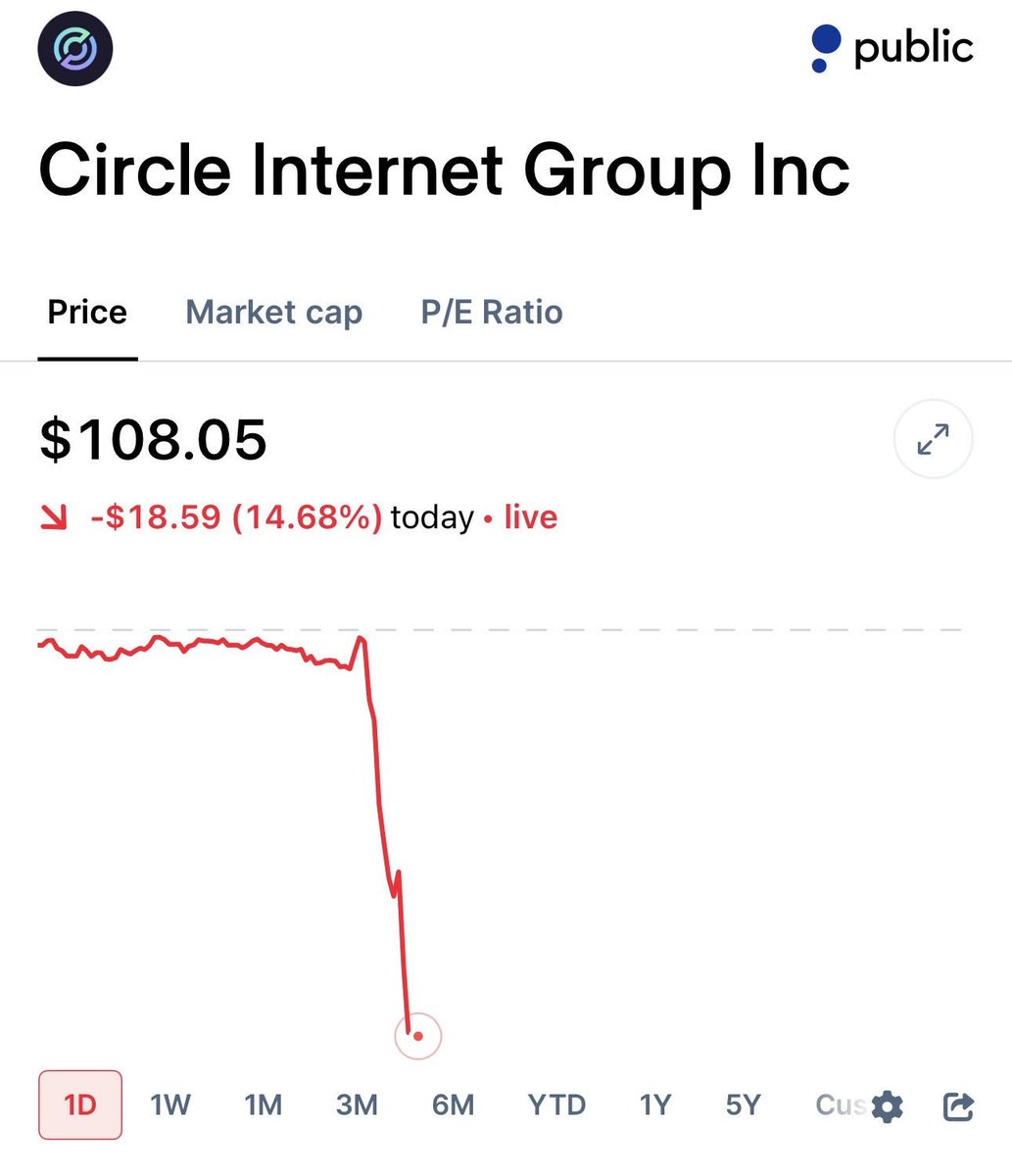
$CRCL falls ~15% after the CLARITY Act deal signals no yield on stablecoin balances by allowing only activity-based rewards.
That weakens a key part of the bull case by making USDC harder to evolve from a payments utility into a real store-of-value product.
As of March 24, gold has been extremely volatile: Reuters reported spot gold at $4,396.74/oz after falling as low as $4,097.99, with pressure coming from a firmer dollar, higher yields, and fading hopes for near-term Fed cuts. Reuters also noted analysts see possible pressure for another 4–6 weeks, even though some remain longer-term bullish because of persistent inflation, large deficits, and reserve diversification by central banks.
My view on gold:
Short term, gold still looks pressured.
Higher yields, a stronger dollar, and fading rate-cut hopes are keeping it heavy.
But the bigger picture is not dead.
If inflation stays sticky and geopolitical risk remains elevated, gold can rebuild its trend.
My bias:
short-term volatility, medium-term opportunity.
Next week, I’m focused on 3 things:
• oil and energy pressure
• whether yields keep tightening financial conditions
• if real strength can survive the macro noise
I’m not looking for hype.
I’m looking for structure, relative strength, and names worth tracking.
I’ll post my watchlist here.
DM “watchlist” if you want me to review a stock.
🚨 WARNING: THE STOCK MARKET WILL CRASH ON MONDAY
The Fed just released emergency macro data, and it’s far worse than expected.
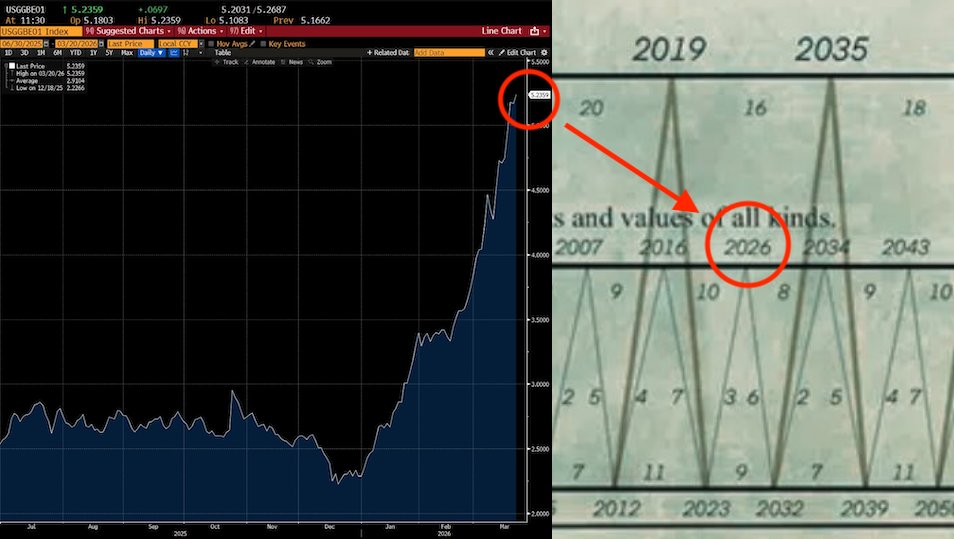
US 12-month inflation surged to 5.2%, highest level in years.
Powell is now talking about rate HIKES instead of rate cuts.
And it gets even worse:
If you’re holding assets right now, you’re probably not going to like what’s coming next.
Just 3 weeks ago, markets were pricing in rate cuts.
Now? They’re rapidly repricing towards RATE HIKES.
That kind of reversal doesn’t happen in stable conditions.
If you’re positioned for easing, you’re on the wrong side of this move.
What we’re seeing right now isn’t normal.
Inflation expectations don’t spike like this unless something is breaking underneath the surface.
And most participants aren’t ready for it.
The Fed is now in a much tighter position than anyone anticipated.
Higher inflation expectations mean financial conditions can tighten without the Fed even moving.
Yields rise.
Liquidity shrinks.
Risk appetite fades.
All without a single rate hike.
Now zoom out.
This isn’t just about one data point.
It’s about what it signals.
Markets went from “Inflation is under control” to “Inflation is reaccelerating”.
In a matter of weeks.
That kind of narrative shift is dangerous.
Because positioning was built on the opposite assumption.
Cuts were expected.
Disinflation was the base case.
Soft landing was consensus.
Now all of that is being questioned.
And when consensus breaks, volatility follows.
Think about the implications.
If inflation expectations stay elevated:
→ The Fed can’t cut
→ Real rates stay restrictive
→ Financial conditions tighten further
That’s not bullish.
That’s a problem.
And it gets worse.
If the Fed is forced to consider hikes again, policy credibility is at risk.
Because they already signaled easing.
Reversing that quickly damages forward guidance.
And markets hate uncertainty more than anything.
Now layer this on top of an already fragile system.
Debt levels are still elevated.
Funding conditions are sensitive.
Growth is slowing beneath the surface.
You now have:
sticky inflation + tight policy + high debt
That combination doesn’t end well.
We’ve seen this before.
→ Inflation surprises to the upside
→ Markets misprice policy
→ Conditions tighten rapidly
→ Risk assets reprice violently
The pattern is clear.
Markets always react late to inflation regime shifts.
They assume it’s temporary, until it isn’t.
And by the time they adjust, the move is already underway.
We just moved from a “cutting cycle” narrative to a “higher-for-longer, possibly hiking” reality.
By the time it’s obvious, it’s already too late.
I’ve been calling major tops and bottoms for over a decade.
When I make my next move, I’ll post it here first.
If you’re not following yet, you absolutely should.
Most people look for excitement.
I look for clean setups, relative strength, and risk that the crowd is still ignoring.
Going into next week, I’m not interested in noise.
I’m focused on what is holding up, what is breaking down, and where real opportunity is starting to build.
I’ll post my watchlist here.
DM “watchlist” if you want me to review a stock.
This week ended with **a fourth sthe S&P 500 fell 1.5%, the Nasdaq fell 2.0%, and the Dow fell about 1.0%, while higher oil prices and rate worries kept pressure on stocks. That makes a weekend positioning post more credible today than a flashy profit post. ost this today
English
This week reminded people of one thing:
the market is not driven by hype — it is driven by risk, rotation, and timing.
For next week, I’m focused on 3 things:
• energy and oil sensitivity
• whether tech can stabilize
• where real relative strength is building
I’ll be sharing my watchlist and market notes here.
If you want me to look at a stock you’re holding, DM me “watchlist”.
I’m not here to sell hype.
I study market structure, sector rotation, and risk before most retail traders even know what to look at.
On this account, I’ll share:
• the sectors I’m watching
• stocks on my active watchlist
• risk signals I think most people ignore
If you want a free market breakdown or want me to look at a stock you’re holding, comment “watchlist” or send me a DM.